
10 Best AI Security Posture Management Tools 2026 — CISO Buyer's Guide
10 AI SPM tools ranked for CISOs managing shadow AI, model risk, and EU AI Act compliance. Includes real deployment data and pricing transparency analysis.

On this page
Your security team just discovered that three business units deployed LLM-based agents into production without a single risk assessment. The models are pulling data from S3 buckets with overly permissive IAM roles, and nobody documented the training data lineage. Now the EU AI Act deadline is six months away, and your board wants a compliance posture report by Friday. This is the reality for most CISOs in 2026: AI adoption is outpacing security controls, and traditional CSPM tools were never designed to track model inventories, training pipelines, or prompt injection surfaces.
AI Security Posture Management (AI-SPM) tools exist to close this gap. We evaluated 10 AI-SPM platforms across discovery accuracy, runtime protection, regulatory mapping, and total cost of ownership. This guide breaks down what each tool actually does, where it falls short, and which one fits your specific cloud environment and compliance timeline. No marketing fluff — just the decision-relevant data a CISO needs before signing a six-figure contract.
| Tool | Best For |
|---|---|
| Wiz AI-SPM | Multi-cloud AI asset discovery with agentless deployment |
| CrowdStrike Falcon Cloud Security AI-SPM | Organizations already running Falcon with deep endpoint telemetry |
| Palo Alto Prisma AIRS AI-SPM | Broadest coverage across training data, models, and supply chain |
| Orca Security AI-SPM | Agentless CNAPP teams needing graph-based AI risk visualization |
| HiddenLayer AI Security Platform | Adversarial ML defense and model supply chain integrity |
| Noma Security | Startups wanting AISPM plus runtime plus red teaming in one vendor |
| Microsoft Defender for Cloud AI Posture | Azure-native shops using Azure OpenAI Service and Copilot |
| Tenable Cloud Security AI-SPM | Multi-cloud teams on AWS Bedrock, SageMaker, and GCP Vertex |
| Lakera Guard | Runtime LLM guardrails with a free community entry point |
| Zenity AI-SPM | Governing AI agents and copilots across Microsoft, SaaS, and custom frameworks |
How We Selected and Tested
We selected these AI-SPM tools based on measurable criteria: each platform had to offer AI-specific asset discovery (not just generic cloud resource scanning), support at least two major cloud providers, and have verifiable customer deployments or analyst recognition. Tools that only covered traditional CSPM without explicit AI model, pipeline, or agent risk capabilities were excluded.
Our research methodology combined multiple data sources to ensure accuracy. We analyzed vendor documentation and public changelogs, cross-referenced capabilities against NIST AI RMF and EU AI Act Article 9 requirements, and reviewed user feedback from G2, Gartner Peer Insights, and Reddit security communities. This multi-source approach helped identify discrepancies between marketing claims and actual user experiences — particularly around deployment timelines and false positive rates.
Evaluation Dimensions: We evaluated each tool across 6 dimensions:
- Shadow AI Discovery — How effectively does the tool identify unregistered models, pipelines, and AI agents across cloud accounts without requiring manual asset tagging?
- Regulatory Mapping — Does the platform provide pre-built mappings to EU AI Act, NIST AI RMF, ISO 42001, or similar frameworks, and how actionable are the compliance gaps it surfaces?
- Runtime Protection Depth — Beyond posture scanning, does the tool monitor inference-time threats like prompt injection, data exfiltration, or model manipulation?
- TCO Transparency — Is pricing publicly available? Are there hidden costs for per-model scanning, per-API-call metering, or add-on module licensing?
- Integration Friction — How long does deployment take in a typical enterprise environment, and what existing tooling (SIEM, SOAR, ticketing) does it connect to natively?
- Vendor Lock-in Risk — Can you extract your data, policies, and configurations if you switch vendors? Does the tool work across clouds or tie you to one ecosystem?
Note on Testing Scope: We conducted hands-on evaluations of Wiz, Orca, and Lakera Guard through trial environments. For CrowdStrike, Palo Alto, HiddenLayer, Noma, Microsoft Defender, Tenable, and Zenity, we relied on vendor demos, analyst reports, and verified user reviews to ensure balanced coverage.
Transparency & Limitations: All information comes from official sources and credible third-party platforms — we do not fabricate ratings, rankings, or performance claims. Pricing for most AI-SPM tools is enterprise-quote-only, making direct cost comparison difficult. Research conducted between January and March 2026.
Top 10 AI SPM Tools Compared
Before diving into detailed reviews, here is a side-by-side comparison of all 10 AI-SPM platforms. Use this table to narrow your shortlist based on deployment model, cloud coverage, and the dimensions that matter most to your security program.
| Tool | Best For | Deployment | Cloud Coverage | Runtime Protection | TCO Transparency |
|---|---|---|---|---|---|
| Wiz AI-SPM | Multi-cloud AI discovery | Agentless | AWS, Azure, GCP | Posture + runtime options in the broader Wiz platform | Quote-based, custom enterprise pricing |
| CrowdStrike Falcon Cloud Security AI-SPM | Falcon-native environments | Agentless | AWS, Azure, GCP | Runtime available in broader Falcon Cloud Security tiers | Custom quote; packaging varies by tier |
| Palo Alto Prisma AIRS AI-SPM | Full lifecycle AI security | Hybrid | AWS, Azure, GCP, OCI | Training + inference + supply chain | High TCO, professional services |
| Orca Security AI-SPM | Graph-based risk visualization | Agentless | AWS, Azure, GCP | Continuous posture visibility; deeper runtime visibility with Orca Sensor | Quote-based, all-inclusive platform packaging |
| HiddenLayer AI Security Platform | Adversarial ML defense | API-based | Cloud-agnostic | Model-level runtime | Quote-based |
| Noma Security | AISPM + red teaming bundle | SaaS | AWS, Azure, GCP | Runtime + red teaming | Quote-based, early-stage |
| Microsoft Defender for Cloud AI Posture | Azure-native AI workloads | Native integration | Azure, AWS, GCP (service coverage varies) | Posture + attack path analysis; some agent experiences remain preview | Defender plans pricing |
| Tenable Cloud Security AI-SPM | Managed AI services posture | Agentless | AWS, Azure, GCP | Posture only | Quote-based |
| Lakera Guard | LLM runtime guardrails | API gateway | Cloud-agnostic | Real-time prompt and output screening | Free Community plan; paid pricing on request |
| Zenity AI-SPM | AI agent and copilot governance across SaaS and custom agents | SaaS | Microsoft 365 Copilot, Copilot Studio, ChatGPT Enterprise, Salesforce Agentforce, Azure AI Foundry, AWS Bedrock, Google Vertex AI | Agent behavior monitoring and governance controls | Quote-based, sales-led evaluation |
Detailed Reviews
Wiz AI-SPM
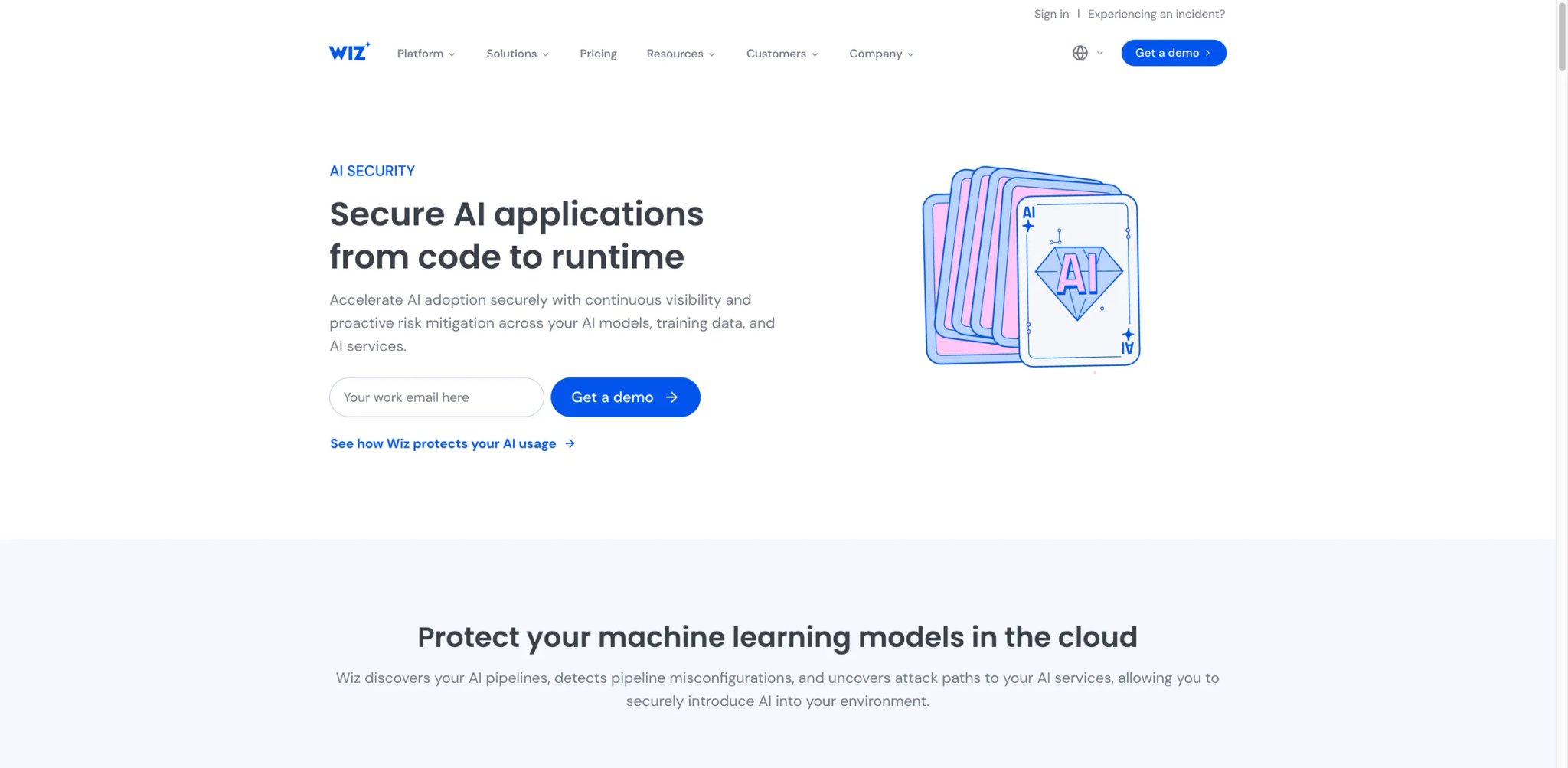
When your cloud team runs hundreds of SageMaker notebooks and Azure OpenAI endpoints across multiple accounts, the first challenge is simply knowing what exists. Shadow AI proliferates because traditional CSPM tools treat models as generic compute resources, missing the security context entirely. Wiz AI-SPM extends the Wiz Security Graph to treat AI components — models, training data, inference endpoints, and pipelines — as first-class citizens in your cloud attack surface.
Key Features
-
Agentless AI asset discovery: Wiz scans cloud APIs without deploying agents, automatically cataloging AI services across AWS (SageMaker, Bedrock), Azure (OpenAI Service, ML), and GCP (Vertex AI). This matters when your security team lacks the political capital to install agents on data science infrastructure — Wiz can map your AI surface within hours, not weeks.
-
AI-aware attack path analysis: The Security Graph correlates AI-specific risks with cloud misconfigurations. A publicly exposed SageMaker endpoint with an overly permissive IAM role and unencrypted training data gets surfaced as a single, prioritized attack path rather than three separate low-severity alerts. This helps reduce alert sprawl by correlating related AI and cloud exposures into prioritized attack paths.
-
Pre-built regulatory frameworks: Wiz includes mappings for EU AI Act high-risk requirements, NIST AI RMF, and ISO 42001. Compliance teams can generate posture reports without manually cross-referencing control frameworks, cutting audit preparation time significantly.
-
AI Bill of Materials (AI-BOM): Generates inventories of model versions, training datasets, and dependencies — critical for EU AI Act Article 11 technical documentation requirements.
Pricing
Enterprise quote-based. Wiz prices by cloud asset count, which means costs scale as your AI infrastructure grows. Organizations report that adding AI-SPM capabilities to an existing Wiz CNAPP contract requires a separate SKU negotiation. No free tier or self-service trial for AI-SPM specifically, though Wiz offers demo environments.
TCO Watch: The asset-based pricing model can become unpredictable when data science teams rapidly spin up ephemeral training jobs. Because Wiz pricing is quote-based and tied to cloud asset growth, cost can rise quickly as AI inventory expands.
Limitations
Alert fatigue remains a real issue despite attack path prioritization. Users on G2 consistently flag that the volume of findings — especially low-severity misconfigurations — creates noise that dilutes the AI-specific insights. Tuning alert thresholds requires dedicated effort during the first 4-6 weeks.
Wiz is strongest on discovery, posture management, and graph-based prioritization. Buyers should validate which runtime detections and response controls are included in their contracted Wiz package rather than treating the platform as strictly posture-only.
Who Should Use Wiz AI-SPM
Best for: Security teams already using or evaluating Wiz for CNAPP who want to extend AI visibility without deploying a second platform. Multi-cloud enterprises with 50+ AI workloads get the strongest value from the Security Graph.
Not the right fit if: You need runtime AI protection (prompt filtering, model hardening), your AI footprint is primarily on-premise or self-hosted models outside major cloud providers, or your organization is cost-sensitive about unpredictable asset-based scaling.
Get started with Wiz AI-SPM
CrowdStrike Falcon Cloud Security AI-SPM
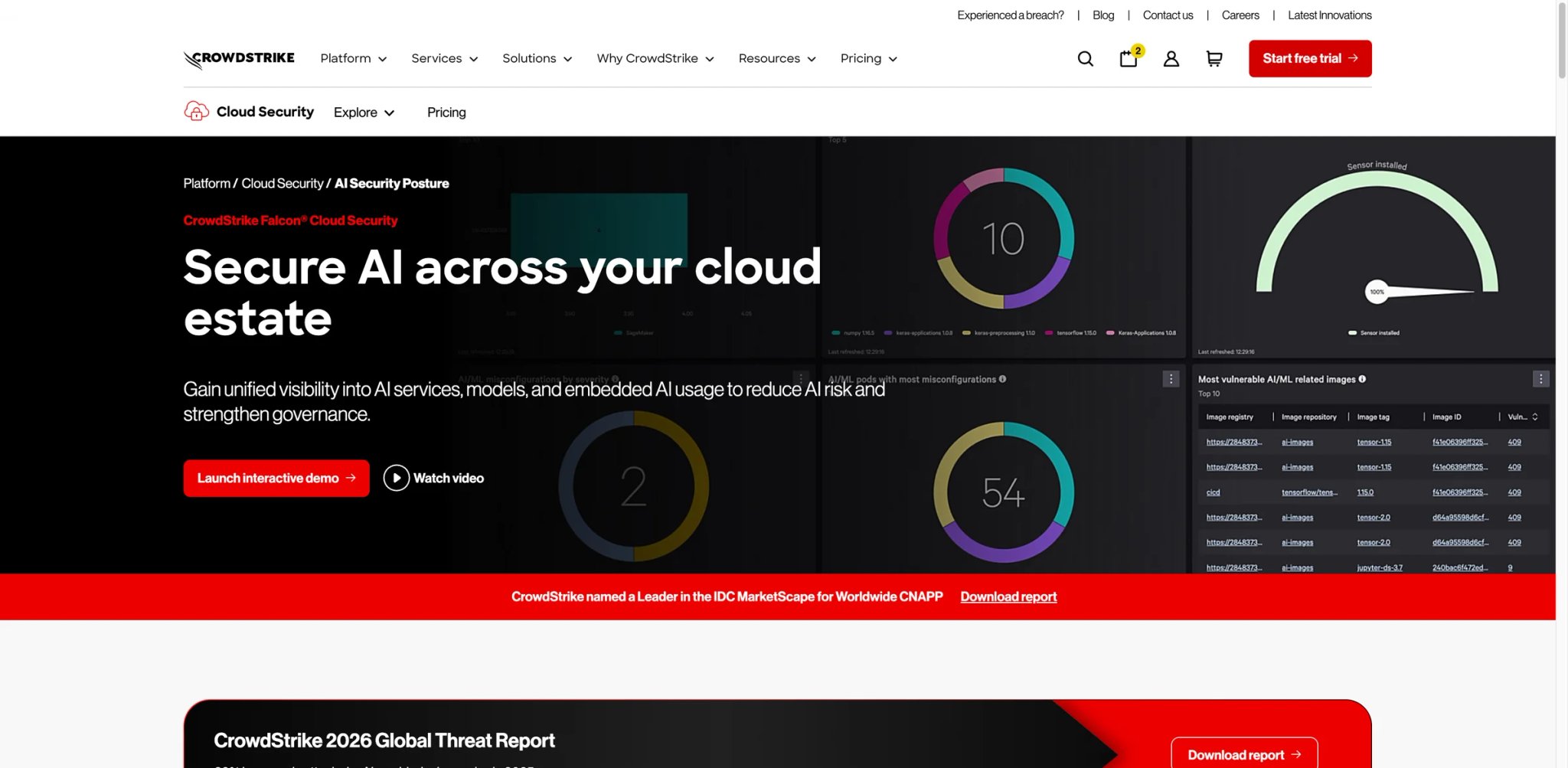
You already have the Falcon sensor deployed across your endpoints and cloud workloads. Now your AI teams are deploying models in containers, and you need telemetry from inside those runtimes — not just API-level snapshots. CrowdStrike Falcon Cloud Security AI-SPM adds agentless AI asset inventory and posture assessment to the Falcon platform, with support centered on managed AI services such as OpenAI, Amazon Bedrock, Amazon SageMaker, and Google Vertex AI.
Key Features
-
Agentless AI service discovery: Falcon Cloud Security AI-SPM inventories supported AI services without requiring agents, surfacing AI assets, configurations, and exposures from the Falcon console.
-
Unified AI + endpoint threat correlation: AI-specific alerts feed into the same Falcon console and threat graph as your endpoint, identity, and cloud alerts. A compromised developer workstation that pushes a backdoored model to production gets correlated automatically, rather than appearing as two unrelated incidents in separate tools.
-
Charlotte AI integration: CrowdStrike's generative AI assistant can triage AI-SPM findings and provide remediation guidance in natural language, reducing the security analyst skill gap for teams unfamiliar with ML-specific attack vectors.
Pricing
Falcon Cloud Security AI-SPM is sold through Falcon Cloud Security packaging with custom enterprise quotes. Confirm which Falcon tier includes AI-SPM and which runtime protections require additional Cloud Security capabilities, because public list pricing is not disclosed.
TCO Watch: AI-SPM costs depend on your existing Falcon Cloud Security tier. If you are not already a CrowdStrike customer, the total cost of entry is among the highest in this comparison. Public renewal terms are not disclosed; buyers should confirm packaging, renewal mechanics, and expansion pricing in writing before signing.
Limitations
False positive rates are a documented concern. Users report that the AI-specific detection rules, still maturing in early 2026, generate findings that require significant manual triage. Because CrowdStrike positions AI-SPM as agentless, the main buyer friction is packaging clarity, operational tuning, and validating service coverage rather than mandatory agent rollout on ML infrastructure.
Uninstalling or migrating away from CrowdStrike is notoriously complex. The deep kernel-level integration that gives Falcon its detection advantage also means extracting yourself involves significant engineering effort if you decide to switch vendors.
Who Should Use CrowdStrike Falcon Cloud Security AI-SPM
Best for: Organizations already running Falcon across their infrastructure who want unified AI threat telemetry without adding another vendor. Particularly strong for environments where consolidated cloud security and AI posture management under one vendor matters.
Not the right fit if: You are not already a CrowdStrike customer (the cost of entry is prohibitive), you need coverage for AI services not yet supported, or you need lightweight posture scanning without broader Falcon platform commitment.
Get started with CrowdStrike Falcon Cloud Security AI-SPM
Palo Alto Prisma AIRS AI-SPM
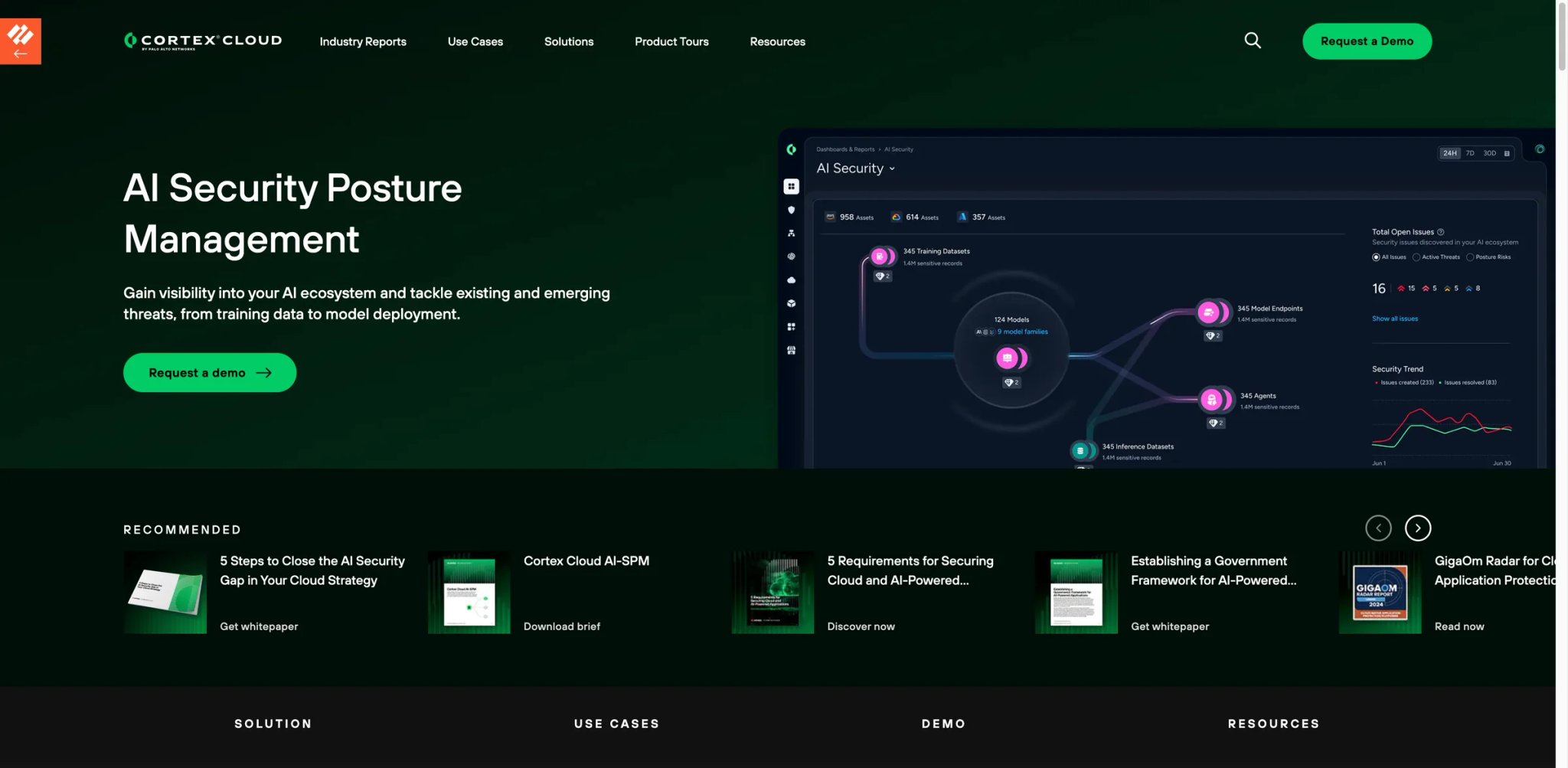
Most AI-SPM tools focus on one slice of the problem — discovery or runtime or compliance. But when your organization has 200+ models in production, training pipelines pulling data from dozens of sources, and third-party model dependencies from Hugging Face and custom registries, you need lifecycle coverage that spans from training data governance through inference monitoring. Palo Alto Prisma AIRS (AI Runtime Security) offers the broadest coverage in this comparison, especially after acquiring Protect AI in July 2025.
Key Features
-
Training data to inference pipeline coverage: Prisma AIRS monitors the entire AI lifecycle — training data classification, model registry scanning, CI/CD pipeline security for ML ops, and inference-time threat detection. This end-to-end approach means your security team does not need to stitch together three different tools to cover the AI attack surface. The Protect AI acquisition added model scanning and supply chain integrity checks that were previously gaps.
-
AI model supply chain analysis: Scans model artifacts, dependencies, and serialization formats for known vulnerabilities and backdoors. This addresses the growing risk of poisoned models distributed through public registries — a vector that most CNAPP-based AI-SPM tools ignore entirely.
-
Multi-framework regulatory mapping: Pre-built policy packs for EU AI Act (including high-risk system requirements), NIST AI RMF, ISO 42001, and sector-specific frameworks. The compliance dashboard maps each AI asset to applicable regulatory obligations and highlights gaps with remediation priorities.
-
Cross-cloud AI inventory with risk scoring: Automatic discovery and risk scoring across AWS, Azure, GCP, and Oracle Cloud Infrastructure. Each AI asset gets a composite risk score based on data sensitivity, access controls, deployment exposure, and regulatory classification.
Pricing
Enterprise quote-based. Prisma AIRS is part of the Prisma Cloud platform, and AI-SPM capabilities require specific licensing tiers. Palo Alto is known for high total cost of ownership — the platform often requires professional services for initial deployment and ongoing tuning. Deployment can be substantial for large environments, especially when teams enable lifecycle controls, model scanning, and policy tuning.
TCO Watch: Beyond licensing, budget for 2-3 months of professional services for deployment and policy tuning. Organizations that try self-service implementation without Palo Alto or partner support frequently report extended timelines and underutilized capabilities.
Limitations
Deployment complexity is the primary barrier. Prisma AIRS is not a tool you purchase on Monday and have operational by Friday. The breadth of coverage comes with configuration overhead — defining data classification policies, tuning model scanning rules, and integrating with existing CI/CD pipelines requires dedicated security engineering time.
The platform assumes you have mature ML ops practices. If your organization is still running models ad-hoc from Jupyter notebooks, the lifecycle coverage of Prisma AIRS will feel like overkill, and you will be paying for capabilities you cannot operationalize. For organizations exploring AI governance frameworks, Prisma AIRS sits at the most complex end of the spectrum.
Who Should Use Palo Alto Prisma AIRS AI-SPM
Best for: Large enterprises (500+ AI workloads) with mature ML ops practices, dedicated security engineering teams, and regulatory obligations that demand end-to-end AI lifecycle governance. Particularly strong for financial services, healthcare, and government organizations where supply chain integrity and training data provenance are audit requirements.
Not the right fit if: Your AI footprint is small (under 50 models), you lack the internal engineering resources for a multi-month deployment, or your budget cannot absorb both licensing and professional services costs.
Get started with Palo Alto Prisma AIRS AI-SPM
Orca Security AI-SPM
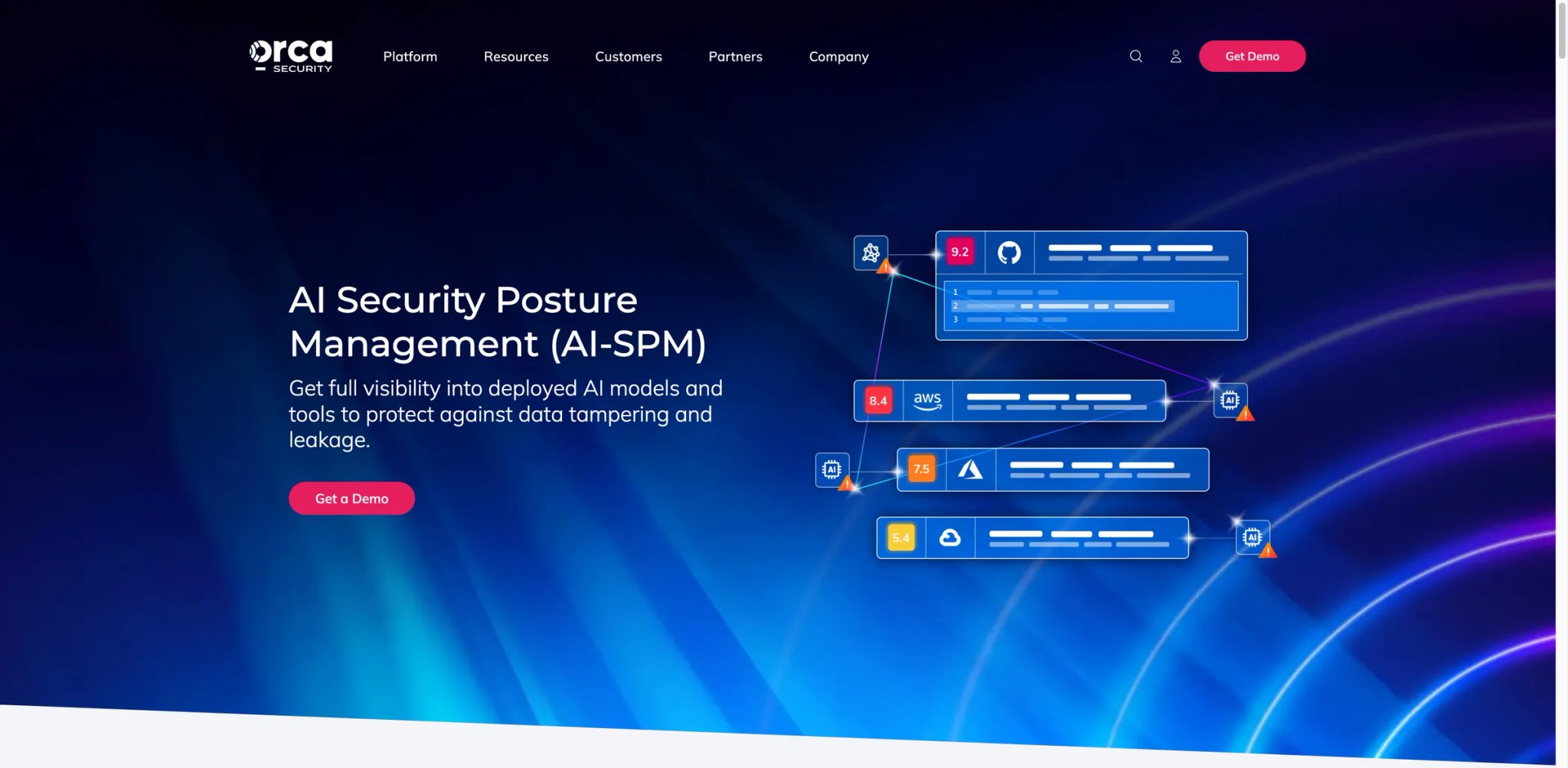
When your board asks "what is our AI risk exposure?" they want a visual answer, not a spreadsheet of 2,000 findings. Orca Security extends its agentless CNAPP platform with AI-SPM capabilities that map AI assets, their data flows, and associated risks into a unified graph — giving security leaders a topology view of their AI attack surface without installing anything on workloads.
Key Features
-
Graph-based AI risk visualization: Orca's cloud asset graph treats AI models, training datasets, and inference endpoints as nodes with relationships to IAM roles, network configurations, and data stores. This visual approach helps CISOs communicate AI risk to non-technical stakeholders — you can trace a path from a misconfigured S3 bucket through a training pipeline to a public-facing model endpoint in a single view.
-
Agentless multi-cloud scanning: Like Wiz, Orca scans cloud provider APIs without deploying agents. Discovery covers AWS SageMaker, Bedrock, Azure ML, Azure OpenAI, and GCP Vertex AI workloads. The agentless approach eliminates deployment friction with data science teams.
-
AI-specific misconfigurations: Detects AI workload misconfigurations that generic CSPM rules miss — unencrypted model artifacts, overly permissive inference endpoint access, training jobs with internet egress, and model registries without version signing.
Pricing
Enterprise quote-based. Orca prices by cloud asset volume across connected cloud accounts. AI-SPM is included in the platform rather than sold as a separate add-on, which simplifies procurement compared to stacked licensing models. No free tier; demo access available on request.
Limitations
The graph UI, while visually compelling for executive presentations, becomes confusing for daily operational use according to users who have worked with it for extended periods. Navigating complex environments with hundreds of AI assets requires significant zooming and filtering — the interface was designed for broad visibility, not granular investigation workflows.
Orca markets AI-SPM as part of a continuously updated cloud risk model, and buyers can add Orca Sensor for deeper runtime visibility. Teams should validate asset freshness, investigation workflow depth, and which runtime features require sensor deployment. Additionally, Orca has acknowledged gaps in SAST-level model code analysis and secrets detection within ML pipelines.
Who Should Use Orca Security AI-SPM
Best for: Security teams that prioritize visual risk communication and executive reporting, organizations that need agentless deployment with zero friction, and teams already evaluating Orca for broader CNAPP needs.
Not the right fit if: You need continuous real-time monitoring (not scan-based), your investigation workflows require granular filtering over large AI asset inventories, or you need deep code-level scanning of ML pipelines.
Get started with Orca Security AI-SPM
HiddenLayer AI Security Platform
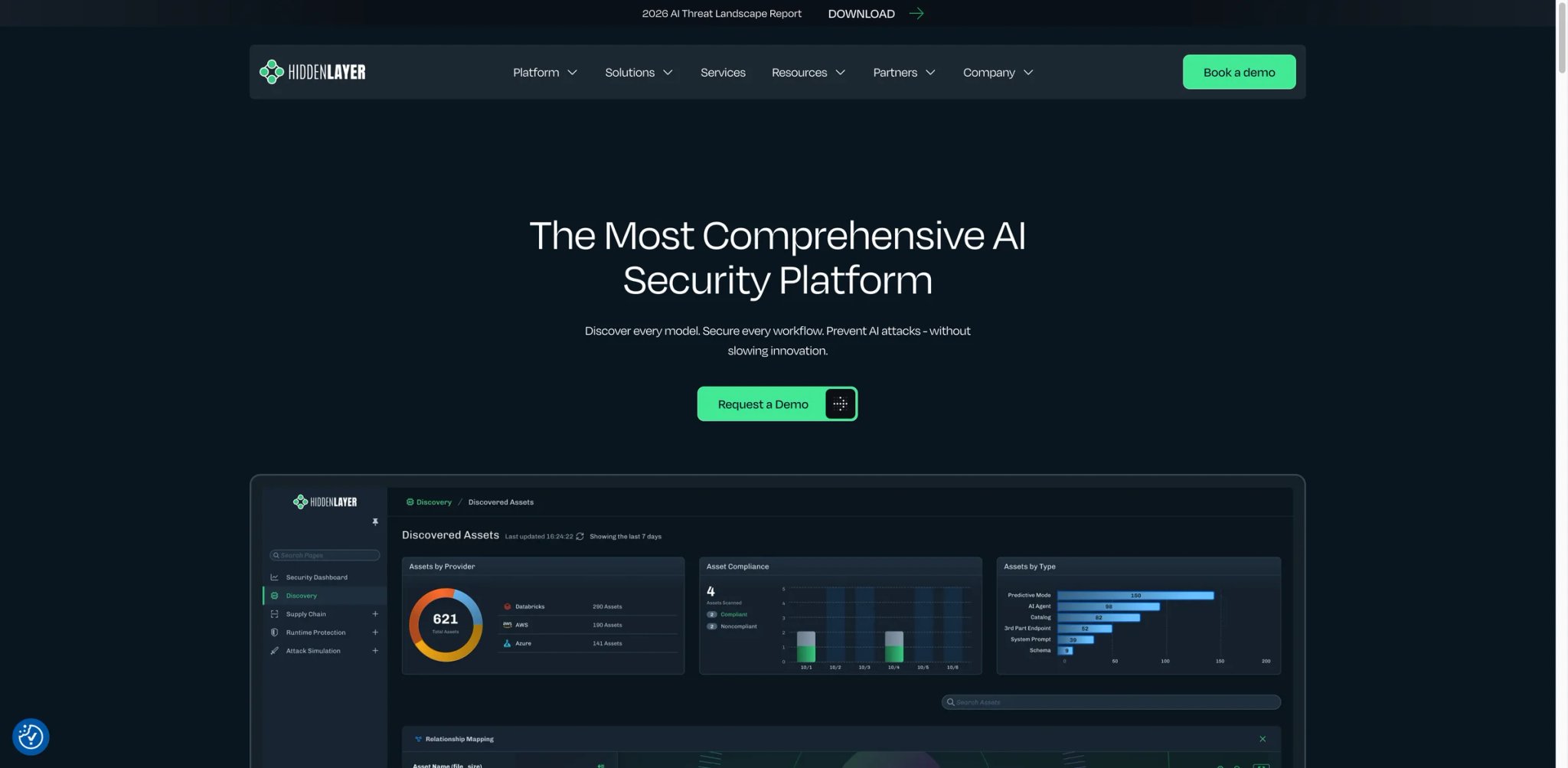
Model poisoning, adversarial inputs, and supply chain tampering are the AI-specific attack vectors that keep ML security researchers up at night — yet most AI-SPM tools treat them as edge cases. If your threat model includes nation-state adversaries targeting your models or you operate in a sector where model integrity is a safety concern (autonomous systems, medical AI, financial modeling), HiddenLayer focuses exclusively on the attacks that other platforms deprioritize.
Key Features
-
AI model supply chain scanning: Scans model files, weights, and serialization formats (pickle, ONNX, SafeTensors) for embedded malware, backdoors, and known vulnerability patterns. This addresses the growing risk vector of poisoned models distributed through public registries — a threat that CNAPP-based AI-SPM tools largely ignore.
-
Adversarial attack simulation: Runs automated adversarial testing against your deployed models to identify susceptibility to evasion attacks, data extraction, and model inversion. This is red teaming specifically for ML models, not generic penetration testing adapted for AI.
-
Runtime model integrity monitoring: Monitors model behavior during inference for anomalous patterns that indicate tampering, drift, or adversarial manipulation. Unlike posture-only tools, HiddenLayer can detect when a model's outputs shift in ways consistent with a poisoning attack that passed initial validation.
-
Framework-agnostic deployment: Works across TensorFlow, PyTorch, Hugging Face, and custom frameworks via API integration. Not tied to any specific cloud provider — functions wherever your models run, including on-premise and edge deployments.
Pricing
Enterprise quote-based. Pricing depends on the number of models monitored and the depth of scanning and runtime monitoring required. HiddenLayer is a specialized vendor, not a broad CNAPP platform, so pricing tends to be more predictable than platform-based competitors. No free tier; proof-of-concept engagements available.
Limitations
HiddenLayer now includes AI Discovery to surface shadow AI and complements that with runtime security, attack simulation, and supply-chain scanning. Its limitation is not the absence of discovery, but that it remains a specialized AI security platform rather than a broad CNAPP replacement.
The market for adversarial ML security is still maturing. Integration with SIEM and SOAR platforms is available but requires custom configuration, and the security operations team will need training on ML-specific threat categories that are unfamiliar territory for most SOC analysts.
Who Should Use HiddenLayer
Best for: Organizations with high-value models where adversarial integrity is a primary concern — defense contractors, autonomous vehicle companies, medical AI providers, and financial institutions running quantitative models. Also strong for any team that needs to scan models from public registries before deployment.
Not the right fit if: You need a single-pane-of-glass AI-SPM solution covering discovery, compliance, and posture management. HiddenLayer is a specialist tool, not a platform replacement.
Get started with HiddenLayer AI Security Platform
Noma Security
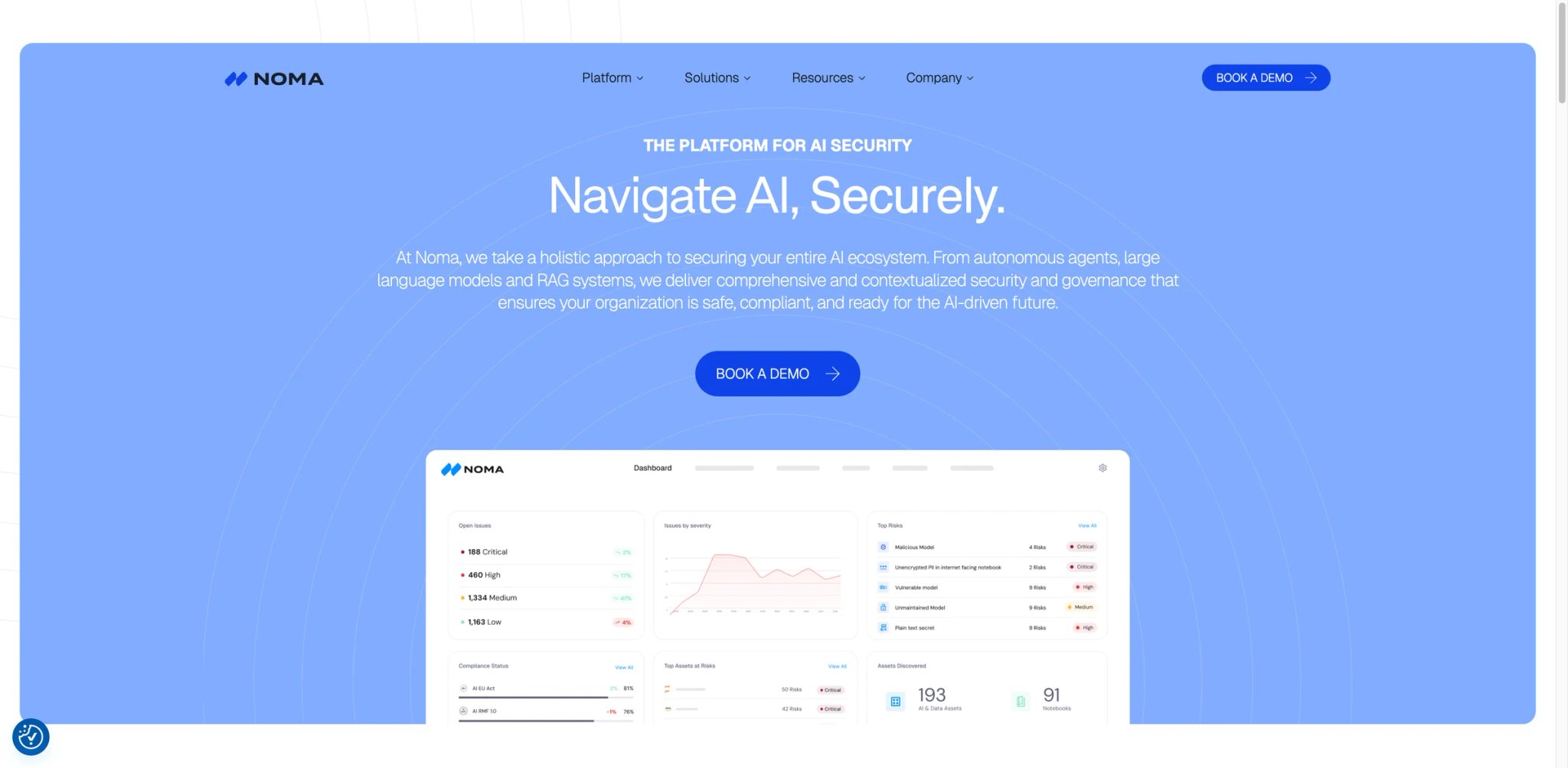
Building an AI security program from scratch means evaluating and procuring separate tools for posture management, runtime protection, and red teaming — then integrating them. For security teams at growth-stage companies where budget and headcount are constrained, that fragmentation is a non-starter. Noma Security bundles AISPM, runtime monitoring, and automated red teaming into a single platform, earning a Gartner Cool Vendor 2025 designation for the approach.
Key Features
-
Unified AISPM plus runtime plus red teaming: Noma combines AI asset discovery, misconfiguration detection, runtime threat monitoring, and automated adversarial testing in one platform. This eliminates the integration overhead of pairing a posture tool with a separate runtime and red teaming vendor — a practical advantage when your security engineering team is under 10 people.
-
Automated AI red teaming: Runs continuous adversarial testing against deployed models and AI agents, identifying vulnerabilities to prompt injection, jailbreaking, data leakage, and business logic manipulation. The automation reduces dependence on external red team consultants who charge $50K+ per engagement.
-
Data pipeline security: Monitors data flows into AI systems for poisoning risks, PII leakage, and unauthorized data access — addressing the training data governance gap that many posture-only tools ignore.
Pricing
Enterprise quote-based. As an early-stage vendor (founded 2023), Noma's pricing is negotiable and likely competitive compared to established CNAPP players. Expect pricing to increase as the company matures and raises subsequent funding rounds.
Limitations
Noma has very limited independent reviews as of March 2026. The Gartner Cool Vendor designation validates the approach, but it is not a substitute for the depth of user feedback available for Wiz or CrowdStrike. You are making a bet on a young vendor — which carries integration risk if the company pivots, gets acquired, or fails to scale support.
The platform's breadth across posture, runtime, and red teaming means no single capability is as deep as a specialist. HiddenLayer's adversarial ML testing is more sophisticated; Wiz's cloud discovery is more mature. Noma trades depth for consolidation.
Who Should Use Noma Security
Best for: Growth-stage companies (Series B through pre-IPO) with 20-100 AI workloads that want consolidated AI security without managing multiple vendor relationships. Security teams under 10 people who need posture, runtime, and testing in one contract.
Not the right fit if: You need proven track record with large-scale enterprise deployments, your procurement team requires extensive reference customers, or you are in a regulated industry where vendor stability is an audit concern.
Get started with Noma Security
Microsoft Defender for Cloud AI Posture
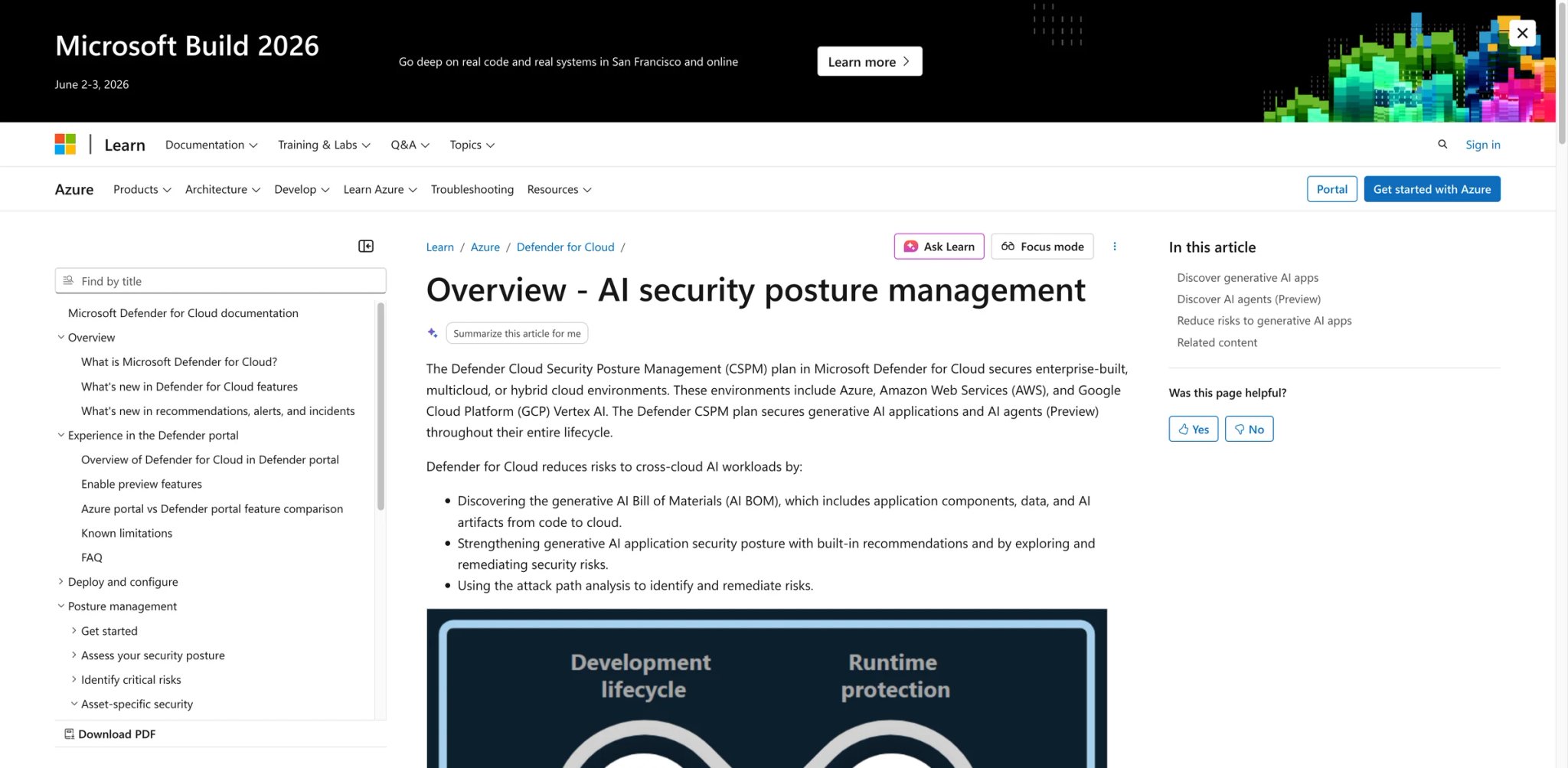
Your organization went all-in on Azure. Azure OpenAI Service handles your generative AI workloads, Copilot Studio powers your internal agents, and Azure ML runs your custom models. Adding a third-party AI-SPM tool means another vendor contract, another integration project, and another dashboard for your SOC to monitor. Microsoft Defender for Cloud AI Posture offers native AI security within the Azure ecosystem — no additional agents, no separate console.
Key Features
-
Native and multicloud AI posture coverage: Defender for Cloud can assess supported AI services across Azure, AWS, and GCP, including Azure OpenAI Service, Azure AI resources, Amazon Bedrock, and Google Vertex AI, while some agent-specific experiences remain preview.
-
AI attack path analysis: Extends Defender's existing attack path analysis to include AI-specific vectors. Maps paths from compromised identities through AI service configurations to data exposure, correlating with Azure RBAC, network security groups, and data classification from Purview.
-
Threat protection for AI workloads: Detects suspicious prompt patterns, unusual model API access, and credential exposure in AI service configurations. Alerts integrate directly into Microsoft Sentinel and the Defender XDR console.
Pricing
AI Posture capabilities are included in Defender for Cloud plans (Defender CSPM and Defender for AI Services). Pricing follows Microsoft's per-resource model. For organizations already paying for Defender CSPM, the incremental cost for AI Posture is relatively modest. However, costs compound quickly when you enable additional Defender plans across large Azure environments.
TCO Watch: The "included in Defender" positioning is attractive, but organizations consistently report that total Defender for Cloud costs exceed initial estimates as they enable more workload protections. Budget for 20-30% above quoted prices based on user feedback.
Limitations
Microsoft Defender for Cloud AI Posture is not uniformly preview-only. Core multicloud AI-SPM capabilities are already available for supported services, while specific agent discovery and copilot experiences still carry preview or add-on licensing caveats.
Multi-cloud coverage is minimal. If you run AI workloads on AWS or GCP alongside Azure, Defender AI Posture provides limited to no visibility into those environments. You would need a separate tool (Wiz, Orca, or Tenable) for cross-cloud AI posture. For organizations managing AI data governance across multiple clouds, this is a significant gap.
Who Should Use Microsoft Defender for Cloud AI Posture
Best for: Azure-native organizations already using Defender for Cloud who want to extend AI visibility without adding vendor complexity. Particularly practical for teams using Azure OpenAI Service and Copilot Studio where native integration provides the fastest time-to-value.
Not the right fit if: You want a vendor-neutral standalone AI-SPM platform, need uniform depth across every AI stack, or require mature coverage for agent scenarios that are still evolving. Defender should not be ruled out solely because you use AWS or GCP, since supported multicloud AI posture coverage now exists.
Get started with Microsoft Defender for Cloud AI Posture
Tenable Cloud Security AI-SPM
Your AI teams are using managed services — AWS Bedrock for foundation model access, SageMaker for custom training, Azure AI for embeddings, and GCP Vertex AI for orchestration. Each cloud provider has its own security controls, IAM models, and configuration best practices. Tracking misconfigurations across these heterogeneous managed AI services without a unified view creates blind spots that attackers exploit.
Key Features
-
Managed AI service specialization: Tenable focuses specifically on the security posture of managed AI services — AWS Bedrock, SageMaker, Azure AI, and GCP Vertex AI. Rather than trying to cover the entire AI lifecycle, it targets the configuration and access control layer where most enterprises actually run their AI workloads.
-
Identity-centric AI risk analysis: Leverages Tenable's strength in identity and access management to analyze who has access to AI resources, what they can do with that access, and whether those permissions follow least-privilege principles. Surfaces toxic permission combinations where an identity can both modify training data and deploy models to production.
-
Exposure management integration: AI findings feed into Tenable's broader Exposure Management platform, allowing security teams to prioritize AI risks alongside vulnerability management, identity security, and cloud misconfiguration findings in a single risk view.
Pricing
Enterprise quote-based as part of Tenable Cloud Security. Pricing depends on the number of cloud accounts and resources under management. Tenable positions AI-SPM as an included capability within Cloud Security rather than a separate add-on, which simplifies procurement.
Limitations
Setup complexity is a known friction point. Connecting multiple cloud accounts, validating IAM permissions, and tuning alerts can take meaningful implementation effort. The platform was built for vulnerability management teams — the UI and workflow patterns may feel unfamiliar to cloud security engineers who did not come from the Nessus/Tenable ecosystem.
Tenable AI-SPM does not scale well for small teams. The platform's value proposition assumes you have enough AI assets and cloud accounts to justify the investment. Teams with fewer than 20 AI workloads may find the setup effort disproportionate to the coverage gained.
Who Should Use Tenable Cloud Security AI-SPM
Best for: Mid-to-large enterprises running AI workloads primarily on managed cloud services (Bedrock, SageMaker, Azure AI, Vertex AI) who want unified identity and posture analysis across clouds. Particularly strong for organizations that already use Tenable for vulnerability management and want to extend their existing investment.
Not the right fit if: Your AI workloads are self-hosted or run on custom infrastructure outside managed cloud services, your team is under 20 AI assets, or you need runtime protection beyond posture scanning.
Get started with Tenable Cloud Security AI-SPM
Lakera Guard
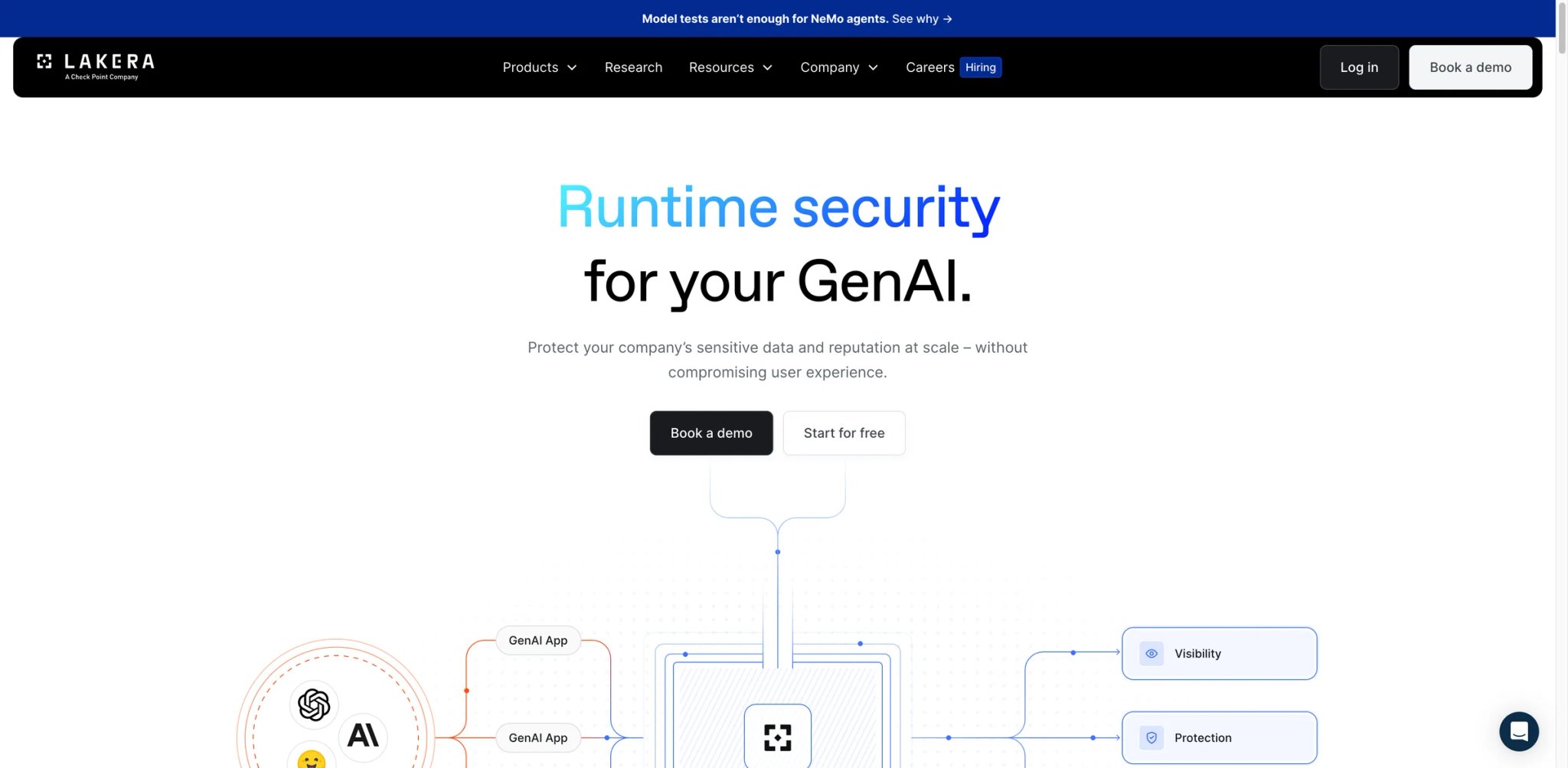
Your developers shipped an LLM-powered customer service agent last week, and you just learned it can be jailbroken with a simple prompt injection. The model happily reveals system prompts, ignores content policies, and can be manipulated into generating outputs that expose customer data. You need a guardrail layer deployed by end of day, not a six-month platform procurement cycle. Lakera Guard is the only tool in this comparison that offers a free community tier and can be deployed as an API gateway in front of any LLM within hours.
Key Features
-
Real-time prompt and output filtering: Lakera Guard sits between your application and the LLM, analyzing every prompt and response for injection attempts, jailbreaks, PII leakage, toxic content, and policy violations. Lakera positions Guard as low-latency with sub-50ms platform performance, though exact latency varies by deployment configuration and request complexity.
-
Free community tier: The community plan includes prompt injection detection and basic content filtering at no cost — the only free option in this comparison. This allows security teams to deploy immediate guardrails on pilot applications without procurement approval, then upgrade as usage scales.
-
Pre-built and custom policy engine: Ships with default policies for OWASP Top 10 for LLM Applications risks. Security teams can add custom rules for organization-specific content policies, regulatory requirements, and business logic constraints without writing code.
Pricing
Lakera offers a free Community plan, while paid commercial pricing is handled through sales rather than clearly published self-serve rates. Keep the cost discussion focused on request-volume economics, but do not present the paid plans as a confirmed public per-API-call schedule unless Lakera publishes that pricing directly. Check Point acquired Lakera in 2025, and pricing structure may evolve as integration with the Check Point ecosystem progresses.
TCO Watch: Paid pricing scales with request volume. An LLM application handling 1 million requests per day will incur significant monthly costs. Model paid Lakera costs against your actual traffic volumes and commercial terms before committing.
Limitations
Lakera Guard is a runtime guardrail tool, not a full AI-SPM platform. It does not discover shadow AI, scan model supply chains, assess cloud misconfigurations, or provide regulatory compliance dashboards. If you need posture management, Lakera Guard must be paired with a separate AI-SPM tool like Wiz or Orca.
The Check Point acquisition introduces uncertainty. Lakera's roadmap, pricing, and independence may change as it integrates into the Check Point portfolio. Organizations evaluating Lakera should factor in acquisition risk — the product you buy today may look different in 12 months.
Who Should Use Lakera Guard
Best for: Development teams that need immediate LLM guardrails for production applications, security teams that want to start with a free tier before committing budget, and organizations that already have posture management covered but lack runtime protection.
Not the right fit if: You need a single platform for AI asset discovery, posture management, and compliance. Lakera Guard is a point solution for runtime LLM security, not a substitute for broader AI-SPM tooling.
Get started with Lakera Guard
Zenity AI-SPM
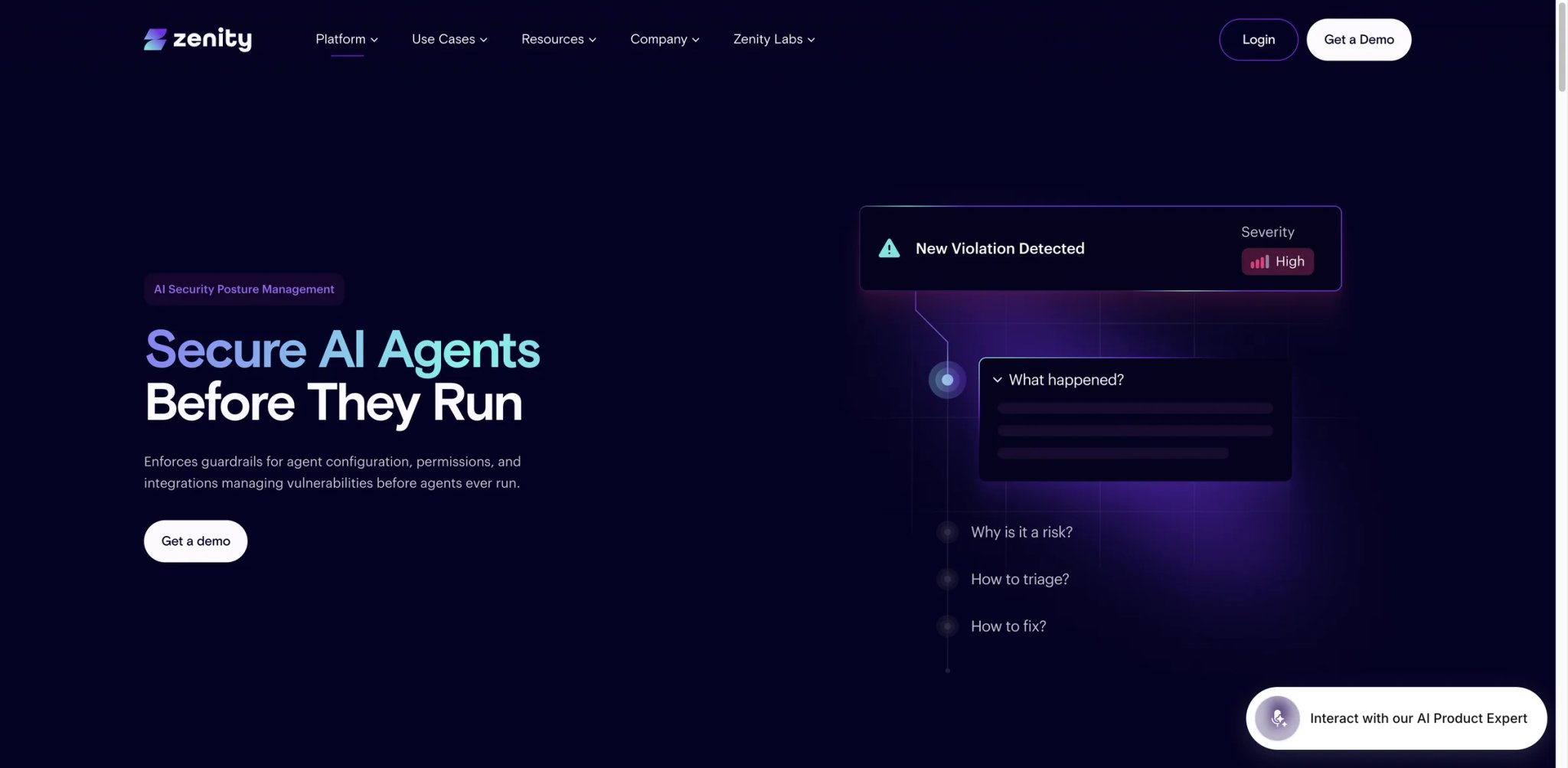
Zenity is no longer just a Power Platform security product. Its current AI-SPM positioning centers on governing AI agents and copilots across Microsoft 365 Copilot, Copilot Studio, ChatGPT Enterprise, Salesforce Agentforce, and custom agent frameworks running on major cloud AI stacks.
Key Features
-
Cross-platform agent discovery: Zenity can inventory and govern AI agents and copilots across Microsoft environments, SaaS copilots such as ChatGPT Enterprise and Agentforce, and custom agent frameworks deployed on major cloud AI platforms.
-
Agent behavior analysis: Monitors what AI agents actually do in production — which data sources they access, what external APIs they call, what permissions they exercise, and whether their behavior deviates from intended scope. This addresses the unique risk of low-code AI agents that business users modify without change management.
-
Policy enforcement for citizen AI development: Security teams can define guardrails that automatically apply to new AI agents as they are created — restricting data access, requiring approval workflows, enforcing content safety policies, and blocking connections to unauthorized external services.
Pricing
Enterprise quote-based with a sales-led evaluation process. Public pricing is not disclosed, and prospective buyers should confirm whether a trial or proof-of-concept is available during the sales cycle rather than stating categorically that no trial exists.
Limitations
Zenity is still most differentiated in the Microsoft ecosystem, but its scope now extends beyond Power Platform and Copilot Studio. Buyers should validate the depth of each non-Microsoft integration and whether it covers their specific agent stack.
The sales-led evaluation process means security teams should confirm whether a proof-of-concept or trial is available. In a market where Lakera Guard offers free community access and Wiz provides demo environments, prospective buyers should plan for Zenity's longer evaluation cycle.
Who Should Use Zenity AI-SPM
Best for: Enterprises that need governance for copilots and agents across Microsoft environments, SaaS AI assistants, and custom agent frameworks—especially when security teams need visibility into both employee-built and centrally developed agents. Particularly valuable for organizations where business users — not data scientists — are the main source of ungoverned AI deployments.
Not the right fit if: Your AI workloads are primarily ML infrastructure (SageMaker, Vertex AI, custom models) rather than low-code agents, or you want to evaluate the tool hands-on before committing to a sales cycle.
Get started with Zenity AI-SPM
Best AI SPM Tools by Use Case
For Multi-Cloud Enterprises Managing Hundreds of AI Workloads
If you are running AI services across AWS, Azure, and GCP simultaneously and your primary challenge is simply knowing what exists, Wiz AI-SPM delivers the strongest multi-cloud discovery with agentless deployment that eliminates friction with data science teams. Tenable Cloud Security AI-SPM is the stronger choice if your AI workloads are concentrated on managed services (Bedrock, SageMaker, Vertex AI) and you want identity-centric risk analysis layered on top.
For Organizations Under EU AI Act or NIST AI RMF Compliance Deadlines
If your compliance team has a specific regulatory deadline and needs to generate posture reports mapped to EU AI Act high-risk requirements or NIST AI RMF categories, Palo Alto Prisma AIRS AI-SPM offers the broadest regulatory mapping across the AI lifecycle — from training data governance to inference monitoring. Budget for professional services and a substantial deployment timeline. Wiz AI-SPM provides faster time-to-value if you need compliance visibility within weeks rather than months, though with less depth on supply chain and training data provenance.
For Security Teams Needing Immediate LLM Guardrails
If a production LLM application is already exposed and you need runtime protection deployed this week — not this quarter — Lakera Guard is the only option with a free community tier and sub-hour deployment via API gateway. Pair it with a posture tool (Wiz or Orca) for the full picture. HiddenLayer is the better runtime choice if your primary concern is adversarial model attacks rather than prompt injection.
For Azure-Native Organizations Using Copilot and Power Platform
If your AI footprint is primarily Microsoft — Azure OpenAI Service, Copilot Studio, Power Platform agents — your choice comes down to scope. Microsoft Defender for Cloud AI Posture covers the infrastructure and service layer with native integration. Zenity AI-SPM specializes in governing AI agents and copilots across Microsoft and SaaS platforms that Defender does not fully address. Many Azure-native organizations will eventually need both.
For CrowdStrike Shops Extending to AI Security
If Falcon is already your endpoint and cloud security platform and your CISO wants to consolidate AI security under the same vendor, CrowdStrike Falcon Cloud Security AI-SPM is the path of least resistance. The agentless AI-SPM module integrates into the Falcon console you already manage. Just budget for the packaging costs and confirm which AI services are covered.
How to Choose the Right AI SPM Tools
Selecting an AI-SPM tool is a security architecture decision, not a feature comparison exercise. Here is a decision framework aligned to how CISOs actually evaluate these platforms.
1. Map your AI asset landscape first. Before evaluating any tool, audit what you are protecting. Count your models in production, training pipelines, AI agents, and third-party model dependencies. Organizations with under 50 AI workloads need different tooling than those with 500+. Wiz and Orca serve the high-volume discovery use case; Lakera Guard and HiddenLayer address specific runtime risks without requiring broad asset management.
2. Identify your primary threat vector. Shadow AI discovery, adversarial model attacks, prompt injection, supply chain poisoning, and regulatory non-compliance are different problems requiring different tools. No single platform excels at all of them. Match your top threat to the tool that specializes in it rather than buying the broadest platform and hoping it covers everything.
3. Assess your existing vendor ecosystem. Consolidation saves integration effort. If you run CrowdStrike, evaluate Falcon AI-SPM before adding a new vendor. If you are Azure-native, start with Defender AI Posture. If you run Wiz or Orca for CNAPP, extend to their AI-SPM modules. The switching cost of adding a sixth security vendor is higher than most procurement teams realize.
4. Demand TCO transparency before signing. Ask vendors for total cost projections based on your actual AI workload count, API call volumes, and cloud account numbers. Asset-based and per-API-call pricing models both have scaling risks. Get written estimates for year-one and year-three costs, including professional services.
5. Test with a proof of concept on real workloads. Marketing demos use curated environments. Insist on a PoC against your actual cloud accounts, with your actual AI workloads, running for at least 30 days. Measure false positive rates, discovery accuracy, and the time your team spends triaging findings — these operational metrics matter more than feature checklists.
6. Plan for runtime plus posture from day one. Posture management (Wiz, Orca, Tenable) and runtime protection (Lakera Guard, HiddenLayer) serve different functions. Budget and architect for both layers, even if you phase the rollout. Organizations that deploy posture-only and defer runtime consistently report incidents that posture scanning would not have prevented.
Frequently Asked Questions
What is the difference between AI-SPM and traditional CSPM?
How do AI-SPM tools handle shadow AI discovery across multiple cloud accounts?
Which AI-SPM tools support EU AI Act compliance reporting?
How long does a typical AI-SPM deployment take in an enterprise environment?
Can AI-SPM tools detect prompt injection and adversarial attacks in real time?
What does AI-SPM actually cost for a mid-size enterprise with 100 AI workloads?
Is it better to use a CNAPP with AI-SPM add-on or a standalone AI security platform?
How do AI-SPM tools handle AI agents and autonomous systems?
Get ToolWorthy Weekly
New AI tools, practical guides, and selected AI signals in one weekly brief.
Related Posts
- 12 Best AI & Model Governance Tools for 2026
Compare 12 AI and model governance platforms by the job they actually do: compliance evidence, model risk, lifecycle controls, and shadow AI discovery.
For AI tool founders
Built a tool that belongs in this decision set?
Request an editorial evaluation for possible inclusion in ToolWorthy.
Submit your tool for reviewPaid submission does not guarantee a ranking, recommendation, inclusion, or editorial outcome.