

Overview
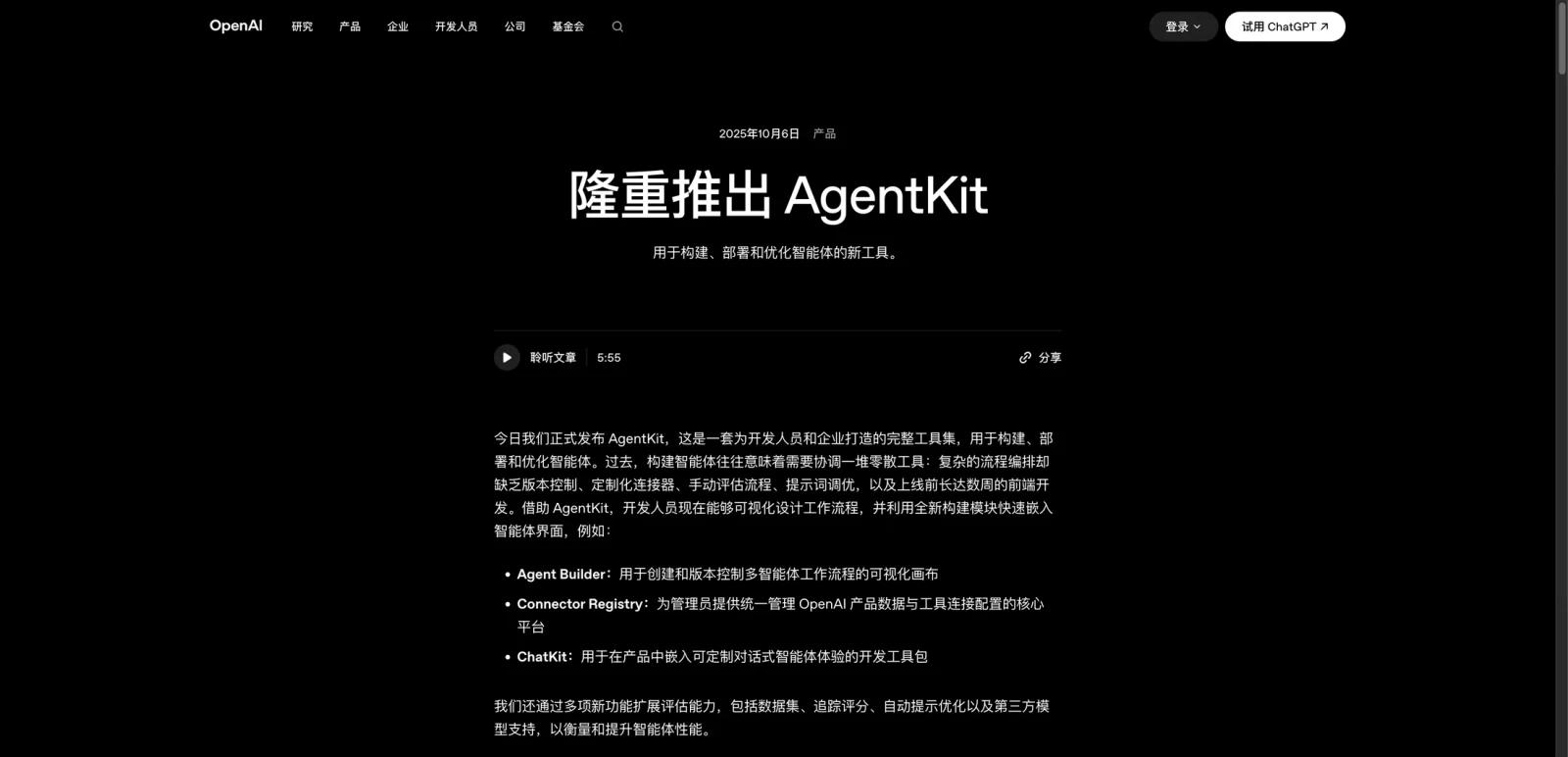
OpenAI AgentKit is OpenAI's bundled toolkit for developers and enterprises building, deploying, and optimizing production agents. Introduced on October 6, 2025, it packages several previously separate needs into one product layer: visual workflow building, embedded chat UI, connector governance, evaluation tooling, and reinforcement fine-tuning enhancements.
The key point is that AgentKit is not a single feature. OpenAI positions it as a complete agent-building toolset built on top of the Responses API and Agents SDK. In practical terms, that means teams can move from orchestration and experimentation to in-product chat experiences and performance evaluation without stitching together as much custom frontend, prompt iteration, and connector administration work.
If you're comparing AI agent platforms, AgentKit sits closer to an application-development toolkit than to a general chatbot product. It is designed for teams building support agents, internal assistants, onboarding flows, deep research tools, and enterprise workflows where deployment speed and reliability matter more than hobbyist experimentation.
For adjacent research, compare AI design tools, AI UI design tools.
Key Features
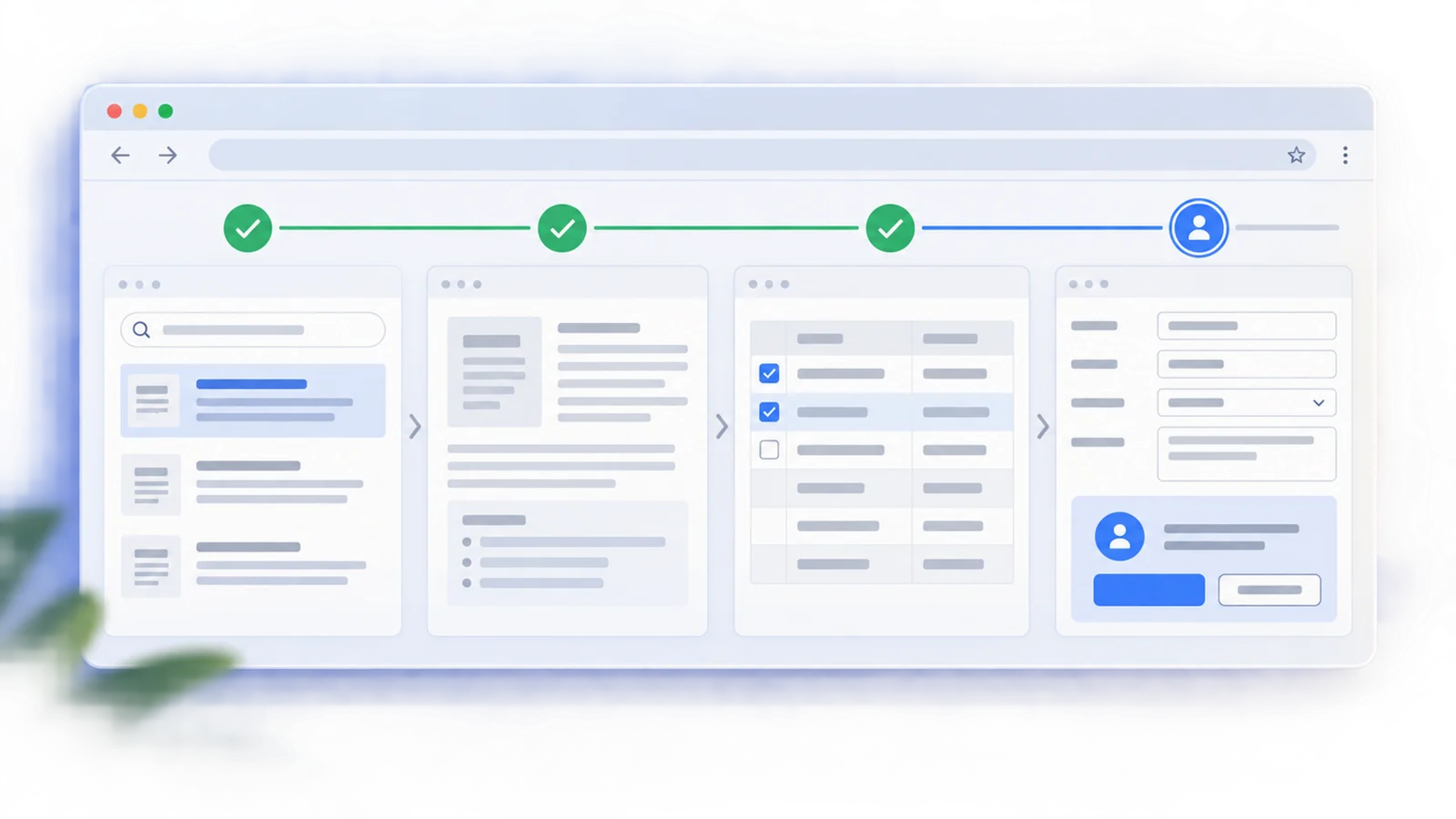
Agent Builder visual workflow canvas — OpenAI describes Agent Builder as a visual canvas for creating and versioning multi-agent workflows. It supports drag-and-drop node composition, preview runs, inline eval configuration, templates, and workflow versioning.
Connector Registry for enterprise governance — Connector Registry is described by OpenAI as a central place to manage how tools and data connect across products. It reportedly includes prebuilt connectors such as Dropbox, Google Drive, SharePoint, and Microsoft Teams, plus third-party MCPs; availability may vary by account tier and rollout status.
ChatKit for embedded agent experiences — ChatKit is a toolkit for embedding chat-based agent interfaces into apps and websites. OpenAI positions it as a way to avoid rebuilding streaming UIs, thread handling, model-thinking views, and customization from scratch.
Expanded Evals capabilities — AgentKit launches alongside stronger Evals features including datasets, trace grading, automated prompt optimization, and third-party model support. That makes it more relevant to teams that care about measurable agent quality rather than demo-only behavior.
Guardrails integration — OpenAI states that developers can enable Guardrails in Agent Builder to mask or flag PII, detect jailbreaks, and apply additional safety controls; specific capabilities and defaults may depend on implementation and SDK usage. Guardrails are also available as open-source libraries for Python and JavaScript.
Reinforcement fine-tuning improvements — OpenAI pairs AgentKit with reinforcement fine-tuning features such as custom tool calls and custom graders, which matter for teams pushing agent performance beyond prompt-only optimization.
Pricing & Plans
AgentKit does not have a simple standalone subscription fee. According to OpenAI's launch materials, these capabilities are included within standard API model pricing; however, exact availability and cost depend on model usage and account eligibility. Please verify current pricing on the official OpenAI pricing page.
| Component | Availability | Pricing note |
|---|---|---|
| ChatKit | Generally available | Included with standard API model pricing |
| New Evals capabilities | Generally available | Included with standard API model pricing |
| Agent Builder | Beta | Included with standard API model pricing |
| Connector Registry | Beta rollout (limited availability) to some API, ChatGPT Enterprise, and Edu customers | Requires Global Admin Console and eligible account setup; confirm eligibility requirements in official documentation. |
That means the practical cost of using AgentKit depends on the models, API traffic, and deployment pattern behind your agent rather than on a separate AgentKit seat fee; actual costs should be validated against current OpenAI API pricing and usage limits. This is important for buyers: AgentKit is a packaging and tooling layer on top of OpenAI's API platform, not a standalone fixed-price SaaS workspace.
Best For
- Product and platform teams building customer support, research, onboarding, or internal knowledge agents
- Developers who want OpenAI-native workflow design and embedded chat without assembling every layer manually
- Enterprises that need agent evals, connector control, and safer deployment patterns
- Teams already using the Responses API and Agents SDK who want to move faster toward production
- Buyers comparing agent-development stacks rather than one-off AI chatbot widgets
FAQ
What is included in OpenAI AgentKit?
OpenAI AgentKit includes Agent Builder, Connector Registry, ChatKit, expanded Evals capabilities, and related reinforcement fine-tuning improvements. It is positioned as a complete toolkit for building, deploying, and optimizing agents.
Is AgentKit a separate paid product?
Not in the usual SaaS sense. OpenAI says these tools are included with standard API model pricing. So you are primarily paying for the underlying model and API usage rather than for a standalone AgentKit license.
What is Agent Builder?
Agent Builder is OpenAI's visual workflow canvas for composing and versioning multi-agent workflows. It supports drag-and-drop logic, preview runs, templates, and inline evaluation configuration.
What is ChatKit?
ChatKit is OpenAI's toolkit for embedding customizable chat-based agent experiences into apps or websites. It is meant to handle the UI plumbing that teams would otherwise need to build themselves.
Who can use Connector Registry?
At launch, Connector Registry is rolling out in beta to some API, ChatGPT Enterprise, and Edu customers with a Global Admin Console. It is not positioned as universally available to every developer account yet.
Does AgentKit help with agent evaluation?
Yes. OpenAI explicitly ties AgentKit to stronger Evals capabilities, including datasets, trace grading, automated prompt optimization, and third-party model support.
Is AgentKit good for small teams?
It can be, especially if a small team is already building on OpenAI APIs and wants to reduce custom frontend and evaluation work. But the bundle is most compelling when you are shipping production agents rather than experimenting casually.
How is AgentKit different from the Agents SDK?
The Agents SDK provides developer primitives. AgentKit adds a broader product layer around those primitives, including visual workflow building, embedded chat UI, connector governance, and evaluation tooling.