

Overview
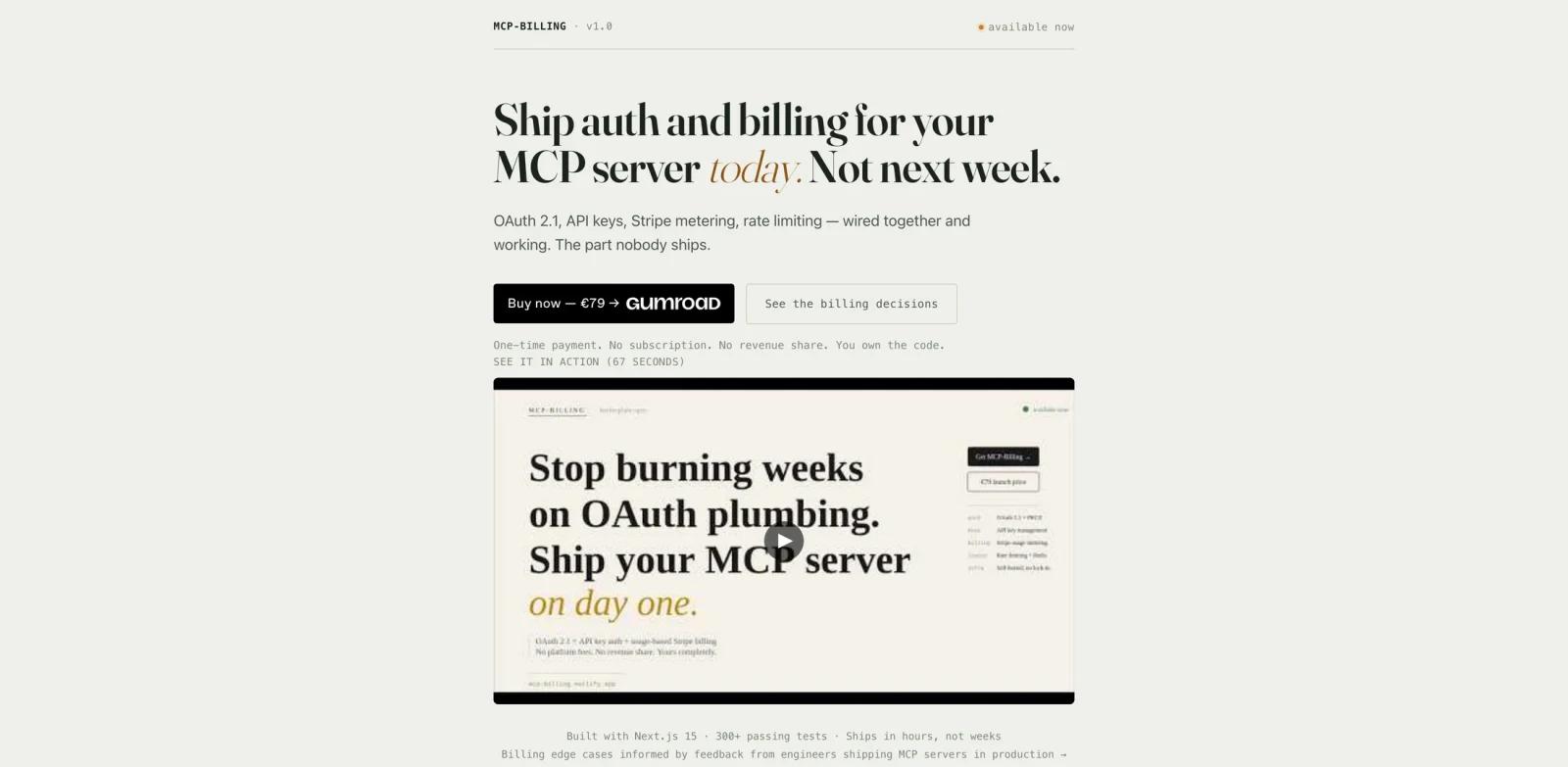
MCP-Billing is a developer boilerplate for teams building paid Model Context Protocol servers. It packages OAuth 2.1 with PKCE, API key management, Stripe usage billing, Redis rate limiting, multi-tenant controls, and billing-safe request handling into a self-hosted Next.js and TypeScript codebase.
The product exists because the MCP ecosystem is moving from demos to commercial infrastructure. If a team wants to expose an MCP server to customers, it needs authentication, usage metering, billing, throttling, and failure-safe accounting. MCP-Billing provides those pieces as source code instead of a hosted platform, which means developers keep control of the stack and avoid revenue share.
This is not a consumer AI app. It is a niche but timely AI agent infrastructure tool for developers who want to sell MCP-powered capabilities without building auth and billing from scratch.
Key Features
- OAuth 2.1 with PKCE — MCP-Billing adds modern authorization flows suitable for client applications connecting to an MCP server.
- API key management — Developers can issue and manage keys for programmatic access, making it easier to support both app-based and server-to-server usage.
- Stripe usage billing — The boilerplate integrates metered billing so teams can charge based on actual MCP usage instead of flat subscriptions only.
- Redis rate limiting — Built-in rate limits help protect paid infrastructure from abuse, runaway clients, and accidental high-volume usage.
- Multi-tenant architecture — The codebase is designed for customer-separated usage, billing, and access control.
- Open-source metering package — The related
mcp-meteringpackage is available as a free MIT-licensed component for teams that only need usage tracking.
How to Get Started
MCP-Billing is best for developers comfortable running a TypeScript stack. A typical setup involves purchasing the boilerplate, configuring environment variables for OAuth and Stripe, connecting Redis for rate limits, wiring it to an existing MCP server, then testing billing edge cases such as idempotency, partial failures, and streaming requests.
Because it ships as source code, teams should budget time for code review, security review, deployment, and integration testing. That tradeoff is the point: MCP-Billing avoids vendor lock-in, but it also puts operational ownership on the buyer.
Pricing & Plans
MCP-Billing uses one-time source-code pricing rather than a SaaS subscription.
| Plan | Price | Includes | Best For |
|---|---|---|---|
| MCP-Billing | €79 one-time launch price | Full source code, commercial license, OAuth, API keys, Stripe usage billing, Redis rate limiting, and multi-tenant modules | Developers shipping a paid MCP server |
| Later price | €149 one-time | Same product after the launch price window | Teams buying after the early launch period |
| mcp-metering | Free | MIT-licensed usage metering package | Developers who only need metering primitives |
The official site states there is no subscription, no revenue share, no vendor lock-in, and a 7-day refund window. The paid boilerplate is currently priced in EUR; the site also describes the €79 price as approximately $90 USD.
Best For
- Developers building commercial MCP servers for agents, IDEs, or workflow platforms
- AI infrastructure startups that need paid access control before opening an MCP endpoint
- Teams already using Stripe and Redis who want source-level control over billing logic
- Builders comparing no-code AI workflow automation tools with custom agent infrastructure
- Engineering teams that prefer owning their auth and billing layer instead of relying on a managed marketplace
FAQ
What is MCP-Billing?
MCP-Billing is a self-hosted Next.js and TypeScript boilerplate that adds authentication, API keys, Stripe usage billing, rate limiting, and tenant management to Model Context Protocol servers.
Is MCP-Billing a SaaS product?
No. The official positioning is source-code boilerplate with a one-time price, not a hosted subscription platform.
How much does MCP-Billing cost?
The launch price is €79 one-time. The site says the price will increase to €149 after the initial release window.
Does MCP-Billing take a revenue share?
No. The official site states there is no revenue share and no vendor lock-in.
Is anything free?
Yes. The related mcp-metering package is listed as a free MIT-licensed package for usage metering.
Who should use MCP-Billing?
It is best for developers or engineering teams that already have, or are building, an MCP server and need paid access control, metering, and usage billing.
What stack does MCP-Billing use?
The public product page describes it as a Next.js and TypeScript boilerplate with OAuth 2.1, API keys, Stripe billing, Redis rate limiting, and multi-tenant modules.
What are the main risks before buying?
Because MCP-Billing is source code rather than managed infrastructure, teams should review the code, test billing edge cases, configure security carefully, and verify that support expectations match their production needs.