



Overview
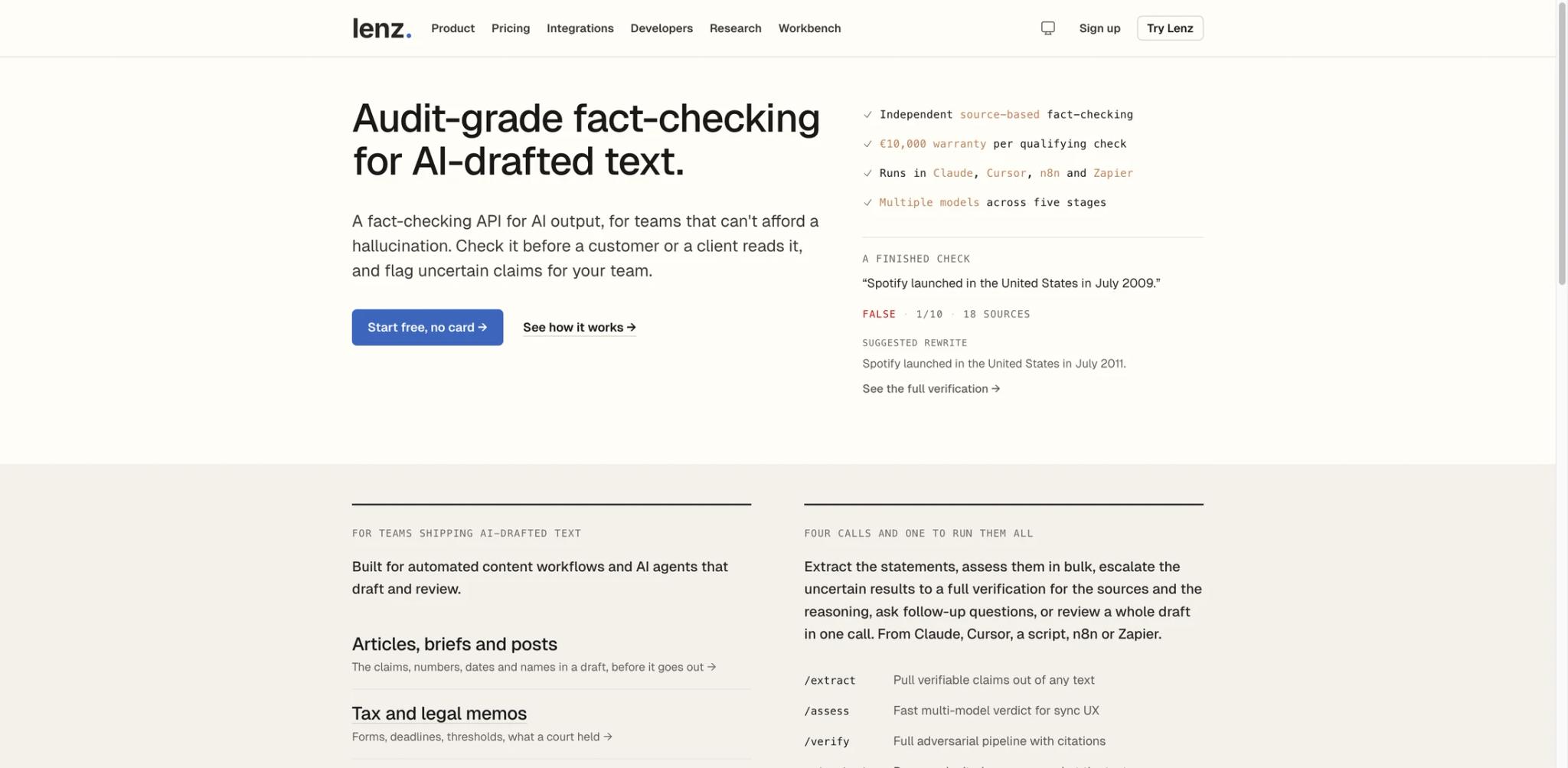
Lenz is a fact-checking API for AI products, content workflows, and document pipelines. It is designed for teams that need to verify factual claims before an answer, report, article, memo, or generated document is shipped to users.
The product is built around four primitives: extract verifiable claims from text, assess claims quickly, verify higher-risk claims through a deeper pipeline, and ask follow-up questions grounded in a completed verification. Lenz returns structured verdicts, citations, confidence signals, and audit details rather than a single model's unsupported answer.
For teams building AI agent or AI content workflows, Lenz fills a narrow but important gap: it can sit after generation and before publication, escalation, customer delivery, or compliance review. It is especially relevant when wrong claims create legal, medical, financial, brand, or customer-trust risk.
Key Features
- Claim extraction - Pull atomic, verifiable claims out of model output, drafts, reports, or other text so verification can run on specific statements.
- Fast assessment - Use
/assessfor a synchronous multi-model panel verdict in roughly the time range Lenz documents for interactive or bulk-screening workflows. - Deep verification - Use
/verifywhen a claim needs citations, stronger evidence gathering, adjudication, and a fuller audit trail. - Grounded follow-up - Ask questions against an existing verification with
/askinstead of starting a new ungrounded chat. - Developer SDKs and CLI - Integrate through REST, Python, TypeScript, or the Lenz CLI, with documented API keys, typed errors, idempotency, and webhook handling.
- Workflow integrations - Connect Lenz through MCP, n8n, Zapier, WhatsApp, and automation workflows so factual checks can run where teams already work.
Integration Guide
Lenz works best when verification depth is matched to risk. A practical integration usually starts with /extract, sends the full text or selected claims through /assess, and escalates low-confidence or high-impact claims to /verify.
For production workflows, the official docs recommend webhook delivery instead of polling for deep verification. The API supports idempotency keys on write operations, so retrying a request after a network failure does not create duplicate verification tasks or double-spend quota when the body is unchanged.
Common integration patterns include:
- Screening generated marketing or SEO drafts before they publish
- Checking claims in AI research, due diligence, or legal-memo workflows
- Running regression tests on a golden set of factual claims before an AI product deploys
- Routing customer-reported bad answers into evidence-backed incident triage
- Giving Claude, Cursor, or other MCP clients access to a fact-checking tool through
lenz.io/mcp
This makes Lenz complementary to AI writing assistants and research tools rather than a replacement for them. It does not generate the whole document; it checks whether the factual claims deserve to ship.
Pricing & Plans
Lenz has a free tier and self-serve paid plans. The official developer page lists a free plan with daily /extract quota and limited monthly /assess, /verify, and /ask quota. Paid self-serve pricing starts with Developer at $99 per month, followed by Scale at $399 per month. Enterprise is custom.
| Plan | Public Price | Included Signal |
|---|---|---|
| Free | $0 | /extract 1,000/day, /assess 100/month, /verify 10/month, /ask 20/month |
| Developer | $99/month | /extract 1,000/day, /assess 5,000/month, /verify 500/month, /ask 1,000/month |
| Scale | $399/month | /extract 1,000/day, /assess 20,000/month, /verify 2,000/month, /ask 4,000/month |
| Enterprise | Custom | Volume beyond Scale, SLAs, white-label, and custom integration support |
The important cost question is not only monthly price. Teams should estimate how many claims each document produces, how often fast assessment is enough, how many claims need deep verification, and whether webhooks or batch verification are required for throughput.
How It Compares
Generic search APIs, web scraping tools, and retrieval systems can gather source material, but they do not necessarily produce a structured verdict with adjudication, confidence, citations, and a reusable audit trail. Exa and Perplexity AI can help teams discover or answer with sources; Lenz is more narrowly focused on verifying claims as a pipeline step.
Plagiarism and AI-detection tools such as Copyleaks answer a different question. They can help with originality or authorship risk, while Lenz evaluates whether factual claims are true, false, mixed, or uncertain according to gathered evidence.
That focus makes Lenz useful when a team already has generation, search, and review tools but lacks a formal factual-verification gate before publication.
Best For
- AI product teams that need a factual gate before answers, reports, or generated documents reach customers
- Content teams publishing high-volume AI-assisted articles, briefs, or research summaries
- Developers adding verification to AI productivity or document workflows through an API, SDK, CLI, or webhook
- Teams that need MCP-accessible fact checking inside coding or research assistants
- Compliance-sensitive organizations that want a stored citation trail for why a claim passed or failed review
FAQ
What is Lenz?
Lenz is a fact-checking API for AI- and human-written content. It extracts claims, assesses them quickly, runs deeper verification with citations when needed, and supports follow-up questions grounded in completed verification.
Is Lenz free?
Lenz has a free tier. The official developer page lists /extract at 1,000 per day and limited monthly quotas for /assess, /verify, and /ask on the free plan.
How much does Lenz cost?
Paid self-serve pricing starts at $99 per month for Developer. Scale is listed at $399 per month, and Enterprise is custom.
What are the main Lenz API endpoints?
The main endpoints are /extract, /assess, /verify, and /ask. The API reference also documents batch verification, verification status, stored verifications, account usage, idempotency keys, and webhooks.
Does Lenz support MCP?
Yes. Lenz provides a remote MCP server at lenz.io/mcp, so compatible clients can access fact-checking tools with an API key.
Can Lenz work with n8n or Zapier?
Yes. Lenz publishes integrations for n8n and Zapier, along with CLI, REST, Python SDK, TypeScript SDK, WhatsApp, and MCP options.
What should teams verify with Lenz?
Start with claims that are customer-facing, expensive to correct, compliance-sensitive, or likely to be copied into a final document. Low-risk drafts may only need extraction or fast assessment, while high-impact claims should use deeper verification.
Who should skip Lenz?
Teams that only need casual source discovery, occasional manual fact checks, or broad AI writing features may not need a dedicated fact-checking API. Lenz is strongest when verification must become a repeatable production workflow.