

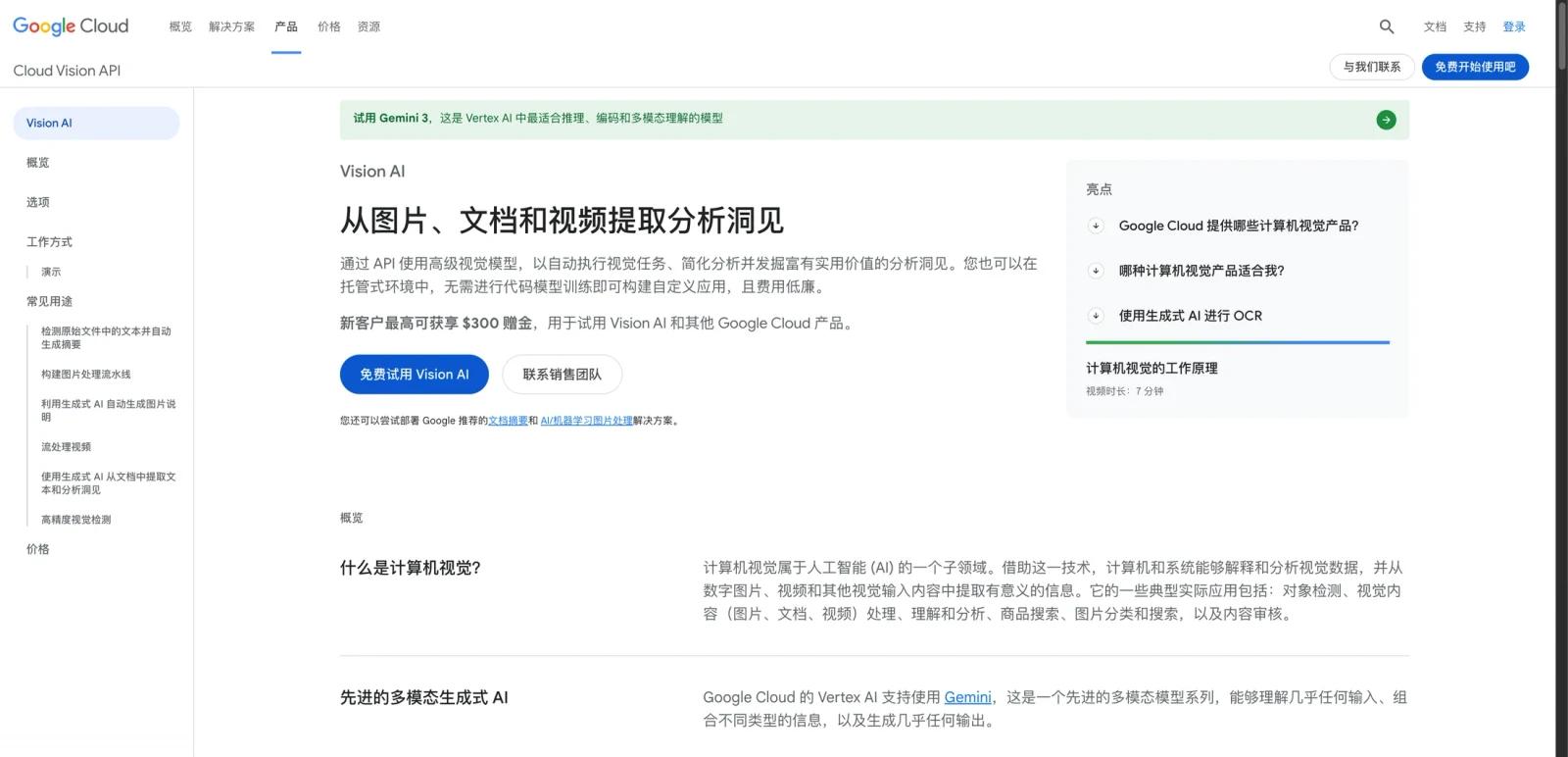


Overview
Google Vision AI is Google's umbrella product page for computer vision across images, documents, and video. The current page does not describe a single standalone model or flat-plan app. Instead, it groups together Cloud Vision API for pretrained image analysis, Document AI for document understanding, Video Intelligence API for stored and streaming video analysis, Vertex AI Vision for custom computer-vision applications, Visual Inspection AI, and Imagen on Vertex AI.
That distinction is the main thing buyers need to understand. If you are looking for a simple OCR or image-tagging API, the relevant product is usually Cloud Vision API. If you need document extraction, the better fit is Document AI. If you need ready-to-use stored or streaming video analysis, the relevant product is usually Video Intelligence API. If you need custom computer-vision applications, managed streams, model orchestration, or searchable media pipelines, Google points you toward Vertex AI Vision. So this page is best understood as a navigation and evaluation layer for Google's broader visual AI stack rather than one narrowly scoped tool.
As of April 24, 2026, Google positions Vision AI around extracting insights from images, documents, and videos; using pretrained APIs for labels, OCR, face and landmark detection, and safe-search moderation; adding generative AI-powered document and image understanding; and scaling workloads through the broader Google Cloud platform. For most teams, the practical question is not whether Google has computer vision capability, but which product inside the Vision AI family maps to the workflow and budget they actually have.
For adjacent research, compare AI video generator tools, AI video editor tools, AI thumbnail maker tools.
Key Features
Cloud Vision API for common image tasks — Google describes Cloud Vision API as the ready-to-use option for labels, OCR, face detection, landmark detection, logo detection, safe-search moderation, and object localization through REST and RPC APIs.
Document AI for document-heavy workflows — The Vision AI page explicitly points buyers toward Document AI when the job is extracting text, fields, and structured data from scanned or complex business documents rather than just labeling images.
Video Intelligence API and Vertex AI Vision for video workflows — Google positions Video Intelligence API as the ready-to-use option for stored and streaming video analysis, while Vertex AI Vision is better framed as a managed environment for building, deploying, and managing custom computer-vision applications and video-stream pipelines.
Generative AI attached to visual workflows — The current page connects Vision AI with Gemini and Imagen on Vertex AI for image captioning, multimodal understanding, and higher-level description or search workflows beyond classic detection APIs.
Free trial and free-usage entry points — Google highlights up to $300 in Google Cloud credits for new customers and notes free monthly allowances for some underlying products, including the first 1,000 Cloud Vision API feature units per month.
Multiple deployment paths instead of one product shape — Google presents Vision AI as a suite that ranges from low-code managed tools to deeper cloud architectures, which is powerful but also more complex than a single-purpose OCR SaaS.
Pricing & Plans
Google Vision AI does not have one simple list price because the page bundles several products. The cleanest published entry point is Cloud Vision API pricing, while Document AI, Vertex AI Vision, and Imagen-based visual workflows have their own separate pricing pages.
| Product | Published pricing signal | Positioning |
|---|---|---|
| Cloud Vision API | First 1,000 feature units per month free, then many common detection features from $1.50 per 1,000 units; object localization from $2.25 per 1,000 units; web detection from $3.50 per 1,000 units | Best for ready-to-use image analysis APIs |
| Document AI | Pricing is processor-sensitive; Enterprise Document OCR is listed at $1.50 per 1,000 pages for 1 to 5,000,000 pages per month and $0.60 per 1,000 pages above that, while other processors such as Form Parser and Custom Extractor have separate prices | Better for OCR, extraction, and document workflows |
| Vertex AI Vision | Pricing is feature-sensitive and should be checked on the detailed Vertex AI Vision pricing page or with Google Cloud pricing tools | Better for managed visual applications, custom models, streams, and media pipelines |
| Imagen on Vertex AI visual features | Vision AI lists multimodal embeddings at $0.0001 per image input and visual captioning at $0.0015 per image, with other Imagen and Gemini visual workloads priced separately in Vertex AI | Better for image generation, editing, captioning, embeddings, and multimodal workflows |
For a buyer comparison, this means Google Vision AI is best treated as a pay-as-you-go ecosystem, not a fixed product plan. Teams with lightweight image analysis needs can often start cheaply with Cloud Vision API. But once the workflow expands into document extraction, video, or generative multimodal tasks, pricing becomes more product-specific and can no longer be summarized as one single Vision AI monthly cost.
Best For
- Teams evaluating Google's full computer vision stack before choosing a sub-product
- Developers who want pretrained image-analysis APIs with room to expand later
- Enterprises combining OCR, document extraction, and video analytics in one cloud vendor
- Products already built on Google Cloud that want a native visual AI path
- Buyers comparing Cloud Vision API against broader platform alternatives such as Azure AI Vision or Amazon Rekognition
FAQ
What is Google Vision AI?
Google Vision AI is Google's umbrella page for computer vision products across image, document, and video workflows. It includes Cloud Vision API, Document AI, Vertex AI Vision, and related generative AI visual capabilities.
Is Google Vision AI the same as Cloud Vision API?
No. Cloud Vision API is one product within the broader Vision AI family. It is the most relevant sub-product when you need ready-to-use image labeling, OCR, face detection, or similar pretrained image-analysis features.
How much does Google Vision AI cost?
There is no single Vision AI price. Cloud Vision API starts with the first 1,000 feature units per month free, then many common features are priced from $1.50 per 1,000 units. Other products such as Document AI and Vertex AI Vision have separate pricing models.
Which Google product is best for OCR?
It depends on the workload. For straightforward OCR and image text extraction, Cloud Vision API may be enough. For richer document extraction, classification, and business-document processing, Google points buyers toward Document AI.
Does Google Vision AI handle video?
Yes, but the relevant product depends on the workflow. Video Intelligence API is the ready-to-use Google Cloud product for stored and streaming video analysis, while Vertex AI Vision is better for building and managing custom video or computer-vision applications.
Is there a free tier?
For Cloud Vision API, yes. Google currently states that the first 1,000 feature units per month are free. Google also advertises free-trial cloud credits for new customers.


