

Overview
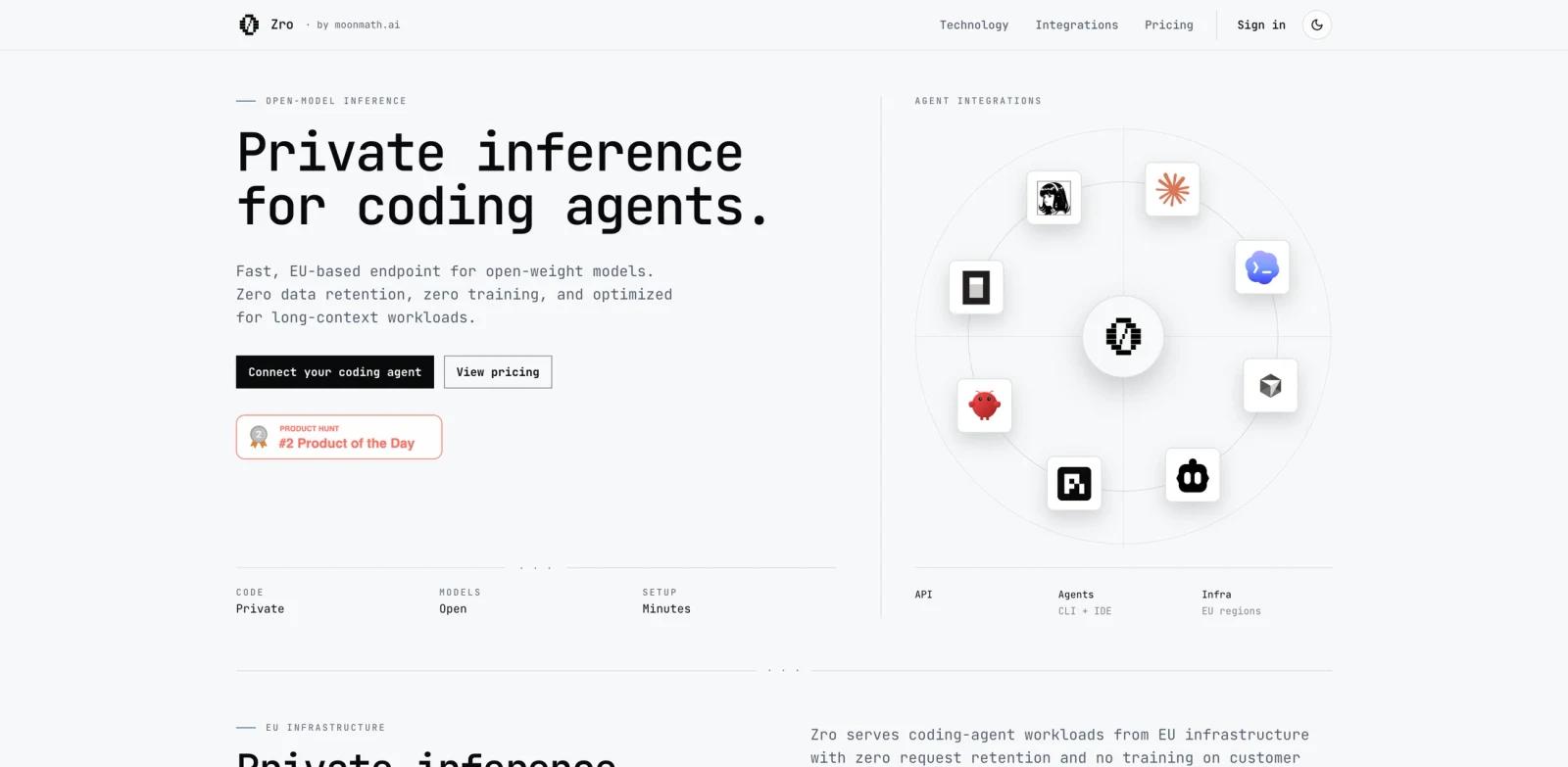
Zro is a private inference endpoint for coding agents from MoonMath. It gives developer tools such as Claude Code, Codex CLI, Cursor, OpenCode, OpenClaw, Hermes, and Pi access to open coding models through an endpoint designed for long-context agent workloads.
The product matters because more teams are using coding agents for real production work, but many still have concerns about prompt retention, training use, regional infrastructure, and compatibility with existing clients. Zro positions itself as a privacy-forward alternative for AI code generator workflows: open-model inference, EU infrastructure, zero request retention by default, and no training on customer prompts or completions.
Zro currently starts with MiniMax M3 and GLM-5.2, with additional open coding models listed as coming soon. It exposes OpenAI-compatible chat completions and Anthropic-compatible Messages requests, which makes it easier to connect to existing AI agent tools without rebuilding the whole stack.
Key Features
- Private coding-agent inference - Route coding agents through an endpoint built for developer tools and multi-turn coding sessions.
- Zero request retention - Zro says prompt and completion bodies are not retained by default after inference is processed.
- No training on customer data - Customer prompts and completions are not used for training, fine-tuning, evaluations, analytics, or dataset creation.
- EU infrastructure - Current regions include Finland and France, useful for teams that care about regional processing.
- Agent integrations - The official site lists launch support for Claude Code, Codex CLI, OpenCode, Hermes, OpenClaw, Pi, and manual setup paths for Cursor and Cline.
- Compatible APIs - Zro supports OpenAI-compatible chat completions and Anthropic-compatible Messages requests for tools that expect those API shapes.
For teams comparing Zro with full coding assistants, the key distinction is scope: Zro is the inference layer, not a complete IDE. It pairs with tools in the AI productivity and coding-agent ecosystem.
How to Get Started
The fastest setup path is the official npm package. Install @moonmath-ai/zro, log in once, and launch a supported coding tool with a temporary session configuration.
npm install -g @moonmath-ai/zro
zro login
zro launch claude
zro launch codex --model glm-5.2
Teams should start by testing Zro on a non-sensitive repository and comparing latency, context handling, cost, and model behavior against their current provider. If privacy is the main driver, confirm internal policy requirements around prompt retention, regional infrastructure, model licensing, and whether open models fit the team's risk profile.
Pricing & Plans
Zro publishes individual plans, custom Enterprise terms, and one-time usage packs. Its pricing page says expected token totals are based on typical cached agent usage and are not fixed allowances; actual usage varies by model mix, prompt shape, output length, and cache reads.
| Plan | Price | Included positioning |
|---|---|---|
| Pro | $20/month | For individual developers; roughly 300M expected monthly tokens; MiniMax M3 and GLM-5.2; OpenAI-compatible API; zero request retention; no training |
| Max | $60/month | Pro with roughly 5x more expected usage, around 1.5B expected monthly tokens |
| Enterprise | Custom | Shared access, custom usage plans, support, procurement, and security needs |
| Usage packs | $5-$100 one-time | Add-on packs for active Pro or Max accounts; expire after 90 days |
Zro also lists web search as a separate tool call at $0.02 per web search. Teams running autonomous agents should include search tool calls in their cost model instead of only estimating model tokens.
Best For
- Developers who want private open-model inference for Claude Code, Codex CLI, Cursor, or OpenCode
- Teams that need coding agents but do not want prompt retention or training on request data
- European teams evaluating regional model-serving infrastructure
- Builders comparing model endpoints for agentic coding workflows
- Security-conscious teams reviewing AI code checker and coding-agent infrastructure options
FAQ
What is Zro?
Zro is a private open-model inference endpoint for coding agents, built by MoonMath.
Which coding tools does Zro support?
The official site lists Claude Code, Codex CLI, Cursor, Cline, Pi, OpenClaw, OpenCode, Hermes, API clients, and CLI/IDE workflows.
Does Zro retain prompts or completions?
Zro says prompt and completion bodies are not retained by default after inference is processed.
Are customer prompts used for model training?
No. Zro says customer prompts and completions are never used for training, fine-tuning, evaluations, analytics, or dataset creation.
How much does Zro cost?
Paid plans start at $20/month for Pro. Max is $60/month, Enterprise is custom, and one-time usage packs are available.
Is Zro a full coding assistant?
No. Zro is the inference endpoint. You use it with coding agents or clients such as Claude Code, Codex CLI, Cursor, and OpenCode.