
10 Best AI Security Tools 2026 - Runtime, Agents, and AI-SPM
Your AI security problem probably did not arrive as a clean platform requirement. It arrived as a Slack message: a team is testing ChatGPT with customer data, a developer just connected an MCP server to an internal agent, a product manager wants a public-facing support bot in production next month, and the board is asking whether the company has an AI risk register. The best AI security tools in 2026 are built for that messy middle: shadow AI discovery, LLM app testing, prompt injection defense, agent control, model supply chain scanning, and data security posture.
This guide compares 10 AI security tools for security leaders, platform teams, AI engineering teams, and governance owners who need practical protection rather than another policy document. We prioritized tools with clear AI-specific security products, evidence of real enterprise workflows, runtime or posture capabilities, and enough documentation to evaluate fit. If you are still building the broader policy layer, start with our best AI governance tools guide; if your main concern is cloud posture for AI assets, also compare this list with our AI-SPM tools roundup.
| Tool | Best For |
|---|---|
| Palo Alto Networks Prisma AIRS | Full-lifecycle AI security for large enterprises standardizing on one platform |
| Cisco AI Defense | Cisco-heavy organizations protecting both employee AI use and internally built AI apps |
| Lakera Guard | Runtime LLM and agent guardrails that engineering teams can deploy quickly |
| Protect AI | AI model security, supply chain protection, and MLSecOps workflows |
| HiddenLayer | Specialized model, supply chain, red-team, and runtime threat defense |
| Noma Security | AI-SPM plus agent, MCP, red-team, and runtime security in one platform |
| Lasso Security | Agentic AI security with low-latency runtime controls and discovery |
| Prompt Security | Employee GenAI usage, AI apps, code assistants, and agentic AI risk |
| Enkrypt AI | Agent guardrails, red teaming, AI policy, and compliance evidence |
| Microsoft Purview Data Security Posture Management | Microsoft 365, Copilot, and third-party GenAI data security posture |
How We Selected and Tested
We selected these AI security tools based on five criteria: explicit AI/LLM/GenAI/agent security positioning, coverage beyond generic DLP or SIEM marketing, evidence of a real product surface, fit for US and European enterprise buyers, and relevance to current 2026 risks such as prompt injection, data leakage, MCP exposure, shadow AI, model supply chain compromise, and autonomous agent behavior. Traditional security vendors were included only when they had a dedicated AI security module, product page, or documentation.
Our research combined official product pages, technical docs, pricing pages where available, vendor case studies, and adjacent ToolWorthy research on AI governance, AI data governance, and AI agents. We weighted breadth, runtime protection, implementation practicality, pricing transparency, and public user evidence. Because this category is still enterprise-sales heavy, we did not invent pricing when vendors require a demo or sales call. "Contact sales" is treated as a decision risk, not an automatic disqualification.
Evaluation Dimensions: We evaluated each platform across six buyer-centered dimensions:
- AI Risk Coverage - Shadow AI, AI-SPM, model security, LLM app testing, prompt injection, runtime protection, and agent security.
- Runtime Enforcement - Whether the tool can actually block or control risky prompts, outputs, model calls, tool calls, or agent actions.
- Implementation Path - API gateway, SaaS console, cloud integration, Microsoft portal, self-hosted option, or full enterprise deployment.
- Security Team Fit - Whether the buyer is a CISO, AppSec lead, AI platform team, SOC, data security team, or MLOps team.
- Pricing Transparency - Public free tier, trial, usage model, license dependency, or quote-only enterprise packaging.
- Ecosystem Risk - Lock-in, acquisition uncertainty, platform dependency, alert tuning burden, and overlap with existing CNAPP/DLP/SIEM tools.
Note on Testing Scope: We reviewed publicly available product surfaces, docs, and pricing signals. Some enterprise-only products require vendor demos for hands-on evaluation; where direct testing was not available, we relied on official documentation and clearly noted gaps.
Transparency & Limitations: AI security is changing quickly, especially around MCP, agents, and runtime guardrails. Pricing and packaging can change after acquisition or platform integration. Research was conducted in June 2026, and every vendor should be rechecked before procurement.
Top 10 AI Security Tools Compared
The best AI security tool depends less on raw ranking and more on where your risk sits. If your issue is employees pasting sensitive data into public AI tools, Prompt Security, Microsoft Purview, and Cisco are natural starting points. If your risk is a production LLM app, Lakera, Lasso, Enkrypt AI, HiddenLayer, and Prisma AIRS deserve closer review. If your risk is model provenance, malicious weights, and ML supply chain exposure, Protect AI and HiddenLayer are stronger than generic governance platforms.
| Tool | Best For | Primary Coverage | Deployment Path | Pricing Signal |
|---|---|---|---|---|
| Palo Alto Networks Prisma AIRS | Full AI lifecycle security | AI agents, runtime, red team, model security, posture | Enterprise platform | Contact sales / credits |
| Cisco AI Defense | Cisco security cloud buyers | AI discovery, validation, runtime threats | Cisco Security Cloud | Demo; Explorer Edition available |
| Lakera Guard | Fast LLM runtime guardrails | Prompt injection, data leakage, agent tool calls | API, console, playground | Free community plan; paid on request |
| Protect AI | MLSecOps and model supply chain | Guardian, Recon, Layer, open-source security tools | Unified AI security platform | Contact sales |
| HiddenLayer | AI threat defense specialists | Discovery, supply chain, attack simulation, runtime | Web platform | Contact sales |
| Noma Security | AI-SPM plus runtime bundle | AI assets, agents, MCP, red team, runtime | SaaS platform | Contact sales |
| Lasso Security | Agentic runtime security | Discovery, risk, red team, runtime | SaaS / platform | Contact sales |
| Prompt Security | Enterprise GenAI adoption | Employees, homegrown apps, code assistants, agents | SaaS or self-hosted | Website demo-led; AWS Marketplace lists annual dimensions |
| Enkrypt AI | Agent guardrails and compliance | Guardrails, red team, policy, MCP, data risk | Web platform | $0 Explore; Launch $149/mo; Scale $1,499/mo; Enterprise custom |
| Microsoft Purview Data Security Posture Management | Microsoft data security teams | Copilot, agents, third-party GenAI data posture | Microsoft Purview portal | License / consumption model |
Detailed Reviews
Palo Alto Networks Prisma AIRS
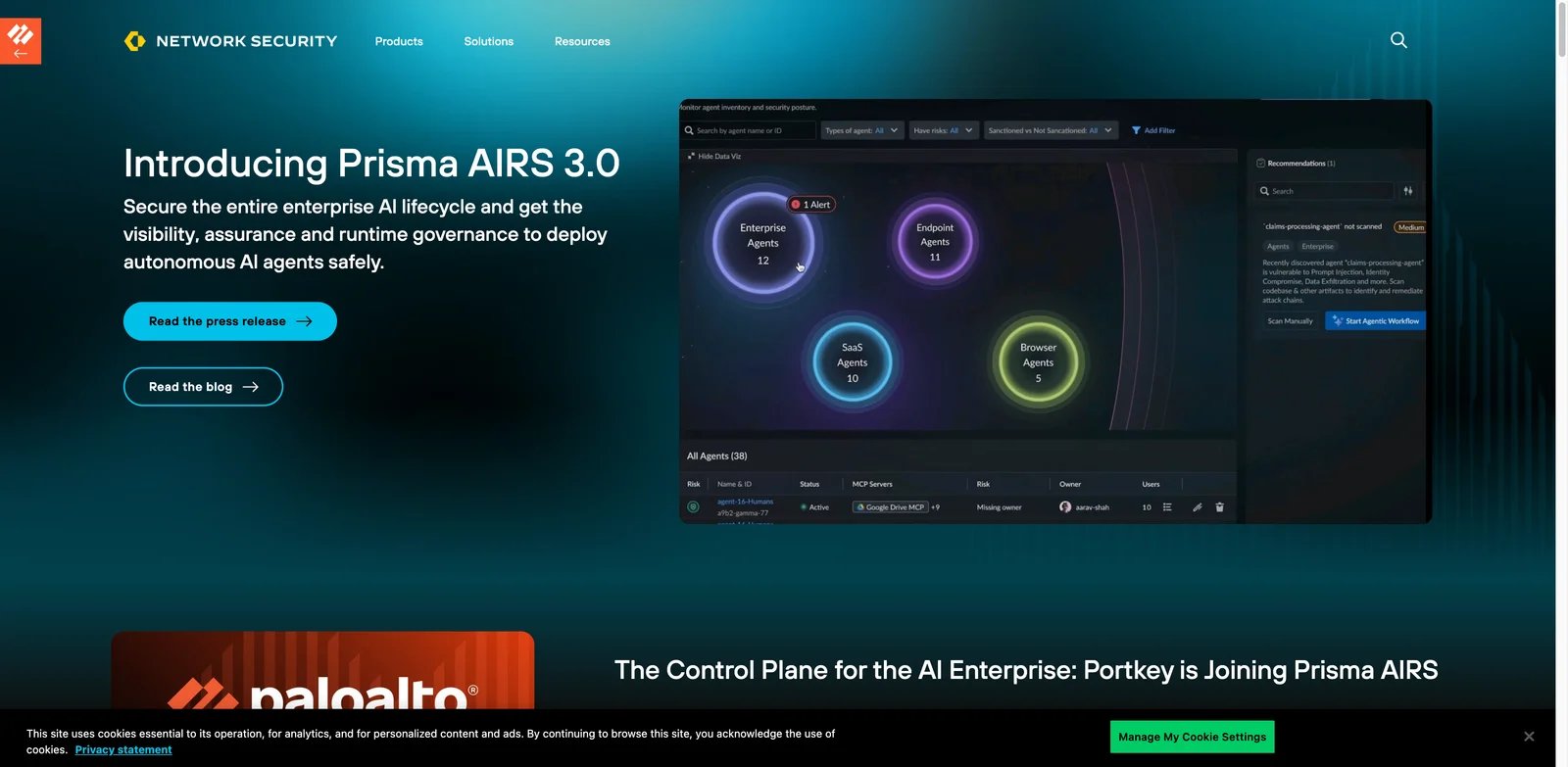
Large enterprises rarely have one AI risk. They have hundreds: sanctioned copilots, unsanctioned browser agents, internal RAG apps, external-facing LLM features, third-party models, developer endpoints, and data pipelines that no single team fully owns. Prisma AIRS is built for that full-lifecycle problem. Palo Alto positions it as a platform for AI agents, apps, models, and data from development to deployment, with capabilities for discovery, assessment, runtime enforcement, red teaming, model security, and AI posture management.
Key Features
- Full lifecycle coverage: Prisma AIRS covers discovery, AI red teaming, runtime security, model security, agent security, and AI posture management, which makes it one of the broadest platforms in this list.
- Agent-specific controls: The platform emphasizes agent identity verification, real-time policy enforcement, and visibility into how agents connect across enterprise systems.
- Enterprise integration gravity: Palo Alto buyers can align AI security with existing network, cloud, and security operations programs instead of adding another isolated tool.
Pricing & Plans
Pricing is not posted as a simple monthly plan. Palo Alto documentation and product materials point to enterprise licensing and Software NGFW credit-based purchasing for Prisma AIRS components. That can be efficient for existing Palo Alto customers, but it makes self-service cost comparison difficult. Budget for procurement, architecture work, policy design, and tuning.
Pros & Cons
Pros: Broad AI lifecycle coverage, agent-specific runtime controls, and strong Palo Alto enterprise integration.
Prisma AIRS is not the lightest first AI security tool. Smaller teams that only need prompt injection protection for one app will likely move faster with Lakera, Enkrypt AI, or Lasso. The platform's breadth also creates overlap with CNAPP, DLP, and governance investments already in place. Teams should map which AIRS modules they will actually use before signing a broad contract.
Best For
Enterprises that want one strategic AI security platform across agents, models, apps, and runtime controls. Not the right fit if you need a low-friction developer guardrail this week.
Get started with Palo Alto Networks Prisma AIRS
Cisco AI Defense
Security teams inside Cisco-heavy organizations often face two different AI adoption paths at once: employees using public AI tools and developers building AI applications. Cisco AI Defense addresses both. Its product messaging centers on discovering AI assets, identifying risks, validating models and AI applications, and mitigating threats in real time, including prompt injection, denial-of-service behavior, and data leakage.
Key Features
- Two-sided AI adoption model: Cisco explicitly separates "using AI" from "developing AI," which matches how enterprises actually roll out GenAI.
- AI asset discovery and validation: The product surfaces AI workloads, apps, models, data, and users across distributed environments, then assesses vulnerabilities and misconfigurations.
- Explorer Edition signal: Cisco has promoted an AI Defense Explorer Edition for AI red teaming, giving builders a lower-friction route to test before moving into enterprise packaging.
Pricing & Plans
Cisco does not publish a simple per-user or per-request price for AI Defense. Expect demo-led enterprise pricing, with packaging influenced by Cisco Security Cloud, Secure Access, and related Cisco security investments. The cost can make sense if your SOC and network teams already operate in Cisco, but buyers outside that ecosystem should compare integration cost carefully.
Pros & Cons
Pros: Strong Cisco Security Cloud fit, AI discovery and validation, and Explorer Edition entry path.
Cisco AI Defense is attractive as part of a Cisco security strategy, not as a neutral developer-first guardrail. Teams using a mix of cloud-native security, open-source MLOps, and non-Cisco networking may face more integration work. The product is also broad, so buyers should ask for exact coverage of MCP servers, custom agent frameworks, model registries, and non-Cisco telemetry during the proof of concept.
Best For
Enterprises with Cisco security architecture that need AI discovery, validation, and runtime protection across both employee AI use and AI app development. Not the right fit if your team wants a standalone LLM API firewall with public pricing.
Get started with Cisco AI Defense
Lakera Guard
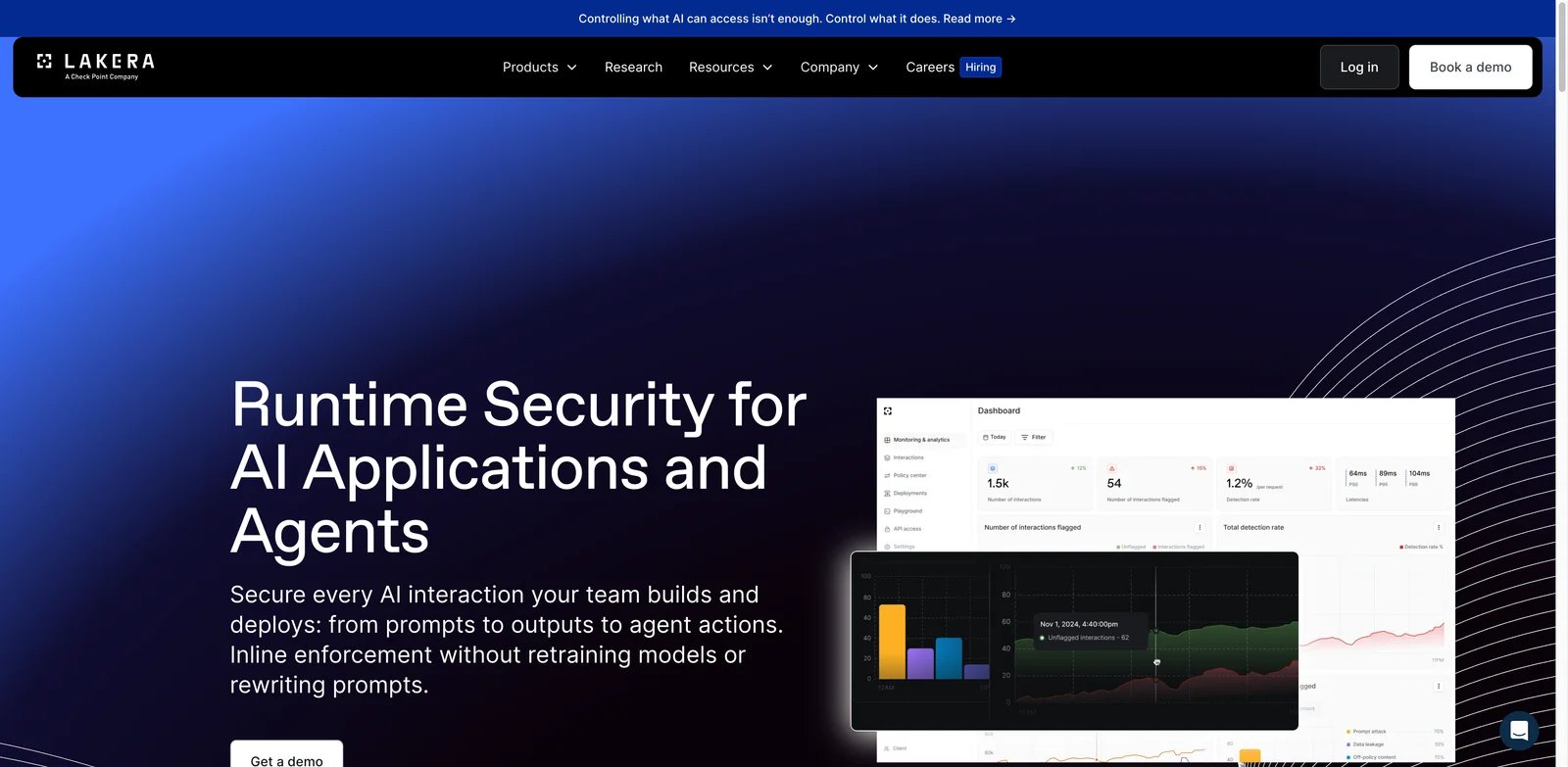
The fastest AI security incident is not a cloud misconfiguration. It is a prompt injection that turns a public-facing agent into a data leakage path. Lakera Guard is built for that runtime layer: inspect inputs, control outputs, and govern agent behavior before risky model or tool interactions cause damage. It is especially useful when engineering teams need a deployable guardrail rather than a months-long platform rollout.
Key Features
- Runtime prompt and response protection: Lakera Guard screens prompts and outputs for jailbreaks, adversarial inputs, sensitive data exposure, policy violations, and unsafe agent behavior.
- Agent and tool-call governance: Lakera's current product positioning includes intercepting and evaluating agent actions, not just filtering chat text.
- Developer-friendly entry point: The platform has docs, a playground, API access, and a public pricing page that lists a Community plan with included requests.
Pricing & Plans
Lakera's platform pricing page shows a Community plan with free access and a limited number of requests. Commercial plans are sales-led. The important cost driver is request volume: a high-traffic customer support bot can create a very different bill than an internal assistant with limited daily use. Ask for request tiers, overage rules, latency commitments, retention settings, and deployment options.
Pros & Cons
Pros: Developer-friendly runtime guardrails, API-first deployment, and prompt plus agent protection.
Lakera is a runtime guardrail, not a complete AI security program. It will not replace AI asset inventory, model supply chain scanning, broad compliance reporting, or cloud posture management. It is best paired with AI-SPM, data governance, or CNAPP tooling when the organization needs full-stack visibility.
Best For
Engineering and security teams that need practical LLM app and agent runtime protection quickly. Not the right fit if your first requirement is enterprise-wide AI asset discovery or EU AI Act governance reporting.
Get started with Lakera Guard
Protect AI
If your AI risk starts before inference, runtime guardrails alone are too late. Model weights, open-source dependencies, model registries, datasets, notebooks, and MLOps pipelines can all become attack surfaces. Protect AI, now part of Palo Alto Networks after the acquisition closed in July 2025, focuses on that MLSecOps layer. Its suite includes Guardian for model security, Recon for AI asset discovery, Layer for runtime security, and open-source security projects that appeal to AI engineering and AppSec teams.
Key Features
- Model and supply chain security depth: Protect AI is strong where many GenAI guardrail vendors are thin: model selection, model scanning, ML artifact integrity, and AI pipeline risk.
- Unified AI security suite: Guardian, Recon, and Layer create a path from discovery to model validation to runtime protection.
- Engineering credibility: Protect AI has invested in open-source AI security tooling, which helps teams evaluate parts of the approach before enterprise procurement.
Pricing & Plans
Protect AI is now part of Palo Alto Networks and remains demo-led publicly. Public pages emphasize demos rather than self-service pricing, so buyers should confirm whether procurement routes through Protect AI, Prisma AIRS, or a Palo Alto Networks contract. TCO depends heavily on how many model registries, deployment paths, and runtime apps you need to cover. Teams with mature MLOps will get more value than teams that only use hosted SaaS copilots.
Pros & Cons
Pros: Deep MLSecOps focus, model supply chain coverage, and credible engineering-oriented security tooling.
Protect AI is strongest for organizations building or operating AI systems. If your main problem is employees pasting sensitive information into public AI tools, Prompt Security, Microsoft Purview, Cisco, or Netskope-style controls may be a better first purchase. Also confirm how Guardian, Recon, and Layer are packaged together; broad coverage may require multiple modules.
Best For
AI engineering, MLOps, and AppSec teams that need to secure models and AI supply chains before production. Not the right fit if your AI risk is mostly employee SaaS usage.
Get started with Protect AI
HiddenLayer
Some AI security programs are not primarily worried about policy drift. They are worried about adversarial model attacks, poisoned artifacts, unsafe outputs, and runtime behavior that traditional security tools cannot interpret. HiddenLayer is a specialist platform for those AI-native attack surfaces. Its platform messaging covers AI discovery, AI supply chain security, AI attack simulation, and AI runtime security.
Key Features
- AI-native threat model: HiddenLayer is built around model and AI application threats rather than retrofitting generic security controls.
- Attack simulation plus runtime defense: The platform can help teams test weaknesses and then monitor production systems for adversarial behavior.
- CISO-friendly positioning: HiddenLayer's materials speak to security leaders that need visibility and control without forcing AI teams to slow every experiment.
Pricing & Plans
HiddenLayer is quote-based. Expect pricing to depend on the number of AI systems, models, runtime endpoints, and platform modules covered. Because it is a specialist vendor, buyers should compare whether the scope duplicates any AI-SPM or model scanning capability already coming from Prisma AIRS, Protect AI, Wiz, or another platform.
Pros & Cons
Pros: AI-native threat focus, attack simulation, and runtime defense for high-risk models and AI apps.
HiddenLayer is not a full cloud security platform or broad data governance suite. It goes deep on AI security threats, but your organization may still need separate tooling for SaaS AI usage, employee DLP, and regulatory governance. It is also more enterprise-oriented than self-serve, so smaller teams may need a vendor-led proof of concept.
Best For
Organizations with high-risk AI models or production AI apps where adversarial ML, runtime attack detection, and model supply chain defense matter. Not the right fit if your immediate need is a simple free-tier guardrail.
Get started with HiddenLayer
Noma Security
AI security gets expensive when every risk requires a separate vendor: one for asset discovery, one for red teaming, one for runtime guardrails, one for agent controls, and one for compliance reporting. Noma Security is trying to consolidate that stack. Its platform focuses on AI-SPM, AI app and agent testing, runtime protection, agentic access control, MCP server risk, governance, and AI supply chain exposure.
Key Features
- AI-SPM plus runtime scope: Noma covers posture management and runtime defense, which helps teams avoid a posture-only program that cannot stop live attacks.
- Agent and MCP visibility: Recent Noma materials emphasize agent access control and MCP risk, which is increasingly important for autonomous workflows.
- Governance alignment: The platform references frameworks such as OWASP Top 10, MITRE ATLAS, and emerging AI regulations, which helps security teams communicate with compliance stakeholders.
Pricing & Plans
Noma uses sales-led enterprise pricing. Since it bundles several AI security layers, buyers should ask whether modules are priced separately and what telemetry integrations are required. Budget for integration with cloud environments, model registries, developer systems, and runtime pathways.
Pros & Cons
Pros: Consolidated AI-SPM, agent security, runtime controls, and governance-oriented reporting.
The tradeoff of consolidation is depth. A specialist such as Lakera may be easier for pure runtime guardrails, Protect AI may be deeper on model supply chain, and Microsoft Purview may be better for Microsoft data security. Noma is strongest when you need an integrated AI security control plane rather than the deepest point solution in one niche.
Best For
Security teams that want AI-SPM, agent security, runtime controls, and governance in one AI-native platform. Not the right fit if you already have mature posture tooling and only need one lightweight LLM filter.
Get started with Noma Security
Lasso Security
Agentic AI changes the risk model because a prompt no longer just produces text. It can trigger tool calls, API actions, data access, and multi-step workflows. Lasso Security is positioned around that agentic era: connecting discovery, AI risk management, automated red teaming, and runtime protection in a continuous loop.
Key Features
- Runtime speed claims: Lasso publicly emphasizes low-latency classification, including sub-50 ms per classification messaging and high accuracy claims across content, context, and intent detections.
- Continuous loop model: Discovery, risk assessment, red teaming, and runtime protection are designed to feed each other rather than operate as disconnected checks.
- Agent-focused posture: Lasso's product narrative is not just LLM prompt filtering; it is about keeping agentic applications inside intended scope.
Pricing & Plans
Lasso pricing is not publicly listed in a self-serve plan. It is demo-led. During evaluation, ask for latency benchmarks under your expected traffic volume, request-based pricing assumptions, self-hosting or data residency options, and how the platform handles custom policies for different teams.
Pros & Cons
Pros: Agentic AI focus, low-latency runtime positioning, and continuous discovery-to-enforcement workflow.
Lasso is a focused AI security vendor. That is an advantage for runtime and agentic use cases, but it may mean another dashboard, another policy language, and another integration point for the SOC. Buyers should also validate performance claims in their own environment, because classification latency depends on traffic shape, deployment architecture, and policy complexity.
Best For
Teams building production agents that need discovery, red teaming, and runtime enforcement around agent actions. Not the right fit if your risk is mostly Microsoft 365 data leakage or broad cloud posture.
Get started with Lasso Security
Prompt Security
Many AI security programs start with a simple question: what are employees actually sending to AI tools? Prompt Security is built around that real adoption problem. It covers employee AI usage, homegrown AI applications, AI code assistants, agentic AI, and red teaming. That makes it useful for organizations where AI risk spans both workforce behavior and product engineering.
Key Features
- Employee and app coverage: Prompt Security is one of the clearer platforms for governing employee GenAI use while also protecting homegrown LLM apps.
- Deployment flexibility: The company describes SaaS and self-hosted delivery, which matters for enterprises with sensitive prompts, regulated data, or residency requirements.
- Agentic AI and MCP awareness: Prompt Security has continued to publish around AI agents, MCP, and AI startup mapping, showing category focus beyond early prompt filters.
Pricing & Plans
Prompt Security is demo-led on its own website, but AWS Marketplace lists public 12-month contract dimensions: Prompt Security for Employees at $200 per employee, AI Code Assistants at $300 per developer, Homegrown Apps at $10 per 1K API calls annually, Self-hosted AI Code Assistants at $230 per developer, Self-hosted Employees at $345 per employee, and Self-hosted Homegrown Apps at $11.50 per 1K API calls annually. The company was acquired by SentinelOne in 2025, so buyers should confirm current packaging, contract owner, roadmap, and whether capabilities are being integrated into SentinelOne's broader Singularity platform. That may be a benefit for SentinelOne customers and a planning variable for everyone else.
Pros & Cons
Pros: Strong coverage across employee GenAI usage, homegrown apps, code assistants, and agentic AI.
Acquisition can create uncertainty around branding, roadmap, support model, and packaging. Prompt Security is also broad across employee usage, apps, code assistants, and agents, so teams should validate the exact workflows they need rather than assume every module is equally mature. For pure model supply chain scanning, Protect AI or HiddenLayer may be stronger.
Best For
Organizations rolling out GenAI across employees, developers, and homegrown apps that need visibility, policy, and runtime controls. Not the right fit if you need deep MLOps artifact security as the core use case.
Get started with Prompt Security
Enkrypt AI
AI teams often need a control layer that speaks both engineering and compliance: block risky behavior, test agents before launch, enforce policy, and produce evidence for governance reviews. Enkrypt AI positions itself around agentic security and compliance, with agent guardrails, agent red teaming, an agent policy engine, data risk auditing, MCP gateway and scanner capabilities, and security workflows for customer-facing agents.
Key Features
- Agent-first product set: Enkrypt AI's menu is unusually aligned with current agent risk: guardrails, red teaming, policy engine, MCP gateway, MCP scanner, and data risk audits.
- Compliance evidence workflow: The platform explicitly connects security controls to evidence, which helps when AI risk owners need to report to governance, legal, or customer security teams.
- Education and adoption signals: Enkrypt AI promotes an academy and self-paced materials, useful for teams building internal literacy around AI security.
Pricing & Plans
Enkrypt AI publishes plan pricing. Explore is free forever with 500 credits to start and 50 credits/month. Launch is $149/month monthly or $134/month billed annually with 250 credits/month. Scale is $1,499/month monthly or $1,349/month billed annually with 1,000 credits/month. Enterprise is custom and aimed at regulated or 500+ employee organizations that need VPC or on-prem deployment.
Pros & Cons
Pros: Public entry pricing, agent-first controls, red teaming, policy enforcement, and compliance evidence workflows.
The platform is evolving quickly, and buyers should validate which agent, MCP, and data-risk capabilities are generally available versus roadmap or demo-led. Enkrypt AI also overlaps with Lakera and Lasso for runtime controls and with Noma for agent governance, so the proof of concept should use your real agent workflows rather than generic prompts.
Best For
Teams building agents that need guardrails, red teaming, policy enforcement, and compliance evidence in one workflow. Not the right fit if you need a mature Microsoft-native data security portal.
Get started with Enkrypt AI
Microsoft Purview Data Security Posture Management
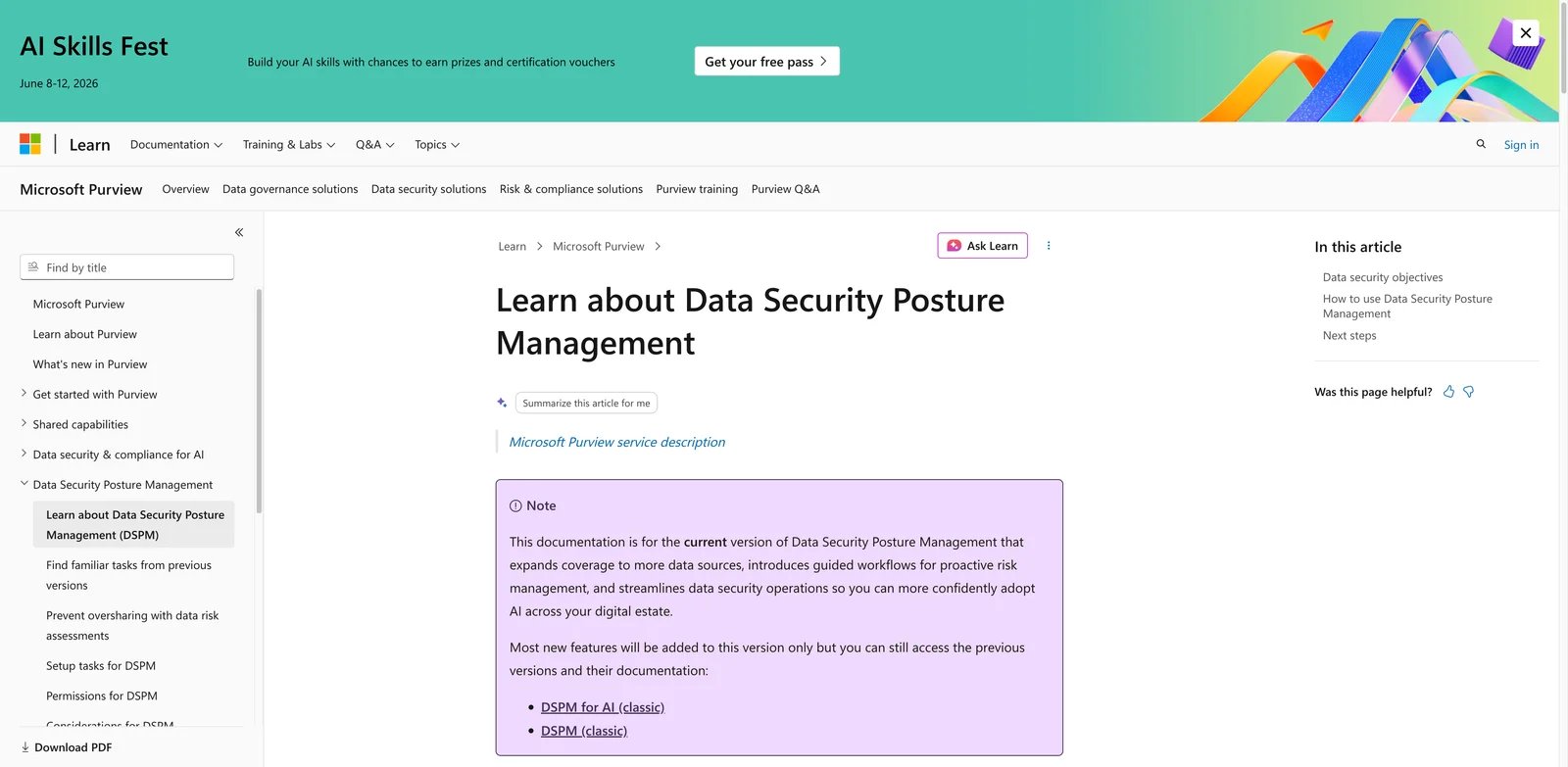
For Microsoft-heavy enterprises, AI security often starts as a data security question: which users are sharing sensitive information with Copilot, Microsoft agents, ChatGPT, Gemini, or custom agents? Microsoft's current Purview Data Security Posture Management experience replaces the older DSPM for AI classic experience and gives data security and compliance teams a central place to monitor AI apps and agents, identify risky interactions, and apply controls across Copilots, agents, and third-party GenAI apps.
Key Features
- Microsoft data security integration: Microsoft Purview Data Security Posture Management sits inside the Microsoft Purview portal, which helps teams already using sensitivity labels, DLP, audit logs, and Microsoft 365 compliance workflows.
- Copilot and third-party app visibility: The product is designed for Microsoft AI and other GenAI apps, making it relevant beyond just Microsoft 365 Copilot.
- Governance bridge: It connects AI adoption to data security posture, which is often the most urgent board-level AI risk.
Pricing & Plans
Microsoft Purview pricing depends on licensing and consumption models. Microsoft also documents pay-as-you-go billing for some Purview capabilities, and DSPM for AI may require specific tenant, license, or Azure subscription prerequisites. Buyers should not treat it as a standalone $20/month tool; it is part of the Microsoft security and compliance ecosystem.
Pros & Cons
Pros: Strong Microsoft 365 fit, data security posture reporting, and Copilot plus third-party GenAI visibility.
Purview DSPM for AI is not an LLM firewall or model supply chain scanner. It will not replace Lakera, HiddenLayer, Protect AI, or Lasso for runtime attack protection inside a custom AI app. It is strongest for data security posture and compliance workflows around AI usage, especially in Microsoft environments.
Best For
Microsoft 365 and Purview customers that need AI data security posture, Copilot monitoring, and sensitive data controls. Not the right fit if your primary risk is prompt injection in a public-facing agent.
Get started with Microsoft Purview Data Security Posture Management
Best AI Security Tools by Use Case
For Enterprises Standardizing on a Strategic AI Security Platform
If your organization wants a single program-level control plane, start with Palo Alto Networks Prisma AIRS, Cisco AI Defense, or Noma Security. Prisma AIRS has the broadest lifecycle positioning across agents, apps, models, posture, red teaming, and runtime controls. Cisco AI Defense fits organizations already committed to Cisco security architecture. Noma is the more AI-native consolidation play for teams that want AI-SPM, agent security, red teaming, and runtime coverage without buying several point tools.
For Production LLM Apps and AI Agents
If a public or internal LLM app is already live, prioritize runtime enforcement. Lakera Guard is the fastest starting point for prompt injection, output control, and agent action governance. Lasso Security is a strong fit for agentic workflows where intent, tool calls, and low-latency classification matter. Enkrypt AI is worth evaluating when the same workflow needs guardrails, red teaming, policy enforcement, and compliance evidence.
For Model Supply Chain and MLSecOps
If your team trains, fine-tunes, scans, or deploys models, choose tools that understand model artifacts and ML pipelines. Protect AI is the clearest fit for model security, AI supply chain, and MLSecOps workflows. HiddenLayer is the stronger specialist when adversarial ML, model runtime behavior, and AI-native threat defense are the top concerns. Prisma AIRS can also cover this layer if you want a broader platform.
For Employee GenAI Usage and Data Leakage
If your first risk is workforce adoption, start with Prompt Security, Microsoft Purview Data Security Posture Management, or Cisco AI Defense. Prompt Security covers employee GenAI usage plus homegrown apps and code assistants. Microsoft Purview fits Microsoft 365, Copilot, DLP, and data security posture teams. Cisco is best when AI employee access and AI app development need to sit inside a broader Cisco security program.
For AI Governance Teams That Need Security Evidence
Governance teams should not buy pure policy software and assume security is covered. Pair governance workflows with technical evidence. Enkrypt AI is strong when guardrails and compliance evidence need to live together. Microsoft Purview helps data governance teams connect AI usage to sensitive data controls. If the program includes regulatory reporting across models, apps, and agents, compare these tools with our AI data governance tools and MCP security guidance.
How to Choose the Right AI Security Tools
1. Map the risk before comparing vendors. Count the AI assets you need to protect: employee AI tools, copilots, model endpoints, agents, MCP servers, datasets, model registries, and public-facing LLM apps. A runtime guardrail cannot discover shadow AI across the company; an AI-SPM platform cannot always block a prompt injection in real time.
2. Decide whether posture or runtime is the first gap. Posture tools show what exists, how it is configured, and where risk is concentrated. Runtime tools inspect and enforce behavior during prompts, outputs, model calls, and agent actions. Mature programs eventually need both, but the first purchase should match the incident you are most likely to have in the next quarter.
3. Validate deployment path with engineers, not only security leadership. API guardrails, gateways, browser controls, cloud connectors, and Microsoft portal reports all create different operational burdens. Ask the team that will implement the tool how it fits CI/CD, model routing, logging, privacy, latency, and incident response.
4. Treat quote-only pricing as a risk to manage. Most AI security tools are enterprise-priced. Ask for year-one and year-three cost projections, request-volume assumptions, module packaging, support level, data retention costs, and professional services requirements. For runtime tools, traffic growth can change economics quickly.
5. Avoid buying the same control twice. CNAPP vendors, DLP vendors, AI security startups, cloud providers, and governance platforms are all racing into AI security. Before signing a new platform, document what your current Microsoft, Cisco, Palo Alto, cloud, SIEM, DLP, and AppSec tools already cover.
6. Include agents and MCP in the proof of concept. A 2024-era LLM security test that only checks prompt injection is no longer enough. If your roadmap includes agents, test tool-call governance, MCP server discovery, agent identity, least privilege, and kill-switch workflows. Our MCP vs A2A comparison can help teams frame those protocol-level decisions.
Frequently Asked Questions
What are AI security tools?
What is the difference between AI security and AI governance?
Do AI security tools stop prompt injection?
Are AI-SPM tools enough for AI security?
Which AI security tool is best for Microsoft 365 and Copilot?
How much do AI security tools cost?
What should I test in an AI security proof of concept?
Get ToolWorthy Weekly
New AI tools, practical guides, and selected AI signals in one weekly brief.
Built an AI security tool we missed?
We review these roundups regularly. If your AI security tool belongs here, submit it for editorial review and reach buyers already searching for it.
Listings start at $49 — live in 24 hours, permanent placement, full refund if we don't approve yours.