
10 Best HeyGen Alternatives 2026 — After the Avatar IV Credit Confusion

In Q1 2026 HeyGen went big on Avatar IV, Video Agent, LiveAvatar, and a Premium Credits layer that runs on top of plan tiers. HeyGen's own Help Center clarifies the credit boundary: Avatar IV always requires Premium Credits, and even on Enterprise it's never unlimited. Six weeks after the Q1 launches, the r/AI_UGC_Marketing thread on April 11 reframed the gap differently: "Pricing page screams unlimited. Inside, though, everything turns into credits, hidden limits, and edge cases." Two days earlier the same subreddit posted "stop shipping new features and just make the damn product work." Later in April a verified r/heygen post asked the question many teams ask during avatar trials: "Is anyone actually getting 'hyper-realistic' avatars in HeyGen… or am I losing my mind?" If you're shopping for a HeyGen alternative right now, you're probably reacting to one of those signals — credits that don't behave like "unlimited," renders that fail and still bill, or a Studio that keeps changing under you.
Below are 10 alternatives, each verified against its April 2026 pricing page. Three are enterprise-training replacements with clearer budgeting models, but not all are per-seat-only: Synthesia uses credits and minutes, Colossyan is minutes-based, and AI Studios combines plan limits with generative credits. Three lean cheaper for marketing tests and short avatar videos (Vidnoz, D-ID, Hedra). Tavus is API-first for conversational digital twins; D-ID is the other clearer developer/API option; Akool is better framed as face-swap and personalized marketing creative with API access on higher tiers. One is a UGC-ad specialist (Creatify), one a minutes-clean training pick (Elai). The Honorable Mentions cover the "I don't actually need an avatar" exit. For the broader AI avatar generator landscape, our best AI avatar generator roundup goes deeper.
| Tool | Best For |
|---|---|
| Synthesia | Enterprise training videos with predictable per-seat pricing |
| Colossyan | Scenario-based workplace learning with role-played avatars |
| AI Studios | Long-form presenter videos with multilingual SEO output |
| Vidnoz | Cheapest entry point for template-heavy avatar marketing |
| Tavus | API-first digital twins for conversational video agents |
| D-ID | Programmatic Studio API for portrait videos |
| Elai | Minutes-based plan with no credit math for training teams |
| Creatify | UGC-style AI ad variants for performance marketers |
| Akool | Face-swap and personalized marketing campaign avatars |
| Hedra | Expressive photo-to-talking-head experiments |
Why People Are Leaving HeyGen in 2026
HeyGen at the end of 2024 was one of the best-known consumer-facing names in AI avatar video — fast renders, generous Creator plan, recognizable Studio UX. The HeyGen of late April 2026 ships more features but the migration discussion across r/heygen, r/AI_UGC_Marketing, Trustpilot, and G2 has crystallized around seven specific complaints. Six of them are fresh, surfacing only in the last twelve weeks as Avatar IV, LiveAvatar, and the premium-credit framing rolled out.
1. "Unlimited" stops being unlimited at the credit ceiling. This is the fresh-news pain that defines 2026 HeyGen. HeyGen's standard generation may be marketed broadly, but Avatar IV, Video Agent, video translation with lip sync, and other premium features consume Premium Credits; Avatar IV has no unlimited plan, including on Enterprise. "Pricing page screams unlimited. Inside, though, everything turns into credits, hidden limits, and edge cases," a user wrote in an r/AI_UGC_Marketing post on April 11 2026. The same complaint surfaced earlier — "I bought membership as it stated 'unlimited video generation', now it says I need more credits" (r/heygen, February 2026) — and was named directly in the January 29 r/heygen "HeyGen misleading" thread. For freelancers and SMBs who picked HeyGen specifically because the marketing said unlimited, the gap between page and product is the breaking point.
2. Cost scales faster than your video volume. Layered on top of credit confusion is just plain cost arithmetic. "Buying credits would cost well over $500/mo for the type of videos I was doing," wrote one user (r/heygen, January 2026). G2 reviews echo it: "The pricing may be a bit high, especially for users who need long-form or frequent videos" (G2, January 2026). The forum quote that gets reposted in every migration thread: "Yes $5 a minute. You better paying Will Smith to do your Avatar videos" (r/heygen, August 2025). For agencies and content marketers running anything beyond a few clips a week, HeyGen stops being competitive on raw price.
3. Failed or stuck renders create support disputes, but HeyGen says failed jobs should not bill Premium Credits. Same April cycle, a user complaint on r/AI_UGC_Marketing made a user-reported complaint about failed or unusable jobs consuming credits; however, HeyGen's own processing help says cancelled or failed videos should not consume Premium Credits or priority quota. Frame this as a support-dispute risk, not confirmed platform policy. For developers iterating on prompts, the gap between vendor policy and user experience turns experimentation into a budget-and-time risk you have to verify on your own account.
4. Studio reliability breaks client deliverables. Throughout Q1 2026, the r/heygen complaint cycle was about render time and queue stability. "11 second video... it has been 3 hours and it still hasn't generated," one user reported in an r/heygen post on January 20 2026. The August 2025 thread "HeyGen Studio has become unusable" is still surfacing in 2026 search results: "Generations sit at 97% for 30-60+ minutes... animations and timings get lost." For agencies billing clients on weekly delivery cycles, "the tool ate my work" isn't a story you can tell twice.
5. Frequent UI churn breaks the workflow you learned. "Changing the product all the time just alienates the users" — r/heygen, February 2026 — captures the meta-complaint. "Every update kind of makes the product a bit worse than before" ran a follow-up in the same subreddit. G2 reviewers add: "New interfaces, shifted buttons, redesigned workflows, and updated logic require time to relearn" (G2, January 2026). Each Avatar IV / LiveAvatar / Studio update has shifted button placement, renamed features, or moved settings — and every relearn costs another weekend the team didn't budget for.
6. The "hyperrealistic" avatars still feel beta-grade. This is the marketing-vs-product gap that a late-April r/heygen post named directly: "Is anyone actually getting 'hyper-realistic' avatars in HeyGen… or am I losing my mind?" — "After weeks... every render has had issues: glitches, unnatural expressions, bad lip-sync." Earlier reviews on the same theme: "The lip sync was way off, the expressions looked unnatural, and the voice rarely matched" (r/heygen, July 2025); "Avatars sometimes still look unnatural, and the customization options feel limited" (G2, March 2026). Avatar IV's marketing implies a step-change; the day-to-day experience hasn't fully delivered it.
7. Support and refund handling shake the trust. When the product breaks, the question becomes "can I get my money back" — and the answer has been disappointing enough to surface as its own painpoint. "I asked to cancel and get a refund. They refused, ghosted me," went a widely-shared r/generativeAI post on March 28 2026. "In five days we cannot get a single normal response" (r/heygen, February 2026). Trustpilot reviewers echo the billing dimension: "My card was hit with bigger amounts than I agreed to and no clear breakdown" (Trustpilot, April 2026). For teams paying Pro-tier prices, support that doesn't respond is a procurement disqualifier.
These seven pain points map directly to the alternatives below. The selection isn't "best AI avatar tool" — it's tools that specifically solve at least one of the seven, scored by how well they solve it without introducing new problems.
Top 10 HeyGen Alternatives Compared
| Tool | Pricing Shape | Predictable Cost? | Output Form | Migration Effort | Score |
|---|---|---|---|---|---|
| HeyGen (anchor) | Free / Creator $29 / Pro $99 / Business or Enterprise; Premium Credits add-ons for Avatar IV, Video Agent, translation, and other premium features | 🔴 Standard usage + Premium Credits; Avatar IV is never unlimited | All-in-one studio + API | — | — |
| Synthesia | Free / Starter $29 monthly ($18 annual) / Creator $89 monthly ($64 annual) / Enterprise; includes credits and video-minute limits | 🟡 Clearer tiers, but credits/minutes still apply | Studio + LMS + SCORM | 🟢 Low | 8.6 |
| Colossyan | From $19/mo annual for 120 min/year; Business includes unlimited minutes; custom avatars add-on | 🟢 Minutes-based | Workplace learning studio | 🟢 Low | 8.5 |
| AI Studios | Free / Personal $24 / Team $55 / Enterprise; unlimited video count but length, dubbing, and generative credits apply | 🟡 Plan limits + generative credits | Presenter + multilingual | 🟡 Medium | 8.4 |
| Tavus | Free / Starter $59 + PAYG / Growth $397 + PAYG / Enterprise | 🟡 Subscription + PAYG | API-first digital twin | 🔴 High (API) | 8.3 |
| D-ID | Studio Trial / Lite $4.70 / Pro $16 / Advanced $108; API pricing separate | 🟡 Plan vs API split | Studio + API | 🟡 Medium | 8.2 |
| Elai | Free 1 min / Creator $29 monthly or $23 annual with 15 min/mo | 🟢 Minutes-based | Studio + slides import | 🟢 Low | 8.1 |
| Creatify | Free 10 credits / Starter / Pro / Enterprise credit buckets | 🟡 Credit buckets | Ad-variant studio | 🟢 Low (UGC niche) | 8.0 |
| Akool | Free / Pro $30 ($18 annual) / Pro Max $59 ($35.40 annual) / Business $249 ($149.40 annual) / Enterprise | 🟡 Credit-based; commercial license appears Business+ | UGC + face-swap studio | 🟡 Medium | 8.0 |
| Hedra | Free limited plan / Basic $15 / Creator $30 / Professional or Teams $75; no credit rollover | 🟡 Credit-based | Photo-to-talking-head | 🟢 Low | 8.0 |
| Vidnoz | Free / from $14.99/mo; credits do not roll over | 🟡 Credits no rollover | Template avatar studio | 🟢 Low | 7.9 |
| Runway (HM) | Free 125 credits / Standard $12 annual ($15 monthly) / Pro $28 annual ($35 monthly) | 🟡 Credit-based | Generative video (no avatar) | 🟡 Medium | — |
| Pika (HM) | Basic 80 credits / Standard $8 / Pro $28 / Fancy $76 | 🟡 Credit-based | Image-to-video | 🟢 Low | — |
| Descript (HM) | Free / Hobbyist $16 annual ($24 monthly) / Creator $24 annual ($35 monthly) / Business $50 annual ($65 monthly) | 🟢 Plan-tiered | Voice + video editor | 🟡 Medium | — |
| Captions (HM) | Free / Pro $9.99 / Max $24.99 / Scale $69.99 | 🟡 Credit-tiered | Short-form social | 🟢 Low | — |
| InVideo AI (HM) | Plus $17 / Max $85 / Generative $170 on annual billing | 🟡 Credit varies by model | Prompt-to-video editor | 🟡 Medium | — |
Detailed Reviews
The 10 tools below are direct HeyGen-replacement candidates, ordered by overall fit and archetype variety so each review feels distinct. Five additional adjacent tools — generative video without avatars, voice-and-video editors — appear in Honorable Mentions. Both groups belong here because each solves a HeyGen switching scenario the others don't.
Synthesia
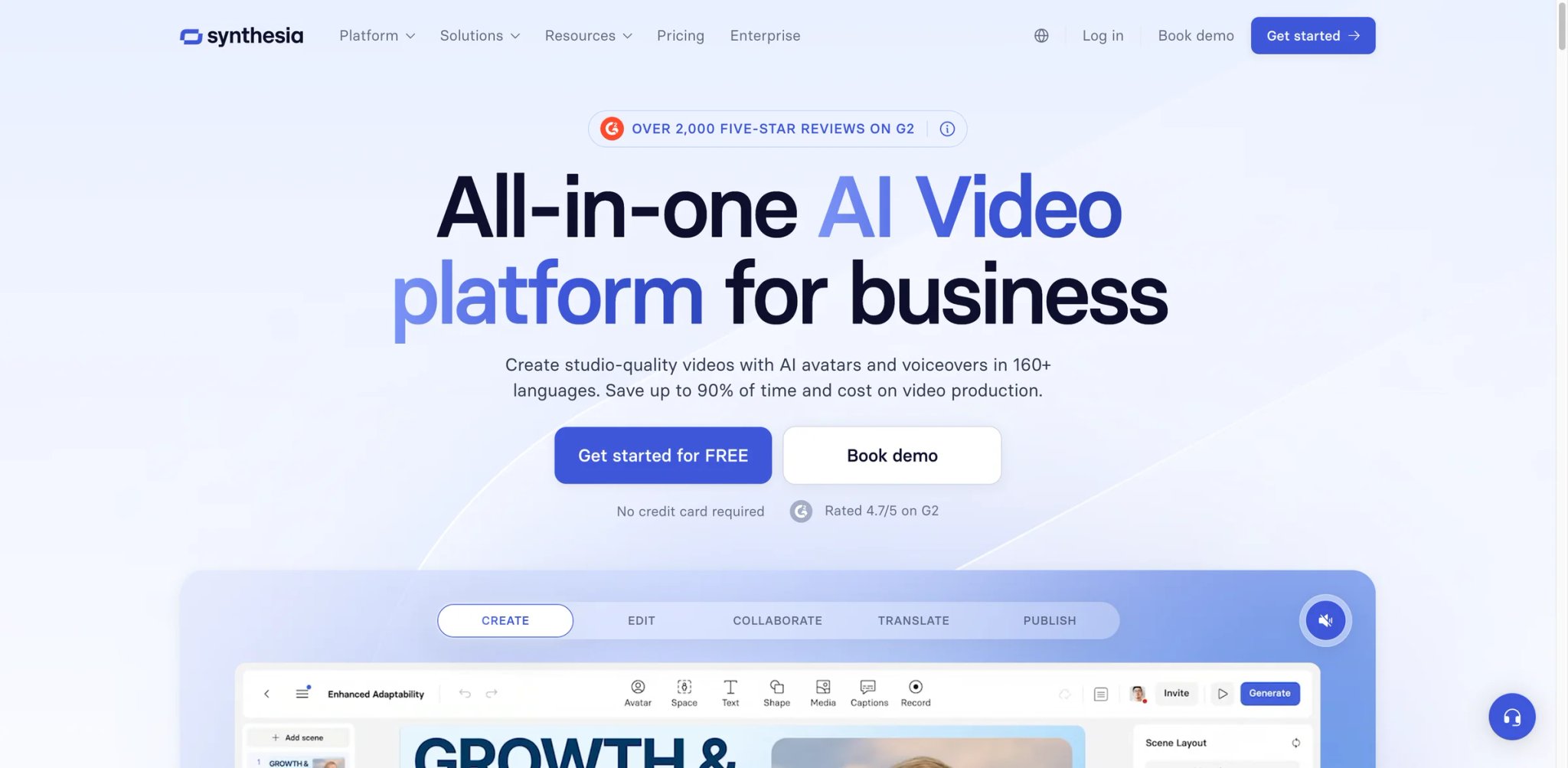
If your migration is driven primarily by "I'm tired of explaining to finance why our AI video bill swings $200 month-over-month," Synthesia is the immediate landing pad. Where HeyGen layers Premium Credits on top of plan tiers, Synthesia uses clearer Starter, Creator, and Enterprise tiers but still has shared AI credits and video-minute limits. Budget by editors, guests, included credits/minutes, and add-ons — not by a flat "seats × plan price" formula. The product stack is also more enterprise-shaped — SCORM export for LMS integration, governance and review workflows, audit logs, SSO at the right tier — which is exactly what L&D and compliance teams need and HeyGen's "unlimited" framing doesn't deliver.
What Synthesia solves vs HeyGen:
- Clearer tiered pricing, not credit-free pricing — Starter is $29/mo ($18/mo annual) and Creator is $89/mo ($64/mo annual), but both include shared AI credits and video-minute limits; Enterprise is quote-based (solves Pain #1, #2)
- Production-grade reliability for delivery work — render queue and Studio uptime are designed around enterprise SLAs rather than "ship fast and break Q2" (solves Pain #4)
- SCORM and LMS integration — export training videos directly into Cornerstone, Workday Learning, Docebo, and most enterprise LMS systems; HeyGen has limited equivalents
- Large enterprise avatar and language library — Synthesia lists 240+ AI avatars on Enterprise and 160+ languages; Starter and Creator include smaller avatar libraries
Pricing vs HeyGen: Governance math — Creator is $89/mo monthly or $64/mo on annual billing for 1 editor and 5 guests, with 3,600 credits/month or 44,000 credits/year; budget extra editors, usage, and add-ons separately. Compared to HeyGen Pro plan plus Premium Credits plus add-ons (which can run $500-$1,000+ for a team depending on Avatar IV / Video Agent / translation use), Synthesia's tier structure is more forecast-friendly. Studio-first; no Anthropic-style API tier.
Real limitations: Synthesia can be unfriendly to solo creators or small marketing teams under 3 people — at that scale HeyGen Creator at $29/mo can still be cheaper if you stay inside its plan and Premium Credit limits. Avatar visual style skews "professional and slightly safe" — if you need expressive UGC-style ads, Creatify and Hedra are better fits. SCORM export is great for L&D but irrelevant if you're not doing LMS-distributed training.
Best for: Mid-to-large enterprise L&D, compliance training teams, and any organization where the procurement team will ask for a 12-month forecast of AI video spend. Not the right fit if you're a solo creator on a $30 budget (try Vidnoz) or you specifically need short-form UGC ads (try Creatify). For deeper coverage of features and tier trade-offs, see our full Synthesia review.
Get started with Synthesia
Colossyan
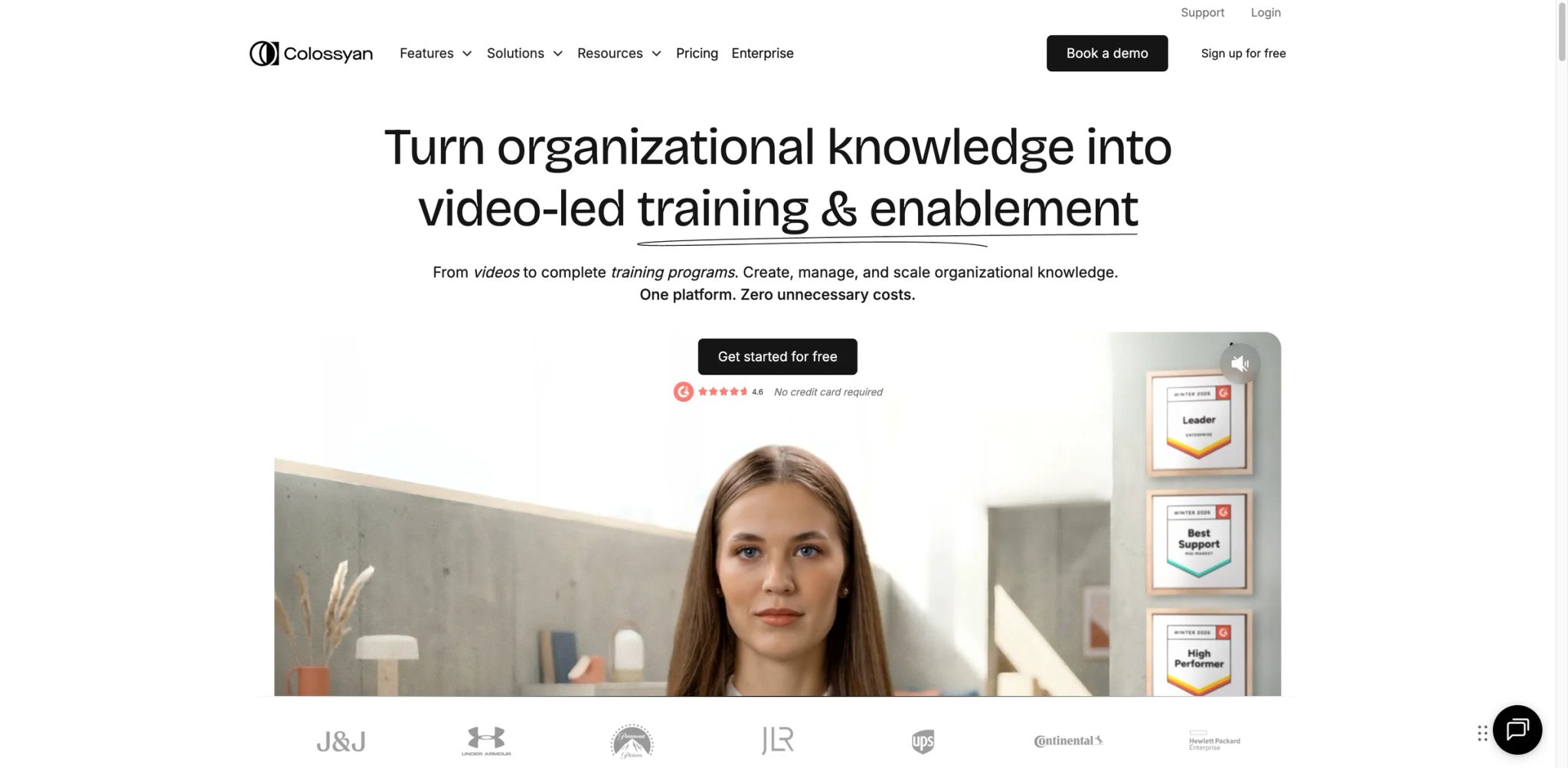
Colossyan was built for one specific use case — workplace learning — and that focus shows up in features HeyGen never prioritized. Multi-avatar scenarios where two characters dialogue in sequence (think: a manager and a direct report in a difficult feedback conversation), branching scenarios with quiz integration, SCORM export, and a Studio that's been running stable for HR teams at Hubspot, EY, and the WHO since 2021. For L&D leaders who picked HeyGen because it was the best-known name and have since regretted it for compliance training, Colossyan is the focused-tool answer.
What Colossyan solves vs HeyGen:
- Scenario-based learning structure — multi-avatar role-plays, branching narratives, quiz integration are first-class features, not template hacks
- Workplace-learning credentials — used by enterprise L&D teams at name-recognition organizations; the case studies survive procurement review
- Stable Studio for delivery work — Colossyan's minutes-based plan and Business unlimited minutes simplify budgeting versus HeyGen's Premium Credit model (solves Pain #4); verify failure and refund handling with support before assuming free iteration
- SCORM export and LMS integration — directly into Cornerstone, Docebo, Workday Learning
Pricing vs HeyGen: Free trial available; paid plans start at $19/mo for 120 minutes per year on the annual plan; Business tier includes unlimited minutes; custom avatar add-on $1,000/year. Compared to HeyGen Creator at $29/mo, Colossyan's $19/mo annual entry tier can be cheaper for low-volume training teams. The custom-avatar add-on is the place to budget carefully — it's where Colossyan's pricing matches HeyGen's pro-tier reality.
Real limitations: The 120 minutes/year cap on the entry tier is genuinely tight if you're producing weekly videos — most serious users are on Business at higher cost. Visual templates skew corporate and slightly conservative; if you need playful or UGC-style aesthetics, Hedra or Creatify handle it better. Custom avatar setup involves a real workflow (recording sessions, training time) — it's not the 5-minute clone HeyGen markets.
Best for: HR, compliance, customer-support, and onboarding training teams who need scenario-based workplace learning videos. Not the right fit if you're a solo creator (use Hedra or Vidnoz) or you need API-first generation (use Tavus).
Get started with Colossyan
AI Studios
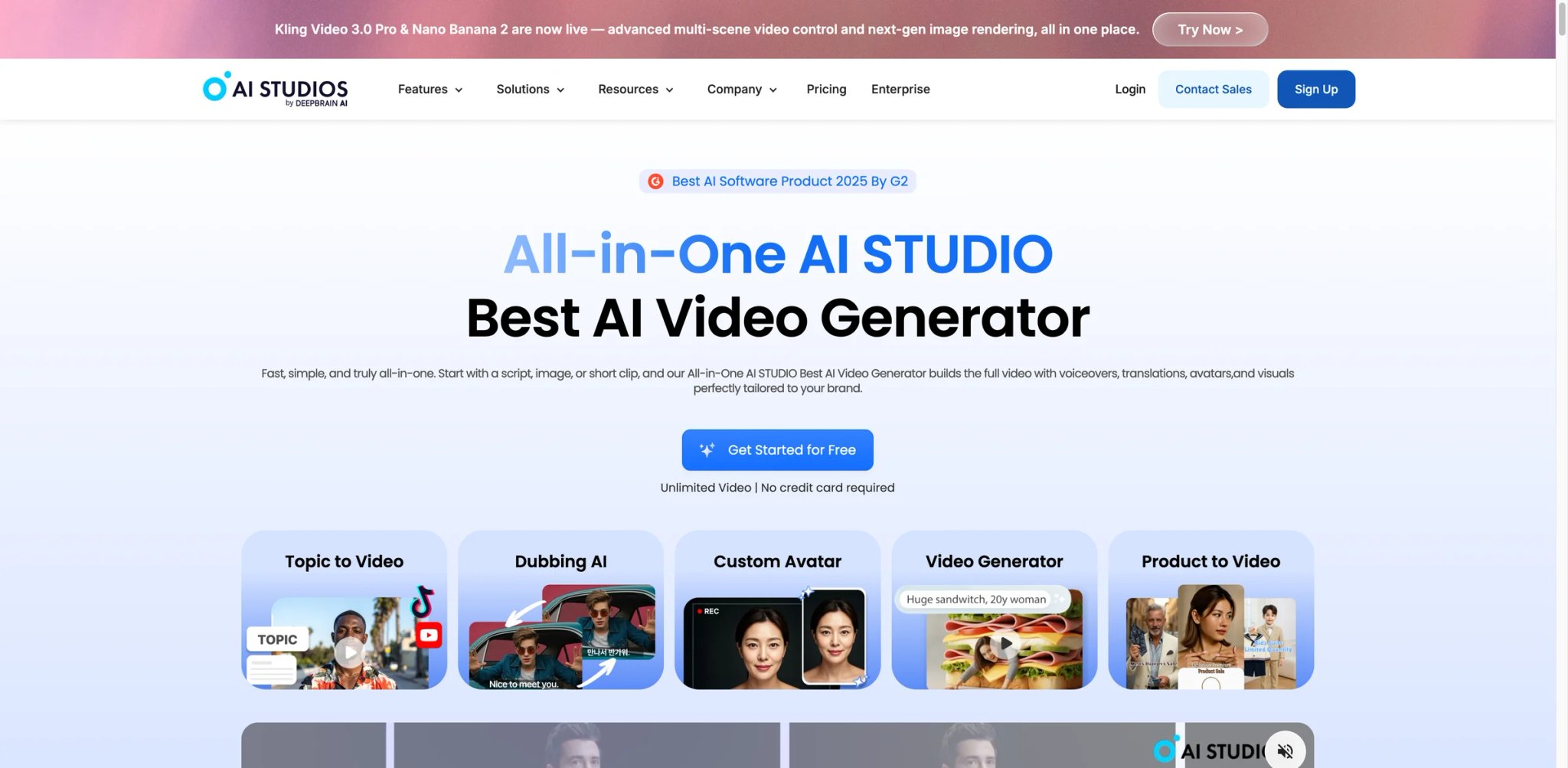
Built by DeepBrain AI, AI Studios is the longest-running serious player in this category — they've been in production with broadcasters and enterprise communications teams since before "AI avatar" was a marketing category. The differentiator that matters now: 2,000+ AI avatars, 150+ languages and accents, AI dubbing, image and video generation, and an article-to-video pipeline that turns blog posts into presenter videos for SEO content marketing teams. Where HeyGen is consumer-shaped, AI Studios is broadcaster-shaped — and that shows up in output quality on long-form videos.
What AI Studios solves vs HeyGen:
- Long-form presenter video — script-to-presenter pipeline that holds quality past 5 minutes, where HeyGen's avatars can drift into the uncanny on extended takes
- Multilingual SEO content pipeline — paste a blog URL, pick a presenter, get a localized presenter video in 80+ languages with synchronized captions
- Long-form business communications focus — earnings call summaries, investor relations videos, all-hands recap videos work cleanly on the platform (solves Pain #6)
- DeepBrain research lineage — AI Studios has a longer avatar-video production history, but avatar realism should still be tested against the same script, language, and video length before claiming it solves HeyGen's realism gap
Pricing vs HeyGen: Free tier with watermark; Personal $24/mo; Team $55/mo; Enterprise quote-based. Compared to HeyGen Creator at $29/mo, AI Studios Personal starts at $24/mo with unlimited video count, videos up to 30 minutes, 120 AI Dubbing minutes/month, and monthly generative credits. Team $55/mo is positioned for small marketing or content teams; HeyGen at the same total spend would still leave finance guessing on next month's overage.
Real limitations: UI has more knobs and a steeper learning curve than HeyGen — the first 30 minutes feel less polished. Visual style is "presenter-driven" — great for explainers and training, less great for short-form social or UGC ads. Free tier watermark is conspicuous; you'll outgrow it quickly. Some advanced features (custom avatar training time, multilingual lip sync edge cases) require Team or higher.
Best for: Content marketing teams making multilingual SEO video, B2B explainer teams, and anyone whose HeyGen pain is specifically "the avatar broke down on a 4-minute take." Not the right fit if your budget is under $20/mo (try Elai) or you specifically need short-form social cuts (try Captions).
Get started with AI Studios
Vidnoz
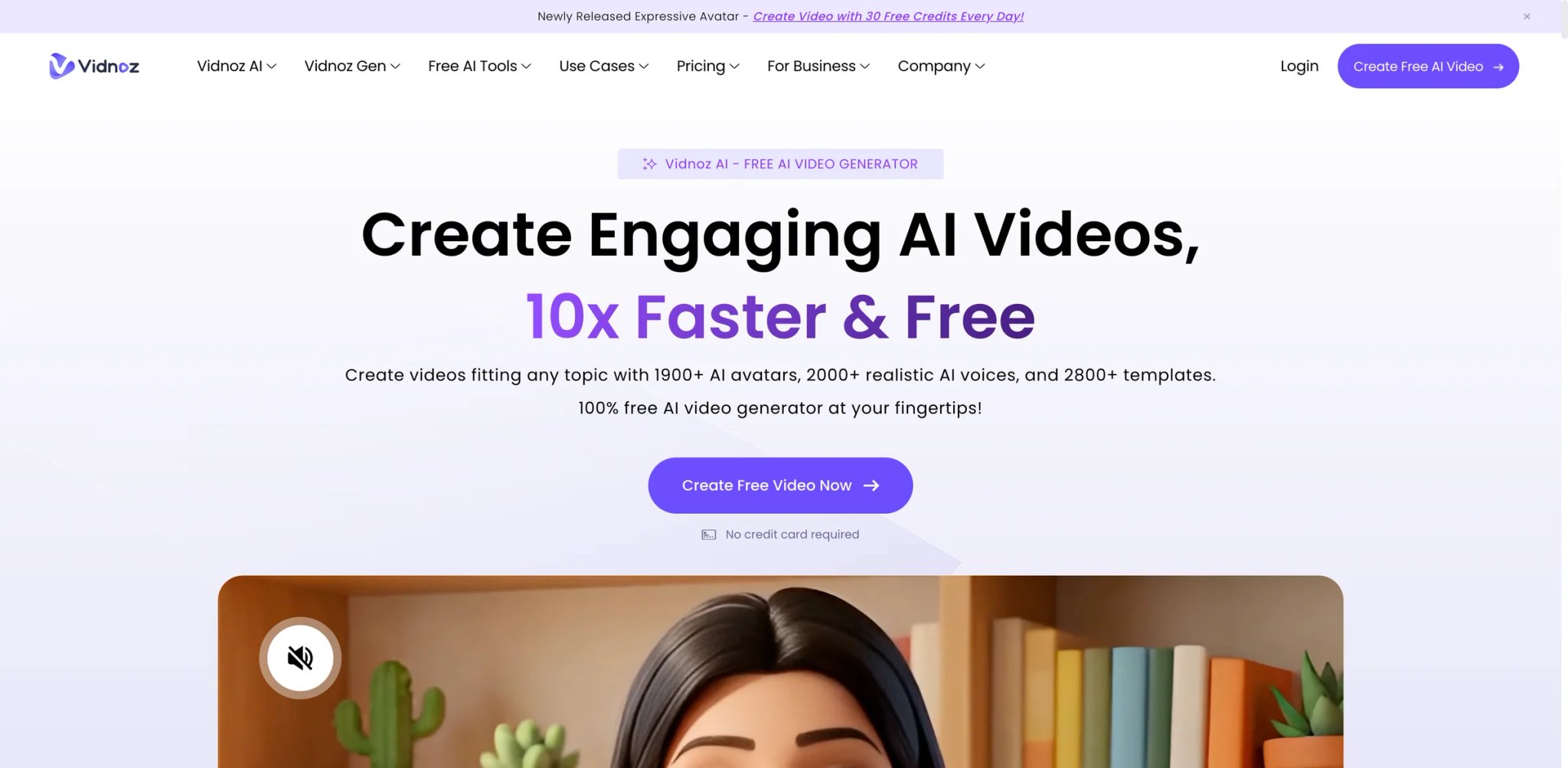
Five seconds into the Vidnoz onboarding the value prop is obvious: free 1-minute generation per day, 800+ avatar templates, paid plans starting at $14.99/mo. For solo marketers and freelancers whose HeyGen complaint is simply "I'm spending $90/mo and most of it is going to features I don't use," Vidnoz is the cheapest credible entry point on this list. The trade-off is real — output quality is good not great, the Pro-tier reality looks more like HeyGen's pricing once you scale, and the free-tier limits are tight — but as a "test 30 avatars for $0" workflow it's hard to beat.
What Vidnoz solves vs HeyGen:
- Genuinely cheap entry point — Free tier covers a real 1 minute/day generation; paid from $14.99/mo
- Template-heavy library — 800+ avatars and 1,000+ video templates make the "pick a template, drop in script, ship" path the fastest on this list
- Low commitment — no annual contract pressure on the entry tiers; you can cancel between projects without losing migration work
- Multilingual coverage — 140+ languages with adequate quality for short marketing clips (long-form is weaker)
Pricing vs HeyGen: The math — Vidnoz $14.99/mo entry vs HeyGen Creator $29/mo (or $90/mo Pro). For the same dollar amount you can get 2 Vidnoz seats and run parallel test campaigns. Credits don't roll over month-to-month, so plan generation cycles around the billing window — a quirk that matters more than the headline price.
Real limitations: Production-grade output may require higher tiers, and at that point the price gap with HeyGen narrows; verify current Vidnoz minute, credit, and rollover rules before publishing. Avatar realism is good for short clips but visibly behind Synthesia and AI Studios on extended takes. Free tier daily limit (1 min) is tight for serious testing — you'll burn through it in one bad-script cycle. Customer support response time is closer to consumer-grade than enterprise.
Best for: Solo marketers, freelance content creators, side projects, and anyone whose budget for AI video this quarter is under $50. Not the right fit if you deliver enterprise training (try Synthesia or Colossyan) or you need long-form output (try AI Studios).
Get started with Vidnoz
Tavus
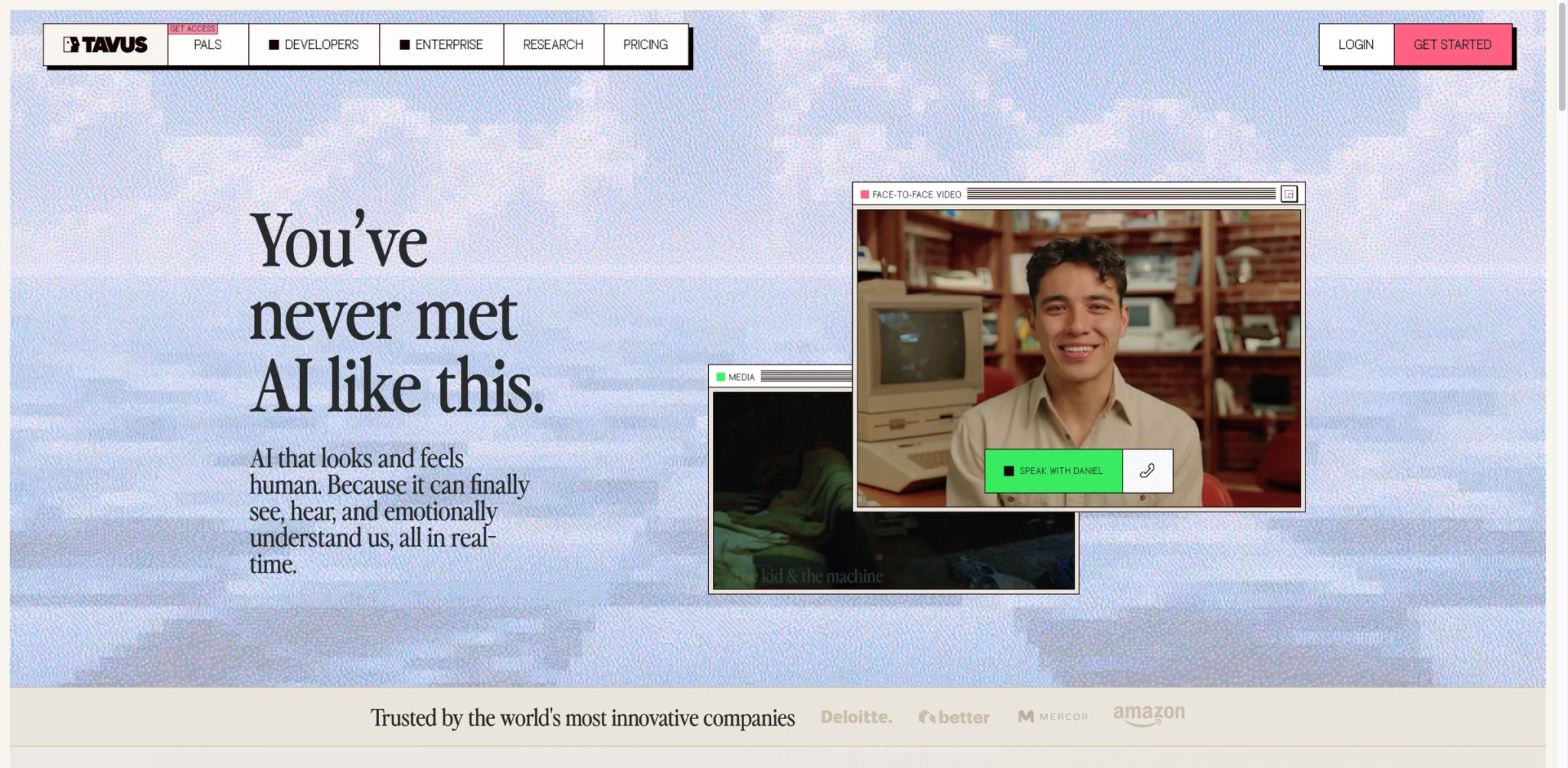
Tavus answers a different question than every other tool on this list: not "make me a video" but "make me an API I can integrate into my product." The Phoenix-3 model handles real-time conversational video at sub-second latency, the platform supports digital twin replicas trained on a few minutes of footage, and the pricing reflects that this is infrastructure, not a content-creation tool. Engineering teams building personalized onboarding video, sales outreach video, or in-product AI personas pick Tavus because the integration story is real — the GUI is secondary.
What Tavus solves vs HeyGen:
- API-first architecture — programmatic video generation; you don't open a Studio, you ship code that calls Tavus and gets back a video URL
- Real-time conversational video agents — sub-second latency for back-and-forth with the avatar, suitable for live use cases
- Personalized video at scale — generate one video per recipient with templated personalization rather than one video for the whole list
- Digital twin replicas — train on your own footage and reuse the persona across thousands of generated videos
CALLOUT in What X Solves: API-first reality — Tavus assumes you have an engineering team. There is a Studio, but it's secondary to the API. If your team's "marketing video stack" has zero developers, this is the wrong tool — pick Synthesia.
Pricing vs HeyGen: Free tier; Starter $59/mo plus pay-as-you-go usage; Growth $397/mo plus PAYG; Enterprise quote-based. The PAYG layer is per-minute or per-replica depending on use; verify on the current pricing page before committing. Compared to HeyGen Pro at $99/mo, Tavus Starter is cheaper on baseline but adds PAYG usage, so the final bill depends on minutes, replicas, and concurrent streams — vastly more capable on programmatic use cases if your spend would have gone to credits and automation.
Real limitations: Steep learning curve if you're not an engineer; the GUI is functional, not delightful. Costs can scale fast at PAYG-heavy usage — large personalization campaigns need budgeting. Avatar style skews "presenter / talking head" — not the right tool for cinematic or UGC-style output. Some advanced features require Enterprise tier and a sales call.
Best for: SaaS teams building personalized onboarding video at scale, sales-engagement platforms with video personalization, customer support teams adding video to chatbots. Not the right fit if you're a non-technical marketer (use Synthesia or Vidnoz) or you need a drag-and-drop Studio (use Colossyan).
Get started with Tavus
D-ID
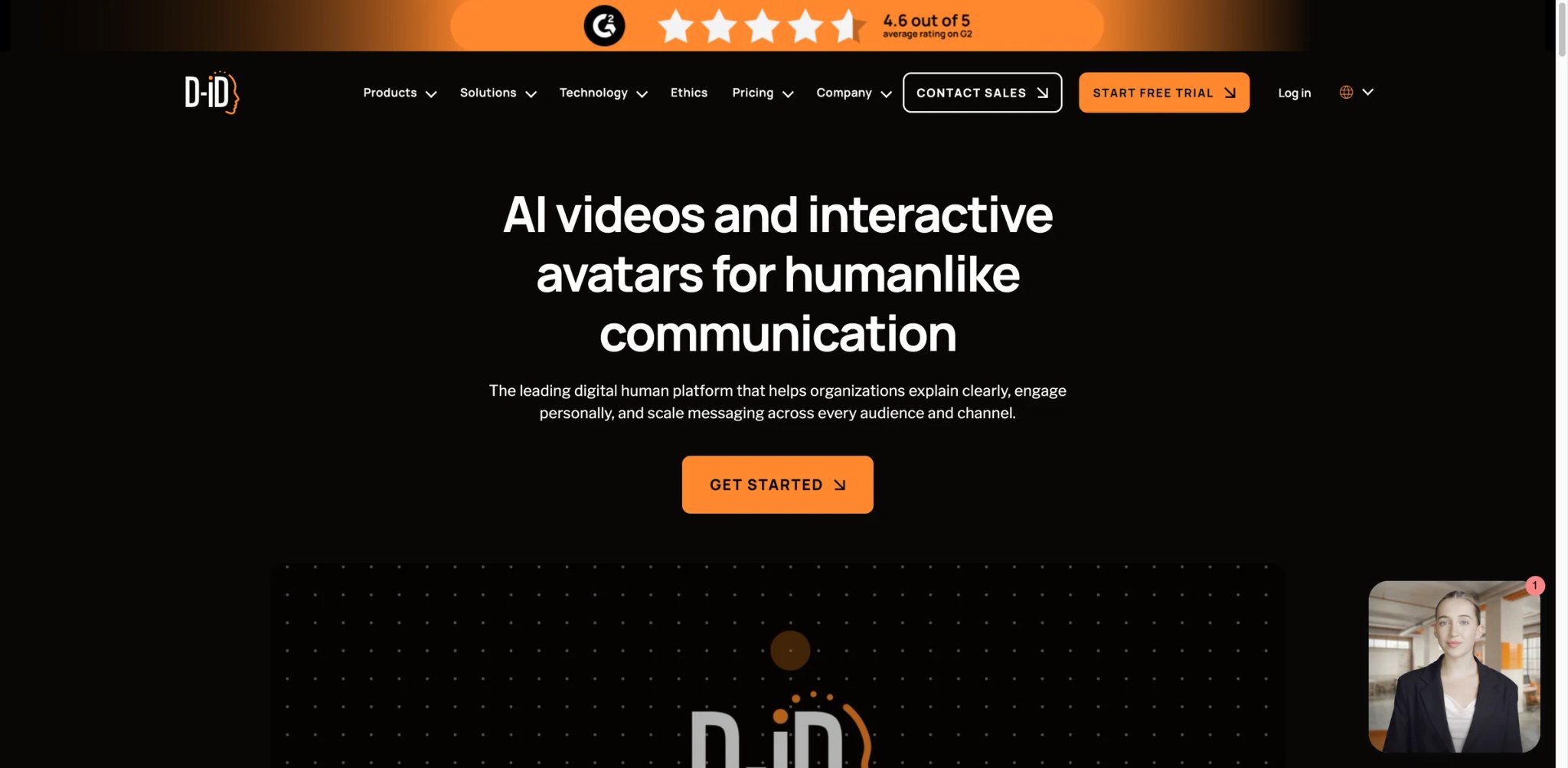
D-ID has been doing talking-head AI longer than HeyGen has been a company — the research lineage goes back to deepfake-detection work that pivoted into legitimate avatar generation. The product split: Studio for non-technical users who want a portrait image to talk, Talks API for developers who want programmable portrait video as a backend service. Built on Microsoft Azure infrastructure, supports 100+ languages and 119 voices. Where Tavus is "API-first with a Studio," D-ID is "two products on one stack" — pick the one your job calls for.
What D-ID solves vs HeyGen:
- Programmable portrait video — Talks API is genuinely lean: send an image and audio, get back a video with lip-synced talking-head output
- Microsoft Azure backbone — for enterprises with existing Azure procurement, D-ID slots in cleanly
- Studio Lite tier — entry pricing well below HeyGen Creator for users who only need short portrait videos (solves Pain #2)
- API + Studio split — choose the surface that matches your team; HeyGen forces both teams into the same Studio interface
Pricing vs HeyGen: Studio plans range from Lite around $4.70/mo through Pro around $16/mo to Advanced around $108/mo (verify current page); API pricing is separate, billed per generated minute. Compared to HeyGen Creator $29/mo, D-ID Studio Pro at ~$16/mo is cheaper for portrait-video use cases. Verify before committing — D-ID has revised pricing tiers more than once in the last year.
Real limitations: Studio is intentionally minimal — if you want template-driven scene composition, HeyGen and Synthesia are richer. Avatar customization is weaker than HeyGen — you bring the portrait, D-ID animates it; less of a "design your avatar" workflow. Pricing tiers have shifted recently — anything you read in older blog reviews may be stale.
Best for: Developers integrating talking-head video into chatbots, e-commerce product demos, customer support flows; Microsoft-stack enterprises. Not the right fit if you want full Studio scene composition (use Synthesia) or you need long-form scripted video (use AI Studios).
Get started with D-ID
Elai
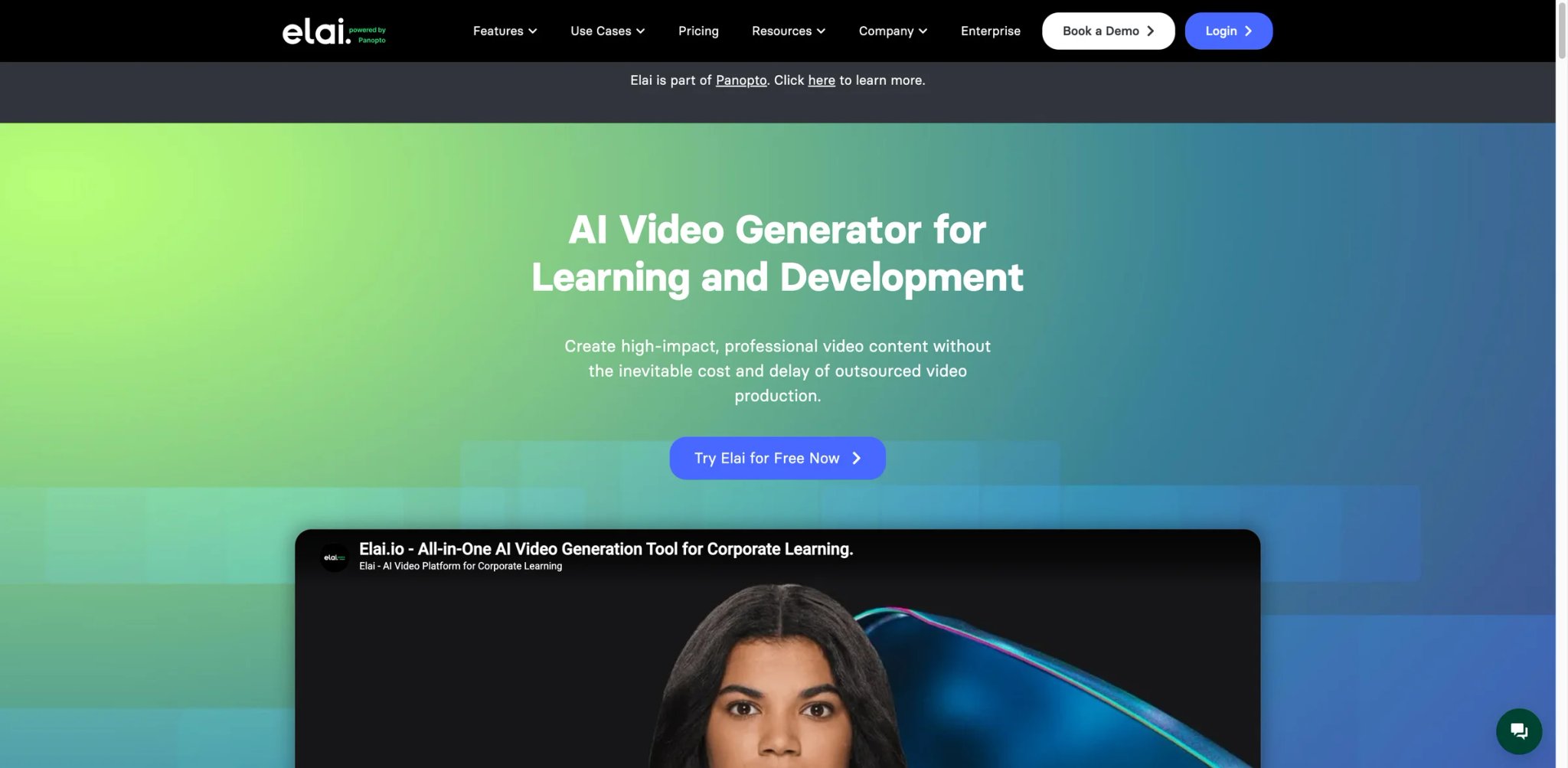
Five-second pitch: Free 1 minute, Creator $23/mo annual = 15 minutes per month, no credit math. Elai is the answer for the HeyGen complaint that goes "I just want to know how many minutes I have and how much it costs." The product is purpose-built for training and presentation creation, with a slides-to-video pipeline that converts PowerPoint or Google Slides into presenter videos with avatar narration. Smaller than Synthesia or Colossyan, but cleaner on the math.
What Elai solves vs HeyGen:
- Strict minutes-based billing — 15 minutes/month on Creator means 15 minutes; no credit conversion, no premium usage layer
- Slides-to-video pipeline — drop in a deck, get a presenter video matching slide-by-slide; the fastest path from PowerPoint to AI video
- Simpler minute-based budgeting — Elai is easier to forecast than HeyGen's credit conversion, but verify failed-render policy with Elai support before assuming attempts are never charged (solves Pain #3)
- Clean training UI — simpler than HeyGen Studio for non-designer teachers and instructors
Pricing vs HeyGen: Free 1 minute on signup; Creator $29/mo monthly or $23/mo billed annually for 15 minutes/month; higher tiers for more minutes. Compared to HeyGen Creator at $24/mo, Elai Creator at $23/mo annual is virtually identical baseline price but with more predictable scaling. Heavy users will outgrow the 15-minute cap and need to step up to higher tiers — that's the real budgeting decision, not the entry price.
Real limitations: Avatar library is smaller than HeyGen's — perhaps 80 stock avatars where HeyGen has hundreds. Custom avatar workflow exists but takes longer than HeyGen's 4-minute clone. API surface is less developed than Tavus or D-ID. 15-minute monthly cap is genuinely tight for full-time content teams.
Best for: Teachers and instructors making lesson videos, internal communications teams, anyone whose pain is "I want minutes, not credits" and whose volume is under 30 minutes/month. Not the right fit if you need scripted product launch trailers (use AI Studios) or scenario-based training (use Colossyan).
Get started with Elai
Creatify
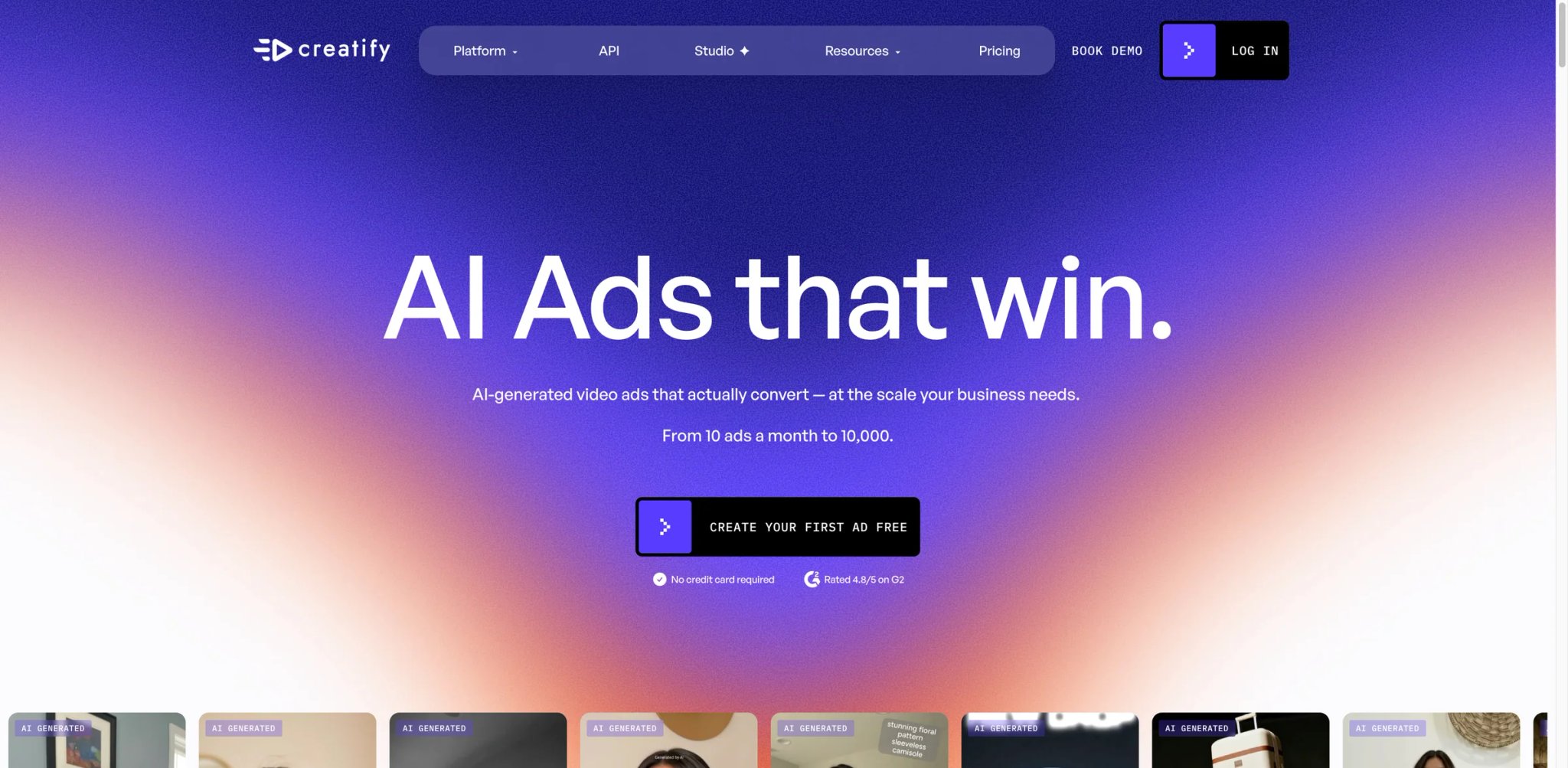
Before features, the framing: Creatify is built for AI UGC ads. Not corporate explainer videos. Not training. Not investor relations. Specifically the kind of TikTok-style ad where an AI avatar talks to camera in 15 seconds about a product. Some teams love that focus — they ship 50 ad variants in an afternoon and let paid social pick the winner. Other teams hate it — they tried Creatify expecting "HeyGen but cheaper" and got something deliberately rougher. The roughness is the product.
What Creatify solves vs HeyGen:
- AI UGC ad variant scaling — generate 30+ ad variants from one script in one workflow, each with different avatar / hook / CTA
- Performance-marketing-shaped UI — designed around the ad-buyer's actual workflow: write the script, pick the avatar, generate variants, hand to paid social team
- Cheaper than HeyGen for ad-variant work — the volume that breaks HeyGen Creator's credit budget is exactly Creatify's sweet spot
- Direct integration with TikTok / Meta Ads format — output dimensions, lengths, and styles match what platforms accept
CALLOUT in Best For: UGC-only caveat — if you're not running paid social, half of Creatify's value is unused. The features cluster around ad workflow specifically; using it for training videos is fighting the product.
Pricing vs HeyGen: Free plan includes 10 monthly credits (good for ~2 video ads or 20 image ads with watermark); Starter, Pro, and Enterprise tiers use credit buckets — verify exact dollar amounts on the current pricing page since they've moved. Compared to HeyGen Pro $90/mo for general-purpose avatar generation, Creatify at the equivalent budget gets you significantly more ad-format video output.
Real limitations: Visual quality is deliberately UGC-style — slightly rough, deliberately not corporate-polished; that's the product, but it surprises people. Not for enterprise training or B2B explainers; the tool fights you. Free tier outputs have watermark. Avatar library is narrower than HeyGen's stock catalog.
Best for: Performance marketers running TikTok and Meta ads, DTC brands testing creative at high cadence, agencies producing ad variants for clients. Not the right fit if you make enterprise training videos (use Synthesia) or you need polished corporate output (use AI Studios).
Get started with Creatify
Akool
Akool occupies an unusual niche — face-swap and personalized AI avatar generation, often used for "personalized marketing creative" where the avatar's face is the customer's, the spokesperson's, or a campaign actor's. Teams running B2C personalization at scale (think: birthday-greeting videos for customers, real-estate outreach with the agent's face, e-commerce thank-you videos) pick Akool because the face-swap workflow is more flexible than HeyGen's. The trade-off is dual-edged: face-swap is also the deepfake-adjacent technology that triggers compliance and PR concerns.
What Akool solves vs HeyGen:
- Face-swap personalization — generate avatar videos with custom faces from photos at higher fidelity than HeyGen's avatar-clone workflow
- UGC + personalized marketing creative — designed around the "one video per customer" use case rather than "one video for the campaign"
- Campaign variant production — generate dozens of personalized variants from one base script
- API access — for engineering teams integrating face-swap into product flows
CALLOUT in Limitations: Face-swap controversy — the technology is deepfake-adjacent. Compliance teams will ask about consent flows, watermark policies, and content moderation. Have answers ready before procurement.
Pricing vs HeyGen: Free tier plus public paid tiers — Pro $30/mo ($18/mo annual) with 600 credits, Pro Max $59/mo ($35.40/mo annual) with 1,200 credits and API access, Business $249/mo ($149.40/mo annual) with 6,000 credits and a commercial license, and Enterprise custom. Compared to HeyGen, Akool's per-credit math is public — but commercial license appears only at Business+, which paid-campaign teams should confirm before launch.
Real limitations: Pricing is public but credit- and license-sensitive — Pro and Pro Max list personal licenses, while Business adds a commercial license; paid-campaign teams should confirm allowed usage before launch. Compliance posture requires careful handling — face-swap features need explicit consent workflows for B2C use cases. UI polish is below Synthesia and HeyGen. Output quality varies more across runs than Synthesia or AI Studios.
Best for: Performance marketers running personalized B2C campaigns, real-estate and high-touch sales teams sending video outreach, e-commerce brands doing one-to-one customer videos. Not the right fit if your compliance team rules out face manipulation (use Synthesia) or you want predictable upfront pricing (use Colossyan).
Get started with Akool
Hedra
If your migration is really a deeper question — "I want my photo to actually feel alive when it talks" — Hedra is the answer. The product is built on a Character-3 model that prioritizes facial expressiveness over corporate-polished output: when an avatar smiles in Hedra it actually looks like a smile, not the slight grin HeyGen tends to produce. Used heavily by creators, character-brand owners, and people building personality-driven content where the avatar's emotional range matters more than enterprise feature sets.
What Hedra solves vs HeyGen:
- Expressive talking-head output — emotional expression is Hedra's design priority and a frequent point of comparison versus HeyGen for character-driven work; verify on the same script, voice, and source image before claiming the realism gap is closed (solves Pain #6)
- Photo-to-talking-head workflow — bring any portrait, get back animated talking-head video; less template-driven, more creative
- Character-brand support — generate personality-driven content where the avatar feels like a character, not a presenter
- Credit-based pricing with no rollover — Basic $15/mo includes 1,500 credits, Creator $30/mo includes 5,400, and Professional/Teams $75/mo includes 14,400; per-generation cost depends on model and output choices
Pricing vs HeyGen: Free plan includes limited non-commercial, watermarked credits. Paid plans start at Basic $15/mo with 1,500 credits/month, commercial use, and no rollover; Creator is $30/mo and Professional/Teams are $75/mo. Compared to HeyGen Creator $29/mo, Hedra Basic at $15/mo is cheaper for short-clip workflows but the credit cost per generation depends on model and output length.
Real limitations: Not enterprise-shaped — no SCORM, no governance, no SSO at the lower tiers. Avatar library is narrower than HeyGen's; the strength is bring-your-own-photo flexibility. UI is creator-shaped, less L&D-friendly. Long-form output (>3 min) is weaker than AI Studios.
Best for: Creators, character-brand owners, indie podcasters, anyone whose avatar choice is "this needs to feel alive." Not the right fit if you do enterprise training (use Synthesia) or you need scripted long-form video (use AI Studios).
Get started with Hedra
Honorable Mentions
These five tools show up repeatedly in HeyGen migration threads but solve a slightly different problem — they're for users whose real complaint is "I don't actually need an avatar; I need generative video, audio editing, or short-form social cuts." Each is a strong fit for a specific exit path the avatar-shaped tools above don't cover.
Runway
Runway Gen-3 and Gen-4 are the answer for "I want cinematic AI video without an avatar." Free tier with 125 one-time credits, Standard $12/user/mo billed annually, Pro $28/user/mo billed annually. Best when your real need is cinematic shots, generative video clips, or motion design rather than a talking-head presenter. Get started with Runway.
Pika
Pika focuses on short creative clips — image-to-video, animated effects, fun character moments. Basic with 80 monthly video credits, Standard $8/mo billed yearly, Pro $28/mo billed yearly, Fancy $76/mo billed yearly. Best for creators making playful short-form content where avatar fidelity isn't the value driver. Get started with Pika.
Descript
Descript is the post-production tool for podcasts and screen recordings — voice cleanup, AI dubbing, captions, video editing with transcript-based editing. Free, Hobbyist $24/mo or $16/mo billed annually, Creator $35/mo or $24/mo billed annually, Business $50/mo billed annually. Best when the real job is editing existing content, not generating from scratch. Get started with Descript.
Captions
Captions is creator-first short-form social — AI captions, AI twins for social-style avatar video, viral-format templates. Free sign-up, Pro $9.99/mo with 200 credits, Max $24.99/mo with 500 credits, Scale from $69.99/mo with 1,400 credits. Best for solo creators making TikTok / Reels / Shorts content. Get started with Captions.
InVideo AI
InVideo AI is prompt-to-video — describe a video, get back a draft with stock media, narration, captions. Plus from $17/mo billed yearly, Max $85/mo, Generative $170/mo. Best for marketing teams making social and explainer videos where stock-footage-driven output is acceptable. Get started with InVideo AI.
Migrating from HeyGen — A Practical Guide
Data and Account Migration
Source materials are yours — your scripts, brand assets, and reference images stayed on your machine, HeyGen only kept generated outputs. Generated videos can be downloaded as MP4 from the dashboard before churning the account; do this before billing-cycle end so you don't lose access mid-download. Custom avatars trained inside HeyGen (Avatar IV replicas, LiveAvatar configurations) don't migrate to other platforms — you'll re-train on the new tool's workflow. API integrations require parallel operation: keep HeyGen API live for at least 2 weeks after the new platform is in production, then switch traffic. Refund expectations should stay low — the support and refund pain that defines Pain #7 means cancel-then-fight-charge is rarely worth the effort.
Learning Curve by Alternative
- Near-zero: Vidnoz, Hedra, Creatify, Captions, Pika — chat-with-template UX, no API setup, generation in five minutes.
- Medium: Synthesia, Colossyan, Elai, AI Studios, Descript, InVideo AI — feature depth that takes a working session to internalize; SCORM and LMS integrations on the enterprise tools add another half-day for first deployment.
- High: Tavus and D-ID API tracks, Runway for serious creative workflow integration — engineering work to wire into your stack; not non-technical migration paths.
Pricing Brackets vs HeyGen Creator $29/mo (excluding Premium Credit add-ons)
- Cheaper than HeyGen Creator $29/mo: Captions Pro $9.99/mo, Pika Standard $8/mo, Runway Standard $12/mo annual, Vidnoz $14.99/mo, Hedra Basic $15/mo, D-ID Lite-Pro $4.70-$16/mo, Descript Hobbyist $16/mo annual.
- Same range: Synthesia Starter $29/mo (or $18 annual), Elai Creator $23-$29/mo, AI Studios Personal $24/mo, Descript Creator $24/mo annual, Captions Max $24.99/mo, InVideo Plus $17/mo, Akool Pro $18/mo annual, Hedra Creator $30/mo.
- More expensive than HeyGen Creator $29/mo: Synthesia Creator $89/mo monthly, Tavus Starter $59/mo plus PAYG, Tavus Growth $397/mo plus PAYG, AI Studios Team $55/mo, Akool Business $249/mo, HeyGen Pro $99/mo plus Premium Credits.
Best HeyGen Alternatives by Use Case
If Your Reason Is "I Thought Unlimited Meant Unlimited"
Synthesia for per-seat predictability that's not credit-based; Elai for strict minutes that don't convert into credit math; Colossyan for unlimited minutes on the Business tier; Tavus for a subscription-plus-PAYG model where the variable cost is at least transparent. Each removes the marketing-vs-product gap that defines the Pain #1 fresh-news complaint.
If Your Reason Is "I Need Cheaper Short Avatar Videos for Tests"
Vidnoz at $14.99/mo with a real free 1-minute daily allowance; D-ID Studio Lite from $4.70/mo for portrait-video work; Hedra at $15/mo for expressive character video; Creatify free 10 credits for ad-variant testing. The total cost of testing 30 avatars across these is less than one month of HeyGen Creator.
If Your Reason Is "I Cannot Risk Failed Renders Eating Credits"
Synthesia, Colossyan, and Elai may be simpler to budget than HeyGen's Premium Credit workflow, but do not assume they never charge failed attempts unless the vendor's current help docs confirm it; Descript is local editing where there's no render fee at all. Together they cover the spread from enterprise studio to creator-friendly editing.
If Your Reason Is "I Need a Stable Training Workflow"
Synthesia for enterprise governance and SCORM; Colossyan for scenario-based learning; Elai for slides-to-video pipelines; AI Studios for multilingual presenter video. Each handles a different shape of training — from compliance modules to global product training — and none have the specific HeyGen complaint pattern described above, though each vendor should still be tested on the same scripts before migration.
If Your Reason Is "I Want UGC-Style Ads, Not Corporate Avatars"
Creatify is the focused-product answer — built specifically for AI UGC ads; Akool for face-swap personalized creative; Captions for creator-shaped short-form social; Hedra for character-driven photo-to-talking-head. The aesthetic is deliberately rougher than Synthesia or AI Studios — that's a feature.
If Your Reason Is "I Need API-First Digital Humans for Conversational Agents"
Tavus for Phoenix-3 model with sub-second conversational latency; D-ID Talks API for programmable portrait video; Akool for face-swap with API access. Engineering-team work, not marketing-team work — pick by integration depth and SLA needs.
If Your Reason Is "I Don't Actually Need Avatars — Just Generative Video or Editing"
Runway for cinematic Gen-3 / Gen-4 generative video; Pika for short creative clips; Descript for voice and video post-production; InVideo AI for prompt-to-video with stock media. Each is a complete escape from the avatar paradigm if your real need was always video, not specifically a talking-head.
How to Choose the Right HeyGen Alternative
1. Diagnose the specific pain, then test the free tier on real material. The seven pains above are different problems with different right answers. Naming yours — "I need predictable per-seat pricing" or "I cannot ship a project that depends on a 2-hour render queue" — narrows the candidate set to two or three tools. Test those on your real script, your real avatar (or face), your real delivery environment for at least 48 hours before deciding.
2. Verify whether pricing is minutes / per-seat / credits / PAYG, and what fails count as. HeyGen's lesson is that the structure of pricing matters more than the headline number. Synthesia's per-seat is genuinely predictable; Tavus subscription-plus-PAYG is predictable plus variable; Colossyan minutes deduct only on success; Vidnoz credits don't roll over. Read the failure-mode language carefully — does this tool charge for failed renders? does the model layer add premium credits? — before committing.
3. Confirm compliance and governance posture if you're enterprise. SCORM, SSO, audit logs, content moderation policies, deepfake / face-swap consent flows — your procurement team will ask, and the answers vary widely across this list. Synthesia and Colossyan are the strongest on enterprise governance; Akool requires careful handling of face-swap consent; Hedra and Vidnoz are creator-shaped and won't pass enterprise security review without custom contracts.
4. Run a 2-week hybrid period before churning HeyGen. Keep HeyGen read-only and renew billing one final cycle if needed. Do all new generation work on the chosen alternative. At week two, compare three things: delivery quality on your hardest video, total spend including any overage, and support response time on a deliberately-induced edge case. Only after that comparison do you cancel HeyGen — and even then, expect refund friction per Pain #7.
Frequently Asked Questions
What is the best HeyGen alternative overall in 2026?
What is the best free alternative to HeyGen?
Is Synthesia better than HeyGen for training videos?
Which HeyGen alternative is cheapest for short avatar videos?
What should I use if HeyGen credits feel unpredictable?
Which HeyGen alternative is best for UGC ads?
Should I wait for HeyGen Avatar IV, LiveAvatar, and Studio updates to stabilize?
What is the best HeyGen alternative if I don't need AI avatars?
Get ToolWorthy Weekly
New AI tools, practical guides, and selected AI signals in one weekly brief.
Related Posts

10 Best Synthesia Alternatives 2026 - After the Credit Reset
Synthesia's 2026 credit model and plan limits make teams compare HeyGen, Colossyan, D-ID, Elai, AI Studios, VEED, and other focused tools.

15 Best AI Avatar Generators in 2026 — Real Costs, Credit Traps, and Honest Limits
Every AI avatar tool demos beautifully. Then the credit system kicks in. Fifteen platforms tested with verified 2026 pricing and real usage caps — across ads, training, and UGC.

6 Best Ahrefs Alternatives in 2026 — Choose by Switching Route
Choose an Ahrefs alternative by the workflow you must preserve, the history you can migrate, and the cost of rebuilding your SEO operating system.
For AI tool founders
Built a tool that belongs in this decision set?
Request an editorial evaluation for possible inclusion in ToolWorthy.
Submit your tool for reviewPaid submission does not guarantee a ranking, recommendation, inclusion, or editorial outcome.
Discover More AI Tools
Browse maintained AI tool listings and source-based editorial guides, then verify current product details with the vendor for your use case.