

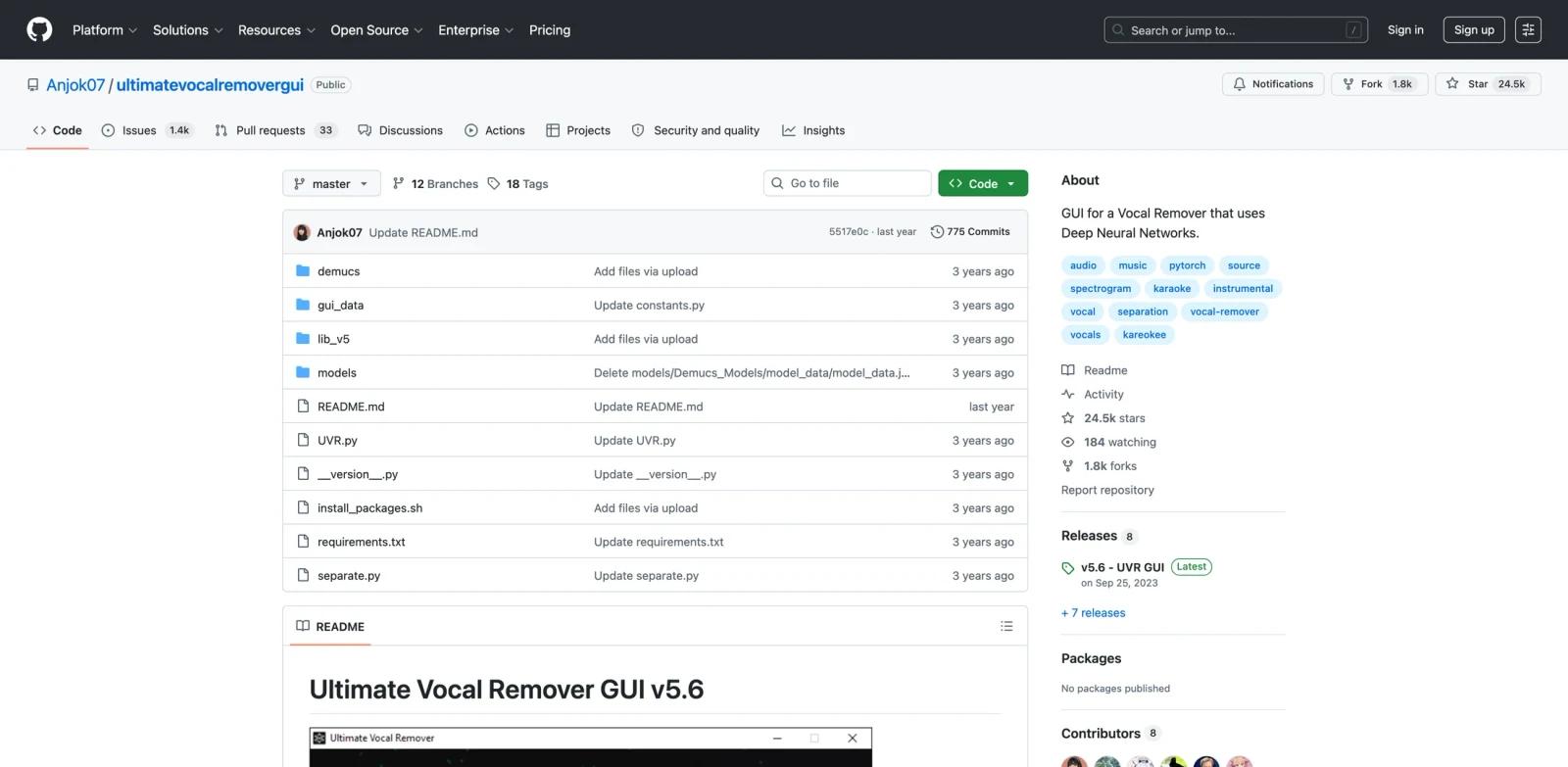


Overview
UVR GUI is an AI audio editor option for teams that need to split, isolate, clean, or manipulate recorded audio so creators can work with stems instead of flat mixes. GUI for a Vocal Remover that uses Deep Neural Networks. - Anjok07/ultimatevocalremovergui. In practical terms, it gives DJs, producers, editors, remixers, and audio engineers a more structured way to handle stem separation, vocal removal, remix preparation, restoration, spectral repair, and clip-level editing without relying entirely on spreadsheets, blank documents, or disconnected manual steps.
The product is especially relevant when the decision is not simply "does AI generate something?" but whether the workflow is repeatable, editable, and reliable enough for real work. UVR GUI should be evaluated on separation quality, export control, hardware requirements, and how naturally the tool fits into an existing DAW or DJ workflow.
For buyers comparing AI audio cleanup, UVR GUI sits in the practical middle ground between a general-purpose assistant and a heavier production system. It is useful when you want a dedicated product surface, clearer exports, and a workflow that non-technical teammates can understand.
Key Features
- Stem-focused editing - Separates vocals, drums, bass, instruments, or spectral regions so users can work on specific parts of a mix.
- Real-time or batch processing - Supports either live performance workflows or offline file processing depending on the product design.
- Creative remix control - Helps users mute, rebalance, loop, or transform individual elements without needing original multitrack files.
- Audio repair workflows - Makes it easier to remove artifacts, clicks, bleed, or unwanted sounds from a finished recording.
- Export and DAW handoff - Produces stems or edited audio files that can move into DJ software, DAWs, video editors, or mastering chains.
- Model and quality options - Gives advanced users control over separation strength, processing modes, or source material choices where supported.
These features matter most when UVR GUI is used repeatedly. A single demo can show whether the interface feels polished, but a real evaluation should include messy inputs, edge cases, team review, and final export so you can see how much manual cleanup remains.
How to Get Started
- Open the official product site - Start from https://github.com/Anjok07/ultimatevocalremovergui so you are using the current product flow rather than an outdated marketplace or review link.
- Create a small test project - Use a real example from your own workflow, such as an existing brief, recording, image, task list, or content asset.
- Check the default output - Review whether UVR GUI produces something useful before heavy editing; this is the fastest way to judge baseline quality.
- Adjust settings and constraints - Test templates, model options, export formats, permissions, brand controls, or integrations that matter to your team.
- Compare against your current process - Measure cleanup time, approval time, and handoff quality against your existing tools, including AI audio enhancer.
- Confirm pricing and rights - Before rollout, verify plan limits, commercial-use terms, privacy commitments, and whether AI podcast generator or API access requires a higher tier.
Pricing & Plans
| Plan | Public pricing signal | What to expect |
|---|---|---|
| Free access | Free | Core UVR GUI workflows are presented as free or open-source access. Review the official site for license, hosting, or usage details before production use. |
UVR GUI should be treated as a free-access option rather than a commercial SaaS subscription. Teams should still check whether paid hosting, compute, support, marketplace assets, or commercial licenses apply to their exact use case.
Best For
- DJs preparing live edits, mashups, and acapella transitions from finished tracks.
- Music producers who need quick stems when original project files are unavailable.
- Podcast and video editors removing background music, noise, or unwanted voices.
- Audio restoration teams working with legacy recordings and complex spectral problems.
- Creators who prefer local or desktop processing over uploading sensitive audio files.
FAQ
What is UVR GUI used for?
UVR GUI is used to split, isolate, clean, or manipulate recorded audio so creators can work with stems instead of flat mixes. It is most relevant for DJs, producers, editors, remixers, and audio engineers who need a more repeatable workflow than manual production.
Who should choose UVR GUI?
Choose UVR GUI if your daily workflow involves stem separation, vocal removal, remix preparation, restoration, spectral repair, and clip-level editing. It is less suitable if you only need a one-off task and do not want to learn a specialized product.
Does UVR GUI have a free plan?
UVR GUI appears to offer free access for its core workflow. Check the official site for license terms, hosted services, support options, or commercial-use restrictions.
What should I test first in UVR GUI?
Start with a realistic sample project, not a toy example. Check output quality, editing control, export options, collaboration, and whether the result fits your existing tools.
How does UVR GUI compare with generic AI tools?
Generic AI tools can help with drafts and ideas, but UVR GUI is built around a more specific audio separation and editing tool workflow with purpose-built controls, templates, integrations, or exports.
Is UVR GUI good for teams?
UVR GUI can work for teams when its collaboration, permissions, sharing, and admin controls match your process. Smaller teams should verify whether those controls are included in entry-level plans.
What are the main limitations of UVR GUI?
The main risks are plan limits, output quality variance, learning curve, and dependency on the product's supported formats or integrations. Always test with your own materials.
Can UVR GUI replace a specialist?
UVR GUI can reduce routine production work, but specialist review still matters for strategy, quality control, compliance, brand voice, and final approval.
What alternatives should I compare with UVR GUI?
Compare it with tools in the broader AI audio editor category, plus any workflow tools your team already uses. The best choice depends on output quality, cost, and adoption friction.


