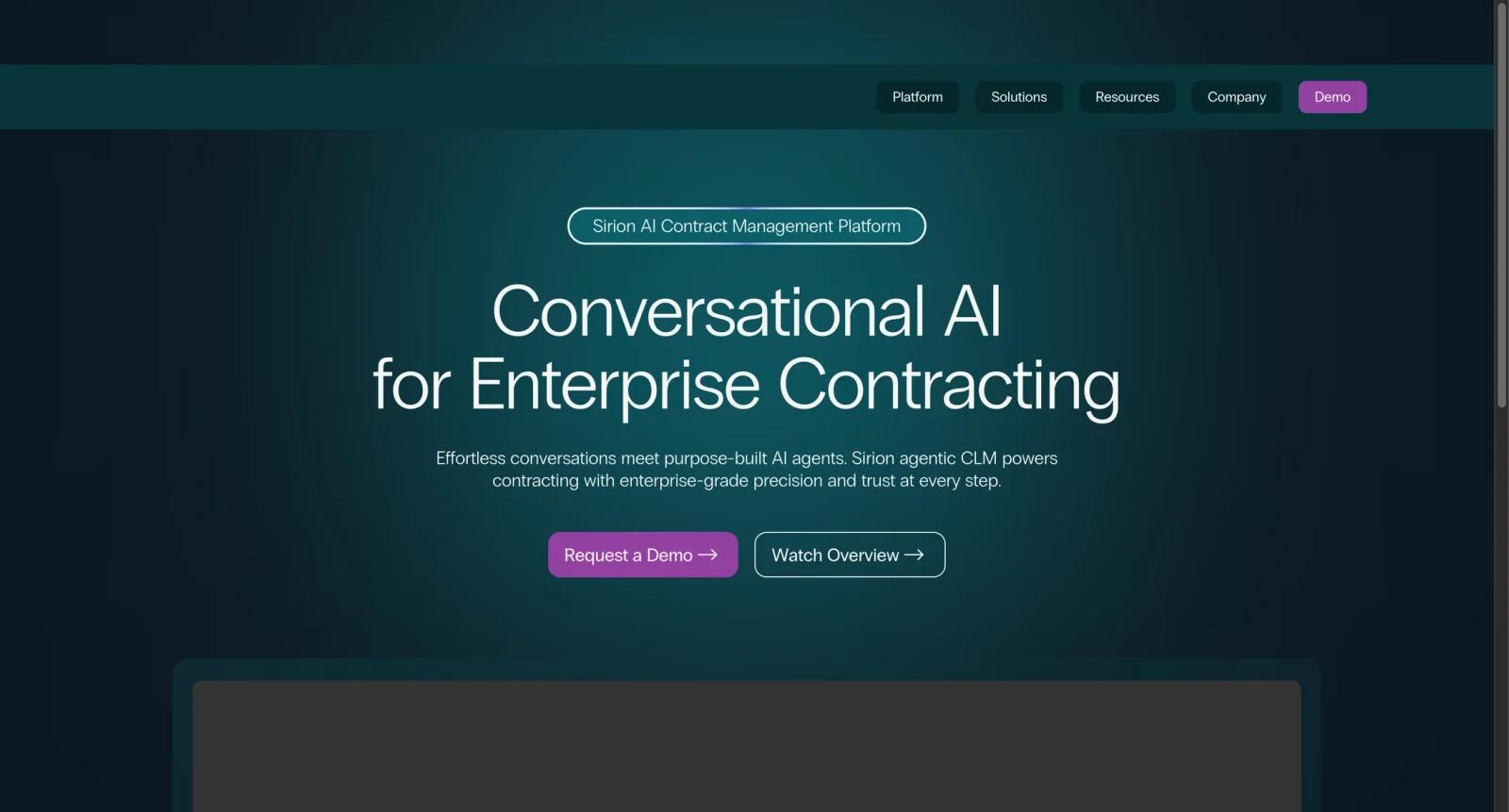


Overview
Sirion is an AI-native contract lifecycle management platform for enterprises that need to create, negotiate, execute, store, analyze, and manage contracts across legal, procurement, sales, finance, and operations. It is built for full-lifecycle contracting rather than one-off contract review.
Sirion's public materials emphasize AI-native CLM, contract drafting, repository intelligence, obligation management, contract analytics, and enterprise risk workflows. Buyers in the AI contract review space may consider Sirion when their needs expand beyond redlining into CLM, obligations, and enterprise contract intelligence. Common comparison points include Ironclad, ContractPodAi, and Juro.
The strongest fit is a large organization with high contract volume, complex obligations, supplier or customer commitments, and multiple teams participating in the contract lifecycle.
Key Features
- AI-native CLM - Supports contract creation, negotiation, execution, storage, analytics, and lifecycle governance across enterprise teams.
- Contract drafting - Provides AI-assisted contract drafting with standardized templates to improve consistency and speed.
- Repository intelligence - Centralizes contracts and extracts structured data so users can find terms, obligations, risks, and commercial details.
- Obligation and milestone tracking - Helps teams monitor renewals, commitments, service levels, pricing terms, and reporting obligations.
- Conversational contract insights - Lets users ask questions about contract terms and retrieve answers grounded in repository data.
- Enterprise integration model - Supports adjacent procurement, finance, sales, and legal systems where contract data needs to flow.
Integration Guide
Sirion implementation should begin with the contract lifecycle stages that create the most risk or value leakage. For procurement teams, that may be supplier obligations and renewal terms. For sales teams, it may be customer contract creation and redline cycle time. For legal operations, it may be intake, templates, approvals, and repository governance.
Because Sirion is an enterprise CLM, migration planning matters. Inventory contract sources, metadata fields, templates, approval paths, and integrations before scoping the rollout.
Pricing & Plans
Sirion pricing is enterprise and quote based. Public pages and collateral focus on CLM capabilities rather than a public monthly price.
| Buying area | Pricing signal | Best fit |
|---|---|---|
| Enterprise CLM | Contact sales | Teams managing full lifecycle contract workflows |
| AI and repository intelligence | Custom quote factor | Organizations extracting terms, obligations, and insights from contracts |
| Implementation and integrations | Custom quote factor | Enterprises connecting Sirion with procurement, finance, sales, and legal systems |
Ask about modules, contract volume, user roles, AI capabilities, implementation services, integrations, repository migration, support, and renewal terms.
Best For
- Enterprises managing high-volume or high-value contract portfolios
- Procurement teams tracking supplier terms, pricing, renewals, and obligations
- Legal operations teams replacing fragmented intake, approval, and repository workflows
- Sales and finance teams needing contract data connected to commercial systems
- Buyers comparing Sirion with Ironclad, ContractPodAi, and Juro
FAQ
What is Sirion?
Sirion is an AI-native contract lifecycle management platform for creating, negotiating, executing, storing, analyzing, and managing enterprise contracts.
How much does Sirion cost?
Sirion uses quote-based enterprise pricing. Buyers should request pricing based on modules, users, contract volume, integrations, and implementation scope.
Is Sirion only for legal teams?
No. Sirion supports legal, procurement, sales, finance, and other teams involved in contract workflows and obligation management.
Does Sirion include AI contract review?
Sirion includes AI-native contract capabilities, but its broader value is full CLM, repository intelligence, and obligation management.
How does Sirion compare with Ironclad?
Both are enterprise CLM platforms. Sirion is especially relevant for obligation, supplier, and contract intelligence workflows, while Ironclad is known for configurable contract collaboration and workflow design.
What should buyers verify?
Verify modules, implementation timeline, repository migration, integrations, user roles, AI capabilities, security, and support requirements.
Can Sirion replace a contract repository?
Yes, Sirion can serve as a contract repository, but migration quality and metadata design are critical for useful search and reporting.
Who should avoid Sirion?
Small teams with low contract volume or a narrow need for AI redlining may prefer a lighter contract review tool.