

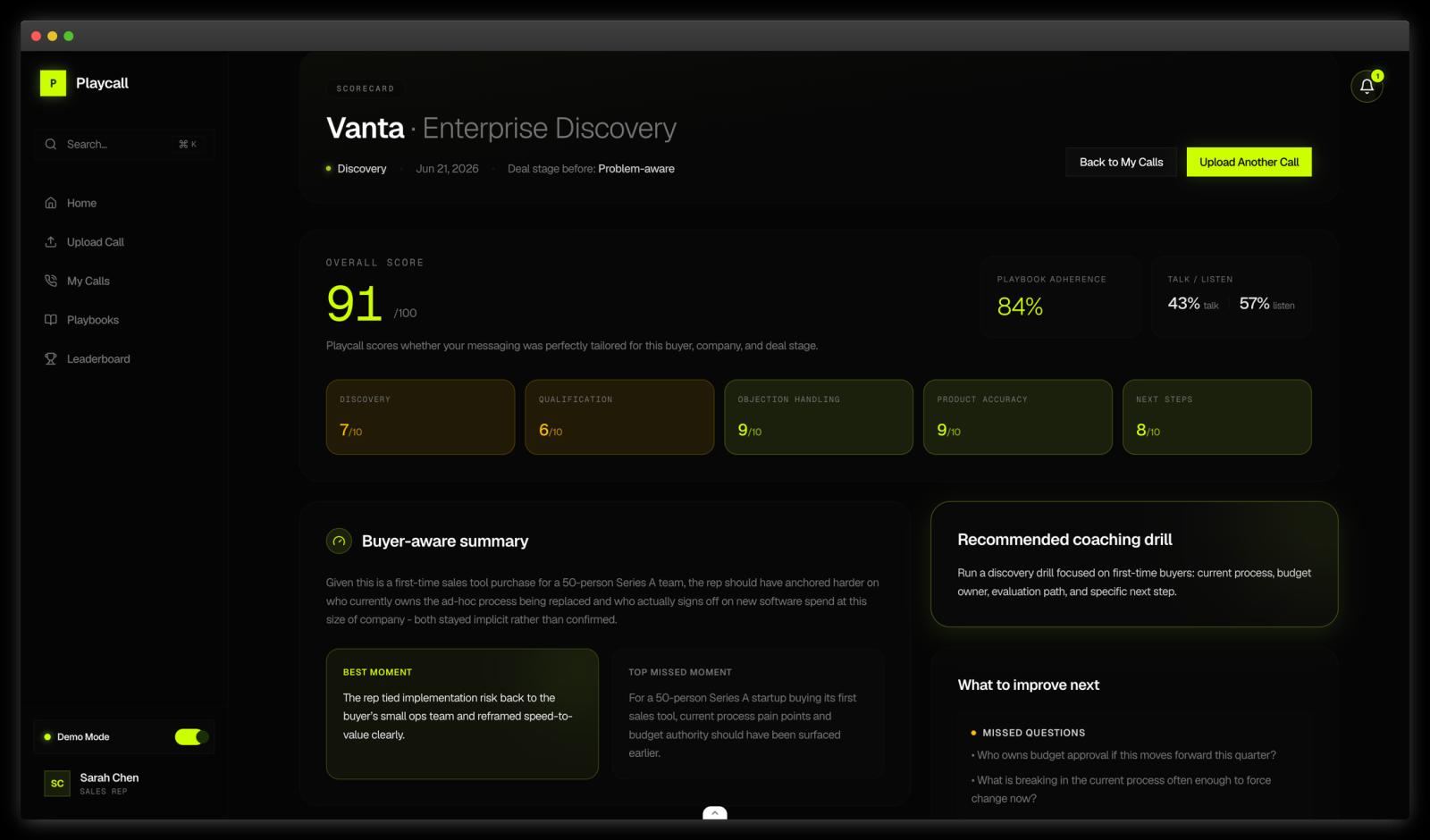


Overview
Playcall is an open-source sales call analysis and coaching platform for AI-native go-to-market teams. Instead of applying one generic scorecard to every conversation, it evaluates whether a rep's messaging fit the buyer, company, deal stage, and sales playbook in that call.
Managers can use established frameworks such as MEDDPICC, BANT, or SPIN, or paste an internal playbook and generate a custom rubric. Each score is tied to the deal stage and outcome, then paired with a specific coaching drill so the review leads to a next action rather than a passive transcript summary.
Playcall is positioned as a self-hosted alternative to larger conversation intelligence suites. The application is MIT licensed and uses Next.js, Supabase, Vercel AI SDK, OpenAI Whisper, LlamaParse, Vercel Blob, and Exa or TheHog buyer enrichment. An enrichment provider is required for the full call-scoring pipeline, although credentials can be supplied per workspace. That architecture gives technical teams control, but it also makes deployment and service costs their responsibility.
Key Features
- Playbook-based scoring - Evaluate every call against MEDDPICC, BANT, SPIN, or the sales methodology your team actually uses.
- Buyer-aware context - Adjust the scorecard using company stage, contact role, buyer context, and deal stage instead of grading only the rep's words.
- Outcome-linked feedback - Connect individual scores to pipeline impact, the current stage, and the eventual deal outcome.
- Actionable coaching drills - Turn each review into a concrete exercise for the rep instead of returning only broad AI advice.
- Multi-provider BYOK - Configure workspace-level keys for providers that are runtime-supported in the current repository. Cohere is currently marked
runtimeSupported: false, and Perplexity is not present in the current direct-provider registry. - Self-hosted data path - Deploy the application and database in your own accounts, with Supabase RLS and encrypted workspace credentials documented in the repository.
How to Get Started
Playcall is not a one-click hosted SaaS signup. The official repository documents a multi-service deployment:
- Clone the repository, install Node.js 20 or later and pnpm, then install dependencies.
- Create a Supabase project and push the included database schema.
- Deploy the
process-jobEdge Function and configure the same workspace-secrets encryption key for the app and function. - Connect Vercel Blob and add Supabase, OpenAI, LlamaParse, application URL, and webhook settings; configure Exa or TheHog enrichment credentials either as an app-level fallback or per workspace. Cron is optional but recommended.
- Deploy the Next.js application to Vercel, complete manager onboarding, create a playbook, and test it with a non-sensitive call.
Before a broader rollout, verify transcript accuracy, rubric consistency, buyer enrichment, deletion procedures, and access rules with real examples from your sales motion.
Integration Guide
The default stack uses OpenAI Whisper for audio transcription, LlamaParse for uploaded documents and playbooks, and Exa or TheHog for buyer and company enrichment. Vercel AI SDK provides the model layer, while Supabase handles Postgres, authentication, row-level security, and background processing through Edge Functions.
The repository requires separate service credentials and documents an encryption key for workspace BYOK secrets. Teams should keep that key consistent across the web application and Edge Function, restrict Supabase service-role access, configure custom SMTP for production email, and decide which call recordings and buyer data may be sent to each provider.
Pricing & Plans
The Playcall software is free under the MIT License, but a production deployment is not necessarily free to operate. The official site says the app can be started on Vercel and Supabase free tiers; the repository also requires or supports services that may charge as usage grows.
| Cost Area | Public Signal | What Drives Cost |
|---|---|---|
| Playcall software | Free, MIT licensed | No license or per-seat fee in the public repository |
| Hosting and database | Self-hosted | Vercel, Supabase, Blob storage, email volume, and background jobs |
| AI and transcription | BYOK | Model tokens and Whisper transcription usage |
| Document parsing | External service | LlamaParse usage beyond its available free allowance |
| Buyer enrichment | Required for full call scoring | Exa or TheHog requests and account plan |
This model can be economical for a technical team with modest volume, but buyers should estimate calls per month, average recording length, document parsing, enrichment requests, storage, and operational support before comparing it with a managed platform.
How It Compares
Gong is a managed revenue intelligence platform with call capture, deal intelligence, forecasting, coaching, integrations, and enterprise procurement. Playcall is narrower and requires self-hosting, but its open code and custom playbook scoring may appeal to teams that do not want a large suite or long contract.
Fathom focuses on meeting recording, transcripts, summaries, and follow-up workflows. Playcall uses transcription as an input but centers the output on buyer-aware sales scoring and coaching. Avoma adds managed meeting, conversation, and revenue intelligence capabilities; Playcall trades that turnkey experience for deployment control and a free software license.
Best For
- RevOps and sales enablement teams with a clearly defined call-review playbook
- Technical GTM teams seeking an AI sales assistant they can inspect and customize
- Organizations that want buyer role and company stage included in call scoring
- Managers who need coaching drills rather than only summaries and transcripts
- Teams comfortable operating a Next.js and Supabase application with several external AI services
FAQ
What is Playcall?
Playcall is an open-source sales call analysis platform that scores conversations against buyer context and a team's sales playbook, links the result to outcomes, and recommends coaching drills.
Is Playcall free?
The software is free under the MIT License. Hosting, databases, storage, model calls, transcription, document parsing, enrichment, and operational work can still create costs.
Is Playcall a Gong alternative?
Yes, the project describes itself as an open-source Gong alternative. It covers buyer-aware call scoring and coaching, but it does not claim the same breadth of managed capture, forecasting, integrations, governance, or enterprise support.
Which sales frameworks does Playcall support?
The official site names MEDDPICC, BANT, and SPIN. Teams can also paste their own playbook and use it to generate a scoring rubric.
Which AI models can Playcall use?
Playcall uses Vercel AI SDK and supports workspace-level BYOK. The marketing site lists those providers, but the current repository does not enable all of them: Cohere is marked runtimeSupported: false, and Perplexity is absent from the current provider registry. Check the repository's current runtime-supported provider list when configuring BYOK.
Where is Playcall data stored?
In the documented setup, application data and authentication live in the operator's Supabase project, while files use Vercel Blob. Audio, documents, prompts, or enrichment requests may also pass through configured third-party providers, so the operator must map the complete data flow.
Does Playcall record meetings automatically?
The public repository documents call upload, Whisper transcription, and processing jobs. It does not present a built-in meeting bot as the primary workflow, so teams requiring automatic Zoom, Meet, or Teams capture should verify current integrations or plan custom development.
Who should skip Playcall?
Teams without engineering support, those that need a turnkey meeting recorder, or enterprises requiring a vendor-managed SLA may prefer a hosted conversation intelligence platform.