

Overview
MiniMax is a Shanghai-based AI company that has released a sequence of frontier language models — M1, M2, M2.1, M2.5, and now M2.7 — each generation improving on the previous in coding ability, agentic task execution, and cost efficiency. The company's stated mission is "Intelligence with Everyone," reflected in its open-source weight releases and unusually low API pricing.
The current flagship, M2.7, supports a 204,800-token context window and outputs at approximately 60 tokens per second. MiniMax also offers MiniMax-M2.7-highspeed, which is listed at approximately 100 TPS for lower-latency use cases. M2.7 reaches 56.22% on the SWE-Pro benchmark — near Claude Opus 4.6 performance on software engineering tasks — at an official API price of $0.30/M input and $1.20/M output tokens. M2.7 is also the first MiniMax model to participate in its own training cycle, using recursive self-improvement to iterate on its own harness and skills.
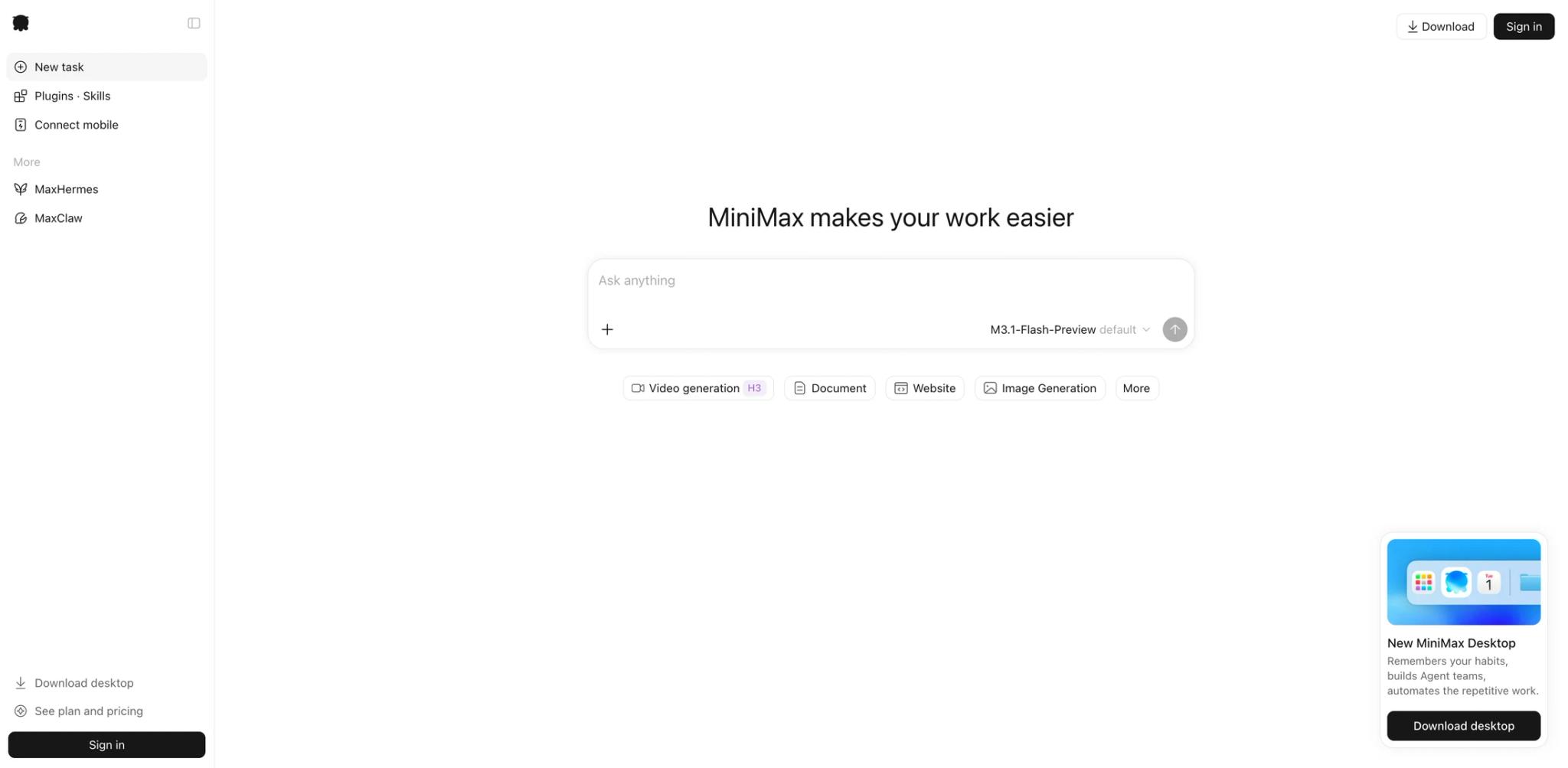
Access comes in two forms: the MiniMax Agent web platform at agent.minimax.io for interactive use, and the API platform at platform.minimax.io for programmatic integration.
Key Features
M2.7 Frontier Model — MiniMax-M2.7 supports a 204,800-token context window and outputs at approximately 60 TPS, while MiniMax-M2.7-highspeed is listed at approximately 100 TPS with the same model performance. M2.7 achieves 56.22% on SWE-Pro, 55.6% on VIBE-Pro (full project delivery), and 57.0% on Terminal Bench 2, placing it in the same tier as leading AI agent models.
Recursive Self-Improvement — M2.7 is the first MiniMax model designed to update its own memory, build new skills in its harness, and run reinforcement learning experiments autonomously. In internal trials, 100+ iterations of recursive harness evolution produced a 30% performance improvement without human intervention.
Multi-Agent Collaboration — Native support for agent teams with defined role boundaries, adversarial reasoning between agents, and behavioral differentiation. Designed for orchestration pipelines rather than single-turn chat.
Open-Source Weights — MiniMax has publicly released open weights for earlier M-series models including M1, M2, M2.1, and M2.5 on Hugging Face, with vLLM and SGLang deployment support. Check the MiniMaxAI organization page for the current status of any M2.7 open-weight release.
Office & Professional Task Automation — Trained extensively on Excel, PowerPoint, and Word workflows. M2.7 achieves a 97% skill adherence rate on complex multi-round office tasks and holds the highest GDPval-AA score (1495 ELO) among open-source models on professional productivity evaluations.
High-Speed Variant — M2.7-highspeed delivers identical results at higher throughput for latency-sensitive applications. Prompt caching is priced separately at $0.06/M read tokens and $0.375/M write tokens. MiniMax-M2.7-highspeed is officially priced at $0.60/M input tokens and $2.40/M output tokens.
How It Compares
| MiniMax M2.7 | Claude Opus 4.6 | GPT-5.3-Codex | |
|---|---|---|---|
| SWE-Pro | 56.22% | ~57% | 56.0% |
| Speed | 100 TPS | ~33 TPS | ~40 TPS |
| Input cost | $0.30/M | $5.00/M | $1.75/M |
| Open weights | ✅ | ❌ | ❌ |
| Self-hosting | ✅ (vLLM/SGLang) | ❌ | ❌ |
| Self-evolution | ✅ M2.7 | ❌ | ❌ |
Compared with Claude Opus 4.6, M2.7 reaches near-parity on software engineering benchmarks while running 3× faster at roughly 15× lower cost. Compared with GPT-5.3-Codex, M2.7 matches SWE-Pro scores with the added advantage of open weights and self-hosted deployment. The tradeoff is a younger ecosystem and less mature tooling around the model compared to the established Claude or GPT product lines.
Pricing & Plans
MiniMax offers three access paths: the Agent web platform, the pay-as-you-go API, and a Coding Plan subscription.
MiniMax Agent (Web Platform)
- Free tier available at agent.minimax.io with credit allocation
- Supports M2.7 for interactive tasks without API setup
API — Pay As You Go
| Model | Input | Output |
|---|---|---|
| M2.7 | $0.30/M | $1.20/M |
| M2.5 | $0.30/M | $1.20/M |
| M2.1 | $0.30/M | $1.20/M |
Exact M2.7 API pricing should be confirmed at platform.minimax.io/docs/pricing as rates may change with model rollout.
Coding Plan
- Subscription plan powered by MiniMax M2.x models
- Available at platform.minimax.io/subscribe/coding-plan
- Designed for development teams needing high daily usage volumes
Best For
- Developers and ML teams building AI agent pipelines who need frontier performance at low API cost
- Organizations evaluating open-source frontier models for on-premise deployment
- Software engineering teams using SWE-bench-class coding tasks where M2.7 reaches near-Opus performance
- Research teams that need fast inference (100 TPS) for high-throughput experiments
- Startups replacing expensive closed-source frontier API calls with an equivalent open-weight alternative
FAQ
What is the difference between MiniMax Agent and the MiniMax API?
MiniMax Agent (agent.minimax.io) is the web-based interactive platform where you can use M2.7 for tasks without writing code — similar to AI chatbots like Claude.ai or ChatGPT. The MiniMax API (platform.minimax.io) is for programmatic integration, offering pay-as-you-go access to M2.7, M2.5, M2.1, and other models with full API key management, usage tracking, and SDK support.
Are MiniMax model weights actually open source?
MiniMax has publicly released open weights for earlier M-series models including M1, M2, M2.1, and M2.5 on Hugging Face. The weights support deployment with vLLM and SGLang, enabling self-hosted inference without depending on the MiniMax API. Check the MiniMaxAI organization page for the current status of any M2.7 open-weight release before deploying.
How does M2.7 compare to Claude Opus 4.6 in practice?
On SWE-Pro (software engineering), M2.7 reaches 56.22% versus Opus 4.6's approximately 57% — effectively within margin of error on that benchmark. M2.7 is about 3× faster at 100 TPS and costs roughly 15× less per token. The self-evolution capability of M2.7 is unique to MiniMax and has no direct Claude equivalent. For general conversational AI, Claude Opus 4.6 remains more mature, with broader ecosystem support and Anthropic enterprise backing.
What is recursive self-improvement in M2.7?
M2.7 can update its own memory, build new harness skills, and run RL experiments autonomously. In MiniMax's internal testing, 100+ self-improvement iterations produced a 30% performance gain without human intervention. This makes M2.7 the first MiniMax model designed to participate in its own training evolution cycle rather than being a static trained artifact.
Is there a free way to try MiniMax?
Yes. MiniMax Agent at agent.minimax.io provides free access with a credit allocation, letting you test M2.7 interactively without an API key or subscription. For API testing, check the current MiniMax pricing and account pages for any available free quota. Official MiniMax docs reference free quota in some contexts, but confirm the latest terms at platform.minimax.io before relying on a fixed credit amount.