



Overview
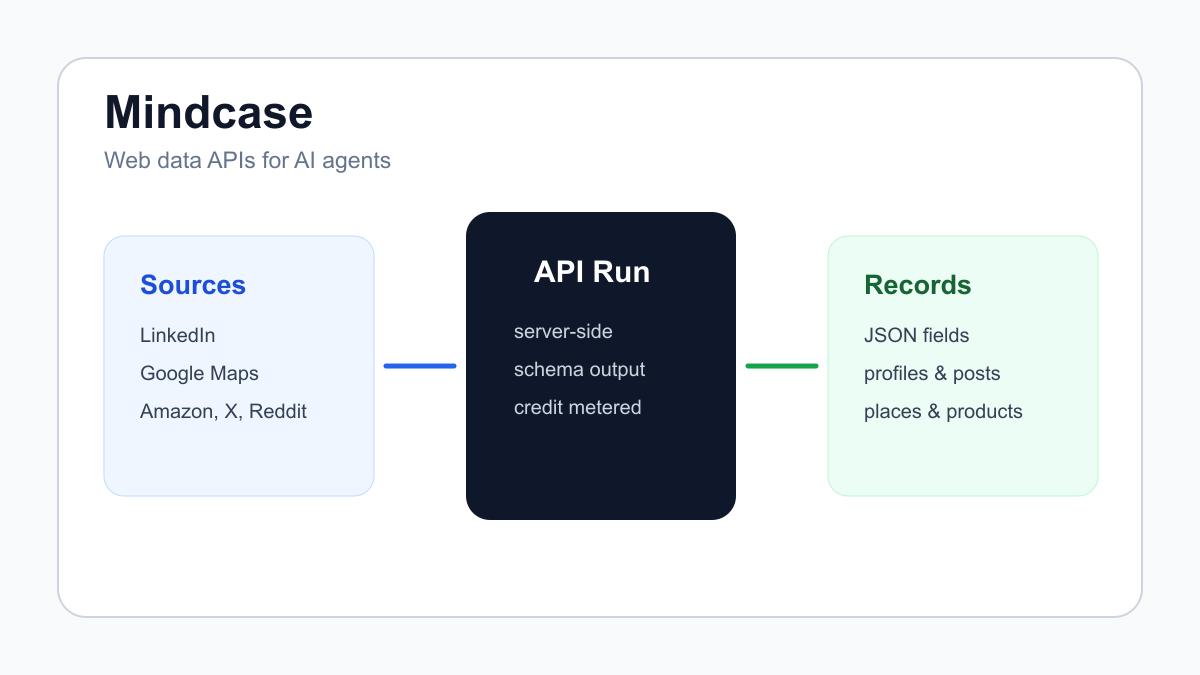
Mindcase is a web data API platform built for AI agents, developers, and data teams that need structured web data without maintaining scraping infrastructure. The official site describes it as web data APIs for AI agents and shows APIs for sources such as LinkedIn, Google Maps, Amazon, Instagram, Reddit, X, TikTok, YouTube, Facebook, Airbnb, Booking.com, Yelp, and more.
The product is most useful when a team needs repeatable structured extraction, not a one-off scrape. Instead of asking an agent to browse a site and improvise, Mindcase exposes task-specific APIs that return clean records such as profiles, posts, comments, products, places, reviews, jobs, and search results. That makes it relevant for AI data analysis, market research, sales operations, recruiting, and AI-agent tool use.
Mindcase is also agent-oriented. Its site highlights console usage, MCP connection, API keys, and server-side runs, which means the product can sit behind Claude, Codex, or a custom workflow where the agent needs live web data in a predictable schema.
Key Features
- Dozens of source-specific APIs - Mindcase lists web data APIs across social networks, marketplaces, maps, search, travel, jobs, and review platforms.
- Structured records - APIs return data such as titles, profile URLs, engagement metrics, ratings, reviews, prices, contact details, dates, and media fields depending on the source.
- Agent-ready access - Developers can use API keys, console runs, and MCP-style connection patterns to expose data extraction inside agent workflows.
- Server-side execution - Runs are handled by Mindcase, reducing the need to manage browsers, sessions, proxies, and extraction jobs yourself.
- Per-result pricing - Each API shows granular usage pricing, such as per profile, place, product, post, comment, or result.
- Custom source support - For sources outside the catalog, Mindcase offers custom data sources and managed runs.
How to Get Started
Start by choosing the exact data source and output you need. For example, a growth team might test Google Maps Places, LinkedIn Companies, or Instagram Posts. A market research workflow might test Amazon Products, Reddit Posts, or X Tweets.
Create an API key in the Mindcase console, load prepaid credits, and run a small job before automating anything. The API docs state that keys use Bearer token authentication and identify the account for credit usage. Build your first workflow around a hard limit, such as 50 records, so you can verify field quality and cost before scaling.
Pricing & Plans
Mindcase uses prepaid credits rather than monthly seats. The pricing page states that credits do not expire and lists credit purchases starting at $19.99 for $20 in credit, with larger top-ups receiving bonus credit. Individual APIs then consume credit according to their per-result prices.
| Pricing area | What to expect |
|---|---|
| Credit purchase | Starts at $19.99 for $20 credit |
| Bonus credits | Larger top-ups can include bonus credit |
| API usage | Charged per result, profile, post, place, product, comment, or similar unit |
| Custom work | Larger or custom data needs can be handled through a sales conversation |
This model is practical for teams that want to meter extraction by actual data volume. It is less predictable if agents can launch broad searches without guardrails, so production workflows should include limits and monitoring.
How It Compares
Firecrawl focuses on turning websites into AI-ready content and crawling/scraping web pages for agents and developers. Apify is broader, with a marketplace of actors and automation workloads. Mindcase is more catalog-driven: it offers specific APIs for popular sources and returns structured records for each task.
That makes Mindcase a good fit when you know the source and the record type you need. Firecrawl may be better for crawling arbitrary websites. Apify may be better when you need a large automation marketplace or custom actors.
Best For
- AI agents that need live web data as structured records
- Sales and market research teams extracting profiles, companies, places, or social posts
- Developers who need APIs instead of maintaining scrapers
- Data teams prototyping lightweight enrichment or competitive intelligence workflows
FAQ
What is Mindcase?
Mindcase is a web data API platform for extracting structured data from public web sources and making it usable by AI agents and developer workflows.
How does Mindcase price usage?
Mindcase uses prepaid credits. Each API consumes credits according to its per-result or per-record price.
Does Mindcase require an API key?
Yes. The docs describe Bearer token authentication, and API keys are used to identify the account and track credit usage.
Is Mindcase the same as Firecrawl?
No. Firecrawl focuses on web crawling and AI-ready page content. Mindcase focuses on source-specific structured APIs for common public data sources.