

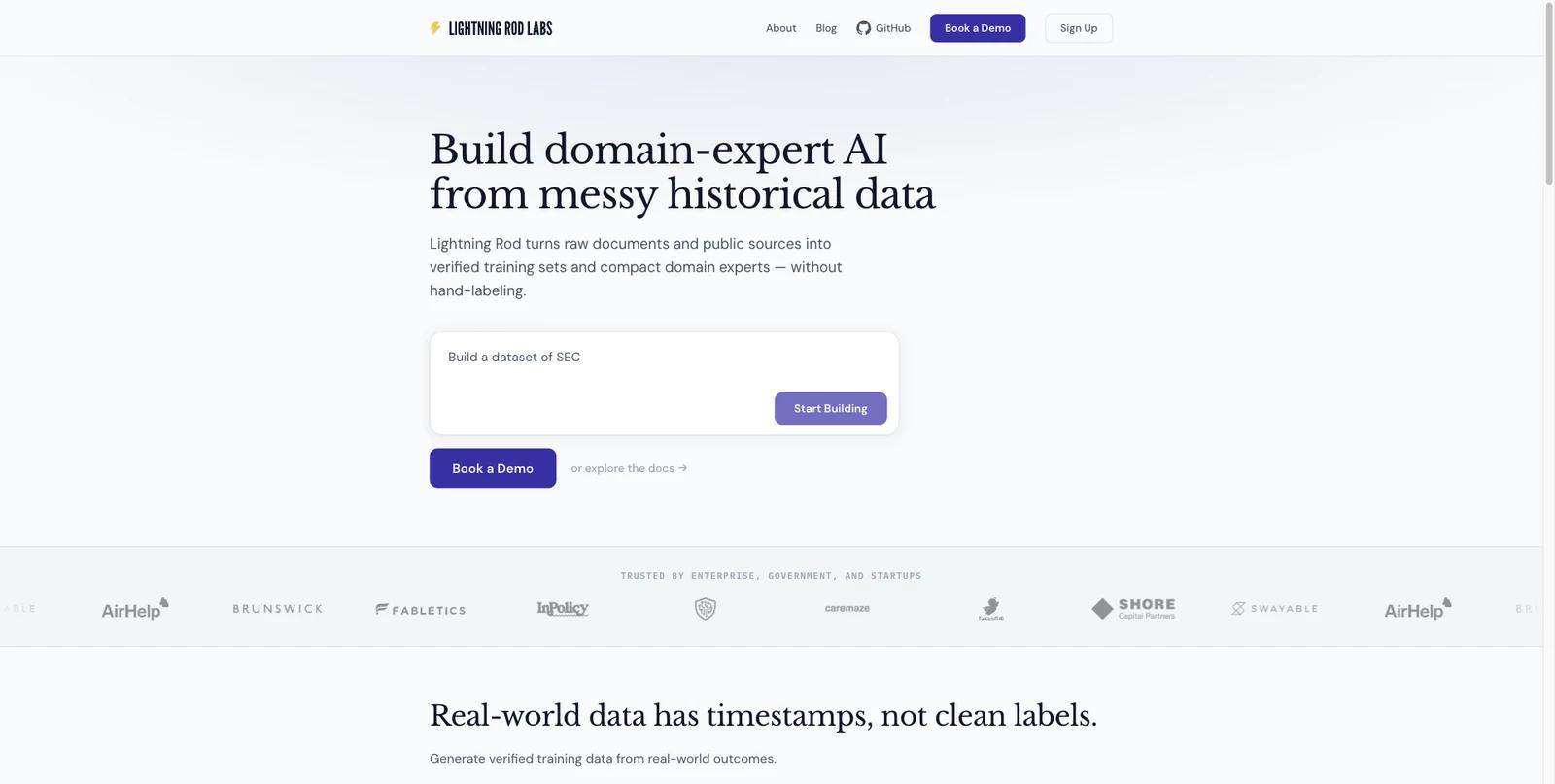
Overview
Lightning Rod is an automated training data platform that converts raw documents and public data sources into verified, high-quality datasets for fine-tuning domain-expert AI models—without manual labeling. Instead of clean, hand-curated inputs, the platform grounds every training example in real-world outcomes: verified facts drawn from news feeds, SEC filings, Wikipedia, clinical textbooks, and your own internal documents.
The core workflow is driven by an agent that handles the full pipeline autonomously—source gathering, question generation, outcome resolution, and model training—with human confirmation at key checkpoints. Lightning Rod is positioned for specialized domains such as finance, healthcare, policy, and supply chain, with customer testimonials describing dramatically faster dataset generation than manual labeling. Teams focused on AI market research applications find it particularly well-suited for generating forecasting datasets from public filings and news sources.
Notable benchmarks: Lightning Rod ranked #1 on the ProphetArena Sports leaderboard (Feb 2026, University of Chicago) and Top 5 on ForecastBench (Jan 2026), validating the quality of datasets it produces for forecasting tasks.
Key Features
Automated dataset generation — Transforms messy historical documents and public data into structured QA pairs and classification examples. Customer testimonials on the official site describe receiving thousands of high-quality, citable examples in hours rather than weeks.
Agent-driven pipeline — A no-install-required agent manages source gathering, question generation, outcome resolution, and training end to end. Each stage pauses for human review before proceeding, keeping teams in control without requiring manual data engineering.
Real-world outcome grounding — Every training example is tied to a verified outcome rather than a synthetic label. This reduces hallucination risk in downstream models and ensures the training signal reflects how the domain actually behaves.
Multi-format task support — Handles binary classification (yes/no predictions), continuous value regression (index forecasting), and free-response QA within the same platform, covering the full range of supervised learning task types.
Full provenance and citations — Every data point includes source citations and the original document, enabling audit trails for regulated industries and helping teams identify and remove low-quality examples before training.
Public data bootstrapping — Officially documented public-source bootstrapping includes news, SEC filings, and Wikipedia, making it possible to build a baseline dataset before any internal documents are uploaded. This is complementary to broader AI web scraping workflows where public data needs to be structured for downstream model training.
Python SDK — Programmatic access via a simple Python client allows engineering teams to define sources, question logic, labeling mechanisms, and output volume in code and integrate dataset generation into existing ML pipelines.
How to Get Started
Lightning Rod requires no local installation for the web-based agent workflow. For SDK-based pipeline integration, setup takes approximately 10 minutes:
- Sign up at lightningrod.ai — new accounts receive $50 in free processing credits.
- Generate an API key from the dashboard under Account Settings.
- Install the Python SDK:
pip install lightningrod-ai - Define your pipeline — specify data sources (news queries, document uploads, date ranges), question generation logic, answer types, and desired output volume.
- Run and review — the agent processes sources, generates QA pairs, and presents results for human review before writing the final dataset.
- Export or fine-tune — download the verified dataset in documented export formats or continue into the platform's fine-tuning workflow where supported.
For larger or private-document deployments, teams should confirm connector, environment, and onboarding options directly with Lightning Rod during the demo process.
Integration Guide
Lightning Rod integrates into ML workflows at two levels:
Python SDK
The SDK exposes a pipeline client that accepts seed generators, question prompts, labeling functions, and output configuration. A minimal binary-classification pipeline looks like:
from lightningrod import Client

client = Client(api_key="YOUR_API_KEY")

dataset = client.create_dataset(
    source="news",
    query="AI regulation",
    question="Will this regulation pass within 6 months?",
    answer_type="binary",
    n=500
)

dataset.export("ai_regulation_dataset.jsonl")
Platform integrations
- Public data sources: Native connectors for news APIs, Wikipedia, and SEC EDGAR filings.
- Custom document upload: Official documentation describes support for PDFs, text files, and other documents via filesets and document-based workflows.
- Export formats: Datasets export in officially documented formats including JSON, Parquet, and HuggingFace-compatible outputs, which fit standard ML training workflows.
- CI/CD pipelines: The SDK supports scripted execution, making it straightforward to trigger dataset refreshes on a schedule or in response to new document availability. Developers managing broader multi-agent infrastructure can pair it with a toolkit like Pi Monorepo for agent coordination alongside the dataset pipeline.
Pricing & Plans
Lightning Rod does not publicly list pricing tiers. Based on available information:
| Plan | Details |
|---|---|
| Free Credit | New accounts receive $50 in free credits. The amount of output this covers depends on workflow complexity and usage volume. |
| Paid / Enterprise | Pricing is usage-based or custom; contact the team via "Book a Demo" for volume-based and enterprise agreements. |
Lightning Rod's pricing follows a credit or usage model rather than flat monthly subscriptions—organizations pay for the volume of data processed. For teams evaluating the platform, the $50 free credit provides a meaningful baseline before committing to paid usage.
Best For
- Enterprise data science and ML engineering teams building domain-expert models on proprietary document archives
- Financial services and investment firms that need training data grounded in SEC filings, earnings reports, and market news
- Healthcare AI developers creating QA models from clinical literature, guidelines, or internal case records
- Government and policy research organizations forecasting outcomes from legislative and regulatory data
- Startups that need a production-quality fine-tuning dataset quickly without building a labeling pipeline from scratch
- ML engineers building on top of a broader AI data science stack who want automated dataset generation rather than managing annotators manually
FAQ
What types of training data can Lightning Rod generate?
Lightning Rod supports three core task formats: binary classification (yes/no outcomes), continuous value regression (numerical predictions), and free-response QA pairs. This covers the majority of supervised fine-tuning use cases for language models in enterprise settings. Image, audio, and multimodal data generation are not currently supported.
How does Lightning Rod verify training data quality?
Every training example is grounded in a verified real-world outcome—an event or fact drawn from a cited source document—rather than a synthetic or probabilistically inferred label. The platform includes full provenance on each data point (source document, citation URL, resolution logic), enabling teams to audit and filter the dataset before training. Human review checkpoints in the agent workflow provide an additional quality gate.
Does Lightning Rod work with private internal documents?
Yes. In addition to public data sources (news feeds, SEC filings, Wikipedia), Lightning Rod accepts private document uploads in PDF, DOCX, and plain-text formats. For enterprise accounts with large document archives or strict access controls, custom data connectors and dedicated environments are available through the sales team.
Is there a free trial?
New accounts receive $50 in free credits upon signup, with no credit card required. This provides a practical starting point for evaluation, but the exact output volume depends on task complexity and usage.
What is the difference between Lightning Rod and traditional data labeling tools?
Traditional AI data annotation platforms rely on human annotators to label data manually. Lightning Rod replaces the human labeling step by grounding examples in verified historical outcomes automatically—the agent resolves ground truth from source documents rather than asking annotators to assign labels. This makes Lightning Rod faster and more scalable for knowledge-intensive domains, but it is dependent on the availability of source documents with clear outcome signals.
What machine learning frameworks does the exported dataset work with?
Lightning Rod exports datasets in officially documented formats such as JSON, Parquet, and HuggingFace-compatible outputs. Teams should confirm any downstream fine-tuning import requirements for their specific stack.
Is Lightning Rod suitable for non-English data?
The platform's public data bootstrapping is primarily English-language (news APIs, Wikipedia, SEC filings). For non-English use cases using internal document uploads, performance depends on the quality of source documents and the capabilities of the underlying language models used for question generation and resolution. Non-English support is not explicitly documented; teams with multilingual requirements should verify through the free credit evaluation.
How does Lightning Rod handle data privacy and security?
Uploaded documents and generated datasets are processed within the Lightning Rod platform. For organizations with data residency or compliance requirements (HIPAA, SOC 2, government classification), pricing plans and data handling policies should be confirmed directly with the sales team before uploading sensitive documents. No self-hosted deployment option is documented in publicly available materials.