

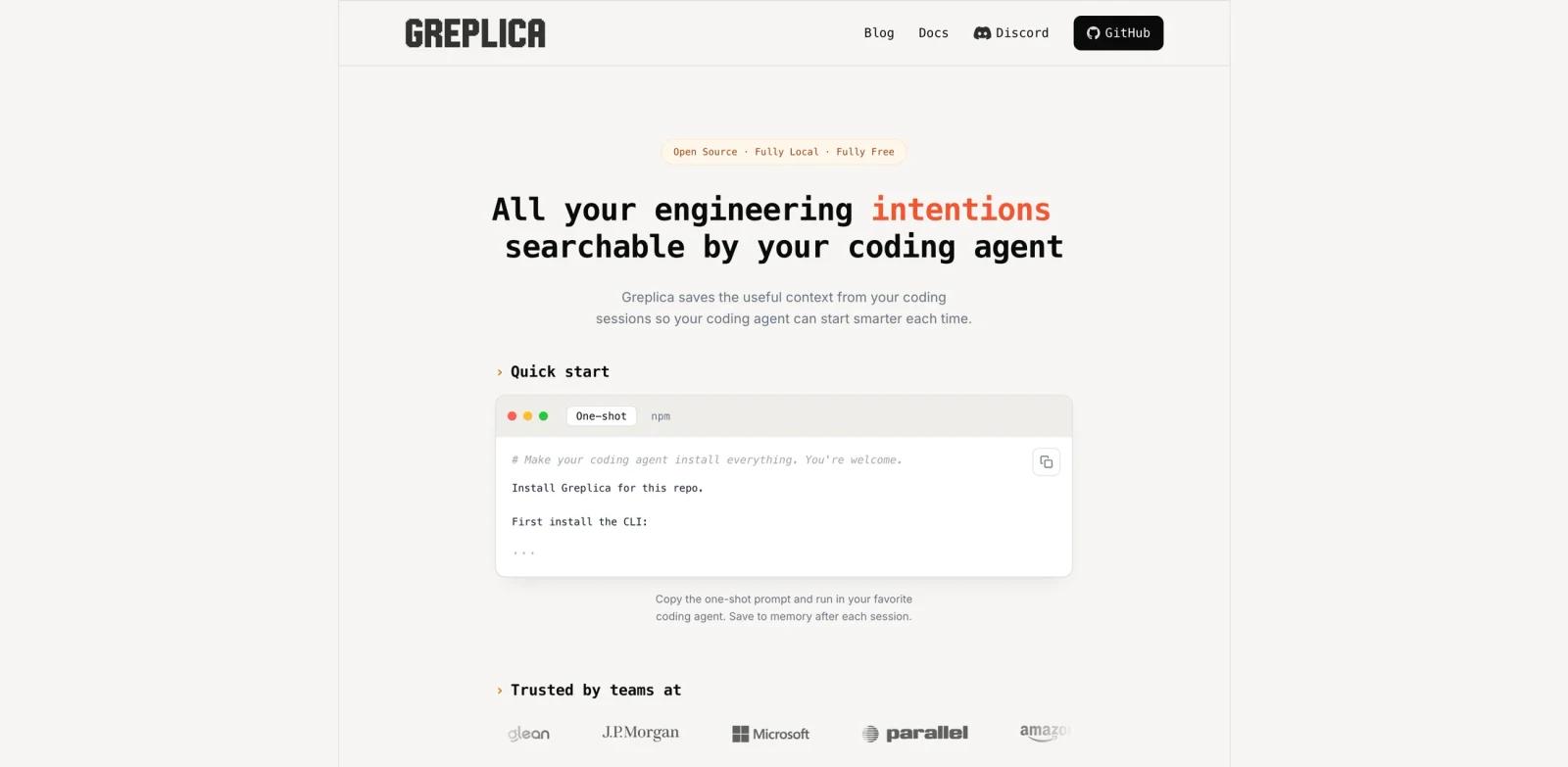


Overview
Greplica is an open-source memory layer for AI coding agents. It stores the useful context that normally disappears between sessions: engineering decisions, constraints, gotchas, failed approaches, file-level notes, and repo-specific patterns. The goal is simple: when Claude Code, Codex, or another coding agent starts a new task, it can retrieve the relevant history instead of rediscovering the same context manually.
The product is aimed at teams already using AI coding agents for real engineering work. Static AGENTS.md or CLAUDE.md files are useful, but they become stale and cannot hold every decision from every agent run. Greplica turns that knowledge into a searchable graph so agents can ask for task-specific context before broad exploration.
Greplica is especially interesting because it is local-first and free. The public site positions it as open source, fully local, and usable without a new API key. That makes it a practical experiment for teams that want better agent continuity without sending private codebase memory to another hosted SaaS product.
Key Features
- Persistent engineering memory - Saves useful decisions, constraints, gotchas, and repo context from coding sessions so future agent runs can start with prior knowledge.
- Agent-native setup - Provides install flows for Codex, Claude Code, and OpenCode, so the memory workflow can be triggered from the same agent environment developers already use.
- Hybrid retrieval - Combines keyword search, semantic search, and graph connections to return relevant context instead of dumping a long flat document into the prompt.
- Self-updating wiki - Structures memory as linked nodes across components, flows, and decisions, helping the knowledge base grow as the repo changes.
- Fully local storage - Stores memory on the developer machine, with the public site describing local storage under the user home Greplica database and no telemetry or cloud requirement for the local mode.
- Open-source workflow - The code is public on GitHub, which matters for a tool that reads engineering context and influences future agent decisions.
How to Get Started
Greplica is a developer tool, so setup is closer to a CLI workflow than a SaaS onboarding screen.
- Install the CLI globally with npm.
- Run the installer for your agent platform, such as Codex or Claude Code.
- Choose local embeddings for a no-API-key setup, or switch later to OpenAI embeddings if you prefer hosted semantic search.
- Bootstrap the repo once so Greplica can build the initial graph.
- During future tasks, ask the agent to retrieve relevant Greplica context before broad manual exploration.
- At the end of useful sessions, update working memory so decisions and follow-up work are retained.
Teams should still keep a small Claude Code or AGENTS guidance file for critical operating rules. Greplica is best treated as a retrieval layer for detailed repo memory, not as the only source of mandatory instructions.
Pricing & Plans
Greplica is currently positioned as fully free and open source.
| Plan | Price | Notes |
|---|---|---|
| Local open-source mode | Free | Runs locally, with no separate API key required when using local embeddings. |
| OpenAI embeddings | Usage-based external cost | Optional if teams switch from local embeddings to OpenAI embeddings. Greplica itself is still open source. |
| Managed shared mode | Not publicly detailed | Product Hunt mentions a managed shared mode, but public pricing details were not visible during this review. |
For most solo developers, the meaningful cost is setup time. For teams, the cost question is whether they want a managed shared memory layer across developers, forks, and clones.
Best For
- Engineering teams using Codex, Claude Code, OpenCode, or similar agents across the same repo
- Developers maintaining large codebases where architectural context is expensive to rediscover
- Teams that want a local-first alternative to hosted agent memory products
- Solo builders who repeatedly return to projects after days or weeks away
- Agent-heavy workflows where AI code review, refactoring, and implementation decisions need continuity
FAQ
What is Greplica?
Greplica is an open-source memory system for AI coding agents. It stores repo-specific engineering context and retrieves relevant notes for future tasks.
Does Greplica work with Codex?
Yes. The public install instructions include Codex, Claude Code, and OpenCode setup paths. It is positioned as agent-agnostic rather than tied to one assistant.
Is Greplica free?
Yes. Greplica is currently positioned as open source, fully local, and free to use. Optional hosted embeddings or managed sharing may introduce external costs or future paid tiers.
Where does Greplica store data?
The public site describes local storage under the user's Greplica graph database for the local mode. Teams should review the GitHub repo and configuration before using it with sensitive codebases.
Does Greplica replace AGENTS.md or CLAUDE.md?
Not completely. It can reduce dependence on large static docs, but mandatory workflow rules should still live in a small, explicit instruction file. Greplica is better for searchable, evolving context.
What is the biggest risk?
The main risk is stale or incorrect memory. Teams should pay attention to provenance, expired assumptions, and failed approaches that may no longer be true after refactors.