

Overview
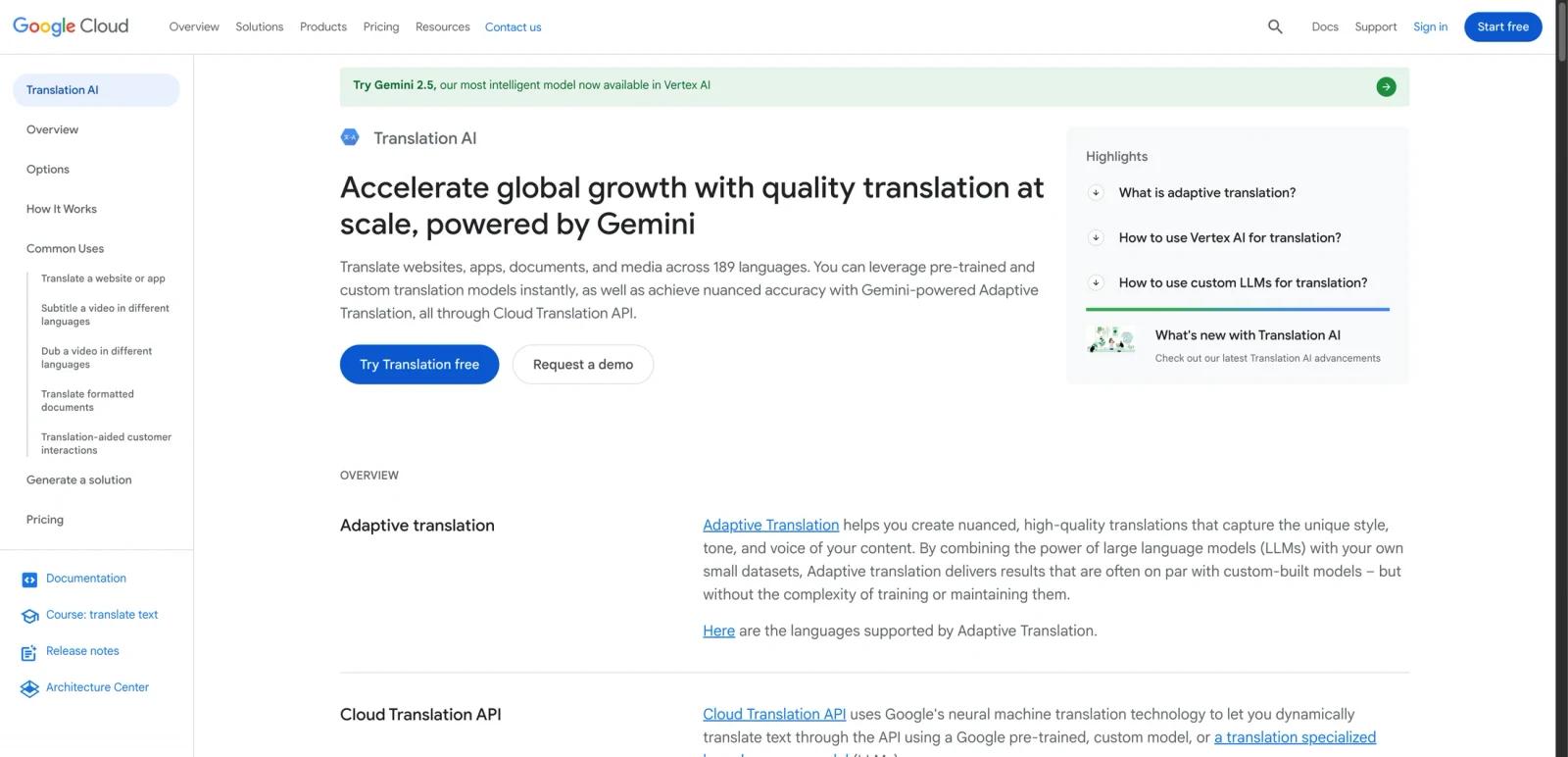
Google Cloud Translation is Google's managed machine translation product for translating text, documents, websites, apps, and media workflows at scale. The current product page brands it as Translation AI and now frames the service around Gemini-powered translation, Adaptive Translation, and a broader portfolio that spans standard API translation, formatted document workflows, and enterprise translation operations.
This is not just a simple text-translation widget. Google positions Cloud Translation as infrastructure for multilingual products and content pipelines. That means the offering covers several translation modes: standard neural machine translation, large-language-model-based translation, adaptive translation using customer examples, and Translation Hub for managed enterprise document workflows.
As of April 24, 2026, the product page highlights support for 189 languages, free monthly character allowances for the core API, document translation, LLM-based translation tiers, and use cases ranging from websites and apps to subtitles, dubbing, and multilingual contact centers. For most buyers, the important question is not whether it translates text at all, but which edition and pricing model fits their content type and quality requirements.
For adjacent research, compare AI video generator tools, AI video editor tools, AI thumbnail maker tools.
Key Features
Translate across 189 languages — Google currently positions Translation AI around translation for websites, apps, documents, and media across 189 languages, which makes it relevant for global product and content teams.
Multiple translation modes — The platform supports standard Neural Machine Translation, Translation LLMs, and Adaptive Translation, giving teams more than one quality-versus-cost option instead of a single fixed model path.
Adaptive Translation with customer examples — Google describes Adaptive Translation as a way to get more nuanced output using LLMs plus smaller customer datasets, without the full overhead of training and maintaining custom models.
Basic and Advanced API editions — Cloud Translation API comes in Basic and Advanced editions. Basic is better for simpler, high-volume use cases, while Advanced adds customization, glossary support, document translation, and batch workflows.
Document translation with format retention — The Advanced edition supports direct translation of formatted files, including Google Workspace files, Microsoft Office files, and PDFs, while preserving layout and structure.
Fits into broader multilingual media workflows — Google explicitly ties Translation API to Speech-to-Text, Text-to-Speech, Transcoder API, and contact-center tooling for subtitles, dubbing, and multilingual customer interactions.
Pricing & Plans
Google Cloud Translation uses multiple pricing models depending on the translation method. The current pricing table on the product page shows a generous free allowance for standard API translation, then tiered pricing for NMT, custom translation, Translation LLMs, Adaptive Translation, and Translation Hub document workflows.
| Option | Price | Positioning |
|---|---|---|
| Translation API NMT | First 500,000 characters/month free as a combined Basic + Advanced monthly credit, then $20 per million input characters per target language up to 1B characters/month; over 1B characters/month requires contacting sales | Best for standard machine translation at scale |
| Document translation (API) | From $0.08 per page | For formatted document workflows |
| Custom Translation | First 500,000 characters/month free as a $40 monthly credit, then $80 per million input characters up to 250M characters/month, with lower published volume tiers above that; custom model training is billed separately at $45/hour, capped at $300 per training job | For domain-specific translation quality |
| Translation LLM | $10 per million input characters and $10 per million output characters | For LLM-based conversational and nuanced translation |
| Adaptive Translation | $25 per million input characters and $25 per million output characters | For style-aware translation using customer examples |
| Translation Hub | From $0.15 per page per target language | Managed enterprise document translation workflows |
The key pricing nuance is that there is no single “Google Translation AI price.” Cost depends on which translation path you choose, whether you are translating plain text or full documents, and whether you need customization or human-review workflows. For simple web and app translation, standard NMT is usually the simplest baseline and often the cheapest predictable path; Translation LLM can be cost-comparable but bills both input and output characters. For brand-sensitive, domain-specific, or enterprise document operations, the higher-value tiers become more relevant.
Best For
- Teams translating websites, apps, and support content at scale
- Enterprises managing multilingual document pipelines and review workflows
- Products that need translation inside broader Google Cloud architectures
- Builders who want multiple translation model options instead of one fixed engine
- Localization workflows that may later expand into subtitles, dubbing, or contact-center translation
FAQ
How much does Google Cloud Translation cost?
It depends on the translation mode. Standard NMT translation starts with the first 500,000 characters per month free, then from $20 per million characters. Other tiers such as Translation LLM, Adaptive Translation, document translation, and Translation Hub use different pricing models.
How many languages does Google Cloud Translation support?
The current product page highlights support for 189 languages.
What is Adaptive Translation?
Google describes Adaptive Translation as a Gemini-powered approach that combines large language models with smaller customer datasets to produce more nuanced, style-aware translations without the overhead of fully custom model training.
What is the difference between Basic and Advanced Translation API?
Basic is better for simpler, high-volume translation tasks. Advanced adds more enterprise and customization features such as glossaries, document translation, and batch workflows.
Is there a free tier?
Yes. Google currently states that the first 500,000 characters processed by Translation API Basic and Advanced combined each month are free as a monthly credit, though that free allowance does not apply to LLM-based translation tiers.
Can Google Cloud Translation handle subtitles or dubbing workflows?
Yes, but usually as part of a broader pipeline. Google explicitly connects Translation API with Speech-to-Text, Text-to-Speech, and Transcoder API for subtitle and dubbing use cases.