



Overview
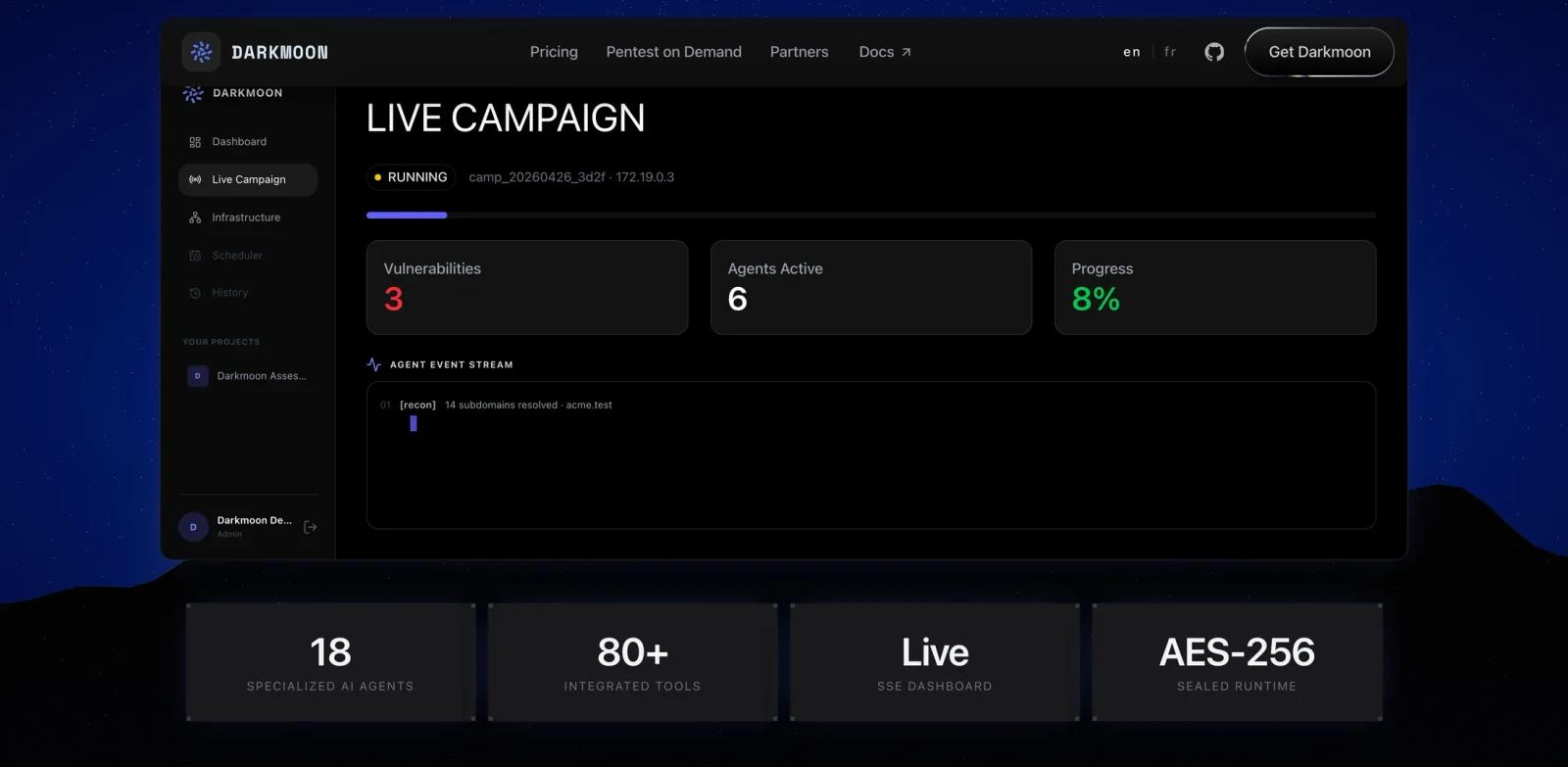
Darkmoon is an autonomous penetration-testing platform that uses specialized AI agents to plan and coordinate offensive security assessments. It covers web applications, APIs, cloud infrastructure, Active Directory, Kubernetes, content management systems, and networks rather than limiting analysis to a single scanner or web layer.
Its architecture separates reasoning from execution: AI agents plan actions, an MCP layer controls allowed tool calls, and an isolated Docker toolbox runs the security utilities. The open-source repository is licensed under GPLv3 and supports cloud LLM providers or local models. Darkmoon is relevant to ToolWorthy's AI agent readers and teams evaluating AI code checking, but it requires substantially more security expertise and authorization than a normal developer assistant.
Darkmoon should only be run against systems the user owns or has explicit written permission to test. Automated findings also require human validation before remediation or disclosure.
Key Features
Multi-agent assessment planning - Detects target technologies and dispatches domain-specific agents for web, AD, Kubernetes, network, API, and CMS testing.
Controlled MCP execution - Keeps the AI reasoning layer away from direct shell access and routes operations through a gatekept tool interface.
Integrated offensive toolbox - Coordinates dozens of established security utilities for discovery, scanning, exploitation validation, and attack-path analysis.
Evidence-backed findings - Records requests, payloads, responses, logs, and reproducible proof instead of returning only generic vulnerability labels.
Live command center - Streams agent events, campaign state, findings, and infrastructure relationships into a dashboard.
Structured reporting - Produces Markdown and PDF reports with CVSS scoring and MITRE ATT&CK mapping; paid features add branded formats.
How to Get Started
The Community edition requires Docker and Docker Compose plus an LLM provider key or supported local model. Clone the repository, run the installer, configure the provider, and begin with a deliberately vulnerable lab rather than a production target.
Define the target, credentials, exclusions, testing noise, and reporting format before launching a campaign. Security teams should document scope approval and keep a human analyst in the loop for finding validation, especially before making changes or contacting a third party.
Pricing & Plans
Darkmoon combines an open-source core, a professional license, and a managed pentest service.
| Option | Price | Notes |
|---|---|---|
| Community | Free | GPLv3 self-hosted engine, AI agents, integrated tools, controlled execution, community support |
| Pro | €149/month | Billed €1,788 annually; hardened runtime, managed command center, branded reports, hardware-bound license, priority email support |
| Pentest on Demand | €799/engagement | Managed assessment, legal framework, expert operation, debriefed report |
Running the Community edition can still incur model API, compute, storage, and security-lab costs.
Best For
- Authorized penetration testers automating repeatable assessment workflows
- DevSecOps teams testing owned staging environments after builds
- Security researchers working in controlled labs
- Organizations that need self-hosted AI security tooling
- Teams that can review evidence and manage false positives responsibly
FAQ
What does Darkmoon do?
Darkmoon plans and runs authorized penetration tests by coordinating specialized AI agents with security tools, then generates evidence-backed findings and reports.
Is Darkmoon open source?
Yes. The Community repository is published under the GNU GPLv3 license.
Is Darkmoon free?
The Community edition is free to self-host. Pro is listed at €149 per month billed annually, and managed engagements start at €799.
Does the AI receive shell access?
The documented architecture routes tool execution through a controlled MCP layer and isolated Docker toolbox rather than giving the reasoning model direct shell access.
Which environments can it assess?
The official sources list web applications, APIs, networks, cloud infrastructure, Active Directory, Kubernetes, and several CMS and application stacks.
Which models can it use?
The repository documents cloud providers such as Anthropic, OpenAI, and OpenRouter, along with local options including Ollama and llama.cpp.
Can I run it against any website?
No. Use it only on systems you own or are explicitly authorized to test. Unauthorized penetration testing may be illegal and harmful.
Are the results guaranteed accurate?
No. Darkmoon's documentation recommends analyst review. Automated evidence improves triage, but severity, exploitability, and remediation still need human validation.