
6 Best AI User Research Tools 2026 — From Sessions to Decisions
Choose AI user research tools by the evidence you need: existing interviews, observed product use, new conversations or in-product feedback. Compare six workflows and their limits.

On this page
A folder full of interviews, a confusing onboarding flow and a question nobody has asked customers yet need different tools. An AI summary can help with the first. It cannot supply the missing participants for the other two.
Start with the evidence you need for one product decision. Dovetail and Looppanel help analyze material you already have. Maze and UserTesting help run studies with people using or discussing a product. Outset is worth evaluating for AI-led interviews with real participants. Sprig fits teams collecting feedback across product journeys and survey channels.
This is an official-source comparison checked on October 23, 2026, not a hands-on accuracy or speed benchmark. The order groups workflows; it does not rank research quality. If your goal is market sizing or competitive intelligence, use our AI market research comparison. If you need wireframes and design handoff, start with AI UX design tools.
AI user research tools at a glance
| Tool | Start with this problem | First boundary to check |
|---|---|---|
| Dovetail | Existing interviews and feedback need a reusable evidence base | Free is one project and one channel; broader rollout needs a quote |
| Looppanel | A researcher needs notes, editable tags and source clips | Solo is one editor with project-level search; cross-project access changes the plan |
| Maze | You need prototype tasks or AI-moderated sessions | AI moderation is Enterprise; mobile AI sessions cannot screen-share |
| UserTesting | You need people to attempt tasks and explain what happens | Edition and consumption model both affect access and cost |
| Outset | You need AI-led human interviews or Figma task studies | Confirm task/device access; separate real interviews from Digital Twins |
| Sprig | You need feedback from users across product journeys | Enterprise quote; response volume, capabilities and deployment affect cost |
The immediate elimination question is: Do you already possess the evidence? If yes, compare analysis and retrieval. If no, compare how each platform reaches appropriate participants and captures the behavior or answers you need.
Compare the evidence you get back
These dimensions matter more than whether a vendor lists an AI assistant. A claim you cannot trace back to a person, session or response is difficult to challenge in a product review.
| Tool | Collection or input | Evidence and review workflow |
|---|---|---|
| Dovetail | Calls, recordings, documents and survey feedback | Cited customer evidence supports chat and product briefs; inspect source context |
| Looppanel | Recordings, open-ended surveys, notes and documents | AI notes and editable themes link back to sources; make video clips |
| Maze | Prototype studies; separate AI-moderated interview format | AI-study themes, highlights, recordings and downloadable transcripts |
| UserTesting | Unmoderated tasks and live moderated conversations | Task summaries combine verbal and behavioral data; View source opens supporting evidence |
| Outset | AI-led human interviews, native Figma tasks and existing recordings | Behavioral signals, playback and tagged transcripts; confirm contracted access and exports |
| Sprig | Surveys through in-product, email, links and external panels | AI-assisted study design and synthesis; pilot response-to-finding traceability |
For existing recordings, Dovetail's free project offers a low-cost first experiment; Looppanel makes an explicit distinction between a solo analysis workflow and a team repository. For observed usability, compare Maze and UserTesting using the same device and task; include Outset when you want AI-led probing around an interactive Figma flow. For new discovery conversations, compare Outset with Maze's AI-moderated study format. Sprig belongs on the shortlist when the moment and channel of feedback collection are central to the question. These are starting routes, not exclusive capability categories.
Do not confuse an AI moderator with an AI respondent. A moderator asks a real person questions. A simulated respondent produces model-generated answers. Both may appear inside one vendor's platform, but they are different evidence types.
Free access, paid gates and the real study bill
Public pricing and limits below were checked on October 23, 2026. USD figures are the vendor's public USD offers, not a local-currency or tax-inclusive checkout quote. Custom pricing is unknown until scoped; it is not zero. A trial is not an ongoing free plan.
| Tool | Entry point | What changes the purchase |
|---|---|---|
| Dovetail | Free: one project, one channel, basic chat and summaries | Enterprise quote for multiple projects and wider organizational features |
| Looppanel | 15-day trial; Solo $49/month with one editor | Pro $395/month includes five editors; analysis runs rise from one to three/project |
| Maze | Plan access depends on study format | AI moderation and advanced panel filters require Enterprise; recruitment costs extra |
| UserTesting | Custom quote | Test-based consumption versus team-based unlimited within a defined scope; edition determines capabilities |
| Outset | Custom subscription and add-ons | Specify interview volume, recruiting, seats, services and exports in the quote |
| Sprig | Enterprise quote | Response volume, activated capabilities and link/email/web/mobile deployment scope |
Recruitment can be a separate budget. Maze's published panel rates are $5 per credit: a Core Network AI-moderated response uses five credits, while a Core unmoderated response uses three. Ten Core AI-moderated responses therefore cost $250 in panel credits, before the platform contract; that is an illustration of the published unit price, not a recommendation that ten people are enough. Credits expire after 12 months. Maze panel-credit documentation.
Ask every vendor to price the same small brief: your target audience, study format, number and length of sessions, required devices, editors and exports. Include incentives, difficult-audience recruitment, reruns and renewal terms. Otherwise two apparently comparable quotes may buy different research.
Choose by your research bottleneck

Best for: teams turning existing customer material into a searchable body of evidence that can inform product planning.
Dovetail positions its research workflow around cited customer evidence, AI chat and briefs. That matters when a PM asks whether a proposed feature addresses a repeated problem or just one memorable sales call. Use the links to inspect what people actually said before turning a generated answer into a roadmap commitment. Official product workflow.
The free plan provides one project and one feedback channel with basic chat and summaries. It is a concrete starting point for one study, not evidence that a whole research organization can run free. The current pricing page lists Free and custom Enterprise; old per-seat Professional prices are not a reliable current buying basis. Current plans.
Dovetail also offers paid Digital Twins built from existing customer material. Their generated answers are not fresh interviews with real participants and should not be confused with the Free plan's basic chat. This recommendation concerns checking existing evidence, not treating a simulation as another research participant. Official launch and availability.
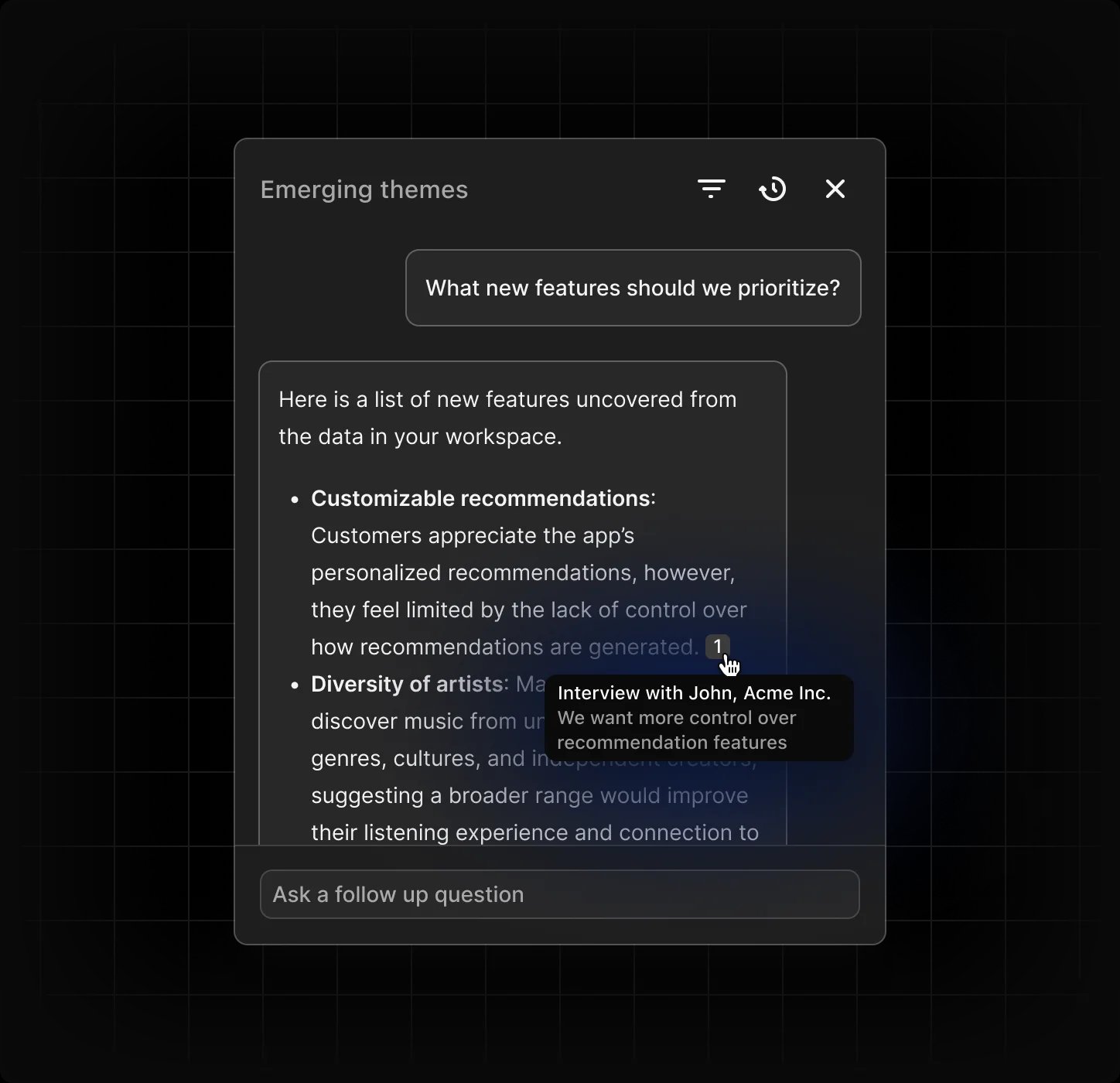
Vendor-provided product example, not a ToolWorthy account test. The decision-relevant feature is the connection between an answer and its supporting customer material.
Skip if: your immediate problem is recruiting people or watching them attempt a new task. Start with a study-delivery platform; an evidence repository alone does not solve that problem.
First elimination test: import a small, consented study with a known disagreement between participants. Ask a focused question, open the cited passages and check whether the disagreement survives. Reject the fit if the output hides important exceptions or your team cannot reliably reopen the supporting material.
Looppanel
Best for: researchers who want interview notes, question-based analysis and editable themes without handing interpretation entirely to an automated report.
Looppanel supports recordings, survey open-ends, app reviews, notes and documents. Its AI tags can be edited, and the vendor documents tracing notes and tags back to sources. Manual tags remain when auto-tagging is used. This makes it a relevant comparison with Dovetail when the working unit is an interview project and discussion guide. AI research assistant.
The plan distinction matters more than the word unlimited. Solo includes one editor, project-level search and one auto-analysis run per project. Pro includes five editors, global search and three runs per project. The public page contains conflicting transcription/upload rows: one says unlimited, while another lists five hours and five uploads for Solo. Confirm the applicable quota before committing a backlog; neither reading removes the stated analysis-run cap. The official monthly selector shows $49/month for Solo and $395/month for Pro; the annual selector shows $540/year and $4,200/year, respectively, in USD at this check. A 15-day trial is available. Compare the actual billing commitment, not an annual equivalent against a monthly bill. Plan details.
Skip if: you require several people to edit or query across projects while budgeting only for a solo seat. Also check whether your expected second analysis pass fits the run allowance.
First elimination test: load three interviews using one discussion guide. Correct an AI tag, create a clip and find a counterexample to the main theme. Then add another interview and inspect what a new analysis consumes. The useful outcome is a reviewable project, not simply a shorter transcript.

Best for: product teams comparing prototype tasks with AI-moderated discovery inside one research platform.
Maze supports prototype testing, but an AI-led interview is a separate study format. Current help documentation places AI-moderated studies on Enterprise. In that format, microphone access is required; camera settings are configurable. A Website task requires screen sharing and disables tablet/mobile access because AI-moderated mobile screen sharing is not supported. Do not buy it assuming that mobile-web participation means mobile screen-recorded usability testing. AI-moderated setup and device limits.
Analysis includes session recordings, transcripts, highlights and themes. You can download transcripts and recordings, add highlights and edit themes. Those review steps matter more than accepting the generated report as a complete explanation. Analysis and reporting.
For unmoderated studies, purchasing panel participants is available on all plans, but advanced audience filters—including work and professional criteria—require Enterprise. Your own knock-out questions are not a free substitute: the panel documentation says screened-out participant sessions still incur payment. Confirm audience eligibility before applying the per-response budget above. Recruitment and filter limits.
Skip if: your essential study is an AI-moderated screen-share on a phone. Evaluate a supported mobile study format instead, and confirm the exact package rather than assuming all Maze methods share the same limits.
First elimination test: build one representative task on the actual participant device. Check permissions, study-format eligibility and whether the exported evidence captures the failure you need to diagnose. Price your real audience separately from the platform subscription.
UserTesting
Best for: organizations that need task-based observations, participant access and both unmoderated and live conversations.
UserTesting combines those study formats with transcripts and AI-assisted analysis. Its public plans distinguish test-based consumption from team-based unlimited within a defined enterprise scope. Neither phrase tells you the final price or every feature entitlement. Ultimate adds capabilities such as Insights Discovery beyond the Advanced edition's advertised summary features. Plans and editions.
There is a specific documentation mismatch worth resolving before purchase: the plans page advertises AI-generated Insight Summaries under Advanced, while the dedicated help page marks its AI insight summary capability for Ultimate/Ultimate+. Ask the vendor to identify the exact task-level feature on your quote. That help page also limits the described summary workflow to unmoderated studies with up to 25 contributors and provides a View source action. AI insight summary documentation.
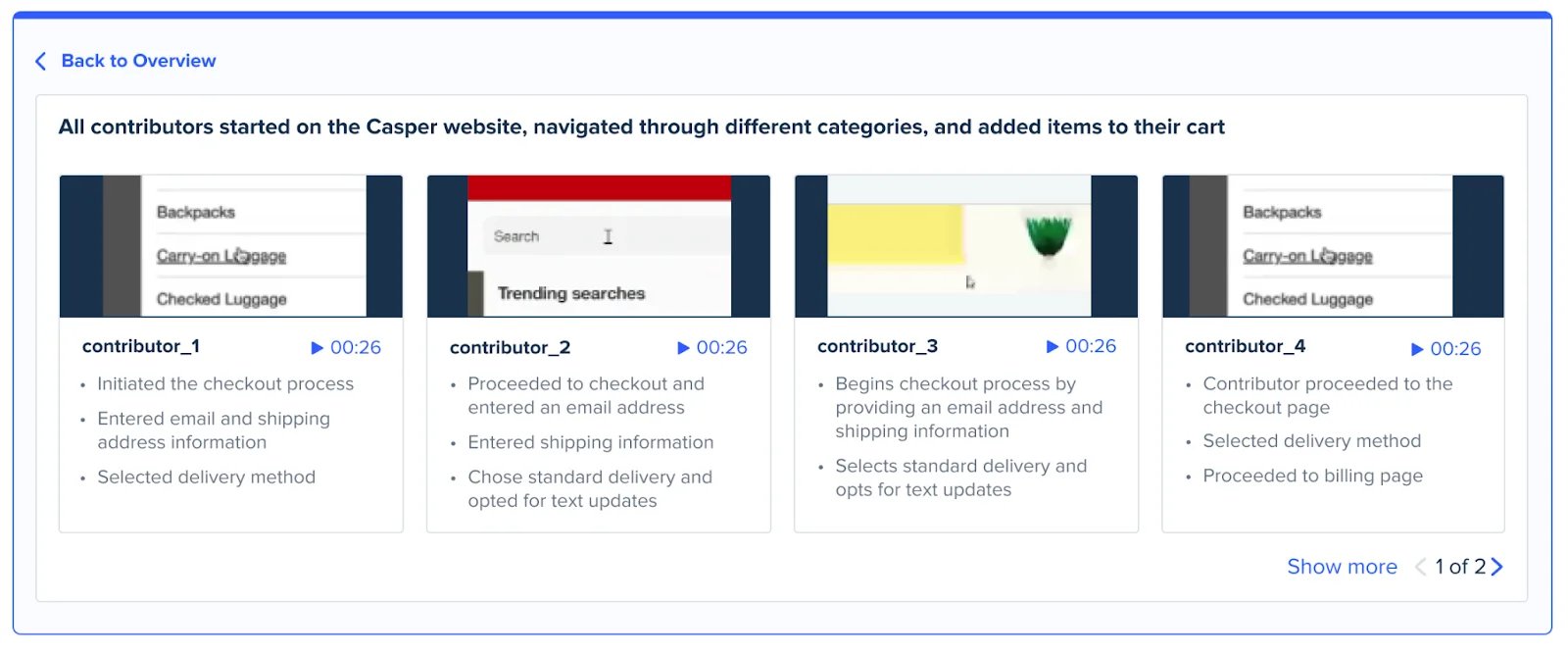
Official help-center example. It illustrates opening supporting evidence; it does not establish that every UserTesting plan includes this feature.
Skip if: you only need to summarize a small archive of existing interviews and cannot justify a study-delivery contract. Compare repository-focused options first.
First elimination test: have representative participants attempt one task. Compare the AI account of the problem with the recording, clicks and spoken explanation. Confirm that the specific summary and source-view controls demonstrated are included in the edition you would buy.
Outset
Best for: teams with a clear qualitative research brief that want an AI interviewer to collect responses from real participants.
Outset's offering includes text, voice and video response formats, bring-your-own audiences or recruitment options, interview playback, tagged transcripts and exports. Access varies with the custom plan and add-ons. Request a quote that separates software, recruiting and research services; do not infer that every listed capability is included. Official scope and pricing.
It is not limited to spoken opinions. The June 2026 Figma integration loads interactive prototypes inside a study and combines behavioral signals with the interview analysis. That makes it relevant alongside task-testing platforms when AI-led probing around a design is the requirement. Verify your prototype, participant device and contracted access in a pilot; this is a documented capability, not our assessment of probing accuracy. Official Figma integration.
The current site also promotes Digital Twins built from interviews with individuals. Their later answers are simulations, even when informed by real quotes and confidence labels. This guide's recommendation concerns interviews with actual participants. Label simulated follow-ups separately and return to people when a decision needs fresh observed evidence. Outset's Digital Twins description.
Skip if: the study depends on a researcher noticing an unexpected interaction and deciding how to probe it live. Evaluate a human-moderated route alongside any automated format.
First elimination test: pilot a short guide that includes a deliberately ambiguous answer and an unexpected objection. For a prototype study, add one task with a known wrong turn and compare the observed interaction with the follow-up transcript—not just the executive summary. Verify the exports you need and whether the quoted package includes the audience and task format you intend to study.
Sprig
Best for: teams whose research question depends on collecting feedback at specific points across a product journey, with additional survey channels available.
Sprig's current platform describes agents for study design, fielding and synthesis. It supports reaching respondents in-product, by email, links and external panels. That is a different starting point from uploading a completed interview archive: you must define who receives the study and when. Current platform explanation.
The current pricing is enterprise-scoped by response volume, activated capabilities and deployment environments. Do not reuse older self-serve dollar figures as a current offer. Also, its separate statistical Analyze agent page is marked Coming soon at this check; do not buy on the assumption that the advertised analysis methods are already enabled for your account. Pricing, Analyze agent status.
Skip if: you lack an appropriate audience or the ability to deploy the study in the channel required by your question. A polished survey summary cannot fix sampling the wrong users.
First elimination test: target one meaningful journey moment, such as abandoning setup. Verify who qualifies, how often they are prompted, whether answers remain traceable and what happens to nonresponders. Treat survey explanations as reported reasons, not automatic proof of what caused a behavior.
Other candidates worth a focused look
Condens is a useful adjacent option for analysis that keeps researcher-controlled highlights central. Its help documentation distinguishes searching raw sessions from reviewed highlights and says AI search retrieves relevant evidence rather than independently drawing conclusions. Consider it if that boundary better matches your research practice; it overlaps the repository lane already compared here. Condens AI search.
Listen Labs is a direct alternative to evaluate beside Outset for AI-led human studies. Its technology offering describes recruitment or your own audience, prototype/product screen sharing, slides and highlight reels. Compare both using the same audience and deliverables brief; we have not established a performance winner or a current public numeric price for Listen Labs. Official technology workflow.
User Interviews deserves a separate look when participant recruitment is the bottleneck. Its screening, scheduling and incentive workflow is useful even if you keep your existing interview and analysis tools. Recruitment access should not be mistaken for the full testing or repository workflow. Official recruiting overview.
Run one evidence check before committing
Use a small study that resembles your actual work. Keep the same question, audience and material when comparing tools. With permission to use the data, check these five outcomes:
- Source fidelity: can you open the passage or recording behind a finding, with enough surrounding context to challenge it?
- Exceptions: does the summary preserve the participant who disagreed, or smooth them into the majority?
- Method fit: do you need observed task behavior, reported opinion or existing-recording analysis? Keep those outputs distinct.
- Portability: export a transcript, recording and final finding. Confirm which useful relationships survive outside the platform; a PDF is not a portable editable repository.
- Full cost: count recruitment, incentives, editor access, analysis reruns and required controls alongside the license.
Use appropriately consented and minimized research material. Confirm who can see recordings, retention/deletion behavior and the handling of AI processing before uploading confidential sessions. These are selection questions; this comparison does not certify a product for your organization's data requirements.
If a simple spreadsheet and a few carefully reviewed recordings already support the decision, finish that study first. Buy additional automation when you can name the repeated work it will remove and the evidence you still need to inspect.
Frequently asked questions
What is the best free AI user research tool?
Dovetail has a documented free starting point for one project and one channel with basic chat and summaries. That can suit a bounded analysis exercise with existing data. It does not make recruiting or a multi-project repository free. Compare the actual first task and ongoing limits rather than trial length alone.
Can AI replace user interviews?
AI can help prepare questions, conduct supported interview formats or organize responses. A simulated answer is not a new interview with a real user. Keep human-led interviews available when contextual probing matters, and verify AI findings against the collected evidence before making a product decision.
What is the difference between Dovetail and Maze?
For this buying decision, start with Dovetail when existing material needs analysis and reuse; start with Maze when you need to run a supported study or task. They can be complementary. Compare the exact study format, free/project limits and evidence exports rather than assuming both replace the same part of your workflow.
Can I use a general AI chat tool to analyze interviews?
For a small, appropriately consented dataset, a general chat tool may help organize text. Evaluate what you lose or must manage yourself: reliable source context, participant separation, editable coding, access controls and reusable evidence. Do not assume a plausible summary has preserved every important qualification.
Which tool should I choose for mobile usability research?
Start with the device, app or website, and recording method you need. Maze's AI-moderated mobile-web sessions currently do not support screen sharing, even though mobile participation is possible. UserTesting documents mobile-site and mobile-app support for its task-summary workflow, subject to plan and task eligibility. Pilot your exact method before buying.
Get ToolWorthy Weekly
New AI tools, practical guides, and selected AI signals in one weekly brief.
For AI tool founders
Built a tool that belongs in this decision set?
Request an editorial evaluation for possible inclusion in ToolWorthy.
Submit your tool for reviewPaid submission does not guarantee a ranking, recommendation, inclusion, or editorial outcome.