
16 Best AI Market Research Tools 2026 — Real Pricing, Category Fit
Tired of sales-call demos? We compared 16 AI market research tools across surveys, social listening, and competitive intel with verified pricing and real user complaints.

On this page
Your VP of Product just asked how the new segment reacts to a pricing change, and the quote from your legacy research agency is $18K with a four-week turnaround. Meanwhile, three different AI research vendors are on your calendar this week — one pitching AI-moderated interviews, one selling a "consumer intelligence suite," one offering a $69/month dashboard that claims to do all of it. The labels overlap, the "Contact Sales" buttons are everywhere, and the only way to compare ROI is to sit through 45-minute demos. You need a shortlist, not another sales call.
We analyzed 16 AI market research tools across five categories — panel-based consumer insights, DIY surveys, social listening, competitive intelligence, and AI-moderated qualitative research — using ChatGPT deep research paired with G2, TrustRadius, Trustpilot, and Capterra user feedback. Every pricing claim was cross-checked against official pages or sales-disclosed quotes, and every limitation comes from verified user reviews (not marketing pages). Whether you're a startup founder testing a new positioning, a product marketer validating a launch message, or a strategy lead defending a category bet, this guide helps you pick the right tool before your first demo call.
| Tool | Best For |
|---|---|
| GWI | Audience profiling across 50+ markets with a rich free tier |
| Quantilope | Brands that need 15 automated advanced methods in one suite |
| Appinio | Fast consumer fieldwork in 190+ markets, hours not weeks |
| Attest | Weekly brand trackers with on-demand research expertise |
| Suzy | Always-on consumer panels tied to quant + qual workflows |
| AlphaSense | Deep research across 500M+ financial and industry documents |
| SightX | Small teams that want an integrated toolkit and can tolerate sales-led pricing |
| Aytm | Agile consumer surveys with Skipper AI assistance |
| Pollfish | Transparent DIY pricing at $0.95/response — no sales call |
| Similarweb | Digital market sizing, traffic, and competitor audience data |
| Zappi | Creative, concept, and ad testing with benchmark data |
| Outset | AI-moderated qualitative interviews at survey-level scale |
| YouScan | Visual social listening with logo detection for CPG brands |
| Brandwatch | Enterprise social + consumer intelligence with Iris AI |
| Quid | Topic clustering and narrative analysis across news and social |
| Brand24 | Affordable social listening with transparent monthly pricing |
How We Selected and Tested
We evaluated tools using the five-dimension framework published on ToolWorthy's tool selection standards: Functionality (25%), User Experience (25%), Innovation (20%), Value for Money (20%), and User Feedback (10%). Candidates needed to combine a working AI capability — not just a chatbot bolted onto an old dashboard — with a research-specific workflow (survey authoring, panel access, consumer intelligence ingestion, qualitative moderation, or social/competitive monitoring). Pure LLM APIs, SEO keyword tools without a consumer insights core, and traditional consultancy firms without self-serve software were excluded.
Our research pipeline combined multiple sources. We started with ChatGPT deep research across 34 candidates to build a scored shortlist, then cross-referenced each finalist against G2, Capterra, TrustRadius, and Trustpilot for user complaints, plus official pricing pages for every disclosed rate. For tools with "custom pricing only," we used sales-leaked ranges reported in public review platforms (e.g., AlphaSense at $10K–$100K+ annually, Quid starting at ~$23K/year). Research was conducted between April 2026, with all cited review counts and prices reflecting that window.
Evaluation Dimensions: We weighted five factors chosen to match the decisions a research buyer actually makes:
- Category fit & depth — Whether the tool genuinely owns its research use case (survey panel, social listening, qualitative interview) versus layering AI marketing on a generic dashboard.
- Pricing transparency & self-serve access — Whether you can get started without a sales call, and what the true entry cost is once sampling/credits are factored in.
- Sample and data quality — Panel size, geographic coverage, source diversity, and whether "AI respondents" versus real consumers are clearly labeled.
- AI usefulness vs. marketing — Whether the AI features change the workflow (AI moderator, automated insight summaries, agentic research) or just add a "summarize" button.
- Integration and export — Whether you can get data into your own BI stack, CRM, or decks without engineering help.
Note on Testing Scope: We did not run paid studies on every platform — panel-based tools with $5K+ minimums are impractical to benchmark at that scale. We relied on vendor-supplied sample reports, recorded product walkthroughs, free-tier dashboards where available, and third-party user reviews to close the gap.
Transparency & Limitations: All pricing and feature claims are cited from official pages or disclosed in third-party reviews at time of writing. We don't fabricate ratings, rankings, or performance numbers. Vendor pricing changes frequently — verify quotes against current sales pages before committing.
Top 16 AI Market Research Tools Compared
Across these 16 tools, the single clearest divide is pricing posture: the enterprise consumer intelligence suites keep everything behind sales, while DIY survey and social listening tools publish per-response or per-month rates you can evaluate in under a minute. The second divide is use-case fit — a social listening tool will not do conjoint analysis, and a survey platform will not analyze news narratives. The table below pairs each tool's core use case with pricing posture and the primary AI differentiator.
| Tool | Best For | Starting Price | AI Capability | Pricing Posture |
|---|---|---|---|---|
| GWI | Audience profiling | Free + $150/seat/mo (Plus) | Agent Spark prompts | Semi-transparent |
| Quantilope | Automated advanced methods | Custom / credits | Quinn AI copilot | Sales-led |
| Appinio | Rapid fieldwork | Credits / per-sample | AI insight layer | Sales-led |
| Attest | Brand trackers | Custom | AI consumer insights engine | Sales-led |
| Suzy | Always-on panels | Custom | AI decision engine | Sales-led |
| AlphaSense | Document deep research | ~$10K–$100K+/yr | Workflow Agents + Deep Research | Enterprise only |
| SightX | Integrated toolkit | Professional / Enterprise (contact sales) | Ada AI assistant | Sales-led |
| Aytm | Agile surveys | Custom | Skipper AI (draft, translate, autocode) | Sales-led |
| Pollfish | DIY consumer surveys | From $0.95/response | AI survey builder | Transparent |
| Similarweb | Digital market data | ~$149–$399/mo (verify) | AI search & audience agents | Mixed |
| Zappi | Creative & ad testing | Custom | AI reporting on benchmark library | Sales-led |
| Outset | AI-moderated interviews | Custom | AI interview moderator | Sales-led |
| YouScan | Visual social listening | ~$499/mo (Starter-3) | Insights Copilot + image AI | Semi-transparent |
| Brandwatch | Enterprise social intel | Custom | Iris AI (post, content, conversation insights) | Sales-led |
| Quid | Narrative analysis | From ~$23K/yr | AI agents + topic clustering | Enterprise only |
| Brand24 | SMB social listening | From $199/mo (annual) | AI sentiment, events, insights | Transparent |
Detailed Reviews
GWI

Most brand teams discover GWI the same way — someone in an exec meeting asks "what do 25-34 year-olds in Germany actually think about sustainability," and three hours later a media agency sends back a GWI-branded deck with the answer. The panel itself is the product: GWI covers 50+ markets and now cites roughly 2M+ interviews annually, with a dataset deep enough to profile niche audiences before committing to a positioning study.
Core capabilities:
- Agent Spark prompts — GWI's free tier includes 10 Agent Spark prompts a month, letting non-analysts query the audience database in plain English instead of fighting a filter tree.
- Cross-market audience profiling — Compare the same persona across countries on 250,000+ data points. Few competitors offer this depth without a six-figure annual contract.
- Custom question add-ons — Bolt your own questions onto the syndicated study so you can mix GWI's panel scale with the specific angle your team cares about.
Pricing & real costs: GWI publishes a free tier with Agent Spark prompts plus full account access for $150 per seat per month on the Plus plan. The full Professional and Enterprise tiers remain custom-quote. The free tier is genuinely useful for sampling — rare in this category.
Real limitations: The learning curve is steep for anyone who has not worked with syndicated consumer data before; G2 reviewers repeatedly mention training is required before self-serve insights flow. Data outside major Western markets is thinner, and OOH/TV media consumption questions are limited compared with ad-focused panels. The 3D data export (wave × question × audience) is clunky and often requires multiple downloads.
Best for: Brand and strategy teams that need audience profiling across multiple markets as an ongoing capability. Not the right fit if you need rapid custom fieldwork on niche questions — GWI is a syndicated panel, not a fast survey tool.
Get started with GWI
Quantilope
If your team is still manually setting up conjoint and MaxDiff studies in SPSS, quantilope is the upgrade. The platform automates 15 advanced research methods — implicit association tests, volumetric demand forecasting, Van Westendorp pricing, brand lift tracking — and Quinn, its AI copilot, handles the study setup and result narration so researchers spend time on the "so what" instead of survey programming.
Core capabilities:
- 15 automated advanced methods — Study types that historically required specialist vendors now run as templates. Results typically arrive in 1–5 days, not weeks.
- Quinn AI copilot — Generates study outlines, writes result summaries, and flags cross-cohort differences. Works end-to-end from brief to deliverable.
- Always-on trackers — Brand health, ad effectiveness, and category trackers that stay live, so you catch shifts between waves instead of waiting for the next quarterly refresh.
Pricing & real costs: Pricing is custom and typically credit-based, tied to study complexity and sample size. Quantilope targets mid-market-to-enterprise consumer brands; expect annual commitments in the five-to-six-figure range. No self-serve tier and no published starter price, which is a friction point for smaller teams evaluating methodology-first platforms.
Real limitations: G2 reviewers note the dashboarding feels clunky and visually dated compared to BI tools like Tableau, so final client-ready slides often get rebuilt outside the platform. Segmentation inside the data explorer is less flexible than users expect. The learning curve for advanced methods is real — you need someone on the team who knows when to use MaxDiff versus a choice model.
Best for: Insights teams at consumer brands that run advanced quant monthly or weekly and want to stop paying agencies per study. Not the right fit if your research volume is under 4–5 studies per year — the license cost won't amortize.
Get started with Quantilope
Appinio
Speed is the entire pitch. Appinio's panel spans 190+ markets and the service promise is consumer answers in hours, not days — the kind of turnaround that lets a product manager validate a packaging tweak before the Monday exec review. The AI insight layer writes the summary as results come in, so by the time sample is complete, you already have a draft story.
Core capabilities:
- 190+ markets with representative quotas — Genuine global coverage, not a US/UK-only panel with a few "international" responders tacked on.
- Minutes-to-hours fieldwork — Surveys of 500–1,000 responses routinely close inside a working day. Rare among panels with representative demographic weighting.
- Automated AI reporting — Summary decks, cross-tabs, and sentiment analysis ship with the results, reducing the analyst-hours per project.
Pricing & real costs: Appinio does not publish a flat monthly rate — pricing is credit- or per-sample-based and depends on country and incidence rate. Trustpilot reviewers report the platform is "absolutely unique" on speed but note that cost escalates fast on narrow audiences. Plan for a sales call to model your spend.
Real limitations: G2 and Trustpilot reviews flag survey rejection inconsistencies on the panel side, which can cause hidden incidence drops. Users also report new UI iterations every few months while longstanding bugs (e.g., travel question logic) go unfixed. Customer support responsiveness is inconsistent depending on region.
Best for: Product, brand, and category teams that need fast consumer checks across multiple markets on a regular cadence. Not the right fit if you need deep methodology (conjoint, segmentation) — Appinio is optimized for rapid-turn quant.
Get started with Appinio
Attest
Attest sits in the same fast-turnaround panel space as Appinio but leans harder on dedicated research advisors — every account gets pairing with a customer research manager, which is the difference for teams that know they need trackers but don't have a senior insights hire. The result: a platform that feels less like software and more like a managed service wrapped around self-serve tooling.
Core capabilities:
- 59-country consumer panel — Wide enough for multi-market brand lifts without stitching together regional vendors.
- AI consumer insights engine — Auto-generated summaries and cross-cut analysis applied to every study; reduces time from fieldwork end to shareable deck.
- Weekly brand and ad trackers — Always-on studies with trend charts and alerting. Common pattern: weekly brand health + monthly category tracker running in parallel.
Pricing & real costs: Attest publishes no rate card — pricing is custom and typically credit-based. TrustRadius and G2 reviewers note the platform is "expensive for smaller companies or startups," and multi-wave trackers can push annual spend into the high five figures.
Real limitations: Reviewers on G2 flag that creative testing capabilities are thinner than dedicated tools like Zappi, and the logic-routing for branching surveys is harder to master than competitors. Statistical significance calls and quota flexibility could be stronger. Character limits on question and answer text frustrate users building complex stimuli.
Best for: Mid-market brand and marketing teams running always-on trackers but lacking a senior research lead. Not the right fit if your primary use case is creative or concept testing — Attest is general-purpose, not specialized.
Get started with Attest

Suzy's wedge is integration — instead of running a quant survey on one tool and a qual study on another, the platform keeps both on top of a single managed panel, and the AI decision engine ties findings across waves so trends surface without a human analyst connecting the dots. Enterprise brands like Duracell and Iams cite Suzy as a "consumer-led" workflow tool, not just another survey vendor.
Core capabilities:
- Unified quant + qual cloud — Run surveys, video IDIs, and focus groups on the same panel; outputs feed a single insight layer rather than living in three exports.
- AI decision engine — Connects findings across studies, highlights trend breaks, and suggests follow-up questions. Reduces the "why did this shift" investigations.
- Always-on consumer community — Dedicated panels for longitudinal work or iterative product testing, with 24-hour average response times.
Pricing & real costs: Custom quote, typically annual contract. Suzy is aimed at enterprise consumer brands with multi-study programs — expect high-five to six-figure annual license costs. There is no self-serve tier.
Real limitations: G2 reviewers cite audience diversity limits when targeting niche professions or specific companies; it's built for consumer research, not B2B. The platform has an upfront learning curve, and users report frustration with time-consuming data summarization workflows. Theme labeling and qualitative coding tools lag dedicated qual platforms.
Best for: Mid-to-large enterprise consumer brands running both quant and qual studies continuously. Not the right fit if you need B2B research, niche-audience targeting, or simple ad-hoc surveys — the platform's value depends on volume.
Get started with Suzy

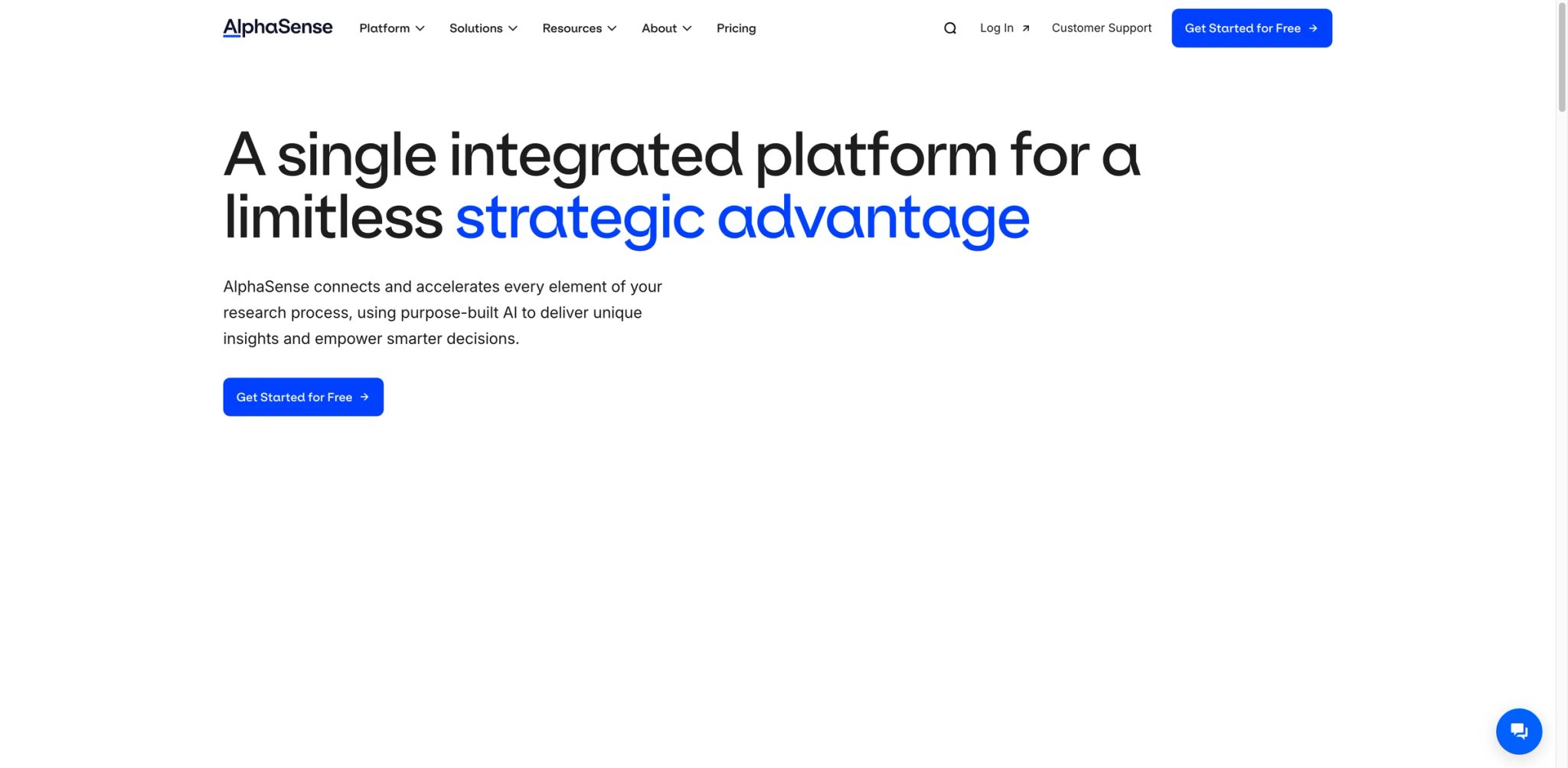
Equity analysts and corporate strategy teams use AlphaSense for one reason: when the research question is "what did every CFO in the semiconductor supply chain say about inventory this quarter," the answer lives inside 500M+ financial filings, broker reports, earnings transcripts, and expert calls — and no general-purpose LLM has access to that corpus. The Deep Research feature runs an agentic workflow across that library and returns cited, traceable answers instead of hallucinated summaries.
Core capabilities:
- 500M+ document corpus — Filings, broker research, trade journals, expert interviews, and company-specific content behind a single search layer.
- Deep Research & Workflow Agents — Multi-step AI agents that plan research, query the corpus, and return sourced synthesis. Citations click through to the exact passage.
- Smart synonyms & industry language — Search for "inventory correction" and the engine surfaces "channel destocking," "excess stock," "de-stocking" hits — critical for scanning competitive and supply-chain signals.
Pricing & real costs: No published rate card. Third-party reports place annual contracts between $10,000 and $100,000+ depending on seats and premium content modules. Broker research, expert transcripts, and some industry data are add-ons that can double the license. AlphaSense reports serving 85%+ of S&P 100 companies.
Real limitations: Reviewers on G2 and Gartner flag a steep learning curve and a complex interface — the power comes with an analyst-grade UX, not a consumer one. Market-cap and industry filters are sometimes buggy, and company-name filters occasionally misfire. Deep Research results can be too broad on niche private-market questions where the source corpus is thin.
Best for: Equity research, IB, corporate strategy, and consulting teams working across public filings and broker content. Not the right fit if your research target is mainstream consumers or social sentiment — AlphaSense is a document intelligence tool, not a consumer panel.
Get started with AlphaSense
SightX
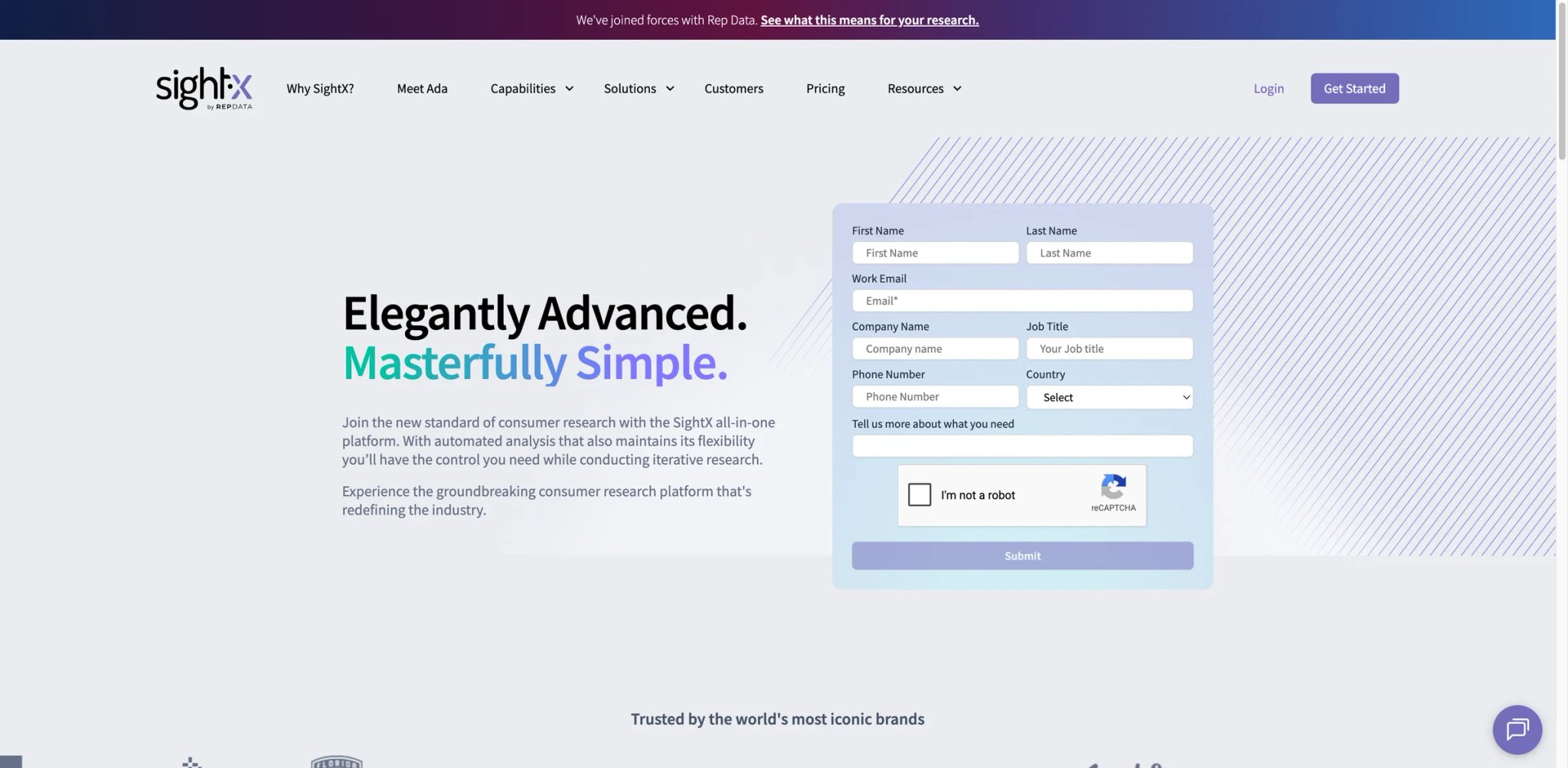
SightX is positioned for teams that want an integrated research stack, but its current official pricing page is sales-led: the public plans shown are Professional and Enterprise, both via "Talk to Sales," with no public free tier listed. Ada, the embedded AI assistant, handles survey drafting and theme extraction across text and video, and the platform stretches from quick ad hoc polls to segmentation projects.
Core capabilities:
- Integrated survey + text + video analytics — Single platform for polls, open-ended analysis, and video IDIs, rather than stitching three tools together.
- Ada AI assistant — Drafts surveys, summarizes open-ends, runs sentiment and thematic analysis, generates executive summaries. Iterated significantly in 2025.
- Small-business friendly tiers — Professional tier for teams that have outgrown SurveyMonkey but can't afford Quantilope.
Pricing & Plans
SightX's current official pricing page shows two public plans: Professional and Enterprise. Both route buyers to "Talk to Sales," and the page does not list a public free tier or self-serve starter plan.
Real limitations: Ada has gotten harsher reviews than the underlying platform — G2 users describe the assistant as "glitchy," sometimes crashing the broader SightX environment, and report that Ada occasionally cannot read the question analysis panel and produces unusable outputs. Several users say they abandoned Ada features and reverted to ChatGPT for summary writing.
Best for: Small and mid-market brand teams that need integrated quant + qual without an enterprise license. Not the right fit if you need advanced conjoint, MaxDiff, or methodology-heavy workflows — SightX prioritizes breadth over depth.
Get started with SightX
Aytm
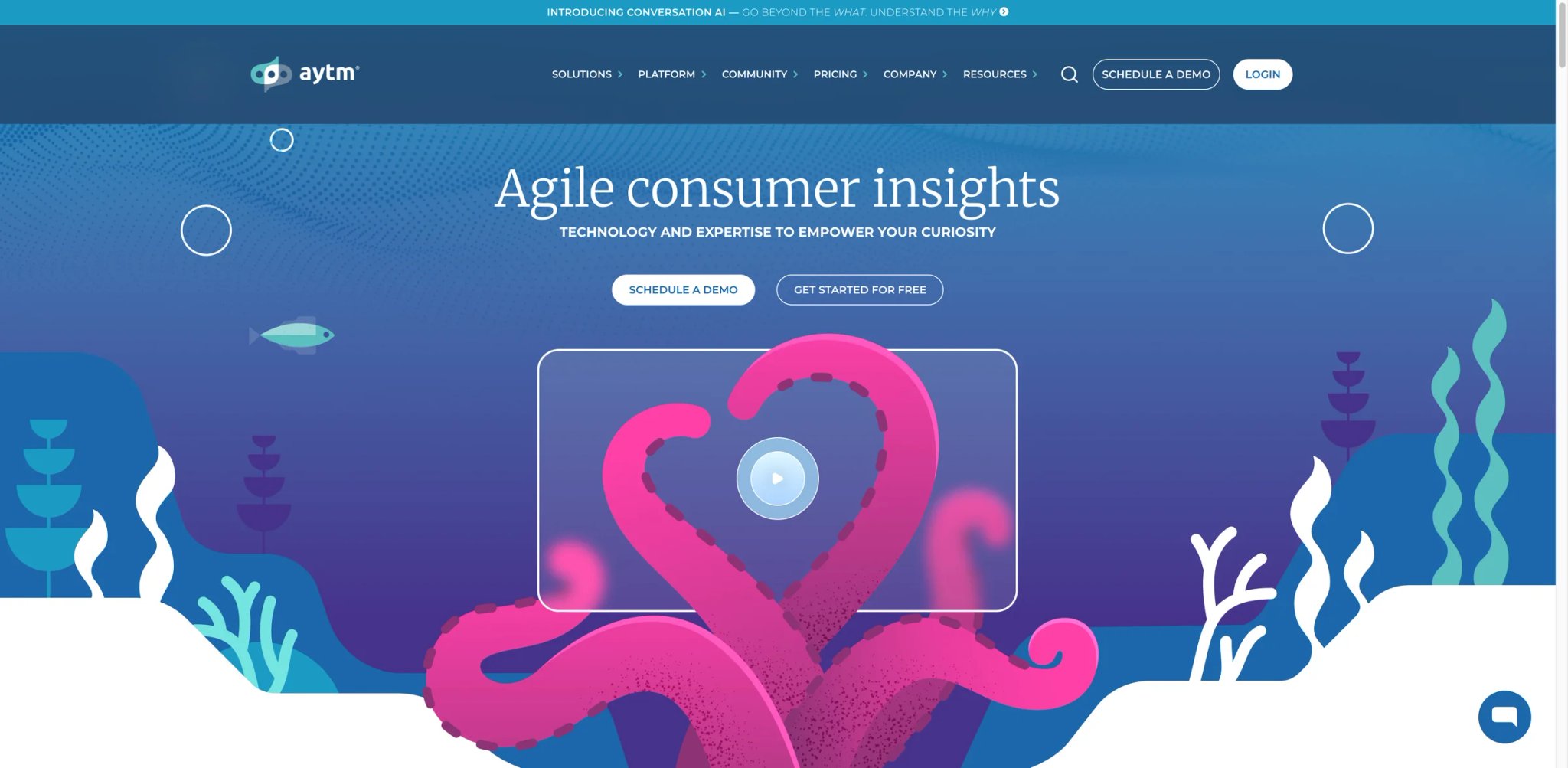
Aytm got its original reputation as "the agile research platform" long before agile was a buzzword in insights. The 2025 push has been Skipper, an AI research assistant rolled out across the entire study lifecycle — drafting surveys, translating into 100+ languages, coding open-ends, and explaining anomalies across cohorts.
Core capabilities:
- Skipper AI across the full workflow — Draft (survey generation), Translate (instant localization), Explore (dataset analysis), and Autocode (qual coding). Replaces multiple agency-billable tasks.
- 100M+ consumer panel — US and international coverage with demographic and behavioral targeting; solid for category quant or segmentation without stitching vendors.
- Methodology templates — Pre-built frameworks for concept testing, pricing, positioning, and brand lift reduce time-to-first-insight from days to hours.
Pricing & real costs: Custom pricing, credit-based. Aytm ranked #9 on the GreenBook GRIT 2025 Top Innovative Tech Suppliers and grew strongly in enterprise adoption, which signals the pricing is aimed at mid-market-to-enterprise annual commitments rather than ad-hoc projects.
Real limitations: Capterra reviewers note that while Aytm excels at speed and agile methods, the platform is not ideal for highly complex survey designs or advanced statistical analysis — teams running heavy conjoint or mixed-methods work typically keep a separate specialist tool. Reporting visualizations, while improved in 2025, still trail BI-native platforms.
Best for: Mid-market consumer and product teams running frequent fast-turn quant studies who want AI-assisted setup and coding. Not the right fit if your research leans academic or requires niche statistical methods (e.g., mixed logit, structural equation modeling).
Get started with Aytm
Pollfish
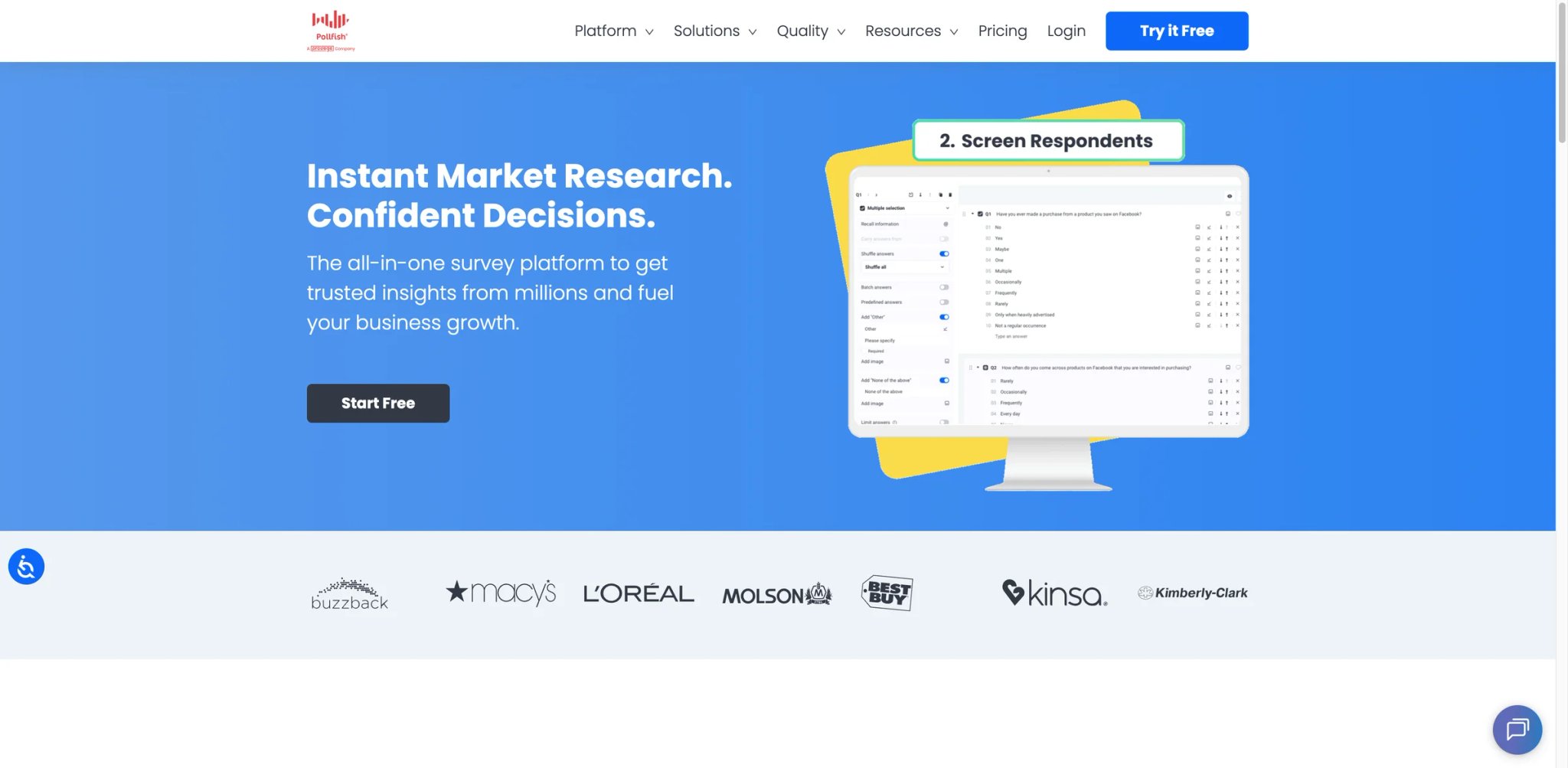
Of every tool on this list, Pollfish is the only one that lets you price a study in under a minute — $0.95 per response at the US entry rate, visible on the pricing page, no sales call required. That single fact makes it the default choice for founders, content marketers, and consultants who need consumer data for a single study and cannot justify an annual license.
Core capabilities:
- Per-response transparent pricing — From $0.95 per response in the US; the cost calculator updates live as you add screeners or targeting layers.
- AI survey builder & reports — Plain-English prompt generates a draft survey; AI auto-summarizes the results into a shareable report.
- 250M+ organic mobile panel — Mobile-first respondents reached via app SDK partnerships; useful for genuinely representative consumer coverage.
Pricing & real costs: Transparent published pricing — from $0.95/response for US DIY studies, scaling up with tight targeting, long surveys, or representative quotas. Trustpilot and G2 reviewers note costs escalate quickly once you layer screeners or ask for representative samples; a 1,000-response US-rep study commonly lands in the $5K–$8K range.
Real limitations: G2 reviewers cite data quality concerns on non-verified mobile respondents, including occasional repetitive or nonsensical answers. The survey builder lacks advanced logic and branching seen in specialist platforms, and question reordering and image embedding have friction. Survey crashes are reported on long instruments.
Best for: Founders, content teams, consultants, and startups that need single-study consumer data with no sales call. Not the right fit if you need high-data-quality panels for regulated research or complex branching logic.
Get started with Pollfish
Similarweb
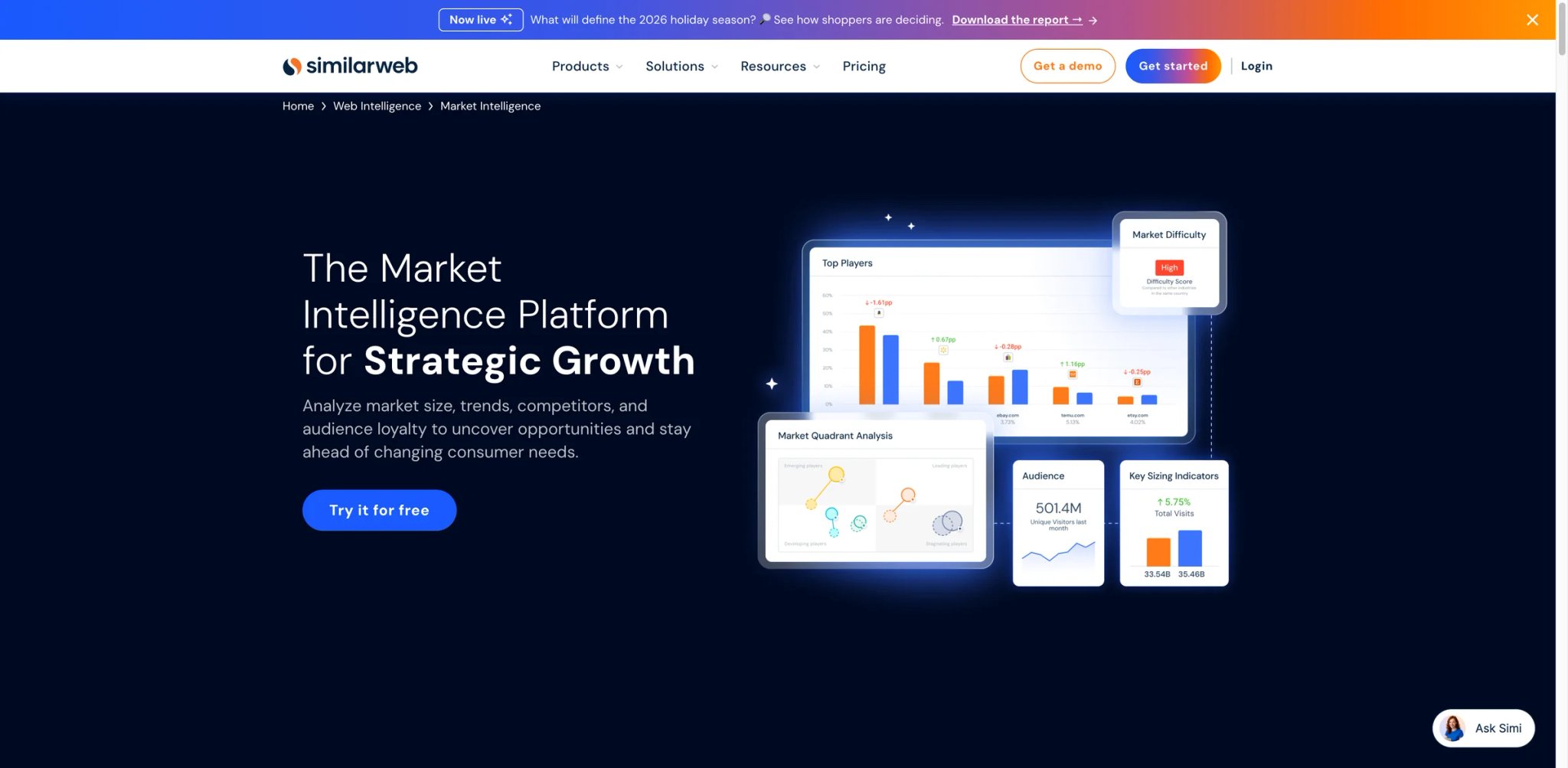
Similarweb is the outlier in this list — it is not a survey tool and it does not run panels. What it does is size markets, rank competitors, and profile digital audiences using traffic, search, and app data. For product managers deciding whether to enter a category, or strategy teams tracking competitor share-of-voice, Similarweb is often the fastest answer before commissioning primary research. Related play: pair it with AI SEO tools for a complete view of keyword and audience competition.
Core capabilities:
- Digital market sizing — Traffic, engagement, and search demand by category and country; accurate enough to defend a go/no-go decision at most board meetings.
- Competitor audience & funnel data — Which sites overlap your competitor's visitors, what they search, where conversion drops off. Rare in survey-based research.
- Similarweb AI agents — Audience, Search, and Sales agents that synthesize results across the dataset and surface insights in natural language.
Pricing & real costs: Recent public references place Similarweb Starter around $149–$199/month and Professional around $399/month, but the current official packages page does not present a clean live rate card. Verify the current quote before publishing. Trustpilot flags a recurring complaint: users charged $1,500+ after failing to cancel free trials in time — read the auto-renewal terms before the 14-day trial ends.
Real limitations: Data accuracy is directional, not gospel. Reddit users have reported that traffic estimates can miss actual analytics by 50% or more on lower-traffic sites; top-100 estimates are usually closer. Historical data depth is limited on lower tiers, and mobile-app analytics trail the web analytics. Support responsiveness on billing questions is a recurring TrustRadius complaint.
Best for: Product marketing, strategy, and growth teams that need digital market sizing and competitor intelligence before primary research. Not the right fit if you need consumer opinion or brand attitude data — Similarweb is behavioral, not attitudinal.
Get started with Similarweb
Zappi
Zappi's specialty is the one category most general survey tools handle poorly — creative, concept, and ad testing. The difference is the benchmark library: after 20+ tests, your scores show up against hundreds of prior concepts in the same category, so you know whether a 75 brand link score is strong or mediocre before the review meeting. This is what brand teams actually pay for.
Core capabilities:
- Category benchmarks — Activate after 20 concept tests or market studies; score new creative against prior performance across industries.
- Creative, concept, and ad testing templates — Pre-configured methodologies for package design, brand campaigns, product concepts, price-value claims. Launchable without a research designer.
- Global self-serve fielding — Tests run live in real time across markets; results typically available within 24 hours.
Pricing & real costs: Custom pricing, Premium or Enterprise subscriptions only — no monthly starter. For smaller companies without a dedicated insights function, the entry point is often cost-prohibitive; Zappi's sweet spot is larger brands with continuous creative development programs. Professional Services add-on available for teams without in-house research capacity.
Real limitations: G2 and TrustRadius reviewers describe the AI reporting as "basic" — it works off metrics alone and doesn't consider the actual creative stimulus, which limits interpretive value. Cross-solution comparisons (Creative vs. Amplify suites) are limited. Benchmarks activate only after 20 tests, so short-term projects or new accounts get the least useful feature.
Best for: Large CPG, retail, and consumer brand teams with continuous creative and concept testing programs. Not the right fit if you run fewer than 10–15 tests a year — benchmarks won't activate and per-test cost stays high.
Get started with Zappi
Outset
Qualitative research has always been the part nobody scales — hiring a moderator, recruiting panel, running interviews one at a time. Outset's bet is that an AI moderator can run 500 video interviews in parallel with the same rigor as 50 human ones, and the Y Combinator–backed roadmap (with Nestlé, Microsoft, and WeightWatchers as customers) is long enough to take it seriously.
Core capabilities:
- AI-moderated video, voice, and text interviews — Concurrent parallel interviewing in any supported language; AI probes, clarifies, and redirects in real time.
- Screen-share usability research — Respondents walk through prototypes while the AI asks questions — effectively remote usability testing at survey scale.
- Quality-detection layer — Flags low-effort answers in real time; auto-removes respondents who fail engagement checks, improving output reliability.
Pricing & real costs: Custom pricing — no published starter. Outset is pitching enterprise and well-funded product research teams; expect annual contracts. Sample cost (panel access) is typically layered on top of the platform license.
Real limitations: User review volume is low — Outset is newer than most on this list, and G2/Trustpilot coverage is thin (hence the conservative "40 / unknown" User Feedback score in our research). AI moderation is still imperfect for nuanced emotional probing; complex qualitative topics (bereavement, mental health) that require human sensitivity remain out of scope. Transcript quality depends heavily on respondent microphone quality in voice interviews.
Best for: Product research, UX, and consumer insights teams that need qualitative scale — 200+ interviews per study — without proportional moderator cost. Not the right fit if your research topic requires high emotional nuance or involves sensitive subjects where a human moderator is non-negotiable.
Get started with Outset
YouScan
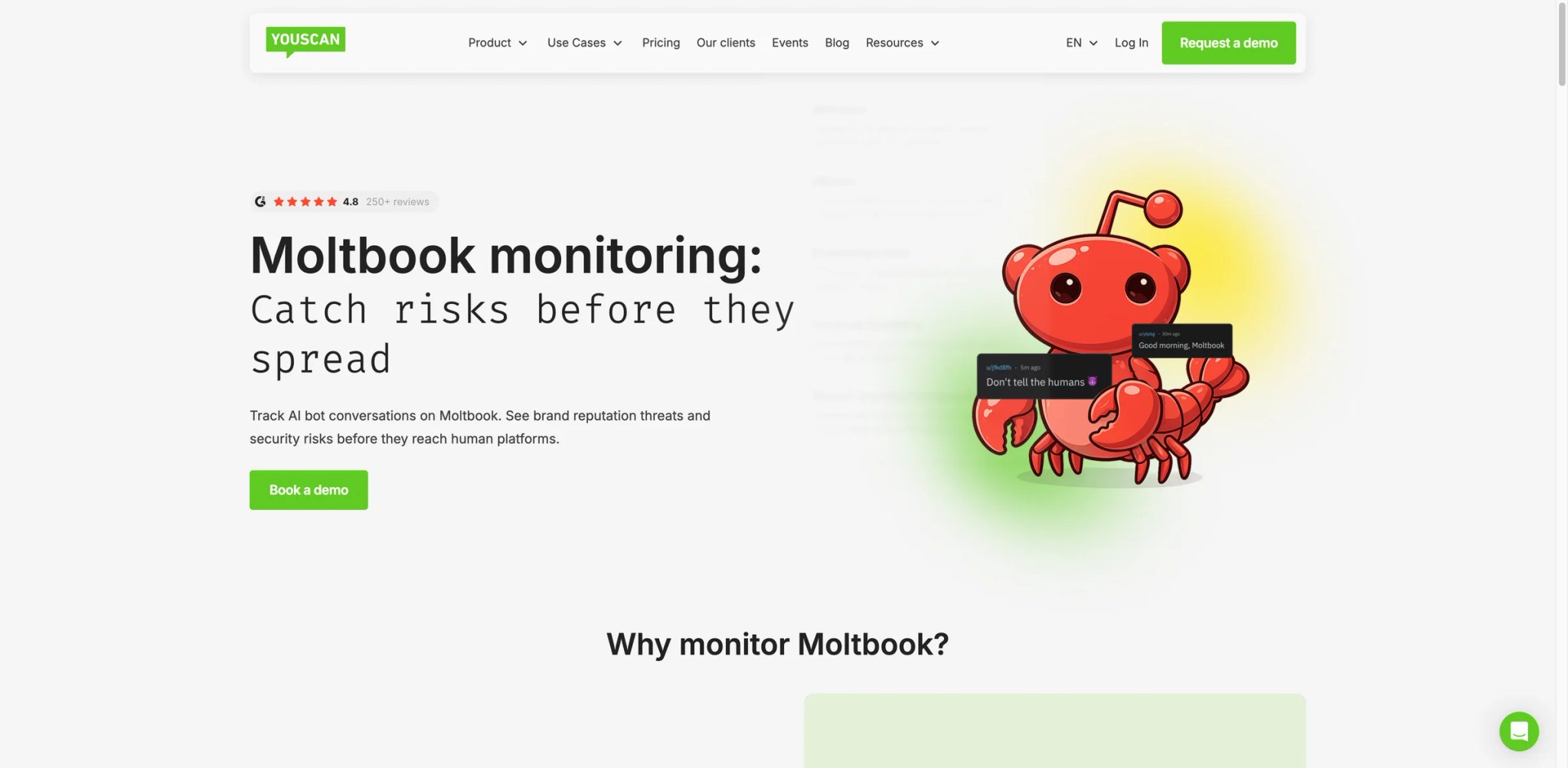
If you sell a CPG product, half your brand signal lives in images — logos on bottles, packaging visible in selfies, products in UGC videos — and text-only social listening misses all of it. YouScan's visual recognition is the reason CPG and beauty brands pay for it: the Insights Copilot conversational agent then lets a PR or comms lead query the feed without learning Boolean logic.
Core capabilities:
- Image & logo detection — Visual recognition across social media images, including logo presence, product context, and scene analysis. Unique in this category.
- Insights Copilot — Conversational AI agent for querying mentions in natural language; surface themes without building Boolean queries.
- Extended platform coverage — Includes VK, OK, and Telegram alongside mainstream networks; useful for brands operating in CIS markets.
Pricing & real costs: Starter-3 plan from approximately $499/month, scaling up to custom enterprise tiers. More expensive than Brand24 or Mentionlytics at the entry level, justified by image analytics.
Real limitations: G2 reviewers describe the query-writing UI as clunky compared with competitors, and the visualization on standard dashboards needs more customization. Alert-frequency settings are rigid. There's no mobile app — the web dashboard works poorly on phones, a gap social teams notice on-call. The learning curve can deter non-technical users.
Best for: CPG, beauty, fashion, and consumer product brands where image-based brand signal matters. Not the right fit if your brand lives primarily in text-based channels (B2B, SaaS) — image recognition won't earn back its cost.
Get started with YouScan
Brandwatch
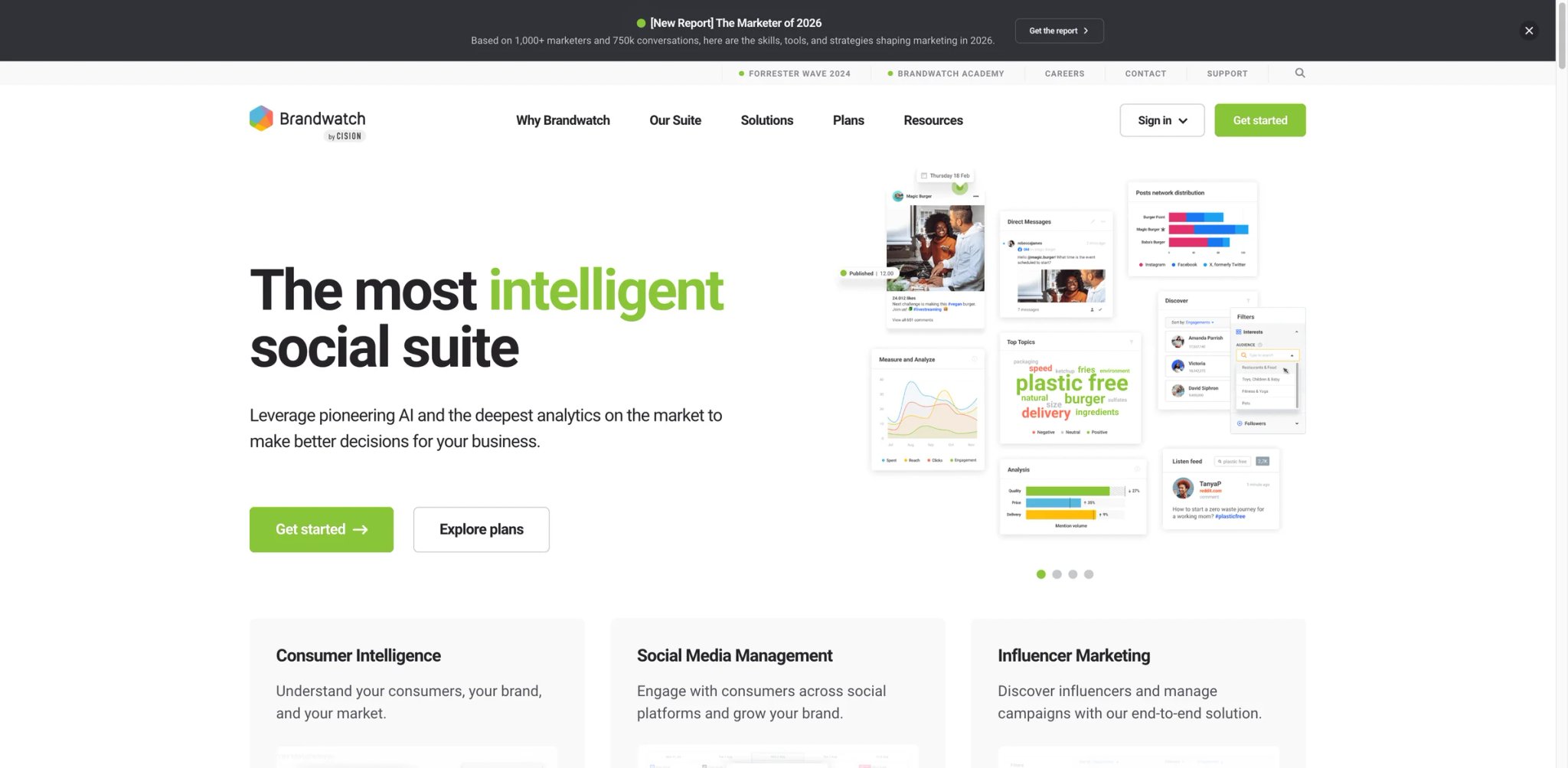
Brandwatch is the enterprise incumbent — the platform where the Fortune 500 consumer brands run their global listening and consumer intelligence programs. The Iris AI layer now runs across three use cases: content, conversation, and post analysis, summarizing thousands of mentions into readable executive briefs. If your communications, brand, and insights teams share a single source of truth, Brandwatch is often already that source.
Core capabilities:
- 100M+ source coverage — Social, news, forums, review sites, and blogs in a single ingestion layer.
- Iris AI across three modules — Iris Conversation Insights (theme summarization), Iris Content Insights (post analysis), and writing assistant for publishing workflows.
- Consumer Intelligence vs. Social Media Management — Two product suites; Consumer Intelligence is the research-focused one with deeper analytical power, SMM handles engagement and scheduling.
Pricing & real costs: Fully custom. Gartner reviews and leaked annual contracts cluster in the $20K–$100K+ range depending on modules and seats. Expect annual commitment; Brandwatch is not a monthly-cancelable subscription.
Real limitations: G2 reviewers note data source coverage is gapped on TikTok and Meta (API limitations industry-wide, not unique to Brandwatch) — users often pair Brandwatch with a TikTok-specific tool. Iris AI has a 2,000-character limit on processed content per operation, which constrains long-form post analysis. New-user learning curve is steep across both suites.
Best for: Enterprise brand, comms, and insights teams with global listening programs and multi-user licensing needs. Not the right fit if you need a single-dashboard SMB social listening tool — Brandwatch is over-capable and over-priced for that job.
Get started with Brandwatch
Quid
Quid (formerly NetBase Quid) is the tool you reach for when the research question is not "what do people think" but "what is the narrative shape of this category." Topic clustering on millions of articles, social posts, and patents maps narrative structure — which themes are rising, which are fragmenting, where two conversations are starting to merge. For strategy and innovation teams, that narrative view drives category bets.
Core capabilities:
- AI-powered topic clustering — Visual maps of conversation structure across news, social, forums, and patents. 27 months of historical data, 200+ countries.
- Agentic workflow layer — AI agents that plan multi-step research across the Quid corpus, returning cited narrative analysis rather than raw metrics.
- Narrative trend detection — Surface emerging themes before they hit mainstream; useful for innovation, corporate VC, and strategy teams.
Pricing & real costs: Enterprise-only. Third-party sources report starting at approximately $23,000 per year, scaling substantially for full feature access and seat counts. No self-serve tier.
Real limitations: G2 reviewers consistently flag a steep learning curve and slow topic-load times on large queries. Visualization polish, while distinctive, is a steep step for users coming from standard BI dashboards. The tool's narrative clustering is powerful but requires analytical training to interpret correctly — it's not a plug-and-play dashboard for non-researchers.
Best for: Strategy, innovation, and M&A research teams at medium-to-large enterprises tracking narrative structure across news and social. Not the right fit if you need day-to-day social listening or brand health KPIs — Quid is a strategic tool, not an operational one.
Get started with Quid
Brand24
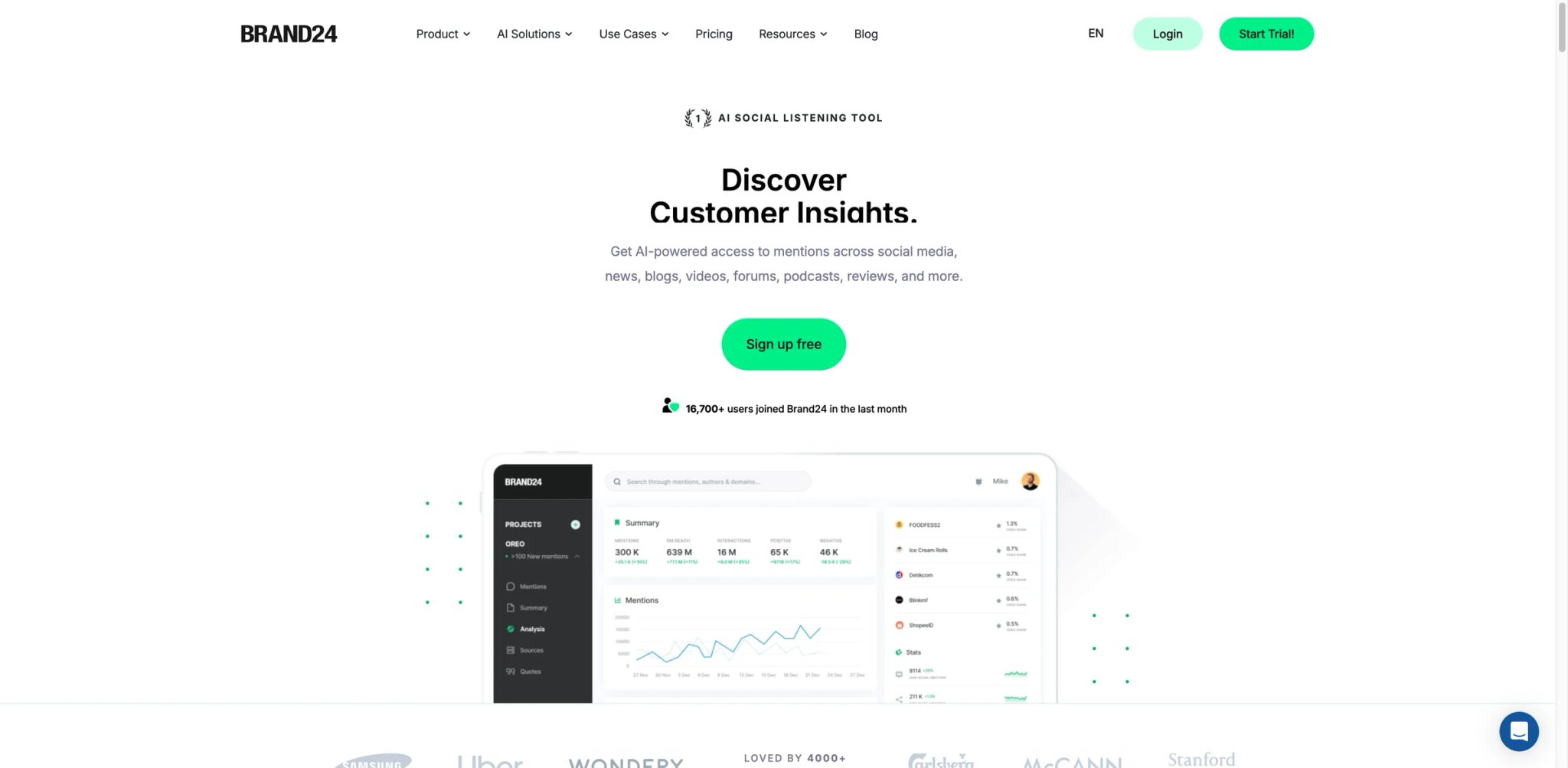
Brand24 is the opposite end of the market from Brandwatch and Quid — transparent monthly pricing, self-serve signup, no sales call, and a genuinely capable AI sentiment layer underneath. For a founder, marketer, or comms lead who needs social listening without a six-figure budget, it's the default starting point. Pair it with AI chatbots if your social monitoring feeds into customer support triage.
Core capabilities:
- Transparent per-tier pricing — Individual, Team, Pro, Enterprise plans on a published rate card. Unusual in this category.
- AI sentiment, topic, and anomaly detection — Auto-classifies mentions, detects sentiment spikes, flags unusual activity in the feed.
- AI-generated reports & alerts — Weekly and monthly auto-generated summaries sent to stakeholders; reduces analyst-hours on routine reporting.
Pricing & Plans
Current official Brand24 pricing is substantially higher: Individual is $199/month billed annually ($249 monthly), Team is $299/month billed annually ($349 monthly), Pro is $399/month billed annually ($499 monthly), Business is $599/month billed annually ($699 monthly), and Enterprise starts from $1,499/month billed annually. The 25-keyword / 100,000-mentions cap belongs to Business, not Enterprise.
Real limitations: LinkedIn coverage is limited — a critical blind spot for B2B companies. Keyword tuning is difficult for common words without Boolean operators (AND/OR/NOT), which creates noise on ambiguous brand names. There are no publishing or engagement features (it's listen-only, not a full SMM suite). Historical data access is tier-locked. If you track 30+ keywords simultaneously, even Enterprise may feel tight.
Best for: SMBs, startups, agencies, and comms teams that need transparent social listening pricing and fast setup. Not the right fit if you run B2B social tracking (LinkedIn gap) or need integrated publishing and engagement workflows.
Get started with Brand24
Best AI Market Research Tools by Use Case
For Founders Validating a Pricing or Positioning Bet
If you're a solo founder or early-stage product lead trying to answer "does this segment actually care about this?" without a six-figure research contract, Pollfish is the pragmatic starting point — $0.95/response with visible pricing lets you run a 500-person screener for under $500. GWI's free tier is the complementary move if you want audience context on the segment before writing the questions. Both can give you defensible, cited data for a fundraising deck without requiring an annual license.
For Product Marketers Running Weekly Brand Trackers
If your brand's deck includes the words "awareness," "consideration," and "favorability" and someone has to refresh them monthly, Attest is purpose-built — the dedicated research advisor plus 59-country panel keeps a weekly tracker running with minimal analyst hours. Suzy is the stronger call if you also run a qualitative always-on community in parallel, since the single-platform quant + qual cloud removes one vendor relationship. Both require enterprise commitment, so budget $50K+/year.
For Strategy Teams Tracking Category Narratives
If you're leading corporate strategy, VC research, or innovation scouting and need to see how a category's conversation is evolving, Quid maps narrative clusters across news, patents, and social better than any survey tool can. Brandwatch is the alternative if you also need operational brand listening on top of the strategic narrative view. Budget at least $20K/year either way.
For CPG & Beauty Brands Where Images Are the Brand
If your packaging, logo, and product context show up in user-generated photos more than in text posts, YouScan is the only mainstream choice with real visual recognition at scale. Pair it with Brand24 for coverage breadth at a lower price point — the two together will cost less than one enterprise Brandwatch seat.
For Equity Analysts & Corporate Strategy Reading Filings
If your research lives in 10-Ks, broker reports, and earnings transcripts, AlphaSense is the category-defining tool. Deep Research plus the Workflow Agents can replace days of junior analyst scanning. Cost is real ($10K–$100K+ annually) but the productivity gain is the reason 85% of the S&P 100 already uses it.
For Insights Teams Running Advanced Quant Methods
If your work involves conjoint, MaxDiff, Van Westendorp, or segmentation on any cadence, Quantilope has the deepest method library as automated templates. Aytm with Skipper AI is the stronger choice for faster ad hoc quant where the methodology matters less than turnaround speed.
How to Choose the Right AI Market Research Tool
The fastest way to avoid a six-month procurement regret is to match the tool category to the research question type, not the other way around.
1. Start with the research question, not the tool category. If your question is "what percentage of X segment prefers Y," you need a survey panel (Appinio, Attest, Pollfish). If it's "what is the narrative around X category," you need a listening or narrative tool (Brandwatch, Quid, YouScan). If it's "how big is this market," you need digital intelligence (Similarweb). Mixing categories is how teams end up with four tools that each do 20% of the job.
2. Test pricing transparency before the feature list. Custom-pricing vendors (Suzy, Quantilope, Attest, Brandwatch) will always take at least one sales call and typically require annual commitment. If your research cadence is less than 4 studies a year, transparent-pricing alternatives like Pollfish and Brand24 will usually beat annual-contract suites on total cost, while Similarweb can be lighter-weight depending on package and SightX is now sales-led rather than a public free-tier starter. Don't demo before you price.
3. Factor in sample quality, not just sample count. A 1,000-response panel from a mobile SDK (Pollfish) is not equivalent to a 1,000-response panel with representative quotas on a verified panel (Attest, Appinio, GWI). For regulated or high-stakes decisions, the quality difference matters more than the cost difference. Our AI market research category page tracks each tool's sample specifications alongside user ratings as they update.
4. Confirm export and integration paths before buying. Every platform promises "API access" in the feature list. Verify what that actually means: Can you push results into Looker/Tableau? Does segmented data export cleanly? Does the API rate-limit meaningfully? If the output lives trapped in the vendor's dashboard, the tool is a study-producer, not a research capability.
5. Price the AI features against the work they replace. Skipper, Quinn, Ada, Iris, Agent Spark — each AI assistant does something real but marginal. If the feature replaces 4 analyst-hours per study and you run 20 studies a year, the AI is worth $4K. If you run 2, it's worth $400. Match the AI add-on cost to actual workflow savings.
6. Ask for a PoC on your real research question. Every enterprise vendor here (AlphaSense, Suzy, Brandwatch, Quid, Zappi) will run a free or low-cost proof-of-concept on a specific question you bring. Bring your hardest recurring research question — if the tool can answer it during PoC, it will earn back its license.
Frequently Asked Questions
Which AI market research tool has the most transparent pricing?
Pollfish is the clearest winner on transparency — the pricing page shows $0.95 per response in the US with a live calculator that updates as you add screeners. Brand24 also publishes a clear rate card, while Similarweb offers self-serve access but does not present a fully transparent live official rate card on its current packages page, and SightX no longer shows a public free tier on its current pricing page. Mentionlytics publishes entry tiers as well. Everything else — Suzy, Quantilope, Attest, Brandwatch, Zappi, Quid — requires a sales call.
What is the difference between consumer insights platforms and social listening tools?
Consumer insights platforms (Quantilope, Suzy, Attest, Appinio) run surveys, interviews, and panel studies to answer attitudinal questions — "what do people think about X." Social listening tools (Brandwatch, YouScan, Brand24, Quid) scrape public social and news content to answer behavioral questions — "what are people saying and how is it trending." They're complementary, not substitutes, and most enterprise teams run both.
Can AI market research tools replace traditional research agencies?
Partially. Platforms like Quantilope and Aytm can replace the survey-programming and basic reporting work agencies bill for, which is often 40-60% of a project's cost. Strategic synthesis, study design for complex methodologies, and last-mile stakeholder recommendations still benefit from human researchers. Most mid-market teams end up with a hybrid — using AI platforms for continuous trackers and quick turnarounds, keeping agencies for annual strategic studies.
How do I evaluate whether an AI research feature is real or marketing?
Ask three diagnostic questions: Can I see the output on a realistic brief in a PoC? What source data does the AI draw from (the vendor's panel, a general LLM, a proprietary corpus)? Does the AI produce citations I can trace back to specific mentions or responses? If the answers are vague or the output is a summary you could get from ChatGPT for free, the "AI" is likely a thin wrapper on a base model rather than a workflow-defining capability.
What is a realistic annual budget for an AI market research platform?
For SMBs and startups, $1,000–$10,000/year on lighter-weight tools such as Pollfish pay-per-study and Brand24 can cover many needs; Similarweb may fit smaller budgets depending on package, while SightX is now sales-led and should be budgeted separately. Mid-market brands running always-on programs spend $25,000–$80,000/year across one or two platforms (typically a quant tool plus a listening tool). Enterprise brands running multi-tool stacks (Brandwatch + Suzy + AlphaSense) commonly clear $150,000–$300,000/year once seat counts and modules are factored in.
Which tool handles qualitative research best in 2026?
Outset is the clear frontrunner for AI-moderated interviewing at scale — 200+ interviews in parallel is genuinely new capability, not just an incremental improvement. SightX and Suzy offer video IDI features inside broader platforms, which is better if you want quant and qual in one vendor. Purely human-moderated qual (for emotionally sensitive or highly nuanced topics) still belongs with specialized qual agencies, not any platform on this list.
How do I decide between Similarweb and a survey-based tool for market sizing?
Similarweb gives you behavioral data — actual traffic, search volume, app usage — fast and without primary research. A survey tool (Attest, Appinio) gives you attitudinal data — stated preference, willingness to pay, awareness. For category sizing and competitor benchmarking, Similarweb is usually sufficient and faster. For new-product validation or untested positioning, you need survey data because behavioral data doesn't exist yet for things that haven't launched.
Get ToolWorthy Weekly
New AI tools, practical guides, and selected AI signals in one weekly brief.
Related Posts
- 10 Best AI Social Media Tools 2026 — Choose by Workflow
Compare ten AI social media tools for creation, scheduling, reporting, listening, and replies. Find the right workflow, plan limits, and human review gates.
For AI tool founders
Built a tool that belongs in this decision set?
Request an editorial evaluation for possible inclusion in ToolWorthy.
Submit your tool for reviewPaid submission does not guarantee a ranking, recommendation, inclusion, or editorial outcome.