
5 Best AI Admissions Assistants 2026 — Plan, Don't Outsource
Compare five AI admissions assistants for college planning and essay feedback, with free-plan limits, privacy tradeoffs and school-policy boundaries.

On this page
The best AI admissions assistant is the one that helps you complete the next application task without taking over your judgment or authorship. A school-list organizer, a conversational coach and an essay reviewer solve different problems. None can promise admission.
For US undergraduate applicants and families, start with Kollegio for a free, broad application workspace; Rory for free conversational guidance; ESAI for guided personal-story development; Sups for managing supplements with feedback allowances; or Kolly for structured draft review. These are workflow shortlists, not a ranking of admissions outcomes. University-side recruitment CRMs are outside this comparison.
Research boundary: Official pages checked October 22, 2026. This is desk research and inspection of public interfaces—not a paid-plan test, essay-quality benchmark or admissions-outcome study. We did not upload a real student's application or buy a plan. Prices are public USD displays before applicable taxes; checkout, region and subscription term can differ.
AI admissions assistants at a glance
Start with the task holding up your application. On a phone, swipe inside a table to read the other column.
| Tool | Start here when… | First reason to rule it out |
|---|---|---|
| Kollegio | You need a free place to organize school discovery, essays and scholarships | Its published data-sharing policy is incompatible with what you are willing to upload |
| Rory by Prepory | You need to ask admissions-process questions and get feedback in a conversation | You need a verified application dashboard rather than chat-based guidance |
| ESAI | You struggle to identify and organize your own experiences into a story | You need a full deadline tracker, or cannot justify its current subscription prices |
| Sups | You need a supplement editor and school-by-school application organization | Your school count or revision workload exceeds the chosen tier |
| Kolly | You already have a draft and want specific, structured feedback | You would treat its percentile or mock committee as an actual admissions prediction |
Already enrolled and looking for study help? Our AI tools for students comparison covers that separate decision. This guide is about preparing an application, not completing coursework.
Check your school's rules before choosing an essay tool
An app's claim to be ethical is not permission from your target university. Yale allows grammar and spelling review, general advice and early topic suggestions, but treats submitting substantive AI output as application fraud. Caltech's Fall 2027 guidance is more specific: AI-generated outlines, drafts and translations are among its prohibited uses; brainstorming questions and grammar review of a completed essay are permitted examples. Read the policy for your own school and cycle. Yale AI policy; Caltech applicant guidelines.
That distinction changes the purchase: a tool can offer drafting, rewriting or outlines while those modes remain unsuitable for your application. Prefer questions and diagnostic comments you can act on yourself. Do not assume accepting a generated paragraph makes it your own work, or that an AI-detector score establishes compliance.
Keep your original notes and successive drafts. You should be able to explain every event, activity and sentence without the assistant. A counselor or trusted adult who knows you is a useful final reader; an AI score is not a substitute.
Detailed comparison: planning, feedback and handoff
Compare the same three outputs, not a count of advertised features. A listing here describes documented functionality, not measured quality. Where a capability is not established, that is an evidence gap—not proof the tool cannot do it.
| Tool | Planning and discovery | Essay feedback and final handoff |
|---|---|---|
| Kollegio | Application planning, college matching and scholarship discovery in one platform | Essay and activity support; verify each school's prompt and keep your own submission copy |
| Rory by Prepory | Conversational help with school lists, requirements, roadmaps and interviews | Chat-based essay feedback; a tracked workspace or portable application archive was not verified |
| ESAI | College Track connects interests and experiences with schools, majors and activities | Guided story discovery and essay support; not a verified substitute for an application-status tracker |
| Sups | Essay Manager and Profile Builder organize supplements and school-specific material | In-line questions and feedback inside its editor; paid tiers change school and suggestion allowances |
| Kolly | Schools, deadlines, roadmap and scholarship tools alongside writing | Paragraph-level review; pricing page lists parent/counselor sharing and PDF/DOCX export on every plan |
Choose between the closest options: Kollegio is the broad free-workspace starting point only if its privacy terms fit. Rory is the narrower choice when the missing piece is an answer, not another organizer. ESAI makes sense when story discovery is the bottleneck. Sups and Kolly are closer competitors once a draft exists: compare school/suggestion limits versus structured review, sharing and export—not a vendor's claimed acceptance rate. Sources are linked in the individual sections below.
Free access and the cost of an application season
The relevant unit is the remaining application workload, not the smallest monthly number. A free first review is different from ongoing free feedback; a six-month pass can renew.
| Tool | What you can start with | Boundary that changes the bill |
|---|---|---|
| Kollegio | Public student platform advertises free access | No numerical unlimited-usage entitlement verified; read data terms before adding a full profile |
| Rory by Prepory | Official FAQ says the AI assistant is completely free after signup | Human coaching is a separate service; do not infer it is included |
| ESAI | College Track labels selected tools free and offers a first Brandi call free | Pricing cards: $19/week, $50/month or $500 paid annually; exact premium access and trial terms need checkout confirmation |
| Sups | Basic lists Common App, access to one college and seven weekly suggestions; no card | Plus $9/month: eight schools, ten daily suggestions; Unlimited $29/month removes those advertised limits |
| Kolly | Application home and one full essay review; no card | $29/month or $99/six months advertised; pricing page and Terms disagree on pass renewal—confirm before paying |
Current official displays: Kollegio, Rory FAQ, ESAI pricing, Sups pricing, Kolly pricing. ESAI's pricing FAQ still uses different plan names from its cards. Kolly's older comparison page also shows different prices; use its current dedicated pricing page, then confirm checkout. Do not convert ESAI's weekly plan into a cheap-looking monthly price or read $500 annually as a $41 monthly checkout.
Do not assume cancellation means a refund. ESAI's refund policy restricts refunds after meaningful use: Brandi after the first completed session or 20 cumulative minutes, whichever comes first; text tools generally after 20 interactions. Other conditions still apply. Kolly's pricing page advertises a renewing pass and a 30-day refund, while its published Terms describe a nonrenewing pass and a conditional seven-day refund. Resolve that discrepancy with the vendor and checkout terms before paying; neither description should be silently treated as settled.
A practical budget example: For eight target schools and two remaining months, Sups Plus totals $18 at the displayed monthly rate, but only if its daily suggestion allowance fits. Kolly monthly totals $58; its $99 pass buys a longer period, not a lower cash outlay for that two-month need. ESAI monthly totals $100, versus $500 upfront annually. These are subscription arithmetic, not equivalent service or essay-quality claims. Start with the free route before paying for overlap.
Privacy comparison: free access is not no-data access
These are published policy disclosures, not a security audit or a privacy ranking. “Not established” means we could not verify the promise. School-provided access can have separate terms; check those too.
| Tool | Training, processing and other recipients | Retention, deletion and minors |
|---|---|---|
| Kollegio | De-identified/aggregated data may train AI; policy permits compensated information transfer to institutions and other customers | Fixed deletion timetable not established here; contact support about your choices. Policy excludes under-13 use |
| Rory by Prepory | Chatbot policy permits AI API and other providers; blanket no-training commitment not established | Account/service period plus necessary later retention; rights requests by email. Ages 13–17 need parent/guardian consent under Terms |
| ESAI | No generalized-model training on submissions/recordings; service processing, improvement and listed disclosures still apply | Necessary service/business retention, not a fixed short expiry. Under-16 use requires appropriate parental consent |
| Sups | Essays/revisions may go to OpenAI's GPT API and service providers; no unconditional no-training promise established | Access/update/deletion requests by contacting support; fixed retention and minor-consent details not established in this notice |
| Kolly | Policy promises no essay training, but AI providers process text; OpenAI embeddings may retain text up to 30 days for abuse monitoring | Free-tool runs: 90 days. App deletion hides an essay; permanent erasure needs a request. Age13+; under18 review Terms with a guardian |
Sources: Kollegio privacy, Rory chatbot privacy and Terms, ESAI privacy, Sups privacy, Kolly privacy and Terms. Third-party processing is not itself proof of model training; a no-training promise is not a no-storage promise.
The five assistants and their first elimination tests
Kollegio
Best for: applicants who want a free, broad application workspace rather than separate discovery, essay and scholarship tools. Its current student site brings those tasks together. Official student product.
Skip if: you need a no-data-sharing service. The published privacy policy permits sharing or transferring personal information to universities, colleges and other customers for compensation. It also permits using aggregated, de-identified or anonymized data for AI training. That is materially different from a blanket promise that nothing is shared or used for training. It does not establish that every essay is sold; review the scope and your choices before uploading.
First elimination test: with non-sensitive preferences, inspect whether its school recommendations explain the academic, location and affordability constraints you care about. Verify one suggested school's requirements on the school's own admissions page. Reject the route if the reasoning is opaque or the data terms are unacceptable.
Trial boundary: free access does not prove unlimited usage or scholarship eligibility. Save a separate copy of your work and use the actual application portal for submission.
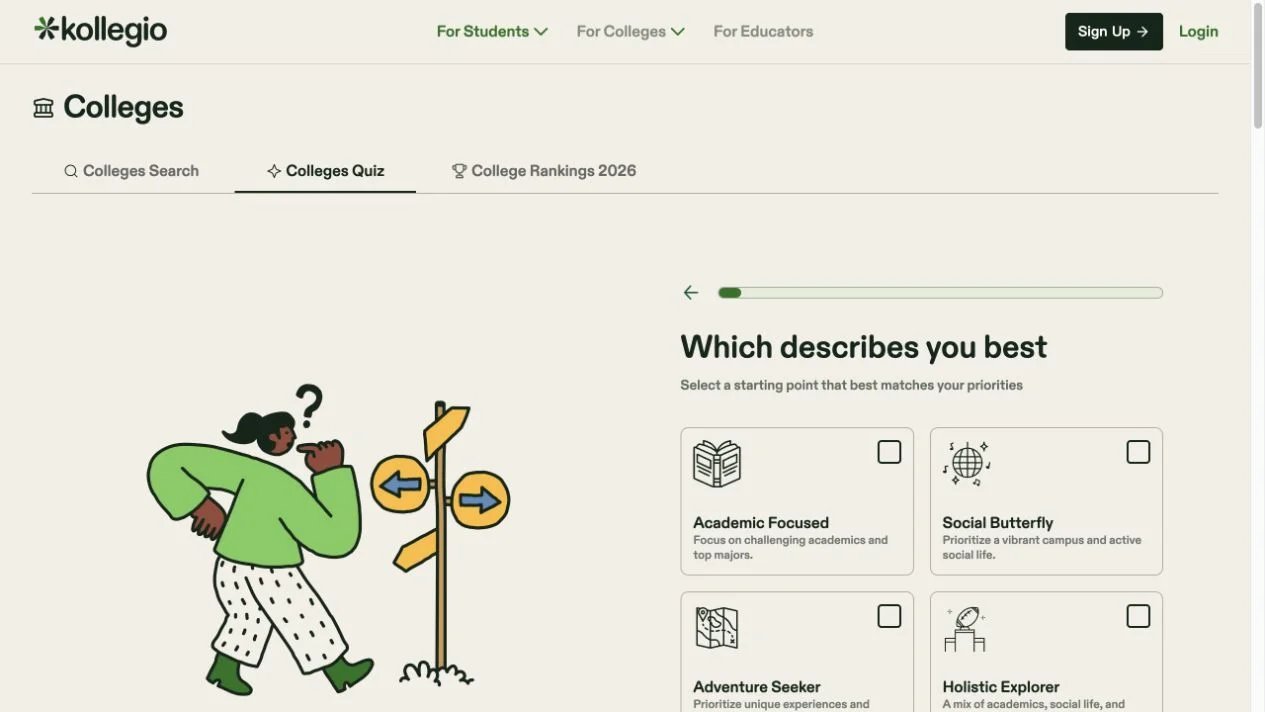
Kollegio's actual public quiz, October 22, 2026; no profile or answers submitted. This shows the discovery entry point, not a tested recommendation or a signed-in dashboard.
Rory by Prepory
Best for: a focused question-and-answer session about the application process. Prepory documents roadmaps, college-list help, essay feedback and interview preparation; its FAQ says Rory is free after signup. Rory product and FAQ.
Skip if: your main problem is tracking twenty separate supplements. We verified conversational guidance, not a complete school-by-school document management system. Prepory's human counseling is a separate path, not an assumed benefit of free AI access.
First elimination test: ask for the official source and application cycle behind a requirement, then open that source yourself. Ask a follow-up that changes one constraint. If the answer stays generic or cannot be checked, keep a counselor or the admissions office in the loop rather than relying on confident wording.
Trial boundary: do not begin by pasting a full sensitive personal statement. Its chatbot-specific privacy policy covers submissions and AI-service providers; Terms require parental consent for ages 13–17. Free AI is not private offline advice. Prepory's training-data and expertise claims do not establish Rory's effect on acceptance chances. Product introduction.
ESAI
Best for: turning your own experiences into a clearer narrative before drafting. Its College Track documents story discovery, major exploration and essay-support tools; Brandi adds conversation-based guidance. Keep this college workflow separate from its career offering. College Track; ESAI FAQ.
Skip if: you only need reminders, or want a low-cost unlimited essay editor. Current pricing is substantially different from older low-price descriptions. Free tools and a free first call do not establish unlimited premium access. Its pricing FAQ's older Starter/Pro labels warrant checking the actual charge and cancellation terms before starting. Current plans.
First elimination test: use one ordinary experience you are comfortable discussing and check whether the prompts help you identify a real detail or reflection you had missed. Reject generic prestige language, invented accomplishments or a suggested story you could not defend. If the school forbids AI outlines, do not use an outline feature for that essay.
Privacy boundary: ESAI's policy says it does not use student submissions, recordings or personal content to train generalized AI models; it still collects and processes data to operate and improve the service. It requires appropriate parental consent for users under 16. This is not a zero-storage claim. Privacy policy.
Sups
Best for: applicants managing supplements in an editor with in-line questions and feedback. Sups documents an Essay Manager and school-specific profiles. Its school-count and suggestion limits make the shortlist concrete: Basic is a small trial, not unlimited support for a large school list. Product and plans.
Skip if: you need extensive feedback across many schools without upgrading. Check the actual number of target schools and how often you revise against the current tier; a low subscription price is not useful if you repeatedly hit its allowance.
First elimination test: ask about one paragraph you wrote yourself. Look for a specific diagnosis you can act on, not a generic rewrite. Decide whether that response is worth the allowance it spends. School policy—not a vendor's ethical-use banner—decides which suggestions you may use.
Privacy boundary: its privacy notice covers essays and revisions and permits sharing data with OpenAI through the GPT API and other service providers. We did not verify a blanket no-training commitment there. Clarify processing and deletion before uploading sensitive material; API sharing alone does not prove training use or misuse.
Kolly
Best for: reviewing an existing draft with paragraph-level feedback while keeping planning and reviewer sharing nearby. Its pricing page documents one free full review, sharing and PDF/DOCX export. Current product; plans and export details.
Skip if: scores would push you to optimize for a simulated reader rather than tell your own story. Its percentile and mock committee are product-generated feedback—not an actual university assessment or an independently calibrated probability of admission. Drafting and rewrite modes may also conflict with school rules.
First elimination test: ask whether a comment identifies a real clarity problem in your own draft. Compare that diagnosis with a trusted reader's view. Keep the useful question; do not transplant a model-written paragraph or imitate an accepted student's story.
Trial boundary: a free full review is not an ongoing unlimited plan. The pricing page and Terms conflict on Season Pass renewal and refunds; confirm the actual purchase terms. Its privacy policy distinguishes AI processing from training: feedback uses Anthropic/DeepSeek models via a gateway; OpenAI processes embeddings. Signed-out free-tool submissions are stored for 90 days; deleting an account essay in the app hides it, while permanent deletion needs an email request. Backups can remain for 30 days after deletion.
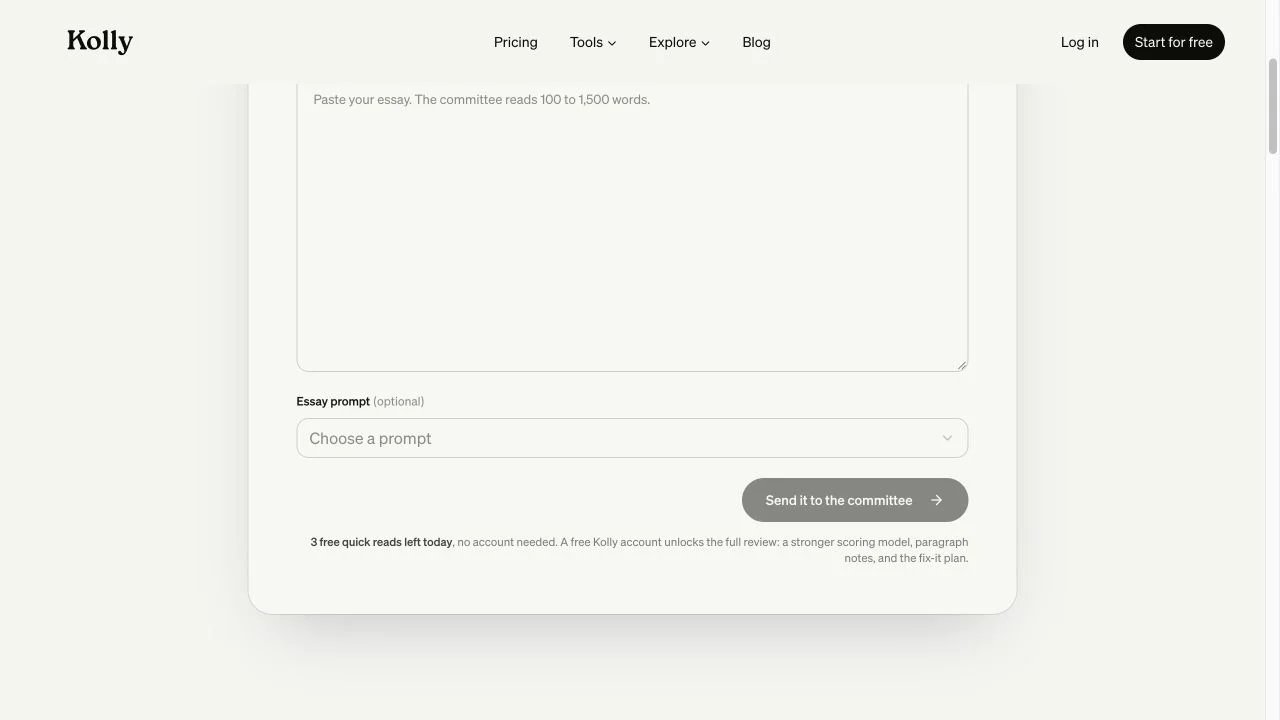
Public Kolly quick-read interface, October 22, 2026. No essay submitted. Quick reads and the account's full review are different offers; the “committee” is an AI simulation, not university staff.
Two narrower routes worth considering
If you want questions, not generated prose: Nudge at writewithnudge.com explicitly describes a questions-only college-essay workflow, without sentences, outlines or rewrites for submission. Its preview offers one essay and question; full access is advertised at $80/month. Compare that cost with simply asking a trusted reader questions. This is a relevant constrained alternative to Sups or Kolly, not proof of better feedback or universal school approval. Its Terms still make checking each school's policy your responsibility. Do not confuse it with other products named Nudge.
If you only need a school-list check: Nojal offers two complete free recommendations and advertises a one-time list audit from $29. Its fit scores are not validated admission probabilities. We screened it as a narrower planning option, not an essay-feedback substitute; investigate its full processing/retention terms before uploading a detailed profile.
A safer first session—and what to keep outside the app
Use one small task before migrating your entire application. Start with public school information or a non-sensitive draft excerpt. For school facts, record the official URL, entry year, application round, exact requirement and date checked. Verify deadline time zones and any later update directly; a model's calendar is not the application authority.
Before uploading, check minimum age and parental-consent rules, retention, AI-training use, data-sharing recipients and deletion. Under-18 users should involve a parent or guardian where required. Avoid uploading passports, payment details, full transcripts or confidential recommendation letters merely to try a tool. Do not request access to a recommender's confidential letter for an AI review.
Maintain your own school/deadline sheet, original drafts, permitted feedback notes and final submitted files outside the assistant. Recheck word counts and formatting after pasting into the official portal; a saved draft is not a submitted application. Use a qualified human for complex financial-aid, immigration, safeguarding or exceptional-circumstance questions rather than treating a chatbot as the decision-maker.
When not to buy: if a school counselor, official admissions FAQ and a simple deadline sheet already solve your problem, another subscription may add little. This is not the same purchase as a general AI writing tool or homework helper. More fluent text is not automatically a more authentic application.
Why some familiar names are not in this shortlist
/ai route redirected to a homepage focused on AI systems for universities. That does not establish that the old student counselor is still a currently available equivalent, so we have not recommended it from historical descriptions. Current CollegeVine site.General chatbots can help explain terminology, but an additional paid subscription is not automatically warranted if you already have one. We did not add them to inflate the tool count or claim they preserve application state. Institutional admissions CRMs, essay ghostwriters and “guaranteed admission” services solve a different problem—or create an unacceptable one.
Frequently asked questions
Which AI admissions assistant should I try first?
Start with the bottleneck: Kollegio for broad free organization if its data terms fit, Rory for a focused conversation, ESAI for story discovery, and Sups or Kolly for draft feedback. Try one limited task before moving a full application. There is no verified universal winner for acceptance outcomes.
Is there a free AI college counselor?
Rory's FAQ says its AI assistant is free after signup, and Kollegio advertises a free student platform. Sups and Kolly also provide limited free feedback. Free AI access does not mean free human counseling, unlimited revisions or a guarantee about what happens to your data.
Can AI write or rewrite my college application essay?
A product may offer that feature while your school prohibits using its output. Yale bars substantive AI output; Caltech's Fall 2027 examples also prohibit AI outlines, drafts and translation. Check each institution's current policy. Keep authorship with the applicant; do not use detection scores as permission.
Can an AI essay score tell me my admission chances?
No admission probability was validated in this comparison. A model's percentile, grade or simulated committee response can at most be a prompt for reviewing a draft. It is not the university's judgment and should not decide your school list or whether you apply.
Can I use these tools for UK or graduate applications?
This shortlist is scoped to US undergraduate workflows. Some vendors advertise broader services, but that does not verify support for your course, application system, requirements or rules. Start with the official program's instructions and confirm product coverage before paying or importing documents.
Get ToolWorthy Weekly
New AI tools, practical guides, and selected AI signals in one weekly brief.
For AI tool founders
Built a tool that belongs in this decision set?
Request an editorial evaluation for possible inclusion in ToolWorthy.
Submit your tool for reviewPaid submission does not guarantee a ranking, recommendation, inclusion, or editorial outcome.