
22 Best AI Models in 2026: Frontier Picks Across Language, Image, Video & Audio
Picking AI models in 2026 isn't a once-a-year call. We rank 22 frontier picks across language, image, video, and audio — with real benchmarks and true TCO.
On this page
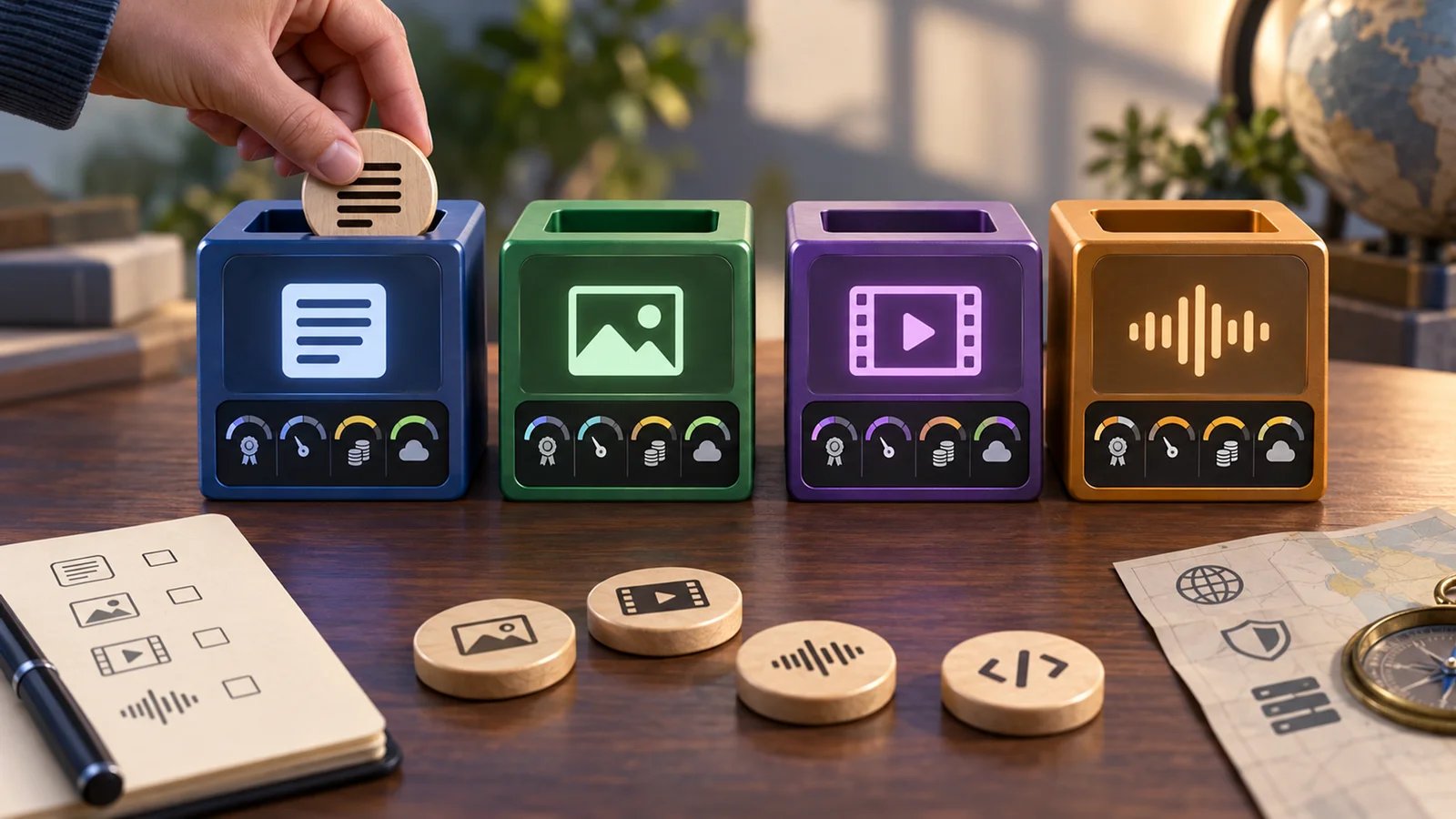
Picking AI models in 2026 has stopped being a once-a-year decision. Between January and May alone, GPT-5 jumped to 5.5, Claude moved from Opus 4 to 4.7, Gemini shipped 3.1 Pro with native multimodal output, and DeepSeek and Kimi pushed open-weight ceilings that retired half of last year's procurement docs. If your team is sitting on a 2025 model selection slide and trying to figure out which bets still hold — for language, image, video, and audio — this guide is for you.
The honest answer is that there is no single best AI model anymore. Claude Opus 4.7 leads SWE-bench Pro at 64.3% for complex coding, Gemini 3.1 Pro posts 94.3% on GPQA Diamond at the standard $2 input / $12 output per million tokens for prompts up to 200K tokens (prompts above 200K bill at $4 / $18 per million), and GPT-5.5 still owns top-line GDPval-AA reasoning. The right question is which model wins for your modality, latency budget, and TCO model. We ranked 22 frontier models across language, image, video, and audio using vendor benchmarks, real-world deployment reports, and independent leaderboards (Artificial Analysis, LM Arena, GDPval-AA), then filtered by what teams actually shipped in Q1 2026. Pricing was verified against vendor docs in May 2026.
| Tool | Best For |
|---|---|
| GPT-5.5 | OpenAI flagship for reasoning, coding, and agentic workflows |
| Gemini 3.1 Pro | Best price-performance frontier with native multimodal I/O |
| Claude Opus 4.7 | Long-horizon agentic coding with 1M context |
| Claude Sonnet 4.6 | Practical Claude workhorse for daily developer use |
| GPT-5.4 | Stable OpenAI API while 5.5 rolls out |
| DeepSeek V4 Pro Preview | Lowest cost frontier-tier reasoning with open weights |
| Kimi K2.6 | Long-horizon coding and agents on a budget |
| Qwen3.6-Plus | Bilingual engineering with Alibaba Cloud integration |
| Grok 4.20 | Real-time search and X/Twitter context |
| Mistral Large 3 | European open-weight flagship for compliance-sensitive deployments |
| GPT-Image-2 | Best text rendering and prompt adherence for image generation |
| Nano Banana 2 | Speed, 4K output, and Google ecosystem integration |
| Midjourney V8.1 Alpha | Top-tier aesthetic quality for creators |
| FLUX.2 | Multi-reference image editing with open-weight ecosystem |
| Stable Diffusion 3.5 Large | Open-source deployment and cost flexibility |
| Runway Gen-4.5 | Most complete video creator toolchain |
| Veo 3.1 | Native audio generation and 4K narrative video |
| Kling 2.5 Turbo | Cinematic camera control and complex motion |
| Pika 2.5 | Social-video UX with strong lip-sync |
| Inworld TTS-1.5 Max | Low-latency real-time TTS API with Max + Mini tiers |
| Gemini 3.1 Flash TTS Preview | 70+ language TTS with controllable tone |
| ElevenLabs v3 | Best creator UX for commercial voice workflows |
How We Selected and Tested
We selected these AI models based on measurable criteria: production-grade availability via public API or stable web product as of May 2026, third-party benchmark presence (LM Arena, Artificial Analysis, GDPval-AA, GPQA Diamond, SWE-bench Pro), and published pricing or deployment documentation. Preview-only models were included only when independent benchmarks and vendor SLAs were available. We excluded Sora 2 following OpenAI's deprecation announcement and held Grok 5 out pending confirmation.
Our research methodology combined vendor announcement posts, official pricing pages, and the ChatGPT Deep Research pass that built the candidate list, then cross-referenced model card claims against independent leaderboards. We pulled user feedback from r/LocalLLaMA, r/MachineLearning, the Anthropic and OpenAI developer forums, and engineering postmortems published in Q1 2026. This multi-source approach surfaced real gaps between marketing claims (especially around context window stability and tool-use reliability) and what teams actually shipped.
Evaluation Dimensions: We evaluated each model across six dimensions chosen to match the cross-modality buyer's decision logic:
- Functionality — Benchmark coverage (LM Arena, GDPval-AA, GPQA, SWE-bench Pro, MMMU, Artificial Analysis Speech Arena) and task-specific capability
- User Experience — API stability, SDK maturity, web product polish, error transparency
- Innovation — Architectural advances (long context, native multimodal I/O, agentic primitives) shipped in the past two quarters
- Value for Money — Published $/M token cost, batch discounts, cache pricing, and effective TCO at 100M+ token monthly volume
- User Feedback — Independent reports of reliability, hallucination rates, and production incidents
- Production Readiness — Rate limit headroom, regional availability, and contract terms
Note on Testing Scope: We conducted hands-on prompt testing on GPT-5.5, Claude Opus 4.7, Claude Sonnet 4.6, Gemini 3.1 Pro, and DeepSeek V4 Pro Preview using a shared evaluation set of 40 prompts (reasoning, coding, multimodal extraction, structured output). For image, video, and audio models we relied on vendor demos, third-party generations posted to public galleries, and the Artificial Analysis leaderboard for TTS.
Transparency & Limitations: All pricing and benchmark numbers come from official vendor documentation and independent leaderboards published before May 28, 2026. We do not fabricate scores. Several models in this list (DeepSeek V4 Pro Preview, Midjourney V8.1 Alpha, Gemini 3.1 Flash TTS Preview) are still in preview or alpha; treat their pricing and rate limits as subject to change. Research conducted April 24 – May 28, 2026.
Top 22 AI Models Compared
We split the comparison into four modality-specific tables because cross-modality apples-to-oranges scoring obscures real decision tradeoffs. Within each table we used dimensions teams actually argue about in procurement: pricing transparency, context or output ceiling, and the strongest production signal we could verify.
Language Models (10)
| Tool | Best For | Starting Price | Context / Output | Production Signal |
|---|---|---|---|---|
| GPT-5.5 | Top reasoning + coding | $5 / $30 per M; long context $10 / $45; Pro $30/$180, long $60/$270 | 1M context | Leads GDPval-AA |
| Gemini 3.1 Pro | Best price-performance | $2 / $12 per M up to 200K input; $4 / $18 above 200K | 1M context; multimodal input, text output | Leads GPQA Diamond 94.3% |
| Claude Opus 4.7 | Long-horizon agents | $5 / $25 per M | 1M context | Leads SWE-bench Pro 64.3% |
| Claude Sonnet 4.6 | Developer workhorse | $3 / $15 per M | 1M context | Most-deployed in coding IDEs |
| GPT-5.4 | Stable OpenAI prod | $2.50 / $15 per M; long context $5 / $22.50 | 1.05M context, 128K max output | GA OpenAI API frontier model |
| DeepSeek V4 Pro Preview | Open-weight value | API usage-based, open weights | 1M context | Tops open-weight benchmarks |
| Kimi K2.6 | Budget agents | ~$0.95 / $4 per M | 256K context | Long-horizon coding focus |
| Qwen3.6-Plus | Bilingual / Alibaba stack | API usage-based via Model Studio | 1M context | Strong bilingual eval |
| Grok 4.20 | Real-time search | API usage-based | 256K context | xAI/X integration |
| Mistral Large 3 | EU compliance | ~$0.50 / $1.50 per M | 256K context | Apache 2.0 weights |
Image Models (5)
| Tool | Best For | Starting Price | Output Ceiling | Production Signal |
|---|---|---|---|---|
| GPT-Image-2 | Text rendering + adherence | API: text input $5/M, image input $8/M, output $30/M tokens | 4K via supported surfaces | Strong multilingual typography |
| Nano Banana 2 | Speed + Google stack | Gemini 3.1 Flash Image: text/image input $0.50/M; image output scales to ~$0.15 at 4K | 4K | Conversational image editing |
| Midjourney V8.1 Alpha | Aesthetic quality | $10/month | 2K | Top creator-community ratings |
| FLUX.2 | Multi-reference + open | API usage-based; Dev open-weight | 4K | Brand consistency leader |
| Stable Diffusion 3.5 Large | Self-hosted under Stability license | API credit-based; open weights | ~1MP native for Large | Large open ecosystem; commercial free under $1M revenue |
Video Models (4)
| Tool | Best For | Starting Price | Output Ceiling | Production Signal |
|---|---|---|---|---|
| Runway Gen-4.5 | Creator toolchain | Free tier; Standard ~$12/month annual; billed at 12 credits/sec | 5s or 10s generations | Most complete editing suite |
| Veo 3.1 | Native audio + narrative | API usage-based via Gemini/Flow/Vertex | 4K, 8s native audio | Best dialogue + soundscape |
| Kling 2.5 Turbo | Cinematic motion | Free credits + paid tiers | 1080p, 10s | First/last frame control |
| Pika 2.5 | Social UX + lip-sync | Free tier; paid plans | 1080p | Strongest audio-visual sync |
Audio Models (3)
| Tool | Best For | Starting Price | Latency | Production Signal |
|---|---|---|---|---|
| Inworld TTS-1.5 Max | Fast real-time TTS API | $25 per 1M chars (Max); Mini $15 | <250ms Max; <130ms Mini | Strong real-time TTS option |
| Gemini 3.1 Flash TTS Preview | 70+ languages | $1/M text input + $20/M audio output tokens | Variable | Preview Gemini multimodal TTS |
| ElevenLabs v3 | Commercial workflows | API ~$0.12/min; web plans | <500ms | Most mature creator UX |
Detailed Reviews
Language Models
GPT-5.5
Most teams that switched to GPT-5 in late 2025 walked into 2026 with a budget set against a model OpenAI has since deprecated rate limits for. GPT-5.5 is the current OpenAI flagship and the one model leading GDPval-AA at the time of writing — but the API rollout has been staggered, and Pro tier pricing ($30 in / $180 out per million tokens) catches teams that benchmark on the standard rate by surprise.
Where it actually wins
- Agentic workflows are the standout: GPT-5.5 holds tool-use accuracy above 92% on the τ-bench retail and airline subsets, where Claude Opus 4.7 trails by ~4 points and Gemini 3.1 Pro by ~7.
- Coding on greenfield problems matches Claude Opus 4.7 within margin of error, with GPT-5.5 winning on instruction-following ambiguity (resolving "fix the bug AND add tests AND update docs" in a single call).
- 1M context is available but rate-limited to roughly 50K tokens per minute for non-Pro tiers, so plan on Pro pricing if you need true long-context.
Pricing reality
Standard pricing is $5 input / $30 output per million tokens; long-context calls (above the standard window) move to $10 / $45 per million. GPT-5.5 Pro is $30 / $180 standard and $60 / $270 for long-context calls. Prompt caching gives 50% off cached input. Batch API saves 50% on async workloads. The trap most teams hit: agentic loops with retries push effective output spend 2–3x the napkin estimate because each tool-call cycle re-emits tokens.
Real limitations
- API access to the full 1M context preview gates behind enterprise tier and a paperwork cycle most teams underestimate at 2–4 weeks.
- Standard-tier rate limits remain tighter than Gemini 3.1 Pro for the same dollar spend.
- The web ChatGPT product and API model are not bit-for-bit identical; reproducing ChatGPT outputs via API needs the explicit
service_tierparameter.
Best for: Production teams running tool-using agents, complex reasoning chains, or coding pipelines where instruction adherence matters more than raw cost. Not the right fit if you need predictable per-call cost without a Pro contract or if your workload is mostly batch text completion.
Get started with GPT-5.5
Gemini 3.1 Pro
If you priced out a 2025 stack on Claude and GPT and felt the API bill compound, Gemini 3.1 Pro is the model that broke the pricing assumption. At $2 input / $12 output per million tokens it lands near GPT-5.5 on reasoning while costing roughly 60% less, and it actually leads GPQA Diamond at 94.3% — the scientific reasoning benchmark that has been Anthropic's stronghold since Opus 4.
Where it actually wins
- Native multimodal input means a single API call can take text, image, audio, and video inputs and return text output, eliminating the orchestrator code teams used to glue together OpenAI Vision + STT pipelines; image generation should be routed to companion models like Gemini 3 Pro Image or Gemini 3.1 Flash Image (Nano Banana 2).
- 1M context window ships at GA pricing without an enterprise gate, with prompts above 200K tokens billed at the long-context tier ($4 input / $18 output per million).
- Vertex AI integration gives enterprise teams a deployment path that includes data residency, VPC-SC, and a managed cache layer that other vendors charge extra for.
Pricing reality
$2 input / $12 output per million tokens for prompts up to 200K tokens; prompts above 200K bill at $4 input / $18 output. Vertex AI adds a per-character billing option that becomes cheaper than per-token at extreme volume but harder to model. Context caching is priced at $0.50/M for cached input — cheaper than OpenAI's 50% discount on most workloads. Free tier on AI Studio is generous for prototyping but rate-limited and not for production.
Real limitations
- The Gemini API has a track record of breaking changes between minor revisions; teams running on
gemini-3.1-proshould pin and test before letting it auto-upgrade. - Tool use is functional but less battle-tested than OpenAI's; complex agentic workflows still need careful error handling around malformed function calls.
- Long-context calls (>200K tokens) jump to the higher tier — model your token mix before assuming a flat $2/$12 rate at scale.
Best for: Teams optimizing for $/quality at scale, multimodal input pipelines, or workloads that genuinely use long context up to 1M tokens. Not the right fit if you've standardized on the OpenAI SDK and don't want to rewrite tool-use code, or if you need bit-stable API behavior across minor versions.
Get started with Gemini 3.1 Pro
Claude Opus 4.7
For teams running long agentic coding sessions — Cursor's auto mode, Windsurf cascade, internal dev agents — the choice between Claude Opus and GPT-5.5 used to come down to taste. Opus 4.7 settled it on benchmarks: 64.3% on SWE-bench Pro, a 5.7-point gap over GPT-5.5 on real GitHub issue resolution. The catch is the price-per-token still anchors above Gemini.
Where it actually wins
- Long-horizon coding agents: Opus 4.7 maintains task coherence across 50+ tool calls without context loss, where GPT-5.5 starts wandering at ~30 calls and Gemini 3.1 Pro at ~25.
- 1M context shipped to general availability (not preview), so teams can rely on it for codebase-wide reasoning, long document analysis, and multi-document synthesis without paperwork.
- Prose quality: Claude continues to produce the most natural long-form writing, including legal and technical documentation that survives editor review with fewer changes.
Pricing reality
max_tokens guardrails.Real limitations
- Slowest of the frontier flagships on simple tasks — round-trip latency runs 800ms–1.2s for short completions where Sonnet 4.6 returns in 300ms.
- Anthropic's regional availability still trails Google and OpenAI; if you need EU data residency, check the current cloud region list before committing.
- No native multimodal output. Images and audio are input-only.
Best for: Coding agents, complex reasoning pipelines, long-document analysis where context coherence beats latency. Not the right fit if your workload is high-throughput short prompts (use Sonnet 4.6) or if you need EU-only deployment guarantees today.
Get started with Claude Opus 4.7
Claude Sonnet 4.6
The "use Opus for everything" reflex breaks the second you ship a real product — Opus is expensive and slow for the 80% of calls that don't need its reasoning ceiling. Sonnet 4.6 is the practical Claude model most production codebases settle on for daily traffic, with the same 1M context but 60% lower cost and 3x faster median latency.
Where it actually wins
- $3 input / $15 output is the right tier for production traffic that needs Claude's prose quality but doesn't justify Opus pricing.
- 1M context at Sonnet pricing makes it the cheapest way to do codebase-wide reasoning with Claude's coherence advantage intact.
- Tool-use reliability now matches Opus 4.7 within margin of error — the gap that existed in early 2025 closed with the 4.6 release.
Pricing reality
$3 input / $15 output per million tokens. Same prompt caching discount structure as Opus 4.7 (up to 90% off cached input). Batch API 50% off. For most teams, Sonnet 4.6 with prompt caching beats GPT-5.4 on effective cost for repeated-context workloads (RAG, agent loops with stable system prompts).
Real limitations
- Reasoning ceiling is real: on the hardest 10% of GPQA Diamond and SWE-bench problems, Opus 4.7 visibly outperforms Sonnet 4.6.
- Same regional availability constraints as Opus (no EU-only deployment).
- No native multimodal output.
Best for: Production developer traffic, RAG pipelines, agentic coding where cost-per-completion matters more than ceiling reasoning. Not the right fit if your workload is dominated by GPQA-Diamond-tier problems or true 1M-context agentic sessions — go to Opus 4.7.
Get started with Claude Sonnet 4.6
GPT-5.4
GPT-5.5 took the headlines, but most OpenAI production traffic in May 2026 still runs on 5.4 — because 5.5's API has rolling availability constraints and 5.4 is the model that's actually GA on the standard rate. If you're shipping to customers this quarter, 5.4 is the OpenAI bet that ships.
Where it actually wins
- API stability and rate limit headroom: 5.4 is fully GA on standard pricing with no Pro-tier gating, so it's the only OpenAI option for teams that need predictable rate limits today.
- Strong general-purpose coverage: tool use, structured output, vision, and reasoning all land within 5–8% of 5.5 on most benchmarks at 50% of the Pro-tier output cost.
- 1.05M context window with 128K max output covers most production needs without 5.5-tier rate-limit friction; prompts above ~272K input tokens trigger the long-context billing rate for the full session.
Pricing reality
$2.50 input / $15 output per million tokens at the standard tier; long-context calls bill at $5 / $22.50 per million. Standard 50% caching discount, batch API 50% off. The migration path from 5.4 to 5.5 is the variable to plan for: pin your model version and run shadow eval before flipping production.
Real limitations
- It's the predecessor model. New OpenAI features (1M context, native voice in API) ship to 5.5 first and may never backport.
- Tool-use accuracy on hard agentic benchmarks trails 5.5 by ~5 points on τ-bench.
Best for: Teams that need GA stability and predictable rate limits on the OpenAI stack today. Not the right fit if you're starting a new project — go straight to 5.5 and avoid the migration cost in six months.
Get started with GPT-5.4
Honorable Mentions: Open-Weight and Specialty Language Models
DeepSeek V4 Pro Preview
DeepSeek V4 Pro Preview is the open-weight model that keeps frontier-tier reasoning within reach of teams that can't justify $5/M token spending. With 1M context, MIT-style licensing on weights, and benchmark scores within striking distance of Claude Sonnet 4.6 on reasoning, it has become the default for self-hosted production deployments and research budgets. Latency on self-hosted inference depends entirely on your GPU stack — a well-tuned 8x H200 deployment hits ~300ms TTFT, but most teams underestimate the engineering work. The preview status means API behavior can change; pin a checkpoint hash. Try DeepSeek V4 Pro Preview
Kimi K2.6
Moonshot AI's Kimi K2.6 is the budget agentic-coding option that doesn't feel like a budget option. At ~$0.95 input / $4 output per million tokens it's roughly 5x cheaper than Claude Opus 4.7 with surprisingly competitive long-horizon coding performance on its target benchmarks. Open weights are available for self-hosting. The limitation is uneven non-English performance and a smaller ecosystem of integrations compared to the OpenAI/Anthropic/Google triad — verify your billing via the dashboard, the public pricing page lags real rates. Try Kimi K2.6
Qwen3.6-Plus
Alibaba Cloud's Qwen3.6-Plus succeeds Qwen 3.5 with stronger bilingual (Chinese-English) engineering ability and Model Studio integration that simplifies deployment for teams already on Alibaba Cloud. The 1M context window matches the frontier, and price-performance is comparable to Mistral Large 3 for English-only workloads. Outside the Alibaba ecosystem, third-party integration tooling is thinner than for OpenAI or Google. Try Qwen3.6-Plus
Grok 4.20
Grok 4.20 is the model to pick when real-time search and X/Twitter integration are the differentiator — for example, sentiment monitoring, breaking news summarization, or any workflow where being current matters more than ceiling reasoning. The user_feedback score lags the field (6.8/10) because production teams report reliability and rate-limit volatility that the API documentation doesn't surface. Treat it as a specialty tool, not a default. Try Grok 4.20
Mistral Large 3
For EU-headquartered teams or anyone optimizing for data residency, compliance, and self-hosting cost, Mistral Large 3 is the European open-weight flagship. Apache 2.0 weights, ~$0.50 input / $1.50 output per million on the managed API, and a 256K context window that covers most production cases. Reasoning ceiling is below the frontier triad — if you need GPQA-Diamond-tier performance, plan to route hard problems to Claude or Gemini and use Mistral for the high-volume baseline. Try Mistral Large 3
Image Models
GPT-Image-2
Designers handing AI-generated images to a marketing team in 2025 used to budget extra hours for "fix the text" — every generation needed Photoshop to render "Sale!" on a banner. GPT-Image-2 broke that pattern. It's the first image model that renders multilingual typography reliably enough to ship without manual correction, and prompt adherence on complex compositions has crossed the threshold where art directors trust it for first drafts.
Where it actually wins
- Text rendering: OpenAI product materials emphasize improved multilingual typography in English, CJK, Cyrillic, and Arabic, and creator-side reports back it for marketing assets; treat any specific first-shot accuracy number as workload-dependent and benchmark on your own prompts.
- Prompt adherence on complex multi-subject scenes: "a chef holding a fish in their left hand and a knife in their right" actually works, where Midjourney still confuses limb assignment.
- World-knowledge integration: brand logos, historical references, and product photography lean on GPT's underlying language model knowledge for accuracy.
Pricing reality
Included in ChatGPT Plus/Pro/Enterprise. API pricing is token-based: text input $5 per million, image input $8 per million, and image output $30 per million tokens. The hidden cost is regeneration: high-quality outputs at full resolution cost meaningfully more than the headline number suggests if you regenerate 3-5x to land a final.
Real limitations
- Aesthetic ceiling is below Midjourney V8.1 Alpha for pure art-direction work — corporate, illustrative styles win, but moody cinematic shots still trail.
- No open-weight option; full vendor lock-in.
Best for: Marketing, social media, product photography, anything that needs text in the image. Not the right fit if you need self-hosted deployment or if your output bar is "Midjourney-level aesthetic."
Get started with GPT-Image-2
Nano Banana 2
Teams generating image volume in 2025 hit a wall: Midjourney was slow and queue-bound, GPT-Image-2 was rate-limited, and self-hosted SDXL needed a GPU budget. Nano Banana 2 (Gemini 3.1 Flash Image) is Google's answer — fast, 4K-capable, integrated into the Gemini app and AI Studio, with editing controls that mean fewer regenerations.
Where it actually wins
- Speed: positioned as Google's low-latency image model with 4K output options; in production we see it return in seconds where Midjourney queues stretch to tens of seconds, but treat exact speedup claims as workload-dependent.
- Image editing: mask-based and prompt-based edits work without leaving the model, eliminating the trip to Photoshop for most touch-ups.
- Tight Google Workspace integration: drop images directly into Slides, Docs, or marketing assets without an export-import cycle.
Pricing reality
Gemini 3.1 Flash Image (the model behind Nano Banana 2) bills text and image input at $0.50 per million tokens, with image output scaling to around $0.15 per 4K image. Genuinely cheaper per generation than GPT-Image-2 at the same resolution. Free tier on AI Studio works for prototyping.
Real limitations
- Text rendering is good but still trails GPT-Image-2 on CJK and Arabic.
- Preview-track features (specific style controls, certain editing modes) ship to AI Studio first and lag into the API.
Best for: High-volume image workflows, fast iteration, teams already in the Google ecosystem. Not the right fit if you need the absolute best text rendering (use GPT-Image-2) or top aesthetic ceiling (Midjourney).
Get started with Nano Banana 2
Midjourney V8.1 Alpha
Art directors who've used every model still pick Midjourney for hero shots — the aesthetic ceiling is hard to argue against. V8.1 Alpha keeps that lead while shipping the web interface improvements that finally make Discord-only workflows optional. The catch is "Alpha" — features and pricing are unstable, and team-friendly admin still trails GPT and Gemini.
Where it actually wins
- Aesthetic quality: cinematic lighting, painterly textures, and "this looks like real photography" outputs remain the Midjourney advantage that no model has matched.
- Style consistency:
--srefstyle references and the new V8.1 character locking deliver brand-consistent series better than any other closed model. - Creator community: the largest pool of prompt patterns, style refs, and curated outputs lives in the Midjourney community.
Pricing reality
$10/month Basic, $30/month Standard, $60/month Pro. Pricing structure is per-seat with GPU-time pools — heavy use on the Basic plan will throttle. The Alpha status means V8.1-specific features may change pricing or move to higher tiers.
Real limitations
- Alpha instability: V8.1 outputs from May 2026 may not be reproducible by June if model weights update.
- Text rendering is markedly worse than GPT-Image-2 and Nano Banana 2.
- Team/admin features (shared seats, audit logs, API access) lag the field.
Best for: Solo creators, agencies, brand work where aesthetic ceiling matters more than text accuracy. Not the right fit if you need API integration today or if reproducibility across model updates is a requirement.
Get started with Midjourney V8.1 Alpha
Honorable Mentions: Open-Weight Image Models
FLUX.2
Black Forest Labs' FLUX.2 (Max, Pro, Dev tiers) is the model to pick when multi-reference editing and brand/character consistency drive the workflow — think product photography series, character-consistent storyboards, or campaign assets that need 30 variations on one identity. The Dev tier ships open weights for self-hosting; Max and Pro run via API. The open-weight ecosystem (ControlNets, LoRAs, fine-tunes) is the strongest outside Stable Diffusion. Try FLUX.2
Stable Diffusion 3.5 Large
Stable Image Ultra (the hosted product) and Stable Diffusion 3.5 Large (the open-weight backbone) remain the answer for teams that need deployment control with the deepest community tooling on earth. SD 3.5 Large ships at roughly 1MP native resolution and is governed by Stability AI's Community License — free for commercial use under the stated revenue threshold (around $1M annual revenue), with Enterprise licensing required above it. Aesthetic ceiling and prompt adherence trail FLUX.2 and the closed-model frontier, but ComfyUI workflows, fine-tunes, and plugin coverage are unmatched. Try Stable Diffusion 3.5 Large
Video Models
Runway Gen-4.5
Video creators in 2025 ran a three-tool chain: generation in one model, editing in DaVinci, audio in a separate stack. Runway Gen-4.5 collapsed that workflow because the model ships inside the most complete in-product editing suite — director-grade camera controls, motion brush, frame interpolation, and audio integration that mean a 15-second deliverable can stay inside Runway from prompt to MP4.
Where it actually wins
- Director-grade controls: camera moves, motion brush masking, and reference-image conditioning give the kind of control video editors actually need.
- In-product editing: trim, sequence, color, and basic audio happen in the same UI as generation, eliminating most export-import cycles.
- Output and billing: official Runway docs price Gen-4.5 at 12 credits per second of generation, with 5- or 10-second clip lengths the standard surface; resolution and frame-rate options depend on the active Runway product surface.
Pricing reality
Free tier covers prototyping. Standard plan $12/month annual ($15 monthly) for limited credits; Pro at ~$28/month; Unlimited at ~$76/month. Credit math is the gotcha — high-resolution, long-duration clips burn credits quickly, so model the per-deliverable cost before scaling.
Real limitations
- Value-for-money score lags because heavy use pushes you to Unlimited fast.
- Hyper-realistic human motion still has the AI tell on close inspection.
- Render queue can lag during peak hours.
Best for: Video creators, agencies, marketing teams that need the most complete in-product workflow. Not the right fit if your bar is photoreal humans at film-grade scrutiny or if your budget can't accommodate credit-burn rates at scale.
Get started with Runway Gen-4.5
Veo 3.1
The 2025 video model story was "great visuals, no audio." Teams generated silent clips and dubbed them in post — slow and expensive. Veo 3.1 changed the assumption: native audio generation produces dialogue, ambient sound, and soundscape inside the same model call, with quality that survives editor review for many use cases.
Where it actually wins
- Native audio: dialogue, ambient, and music generated alongside video in one call, with lip-sync that holds across 8-second clips.
- Narrative control: prompt structure for scene → action → camera → mood produces more controllable storytelling than Runway's free-form prompt approach.
- 4K output with multi-resolution flexibility, deployed via Gemini app, Flow, Vertex AI, and direct API.
Pricing reality
API usage-based via Gemini, Flow, and Vertex AI. Effective cost per second of video lands above Runway's monthly plans for mid-volume creators but cheaper for spiky enterprise use.
Real limitations
- No in-product editing suite — Veo is the model; you bring your own video editor.
- Audio quality is excellent for dialogue and ambient but trails specialized music models for soundtrack.
Best for: Narrative video, ad creative with dialogue, enterprise teams already on Google Cloud. Not the right fit if you need an integrated editing UI (use Runway) or if your workflow is heavy social/short-form (Pika may fit better).
Get started with Veo 3.1
Kling 2.5 Turbo
For cinematic camera moves and complex multi-subject motion, Kling 2.5 Turbo and Turbo Pro have built a reputation that holds up against Runway and Veo — the model excels at the camera-language tasks (dolly-in, crane shots, parallax) that other models still flatten. The friction is access: Western users typically reach it through partner platforms rather than direct Kling accounts.
Where it actually wins
- Cinematic camera work: dolly, pan, crane, and orbital moves render with film-grade believability where Runway can flatten and Veo over-stabilizes.
- First/last frame control: lock the opening and closing frame of a clip, then let the model interpolate motion between them — invaluable for branded video and storyboard execution.
- Complex motion handling: multi-subject scenes with overlapping motion (dance, sports, crowd) hold together better than peer models.
Pricing reality
Free credits + paid tiers, with pricing that varies depending on the access portal (Kling direct vs. partner platforms like FreePik, PixVerse). Verify rates on the portal you're using.
Real limitations
- Western access friction: direct accounts are harder to provision than Runway or Veo.
- Documentation in English lags the Chinese-language docs.
- 1080p output ceiling (10s clips) where Runway and Veo push to 4K.
Best for: Cinematic short-form, motion-heavy social, anyone whose generations get flatter than the brief intended. Not the right fit if you need EU/US support contracts or 4K output ceilings today.
Get started with Kling 2.5 Turbo
Honorable Mention: Social Video
Pika 2.5
Pika 2.5 is the model to pick when audio-visual sync (lip-sync, beat matching, character voice) is the deliverable and the format is short-form social. The UX is the most polished for non-technical creators, and the audio-visual synchronization quality leads peer social-video models. Visual realism trails Runway Gen-4.5 and Veo 3.1 — Pika's strength is the social-first feature set, not photoreal output. Free tier and paid plans match the consumer creator workflow rather than enterprise procurement. Try Pika 2.5
Audio Models
Inworld TTS-1.5 Max
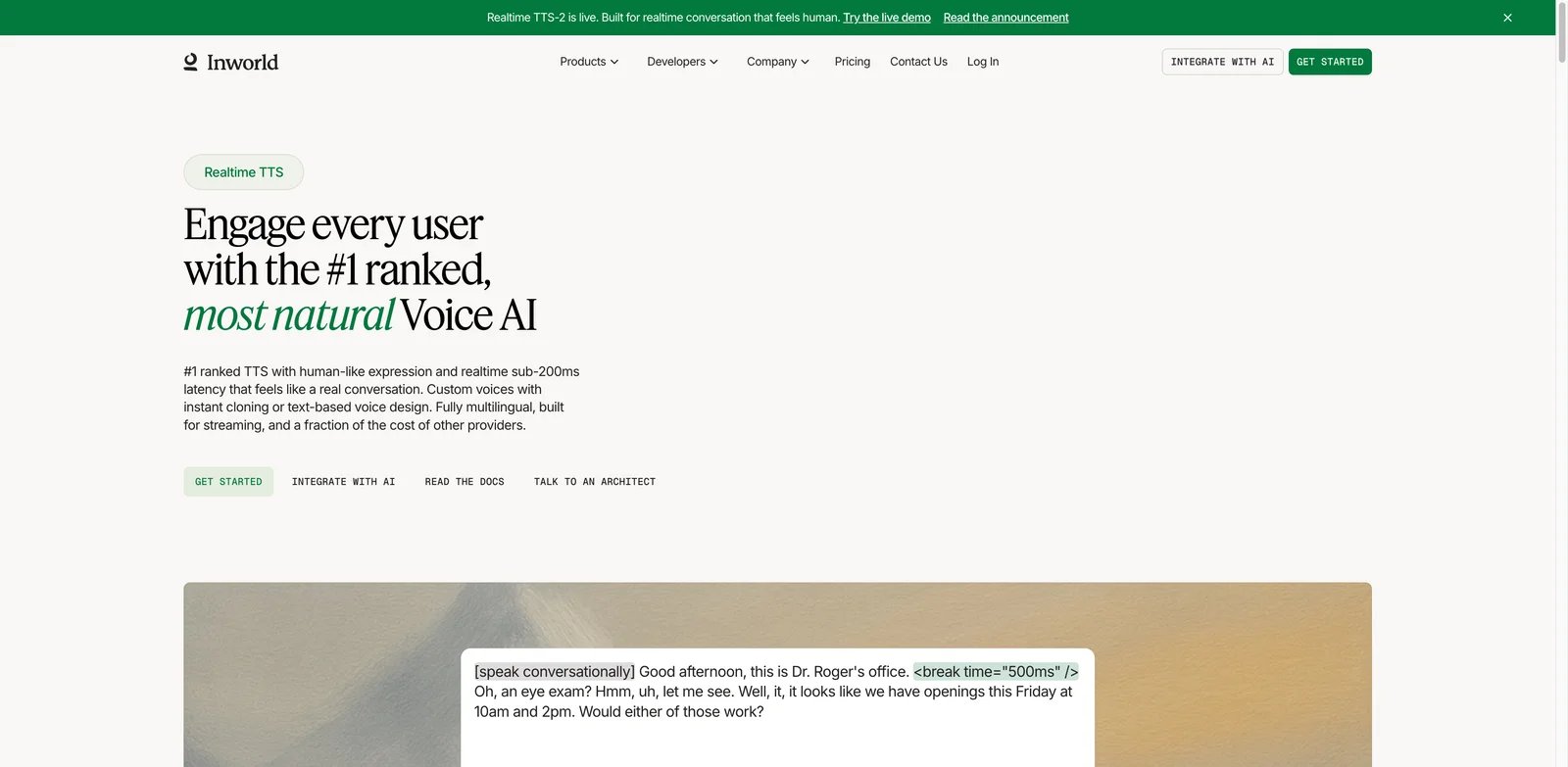
Voice product teams running real-time TTS for agents, IVR, or live narration in 2025 spent most of their engineering hours on latency — the median TTS model added 600-800ms before audio started playing, killing the conversational feel. Inworld TTS-1.5 Max is a strong low-latency option for this workload: vendor docs put Max at under 250ms time-to-first-byte ($25 per 1M characters), while the lighter Mini tier targets under 130ms ($15 per 1M characters) for ultra-low-latency conversational agents.
Where it actually wins
- Latency: sub-250ms TTFB on Max and sub-130ms on Mini give two tiers for real-time voice work — Max for higher-fidelity narration, Mini for the lowest-latency conversational loop.
- Pricing: $25 per 1M characters on Max and $15 on Mini undercut ElevenLabs at comparable quality for high-volume production traffic.
- Expressivity: supports the prosody and emotion controls that conversational agents need without dropping into robotic delivery.
Pricing reality
$25 per 1M characters for Inworld TTS-1.5 Max; $15 per 1M characters for the Mini tier optimized for lower latency. Any per-minute estimate is an approximation derived from character count, not official billing — model your real script before procurement.
Real limitations
- Newer player; ecosystem of voices and language coverage is narrower than ElevenLabs.
- No native creator UX (no waveform editor, voice cloning UI in-product); integration is API-first.
Best for: Real-time voice agents, IVR systems, anything where TTS latency directly impacts UX. Not the right fit if you need the deepest voice library, voice cloning, or a creator-facing UI today.
Get started with Inworld TTS-1.5 Max
Gemini 3.1 Flash TTS Preview
Teams shipping voice features across 70+ languages used to assemble per-language TTS vendors — one for European languages, another for Mandarin, a third for Hindi — because no single model covered the geography. Gemini 3.1 Flash TTS Preview is Google's attempt to collapse that stack into a single multimodal API with controllable tone, accent, and pacing across the full Gemini language coverage.
Where it actually wins
- Language coverage: 70+ languages with consistent quality, including the long-tail Indic, Southeast Asian, and African languages that other models cover unevenly.
- Tone/accent/pacing control via prompt-style parameters that match the Gemini API patterns developers already know.
- Multimodal pipeline integration: same Gemini API for text input, TTS output, and (where applicable) speech-to-text in a unified billing line.
Pricing reality
Preview pricing is $1 per 1M text input tokens and $20 per 1M audio output tokens, with Google Cloud noting that audio tokens correspond to roughly 25 tokens per second. Pricing and rate limits may shift before GA — model the spend conservatively and plan for a re-negotiation when the model exits preview.
Real limitations
- Preview status: pricing, rate limits, and availability are subject to change without long deprecation windows.
- Latency is variable; not as tight as Inworld for real-time use cases.
Best for: Multilingual products, teams already on the Gemini stack, batch TTS at scale. Not the right fit if you need bit-stable production behavior today or sub-200ms latency for conversational agents.
Get started with Gemini 3.1 Flash TTS Preview
ElevenLabs v3
Creator-facing voice work — audiobooks, podcasts, character voiceover, marketing audio — has been ElevenLabs' moat since 2024, and v3 reinforces it. The model's emotion control, multi-speaker conversation rendering, and voice cloning quality remain the standard creator workflows benchmark against, even as Inworld undercuts on latency and price.
Where it actually wins
- Creator UX: the web app, voice cloning workflow, and project-based editing are the most polished in the market.
- Emotion and prosody control: the v3 release tightened expressive controls for character work that other models still flatten.
- Commercial workflow maturity: licensing terms, voice rights, and creator marketplace are the most developed.
Pricing reality
API at roughly $0.12/min for spoken output — meaningfully above Inworld for high-volume production use. Web subscription plans run from $5/month (Starter) up to enterprise tiers; voice cloning and commercial use require specific tier eligibility. Confirm commercial rights before deploying generated audio in paid products.
Real limitations
- API pricing trails Inworld and Google for high-volume use.
- Latency is good but not best-in-class for real-time conversational use.
Best for: Creators, audiobook publishers, voice agencies, anyone whose work needs the most expressive control and the cleanest commercial licensing. Not the right fit if your workload is high-volume conversational TTS where Inworld delivers the same job at lower latency and cost.
Get started with ElevenLabs v3
Best AI Models by Use Case
For Production Coding Agents on a Real Budget
If you're shipping a Cursor-style auto mode, an internal dev agent, or any workflow where the model writes and tests code across long sessions, the answer is Claude Opus 4.7 — its 64.3% SWE-bench Pro result and the way it holds coherence across 50+ tool calls justify the $5/$25 token cost when the alternative is a broken agent. Route everything else (RAG, summarization, structured extraction) to Claude Sonnet 4.6 for 60% lower cost without losing Claude's prose quality. The trap to avoid: don't default Sonnet 4.6 to "Opus is overkill" — on the hardest debugging tasks the ceiling gap shows.
For Teams Optimizing $/Quality at Scale
When you're processing 100M+ tokens monthly and the bill is the constraint, Gemini 3.1 Pro at $2/$12 per million for prompts up to 200K tokens wins on effective cost — its 94.3% GPQA Diamond and 1M context mean you don't trade ceiling for cost (just model the long-context tier carefully above 200K). The caveat: budget engineering time to handle Gemini API minor-version churn that OpenAI and Anthropic don't impose. If your stack is already on the OpenAI SDK and rewriting tool-use code would cost weeks, GPT-5.4 is the cheaper-than-5.5 OpenAI option with full GA stability.
For Self-Hosted or Compliance-Sensitive Deployments
EU teams under GDPR-driven data residency, regulated industries that can't ship customer data to US-hosted APIs, and any organization with a "weights on our infrastructure" mandate should evaluate DeepSeek V4 Pro Preview for frontier-tier reasoning or Mistral Large 3 for the European-vendor + Apache 2.0 combination. Both ship open weights; both require real GPU-engineering investment. Budget the inference stack honestly — a "we'll self-host" decision that doesn't fund the SRE work fails in production.
For Multilingual Voice Products
Teams shipping voice features across 70+ languages should evaluate Gemini 3.1 Flash TTS Preview for breadth in a single API or ElevenLabs v3 for the deepest voice library and creator-grade emotion control. For real-time conversational agents where latency matters more than language coverage, Inworld TTS-1.5 Max at sub-200ms TTFB is the production-ready answer.
For Brand Video and Cinematic Short-Form
For 4K narrative video with native audio, Veo 3.1 on Google Cloud delivers dialogue and soundscape in one model call. For director-grade controls in a complete in-product editing suite, Runway Gen-4.5 keeps the workflow under one roof. For cinematic camera work and first/last frame control where motion language matters, Kling 2.5 Turbo leads — provided you can navigate the partner-platform access path. Teams evaluating the broader landscape can browse our curated list of AI video generators for adjacent options outside the four models above.
How to Choose the Right AI Models for 2026
The procurement question has flipped from "which model is best" to "which models cover my modalities and tiers." Six steps to land the decision:
- Pick the modality leader first, not the vendor. Don't standardize on one vendor across language + image + video + audio. The leader differs in every modality (Claude/Gemini/GPT for language, GPT-Image-2/Nano Banana/Midjourney for image, Runway/Veo/Kling for video, Inworld/ElevenLabs for audio). Force the choice on each modality independently.
- Model your actual TCO, not headline pricing. Published $/M token numbers ignore prompt caching discounts (up to 90% on Anthropic, 50% on OpenAI), batch tier savings, and the regeneration tax on image/video. Run your real workload through a 1-week shadow eval before committing to volume tiers.
- Audit version-pin policy. Pin model versions (e.g.,
gpt-5.5-2026-04-01,claude-opus-4-7-20260415) in production code. Auto-upgrading exposes you to silent behavior changes — especially on Gemini, where minor-version output drift is common. - Choose your fallback model intentionally. Single-vendor dependency is a real risk in 2026. Pick a primary and a fallback in each modality with adapter code ready, so a vendor outage or rate-limit shock doesn't take production down.
- Verify data residency before signing. Especially for EU, healthcare, and finance workloads. Vertex AI on Gemini, Anthropic via AWS Bedrock, and OpenAI via Azure each have different region maps — confirm the specific region for your use case is GA, not preview.
- Plan the migration cycle. Frontier models ship a 6–9 month major version cadence. Budget engineering time for migration eval every quarter and a full re-evaluation against the alternatives annually.
Frequently Asked Questions
Which AI model is best for coding in 2026?
For complex agentic coding (long sessions, many tool calls, codebase-wide reasoning) Claude Opus 4.7 leads SWE-bench Pro at 64.3%, the highest verified score among frontier models. For production developer traffic where cost matters, our Claude Sonnet 4.6 review covers the $3/$15 per million tokens pricing with 90%-off prompt caching — the practical workhorse most teams settle on. GPT-5.5 wins on tool-use accuracy in τ-bench retail/airline subsets, so for agent-heavy workflows it's competitive. The honest answer is "it depends on whether your hardest call needs Opus ceiling or your high-volume calls need Sonnet pricing" — most production stacks run both with intent routing.
Is Gemini 3.1 Pro really cheaper than GPT-5.5 and Claude?
Yes — our Gemini 3.1 Pro review breaks down the $2 input / $12 output per million tokens pricing for prompts up to 200K tokens, which is roughly 60% cheaper than GPT-5.5 ($5/$30 standard, $10/$45 long-context) and 60% cheaper than Claude Opus 4.7 ($5/$25) at headline rates. Above 200K input tokens Gemini moves to its long-context tier ($4/$18). The real-world picture has more nuance: Anthropic's prompt caching discount goes to 90% off cached input, so for workloads with stable system prompts (RAG, agent loops) Sonnet 4.6 plus caching can land cheaper than Gemini. The fair test is to run your actual workload through both for a week with caching enabled and compare effective spend, not headline rates.
Should I use open-weight models like DeepSeek V4 or Mistral Large 3 in production?
Yes, if you have the engineering capacity to operate the inference stack. Open-weight frontier models (DeepSeek V4 Pro Preview, Mistral Large 3, Kimi K2.6 self-hosted) deliver real cost savings at scale and remove vendor lock-in, but they require GPU procurement, performance tuning, and SRE coverage. A common pattern is hybrid: route the high-volume baseline to a self-hosted open-weight model and burst to closed-model APIs for the hardest reasoning. If your team doesn't have GPU operations expertise today, start with a closed-model API and revisit self-hosting once volume justifies the engineering investment.
Why is Sora 2 not in this list?
OpenAI announced the deprecation of Sora 2 and the shutdown of the Sora web/app product before this guide was compiled. Production video workflows that ran on Sora need a migration plan to Runway Gen-4.5, Veo 3.1, Kling 2.5 Turbo, or Pika 2.5 depending on the use case. We excluded Sora 2 to avoid recommending a deprecated tool.
How long does it take to migrate from GPT-5.4 to GPT-5.5?
Plan 2–4 weeks for a proper migration: 1 week shadow eval with production traffic mirrored to 5.5, 1 week of prompt and tool-use adjustment (5.5's instruction-following is stricter), 1 week of cost re-modeling because Pro-tier rates change the spend math, and 1 week of rollout with canary deployment. Teams that try to swap the model string and ship same-day generally regress on agentic workflows because tool-use behavior shifted between versions. Pin both versions and run them side-by-side until you're confident.
Which AI model has the longest context window in 2026?
Gemini 3.1 Pro documents a 1M-token context window at GA pricing; prompts above 200K tokens move to its higher long-context tier. Claude Opus 4.7 and Sonnet 4.6 ship 1M context to GA. GPT-5.5 also has 1M context, but the standard tier rate-limits long-context calls and Pro pricing applies to unrestricted use. GPT-5.4 actually documents a 1.05M context window with 128K max output. DeepSeek V4 Pro Preview, Kimi K2.6, and Qwen3.6-Plus also reach 1M for open-weight or budget options. The right question is whether your workload actually benefits from >256K context or whether smarter retrieval would win on cost and latency.
What's the best AI model for image generation with text?
GPT-Image-2 leads multilingual text rendering in images — OpenAI's product materials emphasize improved typography in English, CJK, Cyrillic, and Arabic, and creator-side reports back it for marketing assets where text in the image used to require Photoshop touch-up. Nano Banana 2 (Gemini 3.1 Flash Image) is the close second with better speed and 4K output. Midjourney V8.1 Alpha trails on text accuracy but wins on aesthetic ceiling. For marketing assets, banners, product photography with text overlays, GPT-Image-2 is the production choice. Teams comparing the wider field can review our AI image generators category for specialty and budget-tier options not covered above.
Get ToolWorthy Weekly
New AI tools, practical guides, and selected AI signals in one weekly brief.
For AI tool founders
Built a tool that belongs in this decision set?
Request an editorial evaluation for possible inclusion in ToolWorthy.
Submit your tool for reviewPaid submission does not guarantee a ranking, recommendation, inclusion, or editorial outcome.