Overview
Grok 4.5 became available through the xAI API and Cursor on July 8, 2026, following a late-June private beta at SpaceX and Tesla and a public rollout confirmed for the next day. Where Grok 4.3 was a quiet cost-and-reasoning update, Grok 4.5 is positioned as a structural shift: xAI's first model jointly trained with Cursor, designed for coding, agentic tasks, and broader knowledge work rather than coding alone. Elon Musk described it as "roughly comparable to Opus 4.7, but much faster" and more token-efficient than competing frontier models — a direct challenge to Anthropic's Claude line rather than a comparison to xAI's own prior Grok versions.
The model (grok-4.5) is available through the xAI API, Grok Build, and — notably — inside Cursor across desktop, web, iOS, CLI, and SDK from launch day. It carries a 500K-token context window, smaller than Grok 4.3's 1M, and a knowledge cutoff of February 1, 2026. Cursor itself disclosed that a codebase snapshot was accidentally included in training, which gives Grok 4.5 an unclear advantage specifically on CursorBench; Cursor excluded that benchmark from its published comparison.
What's New
The First Cursor-Trained Grok
Grok 4.5 is xAI's first model built jointly with Cursor, trained for software engineering plus broader knowledge work including data science, finance, legal work, science, engineering, and math. It shipped already live inside Cursor across desktop, web, iOS, CLI, and SDK, with meaningful token pools included in existing Cursor plans — a distribution move that puts Grok directly in front of working developers rather than requiring a separate sign-up.
Positioned as an Opus-Class Competitor
xAI's framing for Grok 4.5 explicitly targets Anthropic: Musk called it "roughly comparable to Opus 4.7, but much faster" and about twice as token-efficient as comparable systems. This is a different competitive posture than Grok 4.3, which mostly compared itself to xAI's own prior Grok 4.20.
Smaller Context, Tiered Pricing
Grok 4.5's context window is 500K tokens — down from Grok 4.3's 1M and well below Grok 4.1 Fast's 2M. Pricing is tiered by prompt length: $2 input / $6 output per million tokens for prompts under 200K tokens, rising to $4 input / $12 output above that threshold. Cursor's official launch post confirms a faster variant at $4 input / $18 output per million tokens; availability should be verified before relying on it for cost planning.
Vendor-Published Benchmark Results
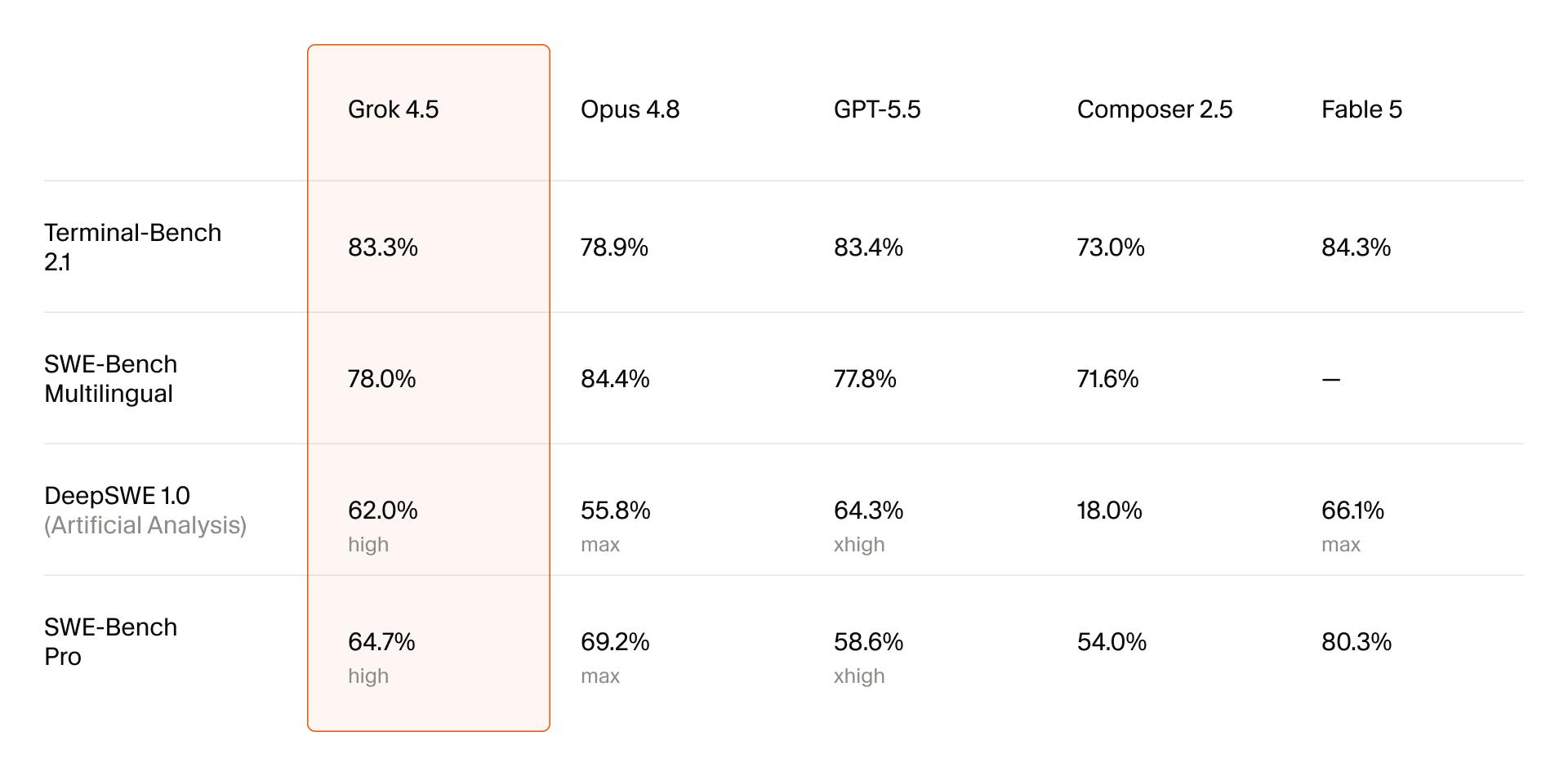
Official benchmark charts published by xAI and Cursor show Grok 4.5 competitive with Opus 4.8, GPT-5.5, and Fable 5 on agentic coding suites (Terminal-Bench 2.1, SWE-Bench Multilingual, DeepSWE 1.0, SWE-Bench Pro), but Cursor's disclosure that a codebase snapshot leaked into training affects CursorBench specifically; Cursor excluded that result because the exact impact is unclear. xAI published benchmark charts in its official Grok 4.5 announcement, and Cursor published an official model card on July 14, 2026.
Performance Benchmarks
Vendor-published figures from xAI and Cursor; treat cross-model comparisons cautiously because harnesses and score sources differ:
| Benchmark | Grok 4.5 | Opus 4.8 | GPT-5.5 | Fable 5 |
|---|---|---|---|---|
| Terminal-Bench 2.1 | 83.3% | 78.9% | 83.4% | 84.3% |
| SWE-Bench Multilingual | 78.0% | 84.4% | 77.8% | — |
| DeepSWE 1.0 | 62.0% | 55.8% | 64.3% | 66.1% |
| SWE-Bench Pro | 64.7% | 69.2% | 58.6% | 80.3% |
Grok 4.5 leads Opus 4.8 on Terminal-Bench 2.1 and DeepSWE 1.0 but trails it on SWE-Bench Multilingual and SWE-Bench Pro — a mixed picture rather than the clean "Opus-class" win Musk's framing implies. Fable 5 leads the three benchmarks for which this table reports a Fable score; no Fable 5 result is shown for SWE-Bench Multilingual.
Migration Guide
Teams moving from Grok 4.3 to Grok 4.5 should check three things before switching the model ID in production:
- Context window shrinks again. Grok 4.3 and Grok 4.20 both support 1M-token context windows; Grok 4.5 reduces that ceiling to 500K. Workloads relying on large single-call context (long codebase analysis, big document bundles) will need chunking or retrieval — verify your typical prompt size against the new ceiling before migrating.
- Pricing is now length-tiered. Grok 4.3 also has higher long-context rates at 200K tokens; Grok 4.5 sets its tiers at $2/$6 below 200K and $4/$12 at or above 200K. Re-run cost estimates on your actual prompt-length distribution, not just average token counts.
- Cursor is now a first-class access path. If your team already uses Cursor, Grok 4.5 is available there without a separate xAI account — useful for evaluating the model before committing API spend.
Pricing & Plans
| Plan | Price | Grok 4.5 Access |
|---|---|---|
| API (grok-4.5, <200K tokens) | $2 input / $6 output per 1M tokens | Direct API access, pay-as-you-go |
| API (grok-4.5, ≥200K tokens) | $4 input / $12 output per 1M tokens | Long-context surcharge |
| Cursor | Included in existing plans | Token pools vary by Cursor tier |
| Free (Grok chat) | $0 | Varies by rollout — check picker |
| SuperGrok | $30/month | Grok 4.5 included |
| SuperGrok Heavy | Check current plan page | Grok 4.5 access and limits depend on the current Heavy plan |
Pricing note: Cached input runs $0.30–$0.60 per million tokens depending on the prompt-length tier. Cursor's official Grok 4.5 launch post lists a fast variant at $4 input / $18 output per million tokens, although xAI's API pricing page does not list it — confirm current rates at x.ai before production use.
Best For
- Teams already using Cursor who want to evaluate Grok 4.5 without a separate xAI account or API commitment
- Cost-sensitive agentic coding pipelines that fit comfortably under the 500K-token context ceiling
- Developers comparing xAI's coding-focused positioning against Anthropic's Opus line before committing to a vendor
- Teams that can tolerate provisional benchmark data and want to independently verify performance before production use
- Organizations prioritizing per-token cost over maximum context window — see Grok 4.3 or Claude Fable 5 for larger-context alternatives
FAQ
How is Grok 4.5 different from Grok 4.3?
Grok 4.5 is xAI's first model jointly trained with Cursor and is explicitly positioned to compete with Anthropic's Opus line, rather than just improving on xAI's own prior Grok 4.20/4.3 line the way Grok 4.3 did. Practically, the context window shrinks again (1M → 500K), pricing becomes length-tiered ($2/$6 under 200K tokens, $4/$12 above), and Cursor becomes a first-class access path alongside the API and Grok Build.
Is Grok 4.5 really "Opus-class" as Musk claims?
Partially, based on early third-party benchmarks. Grok 4.5 leads Opus 4.8 on Terminal-Bench 2.1 and DeepSWE 1.0, but trails it on SWE-Bench Multilingual and SWE-Bench Pro, and trails Fable 5 on nearly every published metric. Cursor's disclosure that a codebase snapshot leaked into training also means CursorBench results should not be used for comparison because Cursor identified an unclear training-data advantage and excluded the benchmark.
How much does Grok 4.5 cost?
$2 per million input tokens and $6 per million output tokens for prompts under 200K tokens, rising to $4/$12 above that threshold. Cached input runs $0.30–$0.60 per million tokens. Existing Cursor plans include Grok 4.5 token pools without a separate xAI subscription.
Where can I use Grok 4.5?
The xAI API (grok-4.5), Grok Build, and Cursor across desktop, web, iOS, CLI, and SDK. Grok 4.5 is currently included with SuperGrok, and xAI has rolled it out to Grok on web, iOS, Android, and X, though availability may vary by region.
Should I upgrade from Grok 4.3 to Grok 4.5?
It depends on your workload. If you're running agentic coding tasks inside Cursor or comparing against Opus-class models on cost, Grok 4.5's positioning and pricing are compelling — but verify the smaller 500K context window fits your prompts, and treat early benchmark claims as provisional given Cursor's training-data disclosure. Teams needing more than 500K tokens of context should stay on Grok 4.3 or evaluate Fable 5 instead.