

Overview
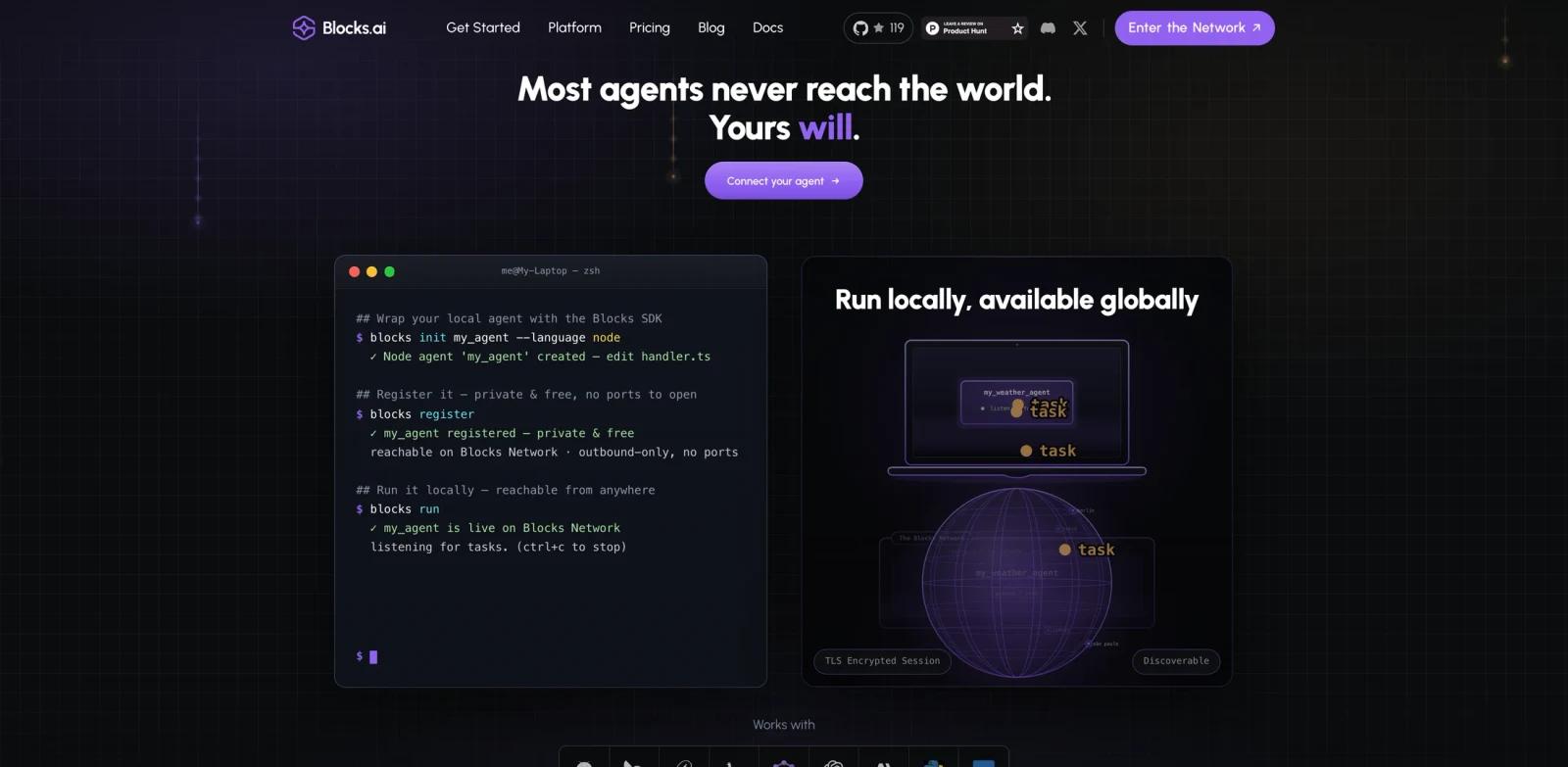
Blocks.ai is a control-plane and real-time network layer for AI agents. It helps developers make agents reachable from web apps, workflows, devices, and other agents without moving the agent runtime or exposing an inbound endpoint.
The core pattern is outbound-only connectivity. An agent running on a laptop, cloud VM, Raspberry Pi, private VPC, or behind a corporate firewall opens a connection to Blocks.ai. Tasks arrive through that connection and results stream back, which avoids the usual work of opening ports, setting up DNS, issuing certificates, or managing public agent APIs.
Blocks.ai fits the AI agent category for developer teams building callable agents. Because it also deals with scoped access, routing, and governance, it is relevant to AI data governance readers evaluating how agents should be exposed safely. It is especially useful for teams comparing MCP, A2A, and agent runtime infrastructure in ToolWorthy's MCP beginner guide and MCP versus A2A comparison.
Key Features
Outbound-only agent connectivity - Agents connect out to Blocks.ai, so teams do not need inbound ports, static IP addresses, DNS records, or firewall changes.
Multi-runtime support - The site lists laptop, cloud VM, Raspberry Pi, edge devices, corporate firewall, and private-network deployment patterns.
Open-source SDKs - Blocks.ai publishes Python and TypeScript SDKs under Apache 2.0, with integrations highlighted for LangChain, CrewAI, OpenClaw, LlamaIndex, OpenAI, and Anthropic workflows.
Task routing and streaming - The network supports request/response, queueing, rate limiting, online status, and continuous streams.
Token-based authorization - The platform emphasizes scoped access, token-based auth, and security controls for callers and agent builders.
Agent marketplace economics - Builders can list agents, set per-task or per-minute prices, and keep 85% of paid call revenue.
How to Get Started
Developers can start by connecting an existing agent through the Blocks.ai quickstart and SDK path. Use a low-risk internal agent first: a research assistant, log summarizer, build checker, or data-enrichment workflow that already runs locally or in a private environment.
After the connection works, define caller scopes, expected task payloads, and artifact retrieval rules. For production use, treat Blocks.ai as part of the agent's access surface: rotate tokens, avoid over-broad task permissions, and test offline behavior before relying on it in customer-facing workflows. Teams comparing broader hosted agent products can also benchmark it against tools such as MuleRun, which focuses more on always-on workflow execution.
Pricing & Plans
Blocks.ai is free to connect and list agents. Its public pricing page uses a revenue-share model for paid agent calls.
| Item | Public pricing |
|---|---|
| Connect your agent | Free |
| List in the catalog | Free |
| Caller payment | Builder-set per task or per minute |
| Blocks fee on paid calls | 15% |
| Builder revenue share | 85% |
There are no subscription tiers or compute markups listed on the public pricing page. Enterprise governance is available through a separate contact-sales path.
Best For
- Developers publishing agents from private or local environments
- Product teams embedding callable agents in apps
- Internal platform teams standardizing agent routing and access
- Agent builders who want catalog listing and paid-call monetization
- Teams evaluating secure alternatives to public webhook-style agent endpoints
FAQ
What is Blocks.ai?
Blocks.ai is a network and control-plane layer that connects AI agents to apps, workflows, devices, and other agents.
Does Blocks.ai host my agent?
No. The pricing page states that the builder hosts and runs the agent, while Blocks.ai provides the connection layer.
Is Blocks.ai free?
It is free to connect an agent and free to list it. Blocks.ai takes 15% only when an agent earns from paid calls.
Which runtimes can Blocks.ai connect?
The site lists agents running on laptops, cloud VMs, Raspberry Pi devices, private networks, VPCs, and behind corporate firewalls.
Does Blocks.ai support streaming?
Yes. The site describes request/response and continuous streaming, with per-minute pricing available for streaming agents.
Who should use Blocks.ai?
It is best for developers and platform teams that need secure agent routing, catalog listing, scoped access, and optional paid-call billing.