
5 Buffer Alternatives 2026 — Is Your Queue Worth Moving?
Compare five Buffer alternatives by bulk scheduling, approvals, evergreen queues and reporting. Check the plan limits and migration work before switching.

On this page
The best Buffer alternative depends on what is breaking your current workflow. Start with Publer for large campaign batches, Metricool for brand-based reporting, SocialBee for evergreen queues, Planable for client sign-off, or Later for visual planning. None is automatically a cheaper or complete replacement.
Before moving, check the current Buffer rather than an old comparison. It now has native CSV bulk upload, analytics and a comment-reply inbox. That inbox is not a claim of full DM/customer-care coverage. Replacing a working queue only pays off if the new tool fixes a specific bottleneck without losing a network, approval rule or publishing format you need.
This is public-source desk research, checked October 23, 2026, not a hands-on publishing benchmark. Trial instructions below are proposed elimination tests, not results we measured.
Buffer alternatives at a glance
Use this table to choose a trial, not to infer a universal ranking.
| Tool | Switch when this is the bottleneck | First reason to rule it out |
|---|---|---|
| Publer | Preparing large batches of posts from a spreadsheet | You expect a free, fully automated migration of your Buffer queue |
| Metricool | Reporting across several brands, not just filling queues | Its brand bundles do not match your account mix, or approvals exceed your budget |
| SocialBee | Reusing a maintained library of evergreen posts | Most content is time-sensitive and should never loop |
| Planable | Clients and teammates need a clear approval workflow | Created-post caps or per-workspace costs outweigh the review benefit |
| Later | Planning visual content across a brand's social set | You need several accounts on the same network, or an unsupported network |
Why switch—and when Buffer is still the better choice
Name the problem before comparing plans:
- The queue is too small: Buffer Free's ten scheduled posts per channel are a rolling queue limit, not ten posts per month. A paid Buffer plan may solve this without migration.
- Campaign preparation is repetitive: Compare batch size and per-network editing, not a yes/no “CSV” checkbox. Buffer already supports CSV on every plan.
- Old content needs a new life: Buffer's recurring-post Beta supports a finite repeat count and cadence. If available in your account, that may cover a few repetitions without migration. An indefinitely recycling category library is a different requirement, with an obligation to expire outdated offers.
- Approval is happening in email: Test who can publish without sign-off and whether your client can review the right content—not just whether an “approval” feature exists.
- Reporting costs more effort than posting: A brand-based package may fit better than per-channel billing. But an inexpensive reporting tier may not include team approvals.
Stay with Buffer's scheduling product if your required networks and formats work, a simple queue is enough, and its current plan covers your collaborators. Its Free plan connects three channels for one user; Team includes unlimited members and approval workflows. Do not move solely because someone says Buffer lacks collaboration or an inbox. Check the current plan comparison.
Approval is role-dependent: Buffer's Needs Approval users must request sign-off, while the owner and Full Access users can move drafts to the queue. That is not the same as a rule requiring every author—including privileged roles—to obtain approval.
Buffer's native bulk upload accepts up to ten posts per channel on Free, subject to remaining queue space, and up to 100 per channel per upload on paid plans. It supports text and single-image posts—not videos, Reels or carousels. YouTube and CSV first comments are excluded. If that already handles your campaign, a different CSV importer is not, by itself, an upgrade.
Compare the limits that change the decision
These are purchasing and workflow boundaries, not feature scores. Prices below are public USD quotes checked October 23, 2026, before applicable tax. Monthly and annually billed equivalents are labeled separately; region, legacy plans and account configuration can change checkout totals.
Start with the cost of staying. Buffer's official pricing lists Essentials at $6/channel/month and Team at $12/channel/month for the first ten channels on monthly billing. Annual equivalents are $5 and $10, billed annually. On paid plans, all connected channels are billed, including the three previously on Free; channels beyond ten use volume tiers.
- Solo publisher, one brand and three channels, no approvals: Buffer Essentials is $18/month. Publer's public calculator displayed $12/month for Professional, three accounts and zero extra members; Metricool Starter is $25/month. Publer's publishing-only configuration saves $6 before migration work, but does not include Business analytics/recycling. Match the capabilities before treating the cheapest quote as equivalent.
- Agency, five brands with Instagram and Facebook for each, approvals required: Ten Buffer Team channels total $120/month. Metricool Advanced's up-to-15-brand tier is $67/month and includes team/client approvals. That is a $53/month subscription difference before any required add-ons—not proof of equivalent reports, roles or publishing formats. Check those requirements and the one-time queue rebuild before deciding.
Add five X accounts to that agency and the comparison changes: Metricool's current X add-on adds $10 per connected X account per month, making $117/month. Buffer Team's 15 channels total $140/month under its volume tiers, so the gap becomes $23, not $53. These are documented-rate calculations, not checkout quotes or measured savings from a migration.
| Tool | What drives the bill | Material plan boundary |
|---|---|---|
| Publer | Social accounts plus additional members | Professional: $12/month in the checked three-account, zero-extra-member configuration. Business adds analytics/recycling; re-price your actual setup. |
| Metricool | Number of brands and plan | Starter: $25/month/up to five brands; Advanced: $67/month/up to 15, with team/client approvals. X adds $10/month per connected X account. |
| SocialBee | Profiles, workspaces and users per workspace | Monthly Bootstrap: $29/5 profiles/one included user; Pro: $99/25 profiles, five workspaces, three users per workspace. Extra users can be added for $10/month each. |
| Planable | Workspaces and created posts, not user seats | Pro: $59/workspace/month, ten pages, 150 created posts/month, Required approval. Multi-level approval is Enterprise. Analytics/inbox cost extra. |
| Later | Social sets, users and publishing allowance | Annual equivalent Starter: $18.75/month, one set/one user, 30 posts/profile/month; Growth: $37.50/month, two sets/two users, 180 posts/profile/month and approvals. |
The cost comparison is not simply “five profiles versus five profiles.” Metricool defines a brand as one connection per network; Later similarly defines a social set as one profile on each of its listed networks. Five Instagram accounts are neither one Metricool brand nor one Later set. Map your actual brands, network identities and reviewers before comparing totals.
| Tool | What you must rebuild or prove | Small trial that can eliminate it |
|---|---|---|
| Publer | Destination CSV fields, media access and per-account variants | Import a representative batch as drafts; inspect captions, times, media and network-specific fields. |
| Metricool | Brand grouping and report definitions; old analytics are not automatically transferred | Recreate one client's report and verify the chosen plan covers the necessary review workflow. |
| SocialBee | Category-based recycling versus Buffer's finite recurring-post Beta; expiration rules | Mix evergreen and dated posts; confirm only the intended content returns to the queue. Mastodon requires a manual handoff. |
| Planable | Workspaces, author/reviewer roles and approval rules | Test rejection, revision, author bypass and edits after approval under the plan you would actually buy. |
| Later | Social-set mapping, monthly post counters and publishing mode | Plan a visual week plus next month's drafts; check counter usage and every required mobile handoff. |
Before you cancel: a queue is not a transferable project
Buffer's calendar documentation says it does not directly export scheduled posts. Paid Insights CSV exports concern published posts and performance; they are not a ready-to-import copy of tomorrow's queue. The Buffer API does expose scheduled-post queries, but programmatic access is not proof of a complete, supported migration into another scheduler.
Save a working inventory before disconnecting anything: post text and per-network variants, original media, destination account, exact time and timezone, first comments, links/UTMs, approvals and any recurring rule. Keep published reports separately as a historical baseline. A destination accepting CSV does not mean it preserves Buffer's queue order, review history, analytics history or account permissions.
First recreate one representative week, including a video, a multi-network variant, a fixed-time campaign and a post needing review. Compare drafts without enabling two live queues for the same posts. Choose one scheduler to own the cutover window; after checking the replacement, stop or remove the matching scheduled items in the old system to avoid duplicates. This is a migration checklist, not a claim that we performed a transfer.
For all five candidates, match each required network, account type and post format to automatic publishing versus a notification/manual handoff before importing the queue. A network logo is not enough. One concrete regression: SocialBee's Mastodon support uses Universal Posting—a mobile reminder and manual publication—not a replacement for Buffer's automated Mastodon queue. Planable's current connected-platform list does not list Bluesky or Mastodon; Later explicitly lists both as unsupported.
Which alternative passes your first elimination test?

Best for: A spreadsheet-first publisher whose campaign batches exceed Buffer's per-upload workflow.
Publer's bulk scheduling documentation describes up to 500 posts in a CSV batch; Buffer's paid limit is 100 posts per channel per upload. These are different units, not a five-times-throughput benchmark. Buffer's CSV is text/single-image only, while Publer's CSV guide describes video and multi-photo inputs. Network-specific fields and plan restrictions still matter; neither importer proves automatic transfer of first comments, per-network variants or a complete Buffer queue.
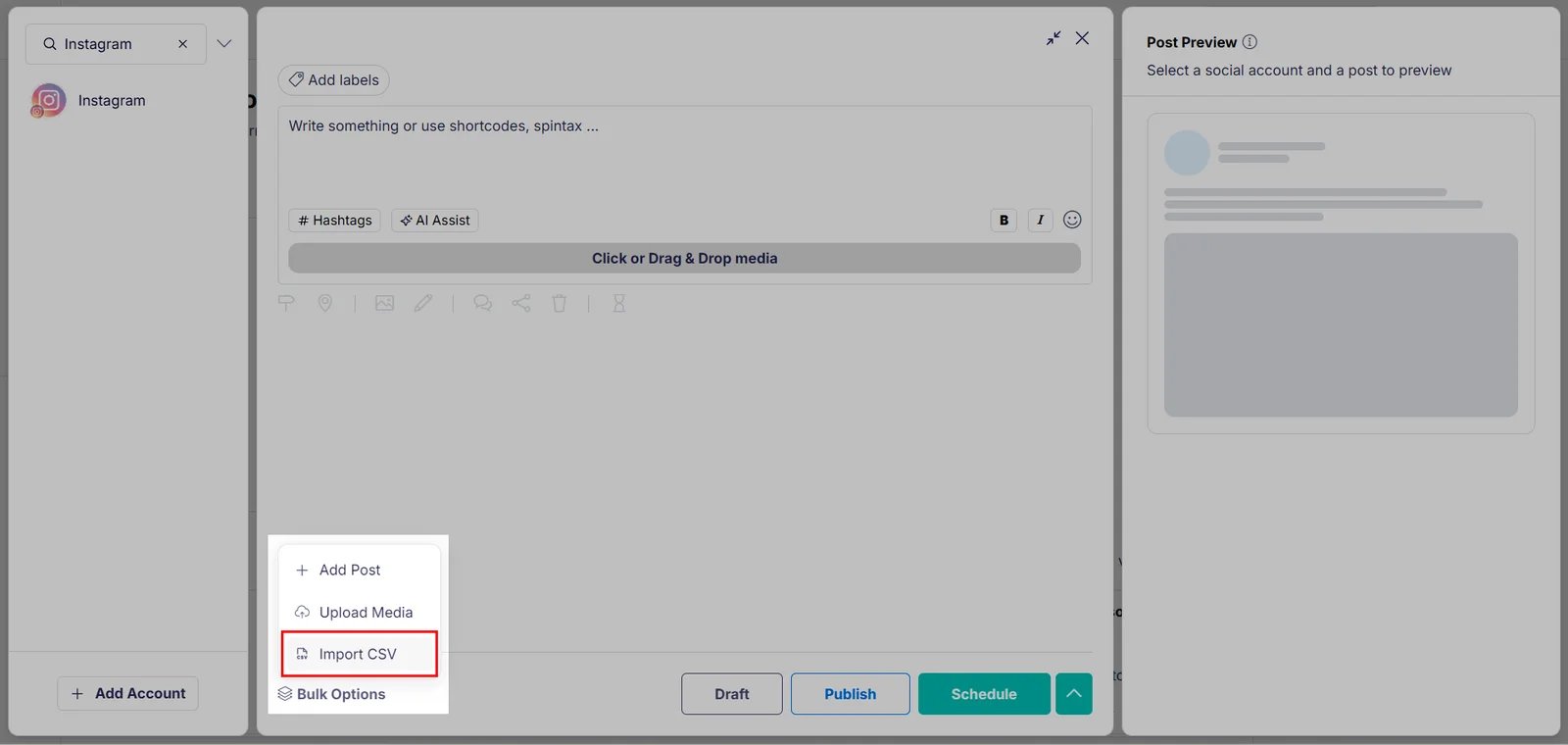
Publer's official help example, last updated October 2024, highlights the CSV entry point. It illustrates the documented workflow, not a fresh account test or proof that imports preserve Buffer settings.
Skip if: A free Buffer replacement is the only objective. Publer's official help limits Free CSV batches to five posts at a time. Its plans also separate Professional publishing from Business analytics/recycling, with pricing configured by accounts and extra members. Do not assume AI, reporting and every team member come with the cheapest publishing configuration.
The checked public calculator localized prices to SGD but exposed an official USD tooltip; the $12 monthly quote above is that tooltip's value, not our currency conversion. Checkout region, account count, collaborators and billing frequency still determine your actual charge.
Trial / first elimination test: On a paid-feature trial, use ten representative draft posts, including media URLs and a channel-specific variant; on Free, split them into batches of five. Inspect the imported drafts, not just the success notification. Reject it if fixing the imported batch takes as much work as preparing it in Buffer.

Best for: A publisher who now spends more time assembling brand reports than scheduling content.
Metricool's current plans combine publishing and reporting around brands. Starter includes PDF/PPT reports; Advanced adds team/client management and post approvals. This can be a useful move when a client's reporting workflow is the actual problem. It is not a claim that Buffer has no analytics.
Skip if: You need approvals but only budgeted for Starter, or your network mix makes its Free plan unsuitable. Free is one brand with 20 posts per month and excludes LinkedIn and X; current paid X access adds $10/month per connected X account, not one flat subscription-wide fee. Paid scheduling is subject to fair-use conditions. A cheap headline does not establish the total for your setup.
Trial / first elimination test: Map one client's exact profiles to a brand, reconstruct their report and confirm the important metrics and date range. Then test a draft with the intended reviewer on the paid tier you would need. If the report does not replace your current manual work, changing schedulers has not solved the problem. Our broader AI social media workflow comparison separates reporting from creation, publishing and listening.

Best for: A team maintaining an evergreen content library rather than a sequence of disposable campaign posts.
SocialBee documents post-level and category-level requeueing, including expiration by date or number of publications. That changes the unit of work: you maintain categories and rules rather than continually refilling a single queue.
The reason to move is the maintained category library—not merely repeating a post. Buffer's recurring-post feature is currently Beta and finite; its scheduling help says indefinite repetition is not supported. Check Beta availability before assuming you need a replacement for a small number of repeats.
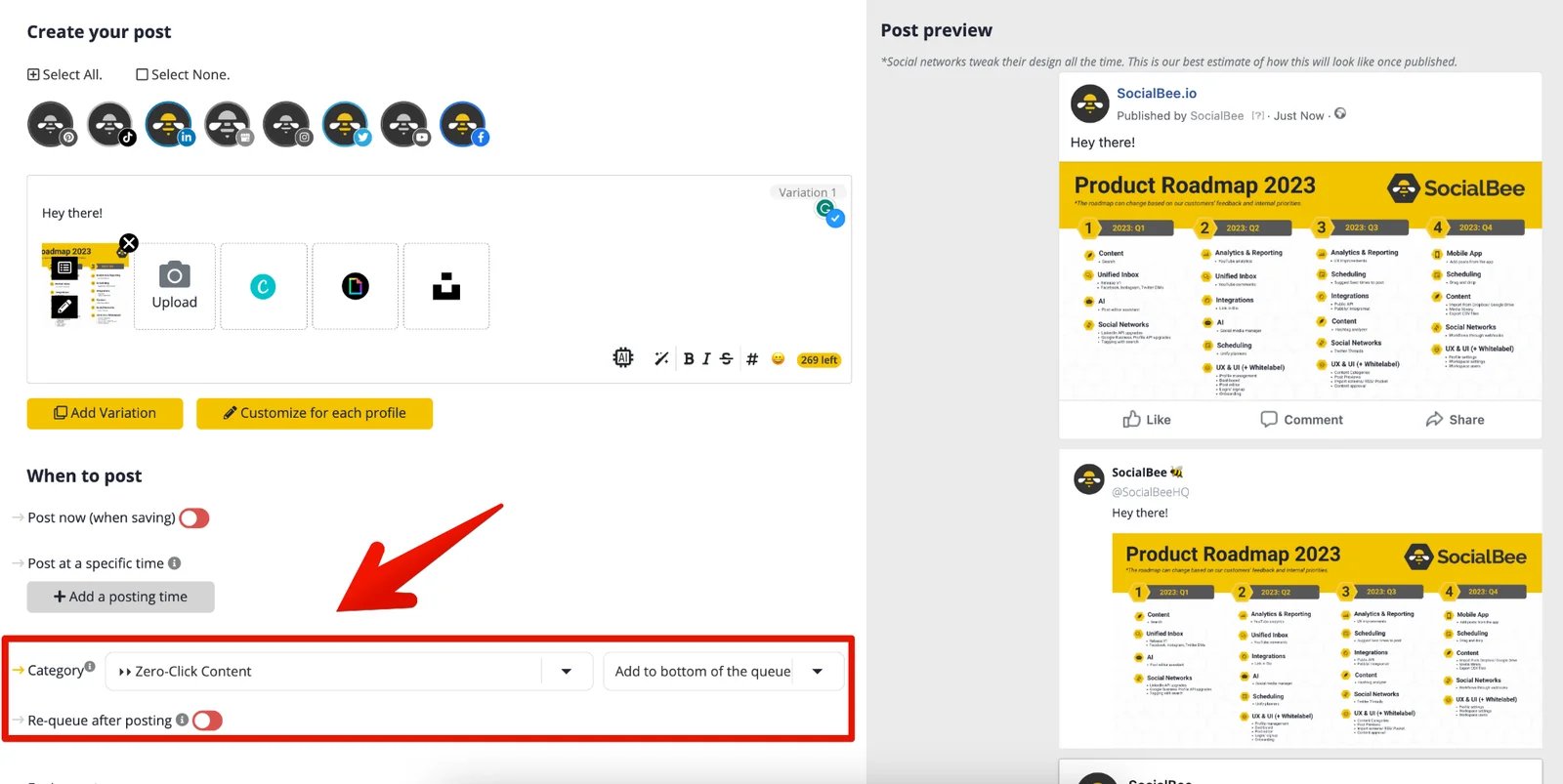
Official SocialBee help illustration showing the category and requeue controls. The example post contains a 2023 roadmap; it is a documented UI example, not a claim that we tested the current account interface.
Skip if: Most posts expire quickly, no one will maintain the library, or automated Mastodon publishing is essential. A recurring promotion with an old date is not an efficiency gain. Bootstrap and Accelerate each include one user per workspace, but user add-ons cost $10/month each without requiring an upgrade. Price the needed feature tier plus seats; a small team need not automatically buy Pro.
Trial / first elimination test: In the 14-day Pro trial, create an evergreen category and a dated campaign category. Confirm that the intended posts requeue and the dated material expires. Then compare the actual users/workspaces you need with the post-trial plan—not just the features visible during the Pro trial. Do not assume identical recycling behavior on every social network.
Planable
Best for: Teams whose main friction is collecting contextual feedback and mandatory client sign-off.
The important distinction is optional versus required approval. Planable's pricing puts Required approval on Pro and multi-level approval on Enterprise; Basic is not an enforced approval upgrade. Unlimited users can make collaboration practical, but workspaces and created-post limits still determine fit.
Skip if: You mainly want an inexpensive unlimited publishing queue. The 50-post free allowance is a one-time trial, not a monthly free tier; X publishing is not included in the free trial. Paid caps count created posts, and cross-network copies count separately. Ten campaign ideas copied to four networks can consume 40 created posts.
Trial / first elimination test: Simulate a rejected draft, revised copy and final sign-off with the actual author/client roles. Check whether an author can bypass review, whether editing an approved post requires a fresh approval, and whether the purchased tier supports the needed number of approvers. Also price the post-trial mode: the free trial exposes features that may require Enterprise. If Buffer Team's configured role-based workflow already meets your policy, additional review structure may be unnecessary.

Best for: A visual-content brand that wants planning and collaboration built around a defined social set.
Later's current packages group accounts across Instagram, Facebook, Threads, Pinterest, TikTok, LinkedIn, YouTube and Snapchat. Its plan guide specifies 30 posts per profile per month on Starter and 180 per profile per month on Growth, which also adds approvals. These are monthly allowances, not rolling queue capacities. Its packaging is useful only if your accounts fit those sets and your publishing pattern fits the selected tier.
Its Visual Instagram Planner previews scheduled content in the feed; drafts appear on desktop, while external sharing requires Growth or above. A solo preview and a shareable client review are different requirements.
Later's post-count documentation counts posts when scheduled rather than published, and also counts newly created drafts without counting them again on scheduling. Filling several future months now can consume the current month's allowance. Check the counter during the trial; do not compare it directly with Buffer Free's reusable ten-slot queue.
Skip if: “Eight profiles” sounds like eight interchangeable accounts. The listed set has one of each network. Starter also does not permit extra social sets or users. Do not assume Buffer's X, Bluesky or Mastodon workflow carries across just because both products are social schedulers.
Trial / first elimination test: During the 14-day trial, plan a representative visual week with your real formats. For every item, establish whether it auto-publishes or needs a notification/mobile completion step, and whether that depends on account type or a platform-native feature. A different dashboard cannot remove a restriction imposed by the social network itself.
Other routes worth pricing—not five more recommendations
If the missing capability is governed customer care or broad listening, investigate a suite separately; our Hootsuite alternatives guide covers that broader replacement decision. Do not pay for an enterprise suite merely to refill a small posting queue.
- SocialPilot: Price its agency bundle if you need more accounts and users together. Premium includes 25 accounts, six users, bulk scheduling and client approval; do not infer client approval from a lower tier's internal manager workflow. It is a bundle alternative to Publer's configurable accounts and Planable's workspace model, not a default cheaper queue.
- Zoho Social: Its Standard plan provides paid scheduling around a brand bundle with one included team member; Premium adds approval workflows. Consider that packaging if your accounts fit it, particularly within the Zoho ecosystem. We have not verified a configuration-specific USD quote, so it is not our declared budget winner or a verified free scheduling upgrade.
If you only publish to Facebook and Instagram, evaluate native planning before paying for multi-network coverage you do not use—but that is a narrower workflow, not a complete Buffer replacement.
Buffer alternatives FAQ
Is there a free Buffer alternative with a bigger queue?
Among these five, we have not verified a like-for-like, permanently free upgrade with a larger reusable queue. Publer Free also offers three accounts and ten queued posts per account, excluding X; Metricool Free's 20 posts are a monthly allowance; Later Free has limited monthly scheduling, not an established bigger reusable queue. Planable's 50 created posts are a one-time trial, and SocialBee offers a 14-day trial rather than a permanent free plan. If Buffer Free already covers your networks, staying may be the lowest-cost answer.
Which Buffer alternative is best for client approvals?
Start with Planable when sign-off is the central problem, and test Pro's Required approval rather than Basic's optional mode. Metricool Advanced is another route when client reporting and approval need to live together. First check whether Buffer Team already supplies the roles you need; migration is not required merely to add one reviewer.
Can I move all my scheduled Buffer posts automatically?
Do not assume so. Buffer documents no direct scheduled-post export from its calendar. Published-post reports are not tomorrow's queue. Its API offers scheduled-post access, but a complete destination importer still needs to handle media, network variants, times and permissions. Trial a representative week before moving everything.
Will switching fix Instagram audio or mobile publishing steps?
Not necessarily. Check the exact format, account type and network-native feature in the candidate's current support documentation. A platform may require mobile completion for some posts even when ordinary posts auto-publish. Do not infer universal auto-publishing from an Instagram logo on a pricing page.
Keep Buffer until a replacement passes the test that matters to your work. A successful switch means less repeated work after restoring the necessary queue, formats and review rules—not merely a longer feature list.
Get ToolWorthy Weekly
New AI tools, practical guides, and selected AI signals in one weekly brief.
For AI tool founders
Built a tool that belongs in this decision set?
Request an editorial evaluation for possible inclusion in ToolWorthy.
Submit your tool for reviewPaid submission does not guarantee a ranking, recommendation, inclusion, or editorial outcome.