
8 Best AI Sales Training Tools 2026 — Practice vs Proof
A convincing AI buyer is only the start. Compare sales training tools by practice limits, scoring standards, team controls, and what your stack already includes.

On this page
The best AI sales training tool is not necessarily the one with the most convincing avatar. It is the one that lets a rep rehearse the conversation they actually struggle with, explains the feedback against your selling standard, and gives a manager a useful next coaching step. A high practice score alone proves none of those things.
This comparison covers sales practice and readiness, not prospecting bots, automated outreach, or a system that talks to customers for you. For those jobs, use our broader AI sales tools comparison. Here, the decision is whether to buy individual rehearsal, a dedicated team program, an expansion of an existing platform, or a specialized field-sales system.
We reviewed official product, pricing, support, and subscription documents on October 19, 2026. This is desk research—not a hands-on assessment of voice realism, scoring accuracy, ramp time, or revenue lift. Dollar amounts are the public USD web offers described below; billing terms, taxes, regional availability, and team quotes require confirmation.
AI sales training tools at a glance
Use the overview to choose a route, then compare the training controls and buying boundaries below. Product names link to their detailed sections; this is not a scored ranking.
| Tool | Start here for | Access |
|---|---|---|
| Yoodli | Individual rehearsal | Personal / team |
| Kendo | Metered team pilot | Trial / paid |
| Hyperbound | Practice + call coaching | Free / quote |
| Second Nature | Content + practice courses | Quote |
| PitchMonster | Team roleplay program | Quote |
| Gong AI Trainer | Existing Gong workflow | Enable |
| Mindtickle | Broader enablement | Order-specific |
| Quantified | Life-sciences training | Quote |
Before adding another subscription, ask your current enablement or call-intelligence vendor to demonstrate its present training module. “Already a customer” does not mean “already licensed,” but an unused entitlement may change the shortlist.
Compare training controls and buying boundaries
The first table compares what the training owner can build and assign; the second separates the public price from the usage or module that changes the bill. These are documented capabilities and entitlements, not tested voice-quality or scoring-accuracy ratings. On a phone, swipe the three-column tables horizontally; the tool name stays visible.
Practice design and team control
| Tool | Scenario / feedback control | Team workflow / plan gate |
|---|---|---|
| Yoodli | Personal Builder; business-specific rubrics | Team / Enterprise: assignments and dashboards |
| Kendo | Custom prospects and scorecards | Team reporting; separate practice and call balances |
| Hyperbound | Practice / Perform: custom bots and scorecards | Manager Assignments and Calls → Practice: Perform |
| Second Nature | Content-generated scenarios and evaluation topics | Courses, assignments; SCORM / LTI connectivity |
| PitchMonster | Custom scenarios, scorecards, certification | Roleplay plan; LMS adds the analysis tier |
| Gong AI Trainer | Call context, buyer persona, review scorecard | Lessons + practice; Enable entitlement |
| Mindtickle | One-way pitch or interactive buyer practice | Two-way roleplay must be in the order |
| Quantified | Approved material and HCP personas | Base: roleplay / certification; Standard: broader platform |
Price and capacity
| Tool | Public entry / paid model | Capacity or purchase boundary |
|---|---|---|
| Yoodli | Starter: 5 lifetime; Pro $8; Advanced $20 | USD/month billed annually; team plans quoted |
| Kendo | Pro $55; Max $100 per seat/month | 180 / 480 practice min; 25 / 100 call hours |
| Hyperbound | Free prebuilt practice; paid plans quoted | Custom bots: paid; assignment / call loop: Perform |
| Second Nature | Custom quote | Scope the cohort, course and LMS rollout |
| PitchMonster | Per-seat quote | Standard 12-month term; shorter by agreement |
| Gong AI Trainer | Per-user licensing + platform fee; quote | Confirm incremental Enable and required seats |
| Mindtickle | Sales quote | Interactive-roleplay entitlement, not just pitches |
| Quantified | Custom quote | Base vs Standard; field-team / program scope |
For Kendo, the two practice-minute and call-hour figures map to Pro and Max respectively and are monthly per-seat allocations; the free option is a trial. For Yoodli, the listed paid prices are individual annual-billing offers, not team seat prices. Official source links and qualifications appear in each tool's section below.
How those differences change the shortlist:
- For one rep, start by comparing Yoodli's weekly/lifetime session allowance with the amount of rehearsal needed. For a managed team, compare its business proposal—not its personal price—with Kendo's seat-and-minute model.
- For an assigned practice program, Hyperbound's published Manager Assignments gate points to Perform, even without a real-call-analytics requirement. PitchMonster puts certification in its roleplay plan but LMS connectivity in its broader analysis tier. Compare the modules you need before comparing quotes.
- For a training sequence that combines teaching material and practice, Second Nature is a different starting point from Gong's customer-call-context workflow. An existing Gong team should price the Enable expansion before adding another program; neither route removes the need to validate its rubric.
Start small: personal access and practice capacity are different decisions

When one person needs to rehearse out loud before the next call, Yoodli offers a lower-commitment evaluation route than an enterprise rollout. Its individual pricing lists five lifetime Starter roleplays, Pro at $8/month billed annually with up to ten roleplays a week, and Advanced at $20/month billed annually with unlimited roleplays. A free allowance is not renewed every month; unused Pro sessions do not roll over.
The purchase-changing detail is the boundary between personal practice and an employer's training program. Team and Enterprise are separately quoted and add organization-specific scenarios, assignments, dashboards, and administration. Do not multiply a personal subscription price by your headcount and assume that buys an equivalent team setup.
What you can configure: the Builder guide documents personal roleplay creation from a prompt and editable conversation context and personas. Business administration and company-specific scoring are separate buying questions; personal customization alone does not make an employer-managed program.
Data terms also matter before using an actual sales script. The pricing FAQ says Starter and Pro session data may be used to improve the platform, while Advanced, Team, and Enterprise exclude roleplay data from AI training by default. That is not permission to upload confidential customer material, nor a complete retention agreement.
First elimination test: practice one sanitized objection, then inspect whether the feedback identifies the selling behavior you wanted to change—not just pace or filler words. For a team, demonstrate the assignment and manager-review workflow on the proposed business plan. Skip the personal route if those controls or its data terms do not fit.
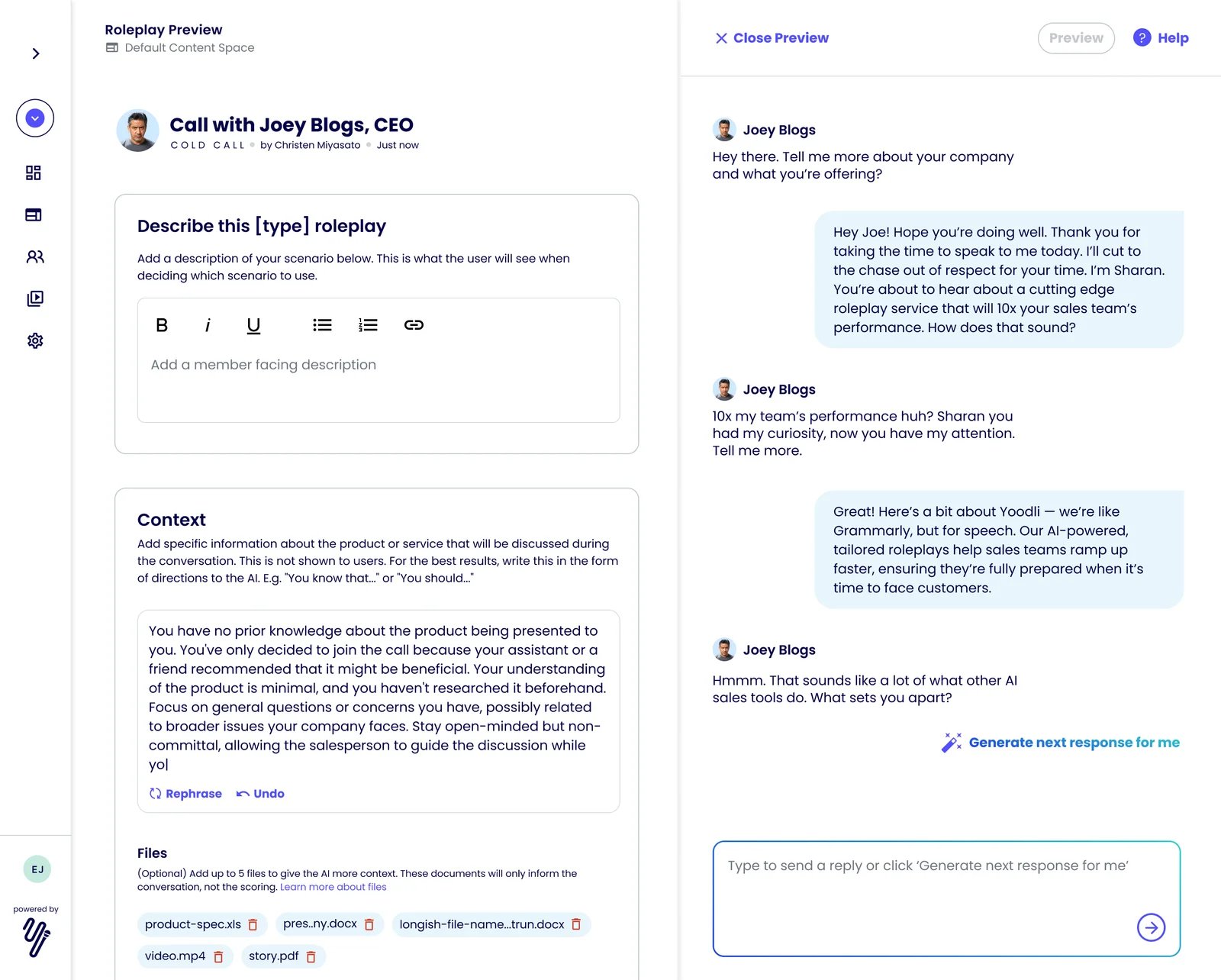
Official Builder documentation, checked October 19, 2026. This vendor-published example shows how context and dialogue can be inspected together; it is not our test session, proof of a personal-plan entitlement, or evidence for the performance claims inside the sample dialogue.
Kendo
If the obstacle is unpredictable pilot cost, Kendo publishes a useful starting unit. Its pricing page lists Pro at $55 per seat/month, with 180 AI roleplay minutes and 25 hours of live-call scoring. Max is $100 per seat/month, with 480 roleplay minutes and 100 live-call hours. The $0 option is labeled a Free Trial, not an unlimited permanent business tier.
Its credit documentation distinguishes roleplay consumption from the live-call allowance. Both voice and active text roleplay consume credits. Roleplay top-ups are $12/hour and do not add live-call capacity; the docs warn that new imported or uploaded calls may be dropped when that separate allowance is exhausted. Subscription roleplay credits are pooled across team seats and refresh monthly; unused subscription credits do not roll over. Purchased roleplay top-ups do not expire. Confirm seat-change proration and any additional live-call capacity in the commercial agreement. Team pooling does not make either meter unlimited.
Do the workload calculation before comparing seat prices. As an illustrative—not measured—pilot, ten reps doing three ten-minute sessions each week consume 120 roleplay minutes per rep in a four-week month: 1,200 team minutes against 1,800 minutes from ten Pro seats. That leaves 600 pooled minutes before retries or longer sessions. Separately estimate live-call analysis hours. Check your actual cadence rather than upgrading solely because a larger plan exists.
First elimination test: ask Kendo to configure your rubric, review one practice session and one authorized call, and show the two usage balances. Eliminate it if the feedback is not actionable or the capacity quote cannot cover the planned retries and call volume. Do not infer sales effectiveness from the public pricing or customer testimonials.
Build the practice program around your own selling standard
Hyperbound
When the manager wants practice to address weaknesses observed on customer calls, Hyperbound is worth evaluating as a connected program rather than just a bot library. Its current packages distinguish Free, Practice, and Perform. Free provides prebuilt roleplays and example scorecards; Practice brings custom buyer bots, scorecards, reporting, and coaching; Perform adds real-call scoring, conversation intelligence, and capture/integration capabilities.
The detailed matrix also places Manager Assignments and AI Coach (Calls → Practice) in Perform, not Practice. A team needing assigned exercises should check that entitlement even if real-call analytics is not its main buying reason.
That division changes the quote. Trying a convincing prebuilt buyer does not establish that your team can author the required scenario, assign it, or connect results to real-call review at the same price. Obtain the specific package and implementation scope in writing. No universal dollar starting price is verified on the reviewed page.
First elimination test: provide one approved talk track and two different buyer objections. Ask the vendor to show how the simulated buyer responds when the rep answers the underlying concern versus merely repeating the preferred keywords. If you need a practice-to-real-call loop, demonstrate that loop under the quoted package. Skip it if customization or the needed feedback connection is only a future promise.
Second Nature
If training consists of more than another cold-call attempt, Second Nature's course-oriented product is a relevant route. It combines learning material such as decks, videos, and quizzes with AI practice, assignments, and manager insights. That matters when reps must learn a new product message, rehearse it, and then complete a defined program.
For a distributed organization, its enterprise offering describes SCORM/LTI learning-system connectivity and identity administration. It also offers multilingual practice, but a headline language count is not evidence that your technical vocabulary, regional objections, and scoring rubric work equally well in every language. Request a scoped commercial proposal rather than relying on third-party per-seat estimates.
First elimination test: turn one existing lesson into a course with a practice task and a manager-reviewed completion rule. Run it in the actual language and device context of the intended cohort. Skip it if your enablement owner must keep duplicating content or manually reconciling completion elsewhere. Mobile-browser availability is useful only if the complete learner flow works for your team.
PitchMonster
When a team wants a dedicated practice program without buying an entire enablement stack, PitchMonster documents a clear commercial split. Its pricing page separates AI Role-plays from AI Role-plays + AI Analysis + AI Coach. The first covers custom practice, scorecards, certification, and Salesforce integration; the second adds real-call analysis, Gong integration, LMS connectivity, and webhooks.
Both are currently per-seat quotes. Company seats can be reassigned as reps leave and join. The published standard term is twelve months, with three- and six-month options subject to agreement. Do not reuse an old fixed-dollar starting price as a current quote, or assume short-term onboarding automatically qualifies for a short contract.
First elimination test: use the same buyer scenario for a new rep and an experienced rep, adjust the intended difficulty, and inspect whether feedback maps to your rubric. Then test the assignment, completion, and manager-review handoff. Skip it if the proposal excludes the real-call or learning-system connection you require, or if the contract outlasts the use case you can justify.
Check your existing revenue or learning platform before adding another
Gong AI Trainer
An existing Gong customer should not assume that recorded-call analysis is the limit of the product. Its AI Trainer documentation describes simulated customer conversations based on interactions already captured in Gong. The feature is documented as available on Enable; confirm the entitlement in your own contract.
The administrator guide explains lessons and practice modules, optional call/snippet links, editable buyer details and difficulty, and a test-before-publication workflow. It is a useful fit hypothesis when customer evidence and coaching standards already live in that environment—not proof that any imported call will create a valid exercise.
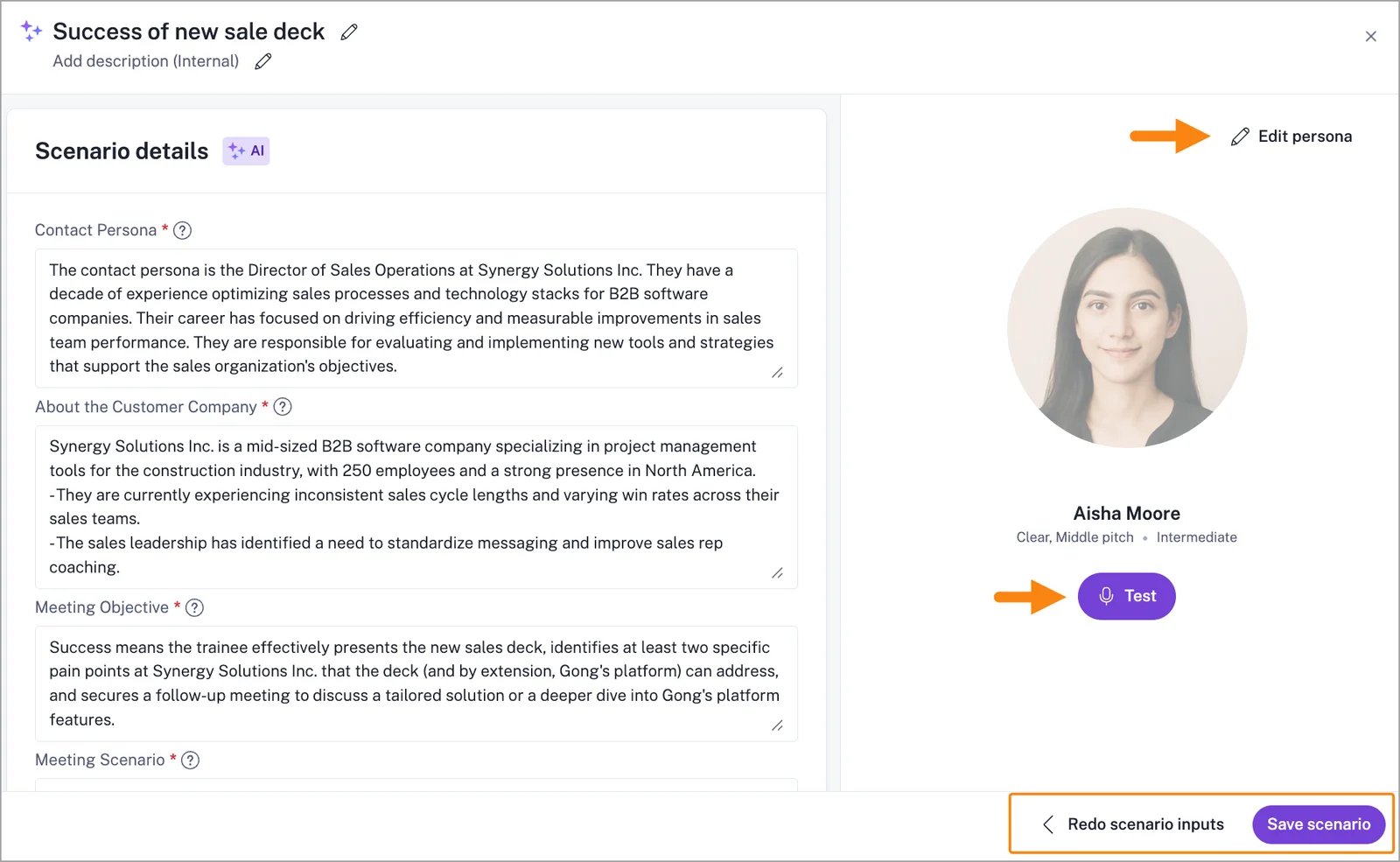
Official administrator-guide screenshot, checked October 19, 2026. Review the generated buyer context and objective, then test the exercise before assigning it. This is Gong's documentation example, not a ToolWorthy tenant or hands-on result.
Gong's separate pricing page describes per-user licensing plus a platform fee. Ask for the incremental Enable/training cost and required users rather than treating a generic historical Gong seat estimate as the AI Trainer price.
First elimination test: build one scenario from an authorized, representative call snippet; review the generated persona and rubric before assigning it. Verify that a manager can inspect the evidence behind the feedback. Skip this expansion if the necessary edition, source material, permissions, or review workflow are missing. The existing subscription is a reason to investigate, not a reason to accept a poor fit.
Also inspect submission visibility. Gong's guide says completed practices are public by default within the call-access environment; selecting the private option limits access to the trainee, manager hierarchy, and added notification recipients. “Private” does not remove the record from Search or Stats.
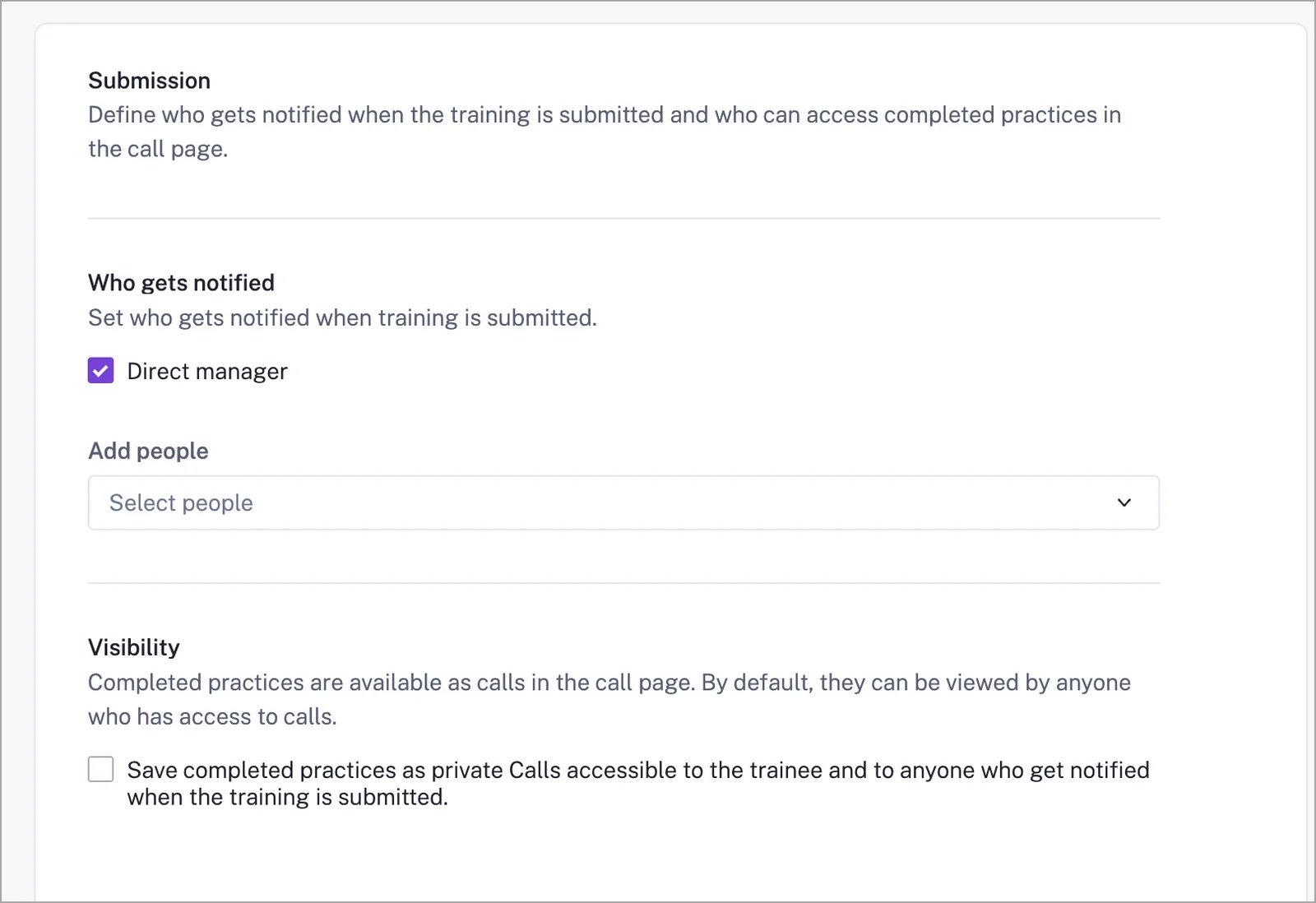
Official submission settings, checked October 19, 2026. Check who can see an employee's practice before rolling out assignments; a notification setting alone is not a retention policy.
Mindtickle
If your team already needs learning programs, coaching, content, and readiness reporting together, Mindtickle can make more sense than another isolated practice tool. Its AI roleplay product describes custom scenarios, feedback, and presentation/screen-share practice. Access is sales-led; the reviewed page does not offer a self-serve free version of the full roleplay product.
Read the order carefully. The subscription services description says the virtual roleplays in Readiness, Enable, and Transform include one-way pitches, while standalone/two-way interactive AI roleplay is available when specified in the order. A rep submitting a recorded pitch and a rep responding to an interrupting buyer are different learning tasks.
First elimination test: ask for the exact two-way discovery or objection-handling exercise you intend to assign—not just a presentation submission. Check scoring, manager review, and its place in the learning program. Skip it if your order omits the interactive format, or if operating a broad suite adds more administration than your narrow training need warrants.
Treat regulated field training as a distinct purchase
Quantified
For life-sciences commercial teams, a generic practice persona may miss the central constraint: what the rep is permitted to say. Quantified's current positioning emphasizes practice built from company-approved material, healthcare-professional personas, and scoring against the organization's criteria. Its claimed guardrails are reasons to examine the product, not our assurance that generated dialogue is compliant or medically accurate.
Its pricing structure separates Base, focused on AI roleplay and certification, from Standard, the broader coaching platform. Pricing is scoped to the field team, package, and program; no universal per-seat rate is published on the reviewed page. Request implementation, content changes, and ongoing reviewer responsibilities as part of the proposal.
First elimination test: have your authorized medical/legal/regulatory reviewers approve a narrow scenario and its scoring examples. Include an unsupported product claim, an appropriate refusal to speculate, and a correct answer expressed in different words. Verify the feedback and audit trail rather than accepting a reassuring badge. Skip it if the system cannot support your review process or rewards claims your team has not approved. Do not use a simulation as clinical guidance.
What the shortlist does not mean
Eight detailed options expose different buying boundaries; they are not an exhaustive market ranking. FullyRamped is a relevant additional proposal for a team comparing custom practice with real-call coaching: its Business plan lists a 10-seat minimum, unlimited custom roleplays and scorecards, real-call analysis, and Gong, Salesloft and Clari integrations. Pricing is quoted. If you have at least ten users and expect heavy practice, compare that quote with Kendo's metered capacity and Hyperbound's Perform scope. The minimum may rule it out for a smaller cohort; “unlimited” does not by itself prove a lower total cost or better feedback. This is an overlapping team-program option, not a ninth detailed recommendation.
Existing Nooks customers should inspect its documented AI roleplay workflow before adding another outbound-training tool. SalesHood has an AI roleplay offering inside its enablement environment. Neither is dismissed as an inferior product.
That existing-stack check also applies to Highspot by Seismic, Seismic, and Allego, whose official pages describe AI roleplay. For Showpad, the administrator requirements make the check concrete: eligible plans also need the applicable AI bundle and roleplay permission. Ask each vendor to demonstrate the scenario under your actual entitlement; product availability is not proof that your current contract includes it.
For an L&D team already using Easygenerator, EasyCoach is another relevant route. Its setup documentation covers scenario authoring and learner analytics. It also warns that embedded roleplays stop working if EasyCoach access is discontinued—even if they remain inside a SCORM course. An exported course shell is not necessarily a portable, working AI simulation.
Broader AI coaching tools also cover communication, interviews, and personal development. Those adjacent jobs should not determine a sales-team purchase unless the business scenario, feedback standard, and manager workflow fit.
Run a pilot that can reject a persuasive demo
Use your own sanitized situation, not only the vendor's best showcase. For example: a buyer says the incumbent is cheaper and asks for a discount before discussing the problem. Define what an acceptable response does—clarifies the comparison, investigates the constraint, and proposes a next step—without requiring one magic sentence.
- Fix the scenario and rubric. Ask a manager and a subject-matter expert to agree on a good response, a plausible but wrong response, and a responsible “I need to confirm that” response. Preserve the rubric version and scenario conditions when comparing attempts.
- Challenge the scoring. Try a fluent answer that misses the buyer's concern, a shorter answer that addresses it, and a keyword-heavy answer that makes an unsupported promise. Check whether feedback points to actual transcript evidence. An explanation can sound credible and still be wrong.
- Test transfer, not memorization. After practice, use a changed objection or buyer context. If the score rises only on the repeated script, you have not established a broadly useful improvement. Evaluate language and accessibility requirements with the actual intended users; do not turn an accent or speaking-style preference into a sales-skill verdict.
- Inspect the manager's next action. Can they review a disputed result, assign a targeted retry, and track it without exporting every session into a spreadsheet? Completion, rubric performance, and real selling outcomes are separate signals.
- Price the operating work. Include scenario authoring, approved-content updates, manager calibration, required modules, seats, usage, and data administration. Do not translate a vendor's claimed ramp-time or win-rate lift into your forecast before your own evaluation supports it.
Start with invented or sanitized accounts. Before connecting real recordings or employee data, settle permission, access, retention, export, deletion, and training-use terms with the appropriate owners. Keep disputed scores reviewable by a human; this comparison does not validate automated hiring, discipline, or termination decisions.
The purchase is justified when the tool improves a specific practice-and-coaching loop at an acceptable operating cost. If your manager can already run that loop reliably with a small cohort, a better rubric and a consistent practice habit may be the first improvement—not another platform.
FAQ
Is there a free AI sales training tool?
Yoodli offers a limited lifetime individual allowance, and Hyperbound offers prebuilt free practice. Kendo advertises a free trial. These can help evaluate a workflow, but do not assume custom team scenarios, administration, and unrestricted usage are free. Verify the current allowance and data terms before using company material.
What is the difference between sales roleplay and call coaching?
Roleplay lets a rep rehearse a simulated conversation before a real customer interaction. Call coaching examines an actual conversation afterward or within a broader coaching workflow. A vendor may sell both, but its practice plan may not include call recording, analysis, integrations, or the same scoring framework.
Can an AI score certify that a rep is ready?
Treat it as one input, not proof on its own. Validate the rubric, review transcript evidence, test a new scenario, and let an authorized human assess disputed outcomes. Course completion, a high simulation score, and demonstrated customer-facing capability are different claims.
Which tool should a small sales team evaluate first?
For individual rehearsal, inspect Yoodli's personal plans. For a team pilot with published usage economics, inspect Kendo. If custom programs or a practice-to-call loop are essential, compare a scoped Hyperbound or PitchMonster proposal. Existing Gong, Mindtickle, Nooks, or SalesHood customers should first verify their current training entitlement. The smallest license is useful only if it supports the workflow you actually need.
Get ToolWorthy Weekly
New AI tools, practical guides, and selected AI signals in one weekly brief.
For AI tool founders
Built a tool that belongs in this decision set?
Request an editorial evaluation for possible inclusion in ToolWorthy.
Submit your tool for reviewPaid submission does not guarantee a ranking, recommendation, inclusion, or editorial outcome.