
10 Best AI RFP Software 2026 - Proposals, DDQs, and Cost
RFP work is rarely just writing. The painful part is finding the last approved answer, checking whether it still applies, pulling evidence from product docs or security policies, getting subject-matter experts to review it, and exporting a response before the deadline. AI RFP software promises to shorten that loop, but the category is crowded with very different products: enterprise proposal suites, security questionnaire automation tools, AI-native answer engines, and lightweight proposal response apps.
This guide compares 10 AI RFP software platforms for sales, proposal, presales, solutions consulting, and security teams. We focused on tools that can help answer RFPs, RFIs, RFQs, DDQs, security questionnaires, vendor questionnaires, or complex proposal requests with reusable knowledge and review workflows. If your team mainly needs a general AI writing assistant, this list may be too specialized; if you need knowledge-grounded internal answers, also compare AI knowledge base tools.
| Tool | Best For |
|---|---|
| AutoRFP.ai | Teams that want public pricing and a focused RFP/DDQ response system |
| Tribble | Enterprise technology teams that need source-backed presales answers |
| Responsive | Large proposal teams managing mature RFX and questionnaire workflows |
| Loopio | Teams that want a proven answer library and review process |
| Conveyor | Security-heavy sales teams answering questionnaires and trust requests |
| Inventive AI | Teams handling spreadsheets, long proposals, and mixed RFP formats |
| 1up | Sales teams that need CRM-connected answers from trusted sources |
| Arphie | AI-native RFP teams that prioritize citations and approved content |
| V7 Go | Teams that want an agentic RFP workflow on top of knowledge hubs |
| RFP.ai | Small teams that want a lower-cost, citation-oriented RFP assistant |
How We Selected and Tested
We selected these AI RFP software tools based on a practical threshold: the product must clearly support RFP, RFI, RFQ, DDQ, security questionnaire, vendor questionnaire, sales questionnaire, or proposal response workflows. Generic writing tools, document generators, CRM tools, e-signature tools, CPQ products, and bid-writing agencies were excluded unless RFP or questionnaire response was a clear product capability.
Our research combined ChatGPT deep research, official product pages, pricing pages, help content, security pages, public review signals, and category search results from July 2026. We evaluated each product across five dimensions: functionality, user experience, AI innovation, value for money, and user feedback. For this category, those dimensions translate into concrete buyer questions: Can the tool import the request? Can it draft answers from approved knowledge? Can it cite sources? Can SMEs review and approve changes? Can it export in the format your buyer expects? Is pricing clear enough to budget?
Testing scope: We reviewed public information rather than connecting every platform to a private RFP repository. When pricing was not public, the value score was reduced. When a product looked powerful but required enterprise implementation, that complexity is called out. We did not fabricate completion-time benchmarks, win-rate improvements, model accuracy, SOC 2 status, or customer satisfaction metrics beyond publicly available evidence.
Top 10 AI RFP Software Compared
The market splits into four groups. Responsive and Loopio are mature proposal management suites. Conveyor is strongest when security questionnaires and trust evidence are central. AutoRFP.ai, Inventive AI, Arphie, 1up, V7 Go, and RFP.ai are more AI-native or response-automation focused. Tribble sits close to enterprise presales knowledge management, which makes it especially relevant for technical sales teams.
| Tool | Best For | Core Workflow | Pricing Signal | Main Caveat |
|---|---|---|---|---|
| AutoRFP.ai | Focused RFP/RFI/DDQ response | Approved responses, AI drafting, questionnaires | Scale $899/month annually; Accelerate $1,299/month annually; Enterprise custom | Entry price is high for very small teams |
| Tribble | Enterprise tech presales | Source-backed answers, confidence, CRM/doc integrations | Quote only | Pricing and implementation scope need discovery |
| Responsive | Mature enterprise RFX teams | RFP/RFX, questionnaires, assessments, content library | Quote only | Powerful but enterprise-weighted |
| Loopio | Proposal teams needing answer governance | Answer library, review workflow, AI assistance | Custom quote; Foundations starts with 10 seats | Package details require a sales conversation |
| Conveyor | Security questionnaire automation | Cited answers, portal response, trust workflows | Quote only | Better for security sections than broad proposal writing |
| Inventive AI | Mixed RFP and proposal formats | Excel questionnaires, long proposals, AI response | Usage-based / quote | Fixed public plan detail is limited |
| 1up | Sales teams using trusted sources | RFP automation, technical answers, CRM context | Free plan; MCP $50/month plus usage; Starter $300/month; Plus $900/month | More sales-answer focused than traditional proposal management |
| Arphie | AI-native RFP teams | Approved data, response generation, citations | Contact vendor | Public review evidence is thinner |
| V7 Go | Agentic RFP workflows | RFP agent, Knowledge Hub, cited outputs | Quote only | Broader agent platform, not only RFP software |
| RFP.ai | Lightweight source-backed RFP help | RFP answers, confidence scores, citations | Single RFP Pack EUR39; subscriptions from EUR49/month; Professional EUR129/month; Enterprise EUR449/month | Public feedback signals are limited |
Detailed Reviews
AutoRFP.ai
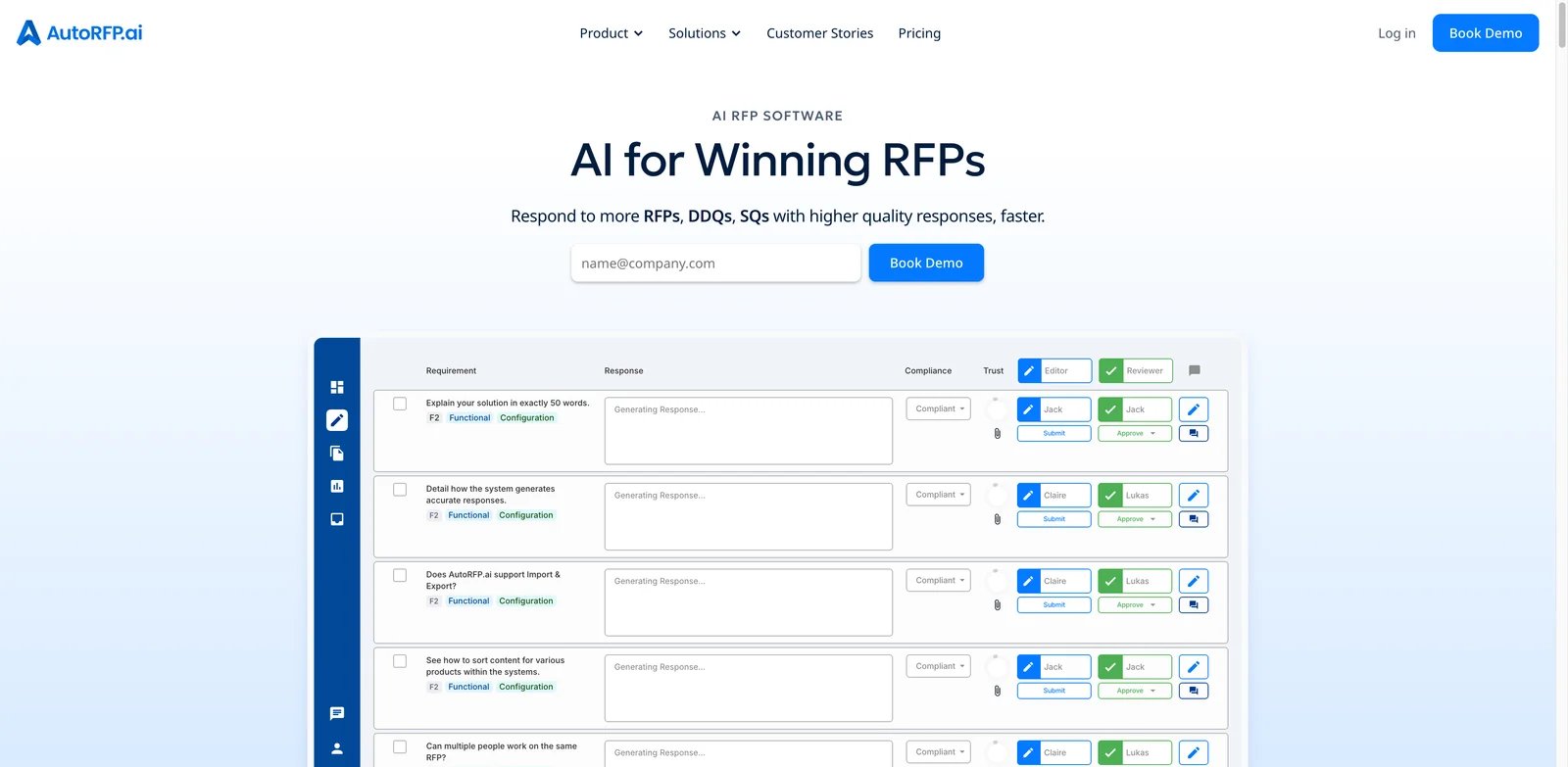
AutoRFP.ai is one of the clearest fits for teams that want dedicated RFP response automation without immediately entering a large enterprise proposal suite buying motion. It is built around RFPs, RFIs, DDQs, and security questionnaires, with a strong emphasis on reusing approved responses and learning from historical answers.
Key Features
- Dedicated RFP response workflow: AutoRFP.ai is focused on RFP, RFI, DDQ, and security questionnaire response rather than generic document generation.
- Approved response reuse: The product is useful when teams already have historical answers but need a better way to retrieve and refresh them.
- Unlimited-user packaging: Public pricing with unlimited users can be attractive when many SMEs need to contribute occasionally.
- Source-grounded drafting: The product emphasizes using existing approved content rather than asking teams to start from a blank AI prompt.
Pricing & Plans
AutoRFP.ai publicly lists Scale at $899/month when billed annually for 24 projects per year, Accelerate at $1,299/month when billed annually for 50 projects per year, and Enterprise with custom pricing. Both listed paid tiers include unlimited users and all features, but buyers should still confirm onboarding, project-count definitions, integrations, security requirements, and renewal terms.
Limitations
AutoRFP.ai is newer than some legacy proposal platforms. Teams with complex compliance workflows, strict procurement controls, or a large existing proposal content library should run a proof of concept with real RFPs before migrating. The main question is not whether it can draft answers, but whether it can preserve approved language, ownership, and review accountability at scale.
Best For
AutoRFP.ai is best for B2B teams that need focused RFP, RFI, DDQ, and security questionnaire response automation with public pricing. Not the right fit if your organization needs a broad enterprise proposal management suite with years of established procurement history.
Get started with AutoRFP.ai
Tribble
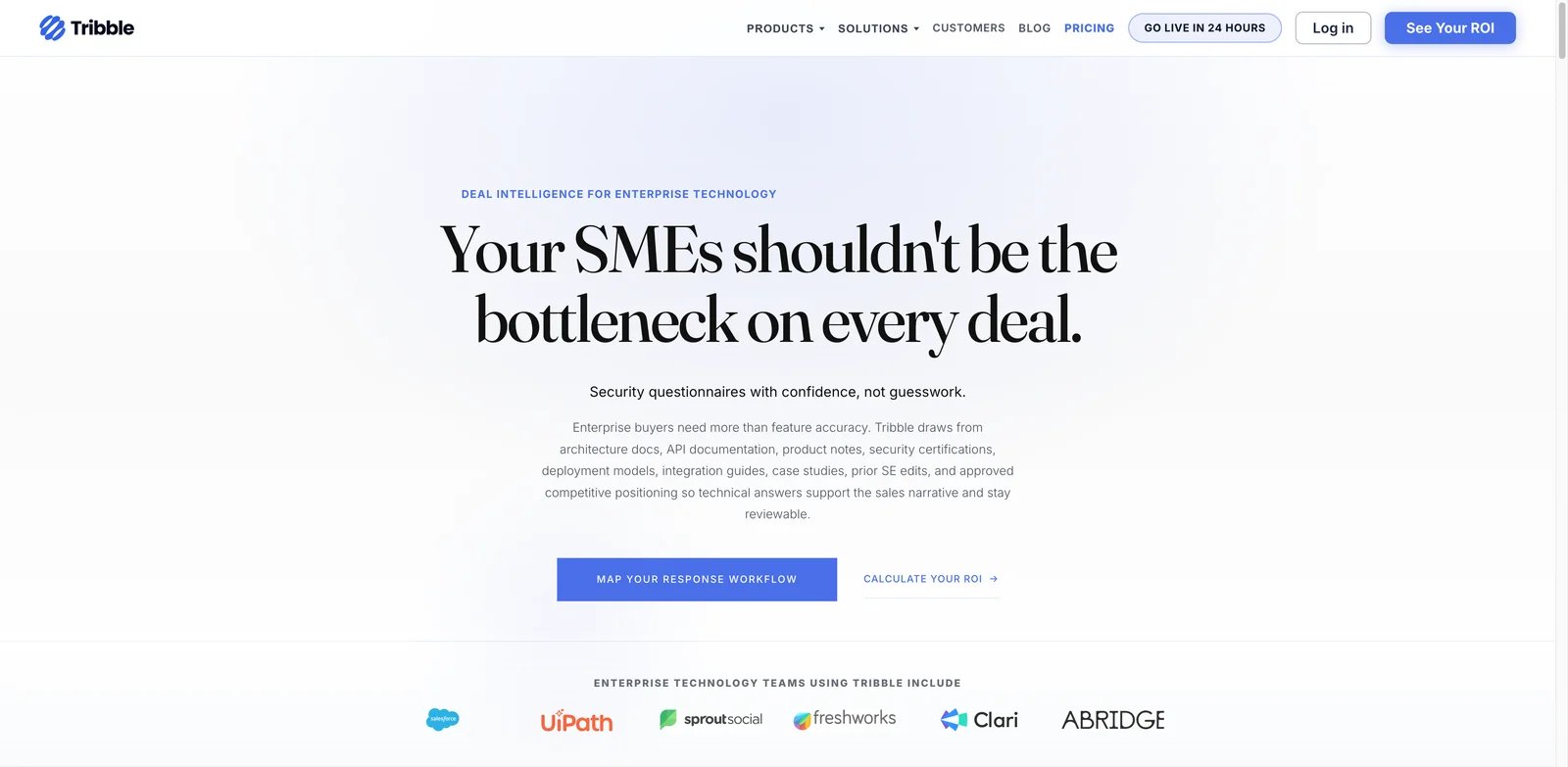
Technical sales teams often lose time answering the same product, security, integration, and implementation questions across RFPs, calls, emails, and Slack threads. Tribble is compelling because it treats RFP work as part of a broader presales knowledge problem. Its fit is strongest when answers need to be grounded in source documents and connected to tools like Salesforce, HubSpot, SharePoint, or Google Drive.
Key Features
- Presales knowledge layer: Tribble is built for enterprise technology teams that need answers across RFPs, security questionnaires, sales calls, and technical deal support.
- Source documents and confidence: The product emphasizes answers tied to source material and confidence signals, which matters when AI output needs review.
- Sales stack integrations: CRM and document repository integrations make it more useful when RFP answers depend on current product, legal, and security collateral.
- Enterprise workflow fit: Tribble is positioned for larger go-to-market teams that need repeatable answer governance, not one-off proposal writing.
Pricing & Plans
Tribble does not publish simple self-serve pricing for this use case. Expect a sales-led buying process where cost depends on team size, integrations, knowledge sources, security requirements, and rollout scope. That quote-only model is normal for enterprise presales software, but it makes value comparison harder before a demo.
Limitations
Tribble may be more platform than a small team needs if the immediate problem is a few RFPs per quarter. It also requires clean source documents and internal ownership. If outdated product sheets and conflicting answers are already scattered across systems, Tribble can help retrieve knowledge, but the team still has to govern what is approved.
Best For
Tribble is best for enterprise technology companies that need AI RFP help as part of a broader presales knowledge workflow. Not the right fit if you want lightweight, public-price RFP drafting with minimal implementation.
Get started with Tribble
Responsive
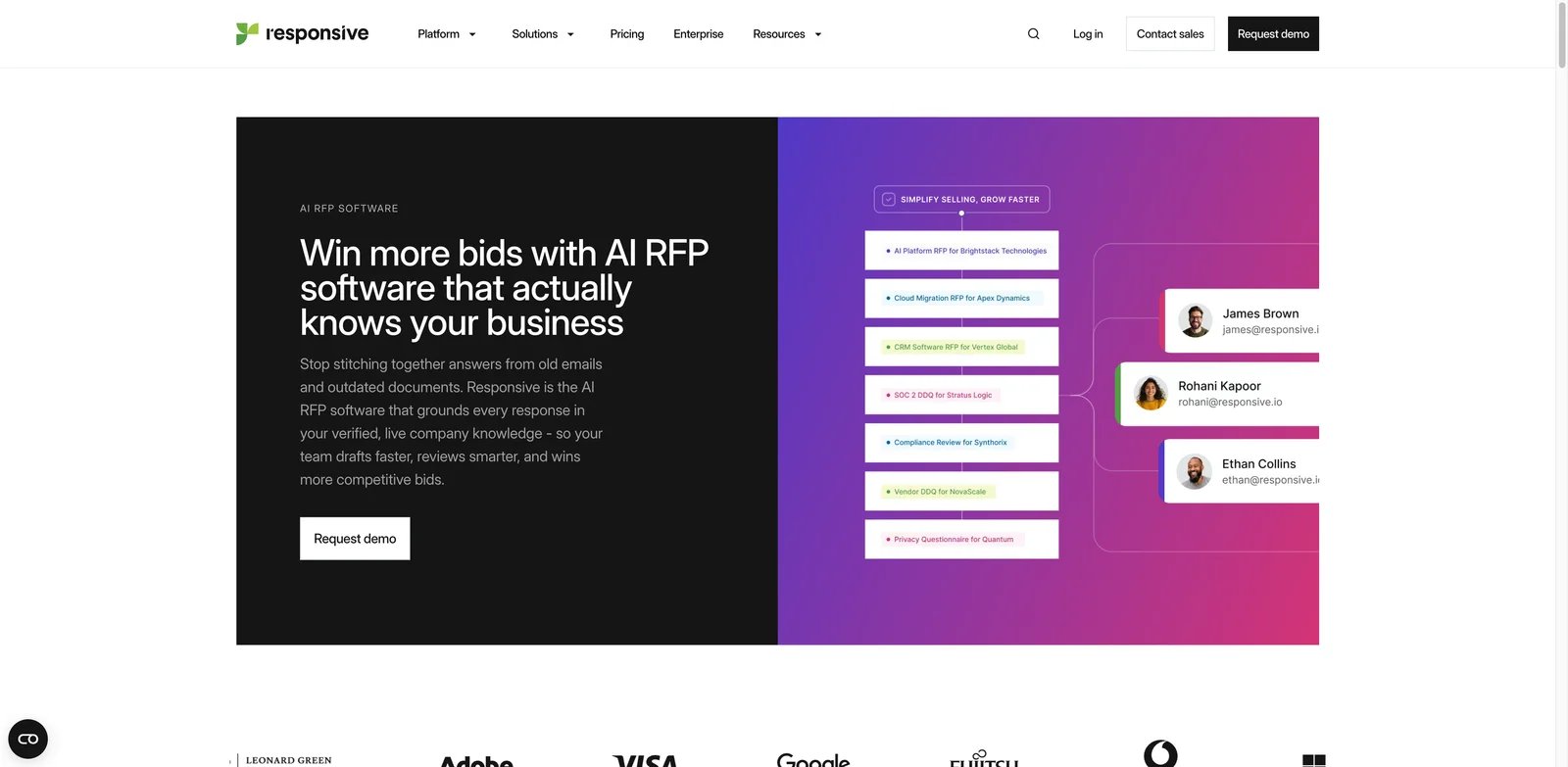
Responsive is one of the most established names in RFP and response management. It is not just an AI writing layer; it is a mature platform for RFX work, questionnaires, assessments, content management, collaboration, and reporting. That makes it a strong shortlist option for teams where RFP response is a repeatable business process, not an occasional sales task.
Key Features
- RFX and questionnaire management: Responsive supports structured response workflows for RFPs, RFIs, security questionnaires, assessments, and related requests.
- Content library and governance: Teams can centralize reusable answers, assign owners, and manage review cycles.
- AI assistance inside an established workflow: AI helps with response generation and content reuse without replacing the proposal process.
- Enterprise reporting and collaboration: Larger teams can coordinate subject-matter experts, deadlines, assignments, and approval workflows.
Pricing & Plans
Responsive is generally quote-based. Buyers should ask how pricing is affected by user count, response volume, content library size, integrations, AI usage, security requirements, and implementation services. The platform can be excellent value when RFP response is revenue-critical, but it may be too much process for smaller teams that only answer occasional questionnaires.
Limitations
Responsive has enterprise strength, but that also means procurement, implementation, and change management matter. Teams should pilot with a real RFP, a messy historical answer library, and multiple SME reviewers. A polished demo does not prove the tool can handle your actual ownership and approval process.
Best For
Responsive is best for mature proposal teams that manage frequent RFPs, RFXs, assessments, and questionnaires across departments. Not the right fit if you want a lightweight AI assistant with transparent monthly pricing.
Get started with Responsive
Loopio
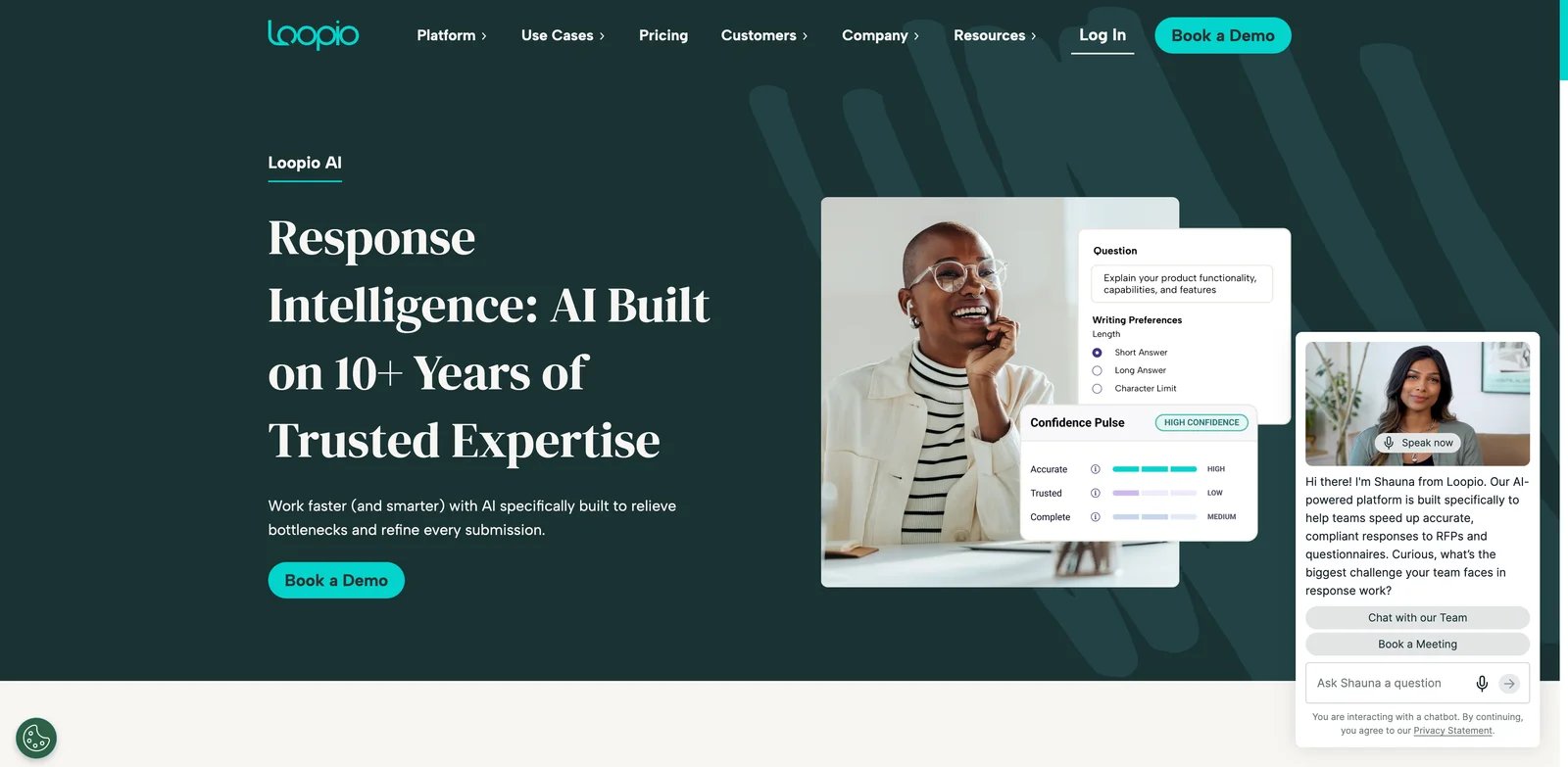
Loopio is a strong option when the answer library is the center of the buying decision. Many proposal teams do not fail because they cannot write; they fail because approved answers are stale, owners are unclear, and every new RFP triggers another hunt through old documents. Loopio's value is in making reusable content, review workflows, and AI assistance work together.
Key Features
- Answer library management: Loopio helps teams store, search, update, and reuse approved response content.
- AI support for proposal teams: Its AI features assist with drafting and reuse while keeping the response process tied to governed content.
- Review and collaboration workflows: Teams can assign sections, involve SMEs, and manage deadlines more systematically.
- Broad RFP coverage: Loopio fits RFPs, RFIs, RFQs, DDQs, security questionnaires, and other response-heavy documents.
Pricing & Plans
Loopio uses a custom-quote pricing motion. Its pricing page says the Foundations tier starts with 10 seats for smaller, sales-led RFP teams, while Enhanced and Enterprise packages are positioned for more mature collaborative proposal teams. Buyers should confirm seat rules, AI feature access, contributor access, integrations, implementation, support, and how content library governance is handled.
Limitations
Loopio is strongest when your team is ready to treat the answer library as a maintained asset. If no one owns content freshness, AI can accelerate stale answers. Smaller teams may also find the buying motion heavier than newer lightweight RFP tools.
Best For
Loopio is best for proposal teams that need a proven answer library and collaborative review workflow. Not the right fit if your main need is low-cost, ad hoc AI drafting.
Get started with Loopio
Conveyor
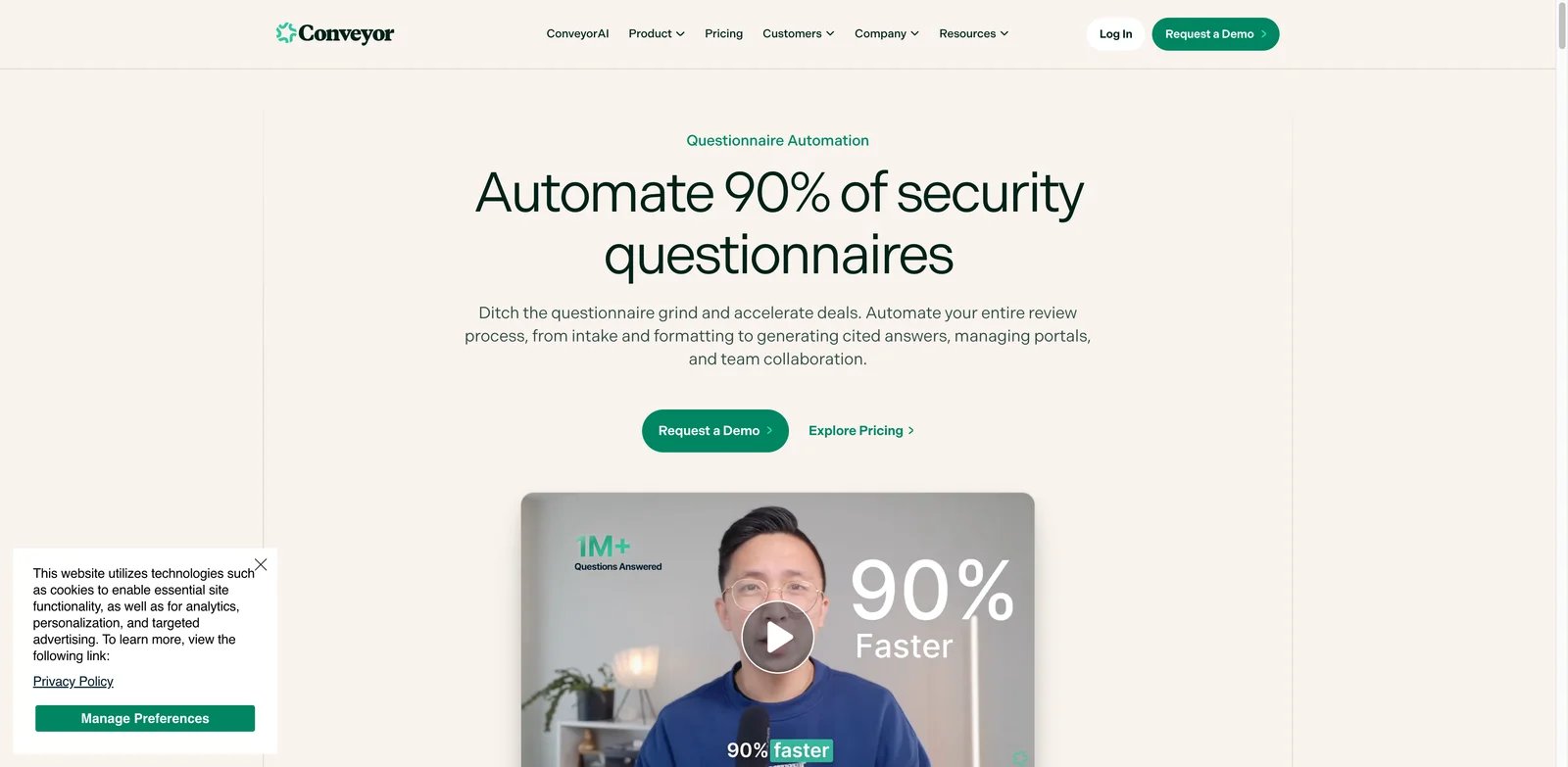
Conveyor is not a generic proposal suite. Its strength is security questionnaire automation, customer trust, and sales-cycle evidence management. That makes it highly relevant for SaaS and technology companies where RFPs often include long security sections, vendor risk questionnaires, trust portal requests, and repetitive compliance answers.
Key Features
- Security questionnaire automation: Conveyor is built to answer security questionnaires and vendor risk requests faster.
- Cited answers: Source-backed responses help reviewers understand where an answer came from before sending it to a buyer.
- Trust workflow support: Conveyor fits teams that also manage trust centers, security documentation, and buyer due diligence.
- Portal response help: The product is especially useful when questions arrive in customer portals rather than clean Word documents.
Pricing & Plans
Conveyor is quote-based. Buyers should model the number of questionnaires, portal responses, trust center needs, security reviewers, and integrations required. The value case is strongest when security questionnaires consume sales engineering, security, and compliance time every week.
Limitations
Conveyor is narrower than broad proposal management platforms. If your primary pain is writing persuasive executive proposals, pricing narratives, or custom implementation plans, Conveyor may need to sit beside another proposal process. If the bottleneck is security evidence, it can be a very strong fit.
Best For
Conveyor is best for B2B companies that spend significant time on security questionnaires, DDQs, trust requests, and RFP security sections. Not the right fit if your RFP work is mostly narrative proposal writing.
Get started with Conveyor
Inventive AI
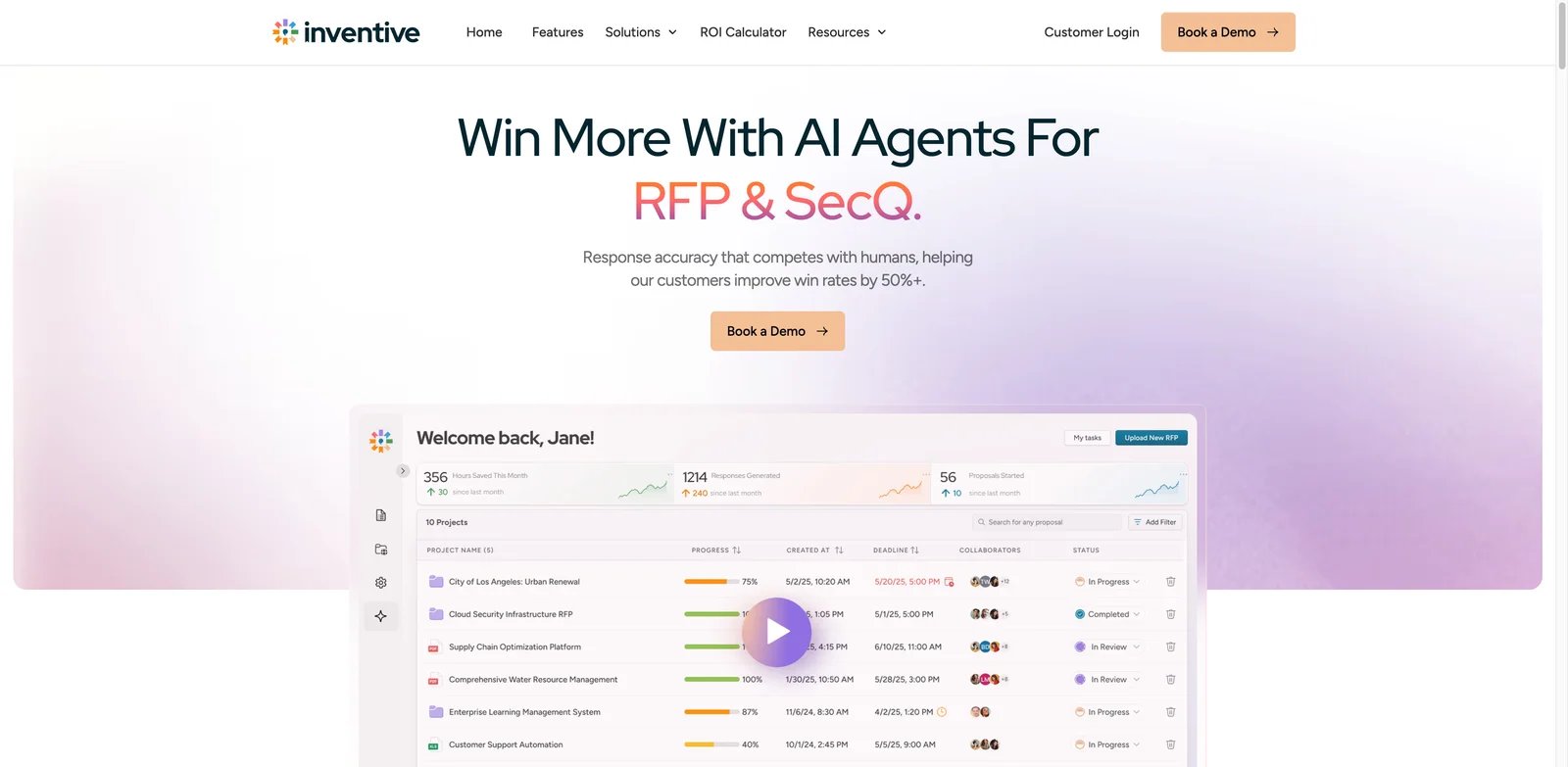
Inventive AI is useful when RFP work arrives in messy formats: Excel questionnaires, long-form proposals, technical requests, and buyer-specific response templates. It is positioned around AI response automation for sales and proposal teams rather than only content-library management.
Key Features
- Mixed-format response support: Inventive AI is relevant when teams handle spreadsheets, documents, and longer proposal responses.
- AI answer generation: The product focuses on generating responses from company knowledge and past material.
- Proposal and questionnaire coverage: It can fit teams that need both structured questionnaire answers and narrative proposal drafting.
- Sales-team orientation: Inventive AI is aimed at teams trying to reduce manual proposal and RFP response work in revenue workflows.
Pricing & Plans
Inventive AI appears to use sales-led or usage-based pricing rather than a simple public monthly plan. Ask how pricing changes by response volume, user count, knowledge sources, document size, and AI usage. Also verify onboarding effort and whether the platform can handle your most common RFP file types.
Limitations
The biggest buying question is governance depth. AI response generation is valuable, but proposal teams still need approved answers, source traceability, SME review, and final accountability. Teams should test Inventive AI against a completed historical RFP and compare generated answers with what they actually submitted.
Best For
Inventive AI is best for sales and proposal teams handling mixed RFP, Excel questionnaire, and long-form proposal formats. Not the right fit if you mainly need a mature enterprise content library with years of established workflow patterns.
Get started with Inventive AI
1up
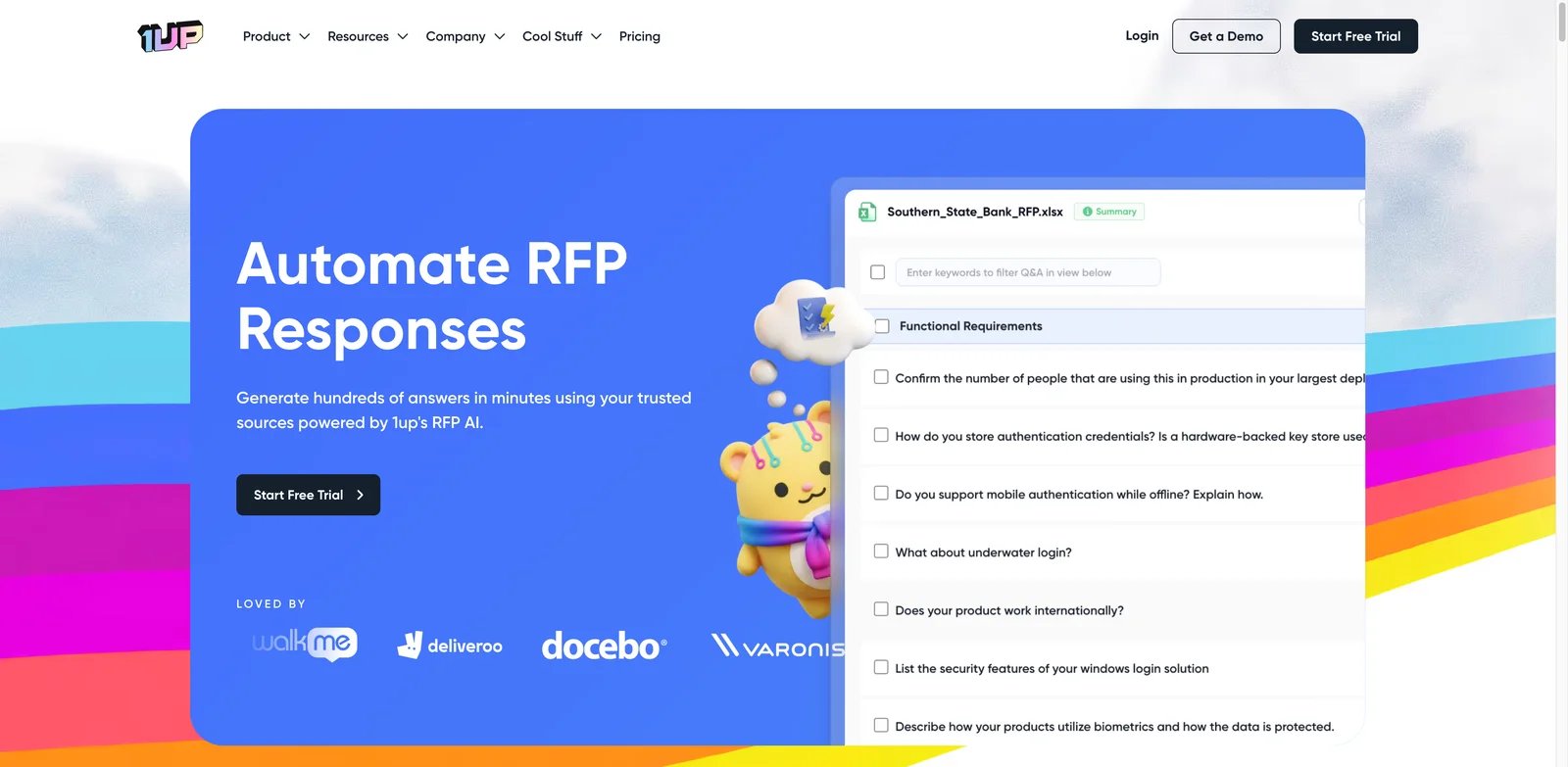
1up is strongest when RFP answers are part of a broader sales knowledge problem. Sales reps, solutions consultants, and technical account teams often need fast, accurate answers from trusted sources, whether the question appears in an RFP, a customer email, a Slack thread, or a call follow-up. 1up's RFP automation is useful for teams that want those answers connected to the revenue workflow.
Key Features
- RFP automation for sales: 1up focuses on generating answers from trusted company sources for RFP and technical questionnaire work.
- CRM-context fit: It is especially relevant for teams that want answers tied to sales processes rather than a standalone proposal silo.
- Technical answer support: The product can help sales and presales teams respond to detailed product, integration, and security questions.
- Knowledge reuse: 1up helps reduce repeated SME interruptions when the same customer questions keep appearing.
Pricing & Plans
1up publishes pricing on its official pricing page: Free, MCP at $50/month plus automation usage, Starter at $300/month, and Plus at $900/month. Its RFP automation page also references a 14-day free trial and packages starting around $250/month, so buyers should confirm the exact RFP automation package, questionnaire volume, admin limits, integrations, and annual-billing discounts before purchase.
Limitations
1up is not positioned like a traditional enterprise proposal management suite. That can be an advantage for sales teams, but proposal operations groups should verify review assignment, content governance, export formats, and audit needs before standardizing on it.
Best For
1up is best for sales and presales teams that need AI RFP help connected to trusted sources and revenue workflows. Not the right fit if your main requirement is a formal proposal management system for large bid teams.
Get started with 1up
Arphie
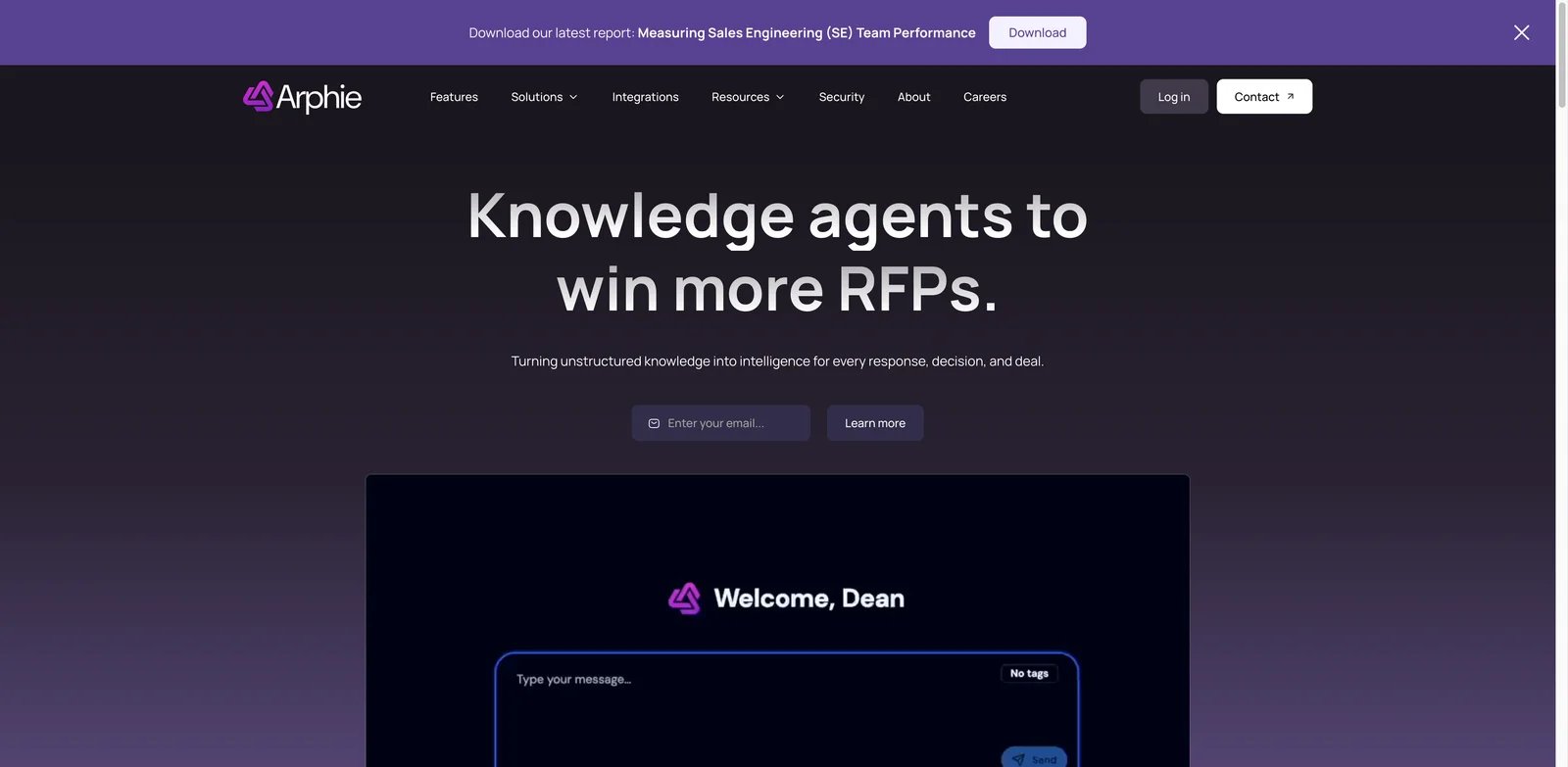
Arphie is an AI-native option for teams that want RFP response automation built around approved data and source-cited answers. It is most interesting when a company wants to move faster than legacy proposal workflows but still needs more control than a general-purpose chatbot can provide.
Key Features
- AI-native response workflow: Arphie is designed around RFPs, RFQs, questionnaires, and DDQs rather than generic writing.
- Approved data orientation: The product emphasizes using trusted company knowledge to draft answers.
- Citation-aware responses: Source context helps reviewers decide whether an AI-generated answer is safe to send.
- Modern proposal workflow: Arphie is a good fit for teams evaluating newer RFP automation tools instead of legacy suites.
Pricing & Plans
Arphie uses a contact-vendor pricing motion. Ask how pricing is affected by users, document volume, knowledge sources, security needs, and onboarding. Also confirm whether all review contributors need paid seats and how AI usage is limited.
Limitations
Arphie has less public third-party review evidence than older proposal management platforms. That does not make it weak, but it means buyers should run a serious proof of concept. Test citation quality, answer freshness, export handling, and how easily SMEs can review content.
Best For
Arphie is best for teams that want a modern, AI-native RFP and questionnaire response platform with source-grounded answers. Not the right fit if procurement requires extensive public references before a trial.
Get started with Arphie
V7 Go
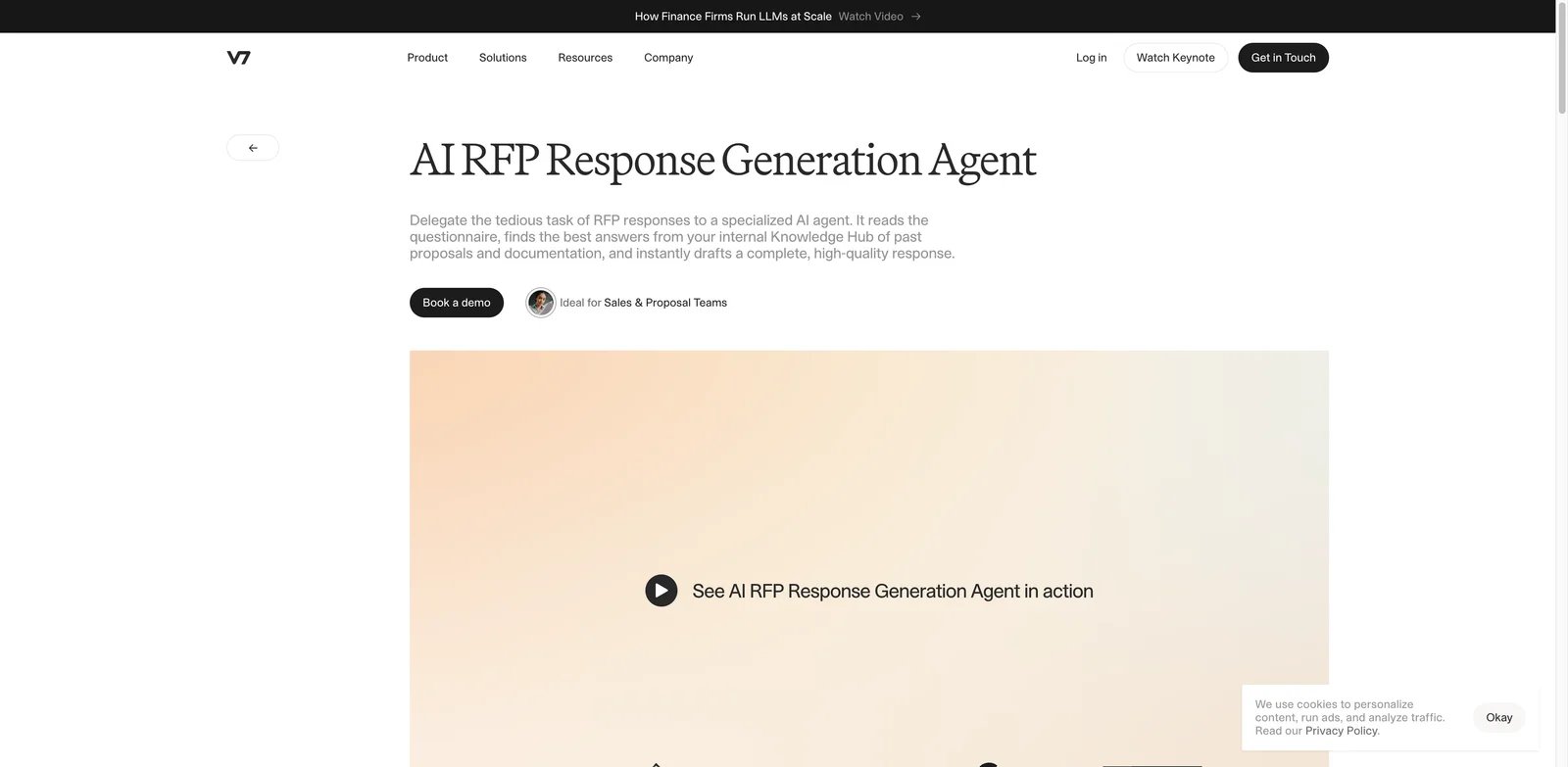
V7 Go is different from most tools on this list because it is framed as an agentic workflow platform with an RFP response generation agent. That can be valuable if your team wants AI agents to operate over a knowledge hub, extract requirements, draft responses, and support repeatable document workflows beyond a single RFP use case.
Key Features
- RFP response agent: V7 Go provides an RFP response generation agent for RFPs, RFIs, security questionnaires, and DDQs.
- Knowledge Hub citations: Source-backed answer generation is a key part of making AI output reviewable.
- Agentic workflow model: The product can fit teams that want AI agents for document-heavy operations, not only proposal work.
- Broader automation potential: V7 Go may be useful when RFP response is one of several document intelligence workflows.
Pricing & Plans
V7 Go pricing for this use case is sales-led. Buyers should ask about platform fees, agent usage, knowledge hub limits, document volume, review users, and whether RFP workflows require custom configuration. The value case improves when the same platform can support multiple document automation workflows.
Limitations
V7 Go is broader than dedicated RFP software. That means teams should test whether the RFP agent covers the full response lifecycle: import, requirement extraction, answer generation, citations, SME review, approval, and export. If you only need a proposal content library, a dedicated RFP suite may be simpler.
Best For
V7 Go is best for teams that want agentic RFP response workflows tied to a broader knowledge and document automation platform. Not the right fit if you need a traditional proposal management suite out of the box.
Get started with V7 Go
RFP.ai
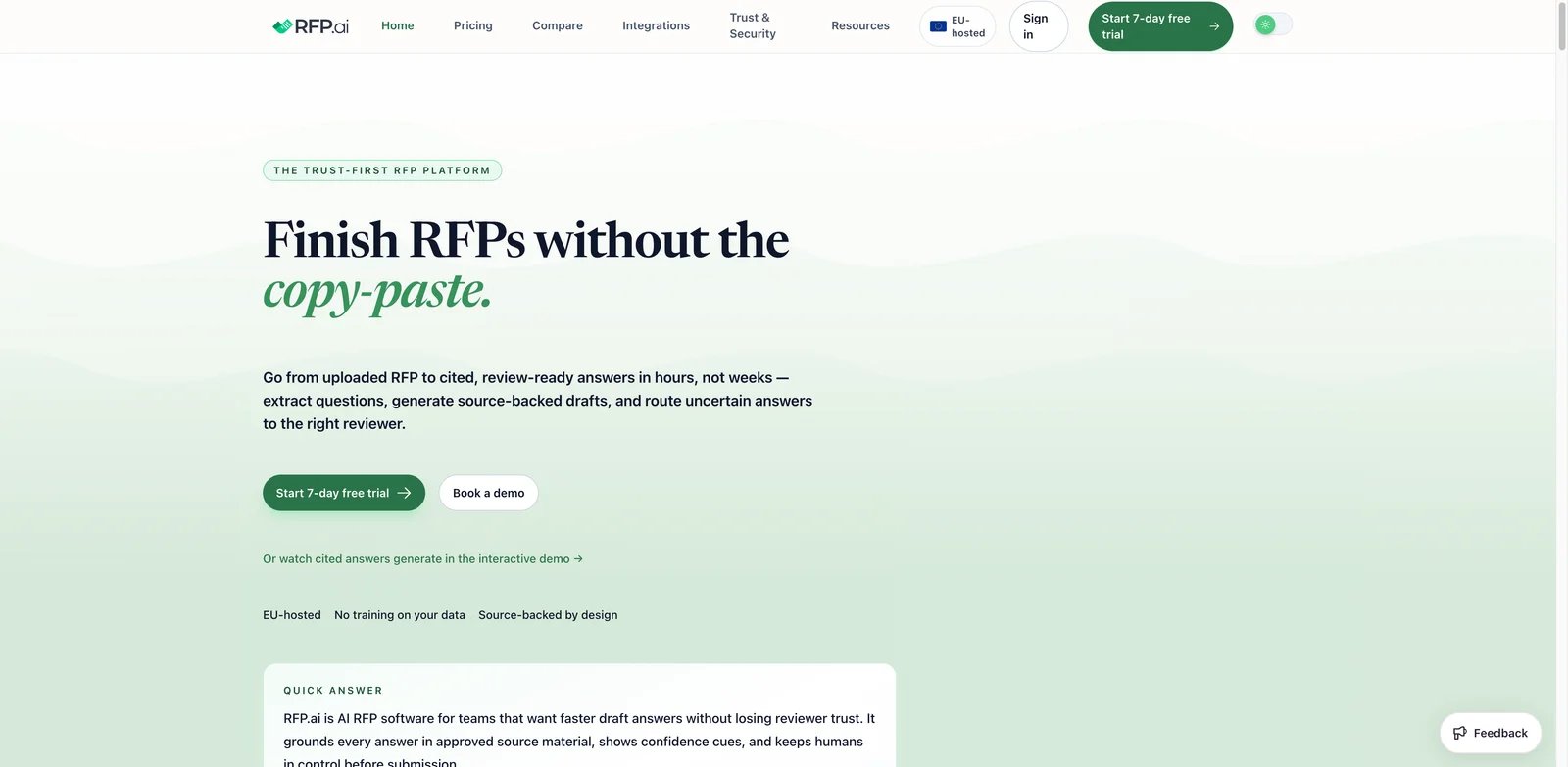
RFP.ai stands out because it appears more accessible than many enterprise tools in this category. Public pricing and a lightweight positioning make it worth considering for smaller teams that want source-backed RFP answers without immediately buying a full proposal management platform.
Key Features
- RFP answer generation: RFP.ai focuses on helping teams respond to RFP questions faster.
- Citations and confidence signals: Source-backed answers and confidence indicators are useful guardrails for review.
- Lower public entry price: Public pricing gives small teams a clearer path to test the product.
- Lightweight workflow: It can be easier to evaluate than quote-only enterprise tools.
Pricing & Plans
RFP.ai lists a 7-day trial with card required, subscription plans starting at EUR49/month, Professional at EUR129/month, and Enterprise at EUR449/month. It also offers one-time packs, including a Single RFP Pack at EUR39 and a Busy Quarter Pack at EUR99, with published overage rates for tokens and pages.
Limitations
RFP.ai has less public user-feedback evidence than more established platforms. Smaller teams may accept that tradeoff for price and simplicity, but larger organizations should validate security, data retention, admin controls, and review workflow before relying on it for high-value bids.
Best For
RFP.ai is best for small teams that want a lower-cost, source-backed RFP assistant. Not the right fit if your organization needs enterprise proposal governance, extensive integrations, or public proof from many large customers.
Get started with RFP.ai
Best AI RFP Software by Use Case
For Mature Enterprise Proposal Teams
Responsive and Loopio are the safest starting points when RFP response is already a formal business process. They are built for answer libraries, assignments, reviews, and cross-functional response work. Choose Responsive if your process spans broad RFX and assessment management; choose Loopio if answer-library governance is the center of the workflow.
For Security Questionnaire and Trust Workflows
Conveyor should be tested first when security questionnaires, trust center evidence, and customer due diligence are the main bottleneck. AutoRFP.ai, Loopio, and Responsive can also handle security-related work, but Conveyor is more directly shaped around security questionnaire automation.
For Enterprise Technology Sales Teams
Tribble and 1up are strong when RFP answers overlap with presales knowledge, CRM context, and technical customer questions. They are useful when the same product, security, and integration answers appear across RFPs, emails, demos, and sales calls.
For AI-Native Response Automation
AutoRFP.ai, Arphie, Inventive AI, and V7 Go are worth shortlisting when your team wants AI-first automation rather than a legacy proposal system with AI added later. Run a proof of concept with real RFPs and check citation quality, answer governance, and export handling.
For Smaller Teams and Consultants
RFP.ai and 1up are the easiest tools in this list to evaluate on public pricing. RFP.ai is the lower-cost starting point for lightweight RFP work, while 1up is more relevant when small sales teams also want a sales answer engine. DeepRFP, SEQUESTO, and similar tools from the broader research pool may also be worth testing if you need public pricing and a lighter process. The tradeoff is usually less enterprise governance and fewer public review signals.
How to Choose the Right AI RFP Software
1. Start with the request types you actually receive. A tool optimized for security questionnaires is different from one optimized for narrative proposals. Pull the last 10 requests your team answered and categorize them by RFP, RFI, DDQ, security questionnaire, Excel grid, portal form, or long proposal.
2. Test answer grounding before testing writing style. The best demo answer is useless if no one can verify where it came from. Require source citations, approved-answer status, last-reviewed dates, and owner visibility before trusting AI-generated responses.
3. Model reviewer effort, not only drafting speed. RFP software should reduce SME interruptions and review loops. During a pilot, measure how many answers require expert rewrite, how many can be approved with minor edits, and how long final review takes.
4. Check export and portal handling. Many teams answer RFPs in Word, Excel, spreadsheets, PDFs, or buyer portals. A tool that drafts good answers but breaks formatting can still create manual cleanup work.
5. Treat pricing opacity as implementation risk. Quote-only pricing is normal in this category, but you should still ask for seat rules, contributor access, AI usage limits, response volume, onboarding fees, integration costs, and renewal escalators.
Frequently Asked Questions
What is the best AI RFP software overall?
What is the best AI RFP software for small teams?
Can AI RFP software replace proposal managers?
How is AI RFP software different from AI proposal software?
What should I test in an AI RFP software pilot?
Final Verdict
Choose Responsive or Loopio if your team already has a mature proposal operation and needs enterprise-grade workflow. Choose Conveyor if security questionnaires are slowing deals. Choose Tribble or 1up if RFP answers are part of a broader presales knowledge problem. Choose AutoRFP.ai, Inventive AI, Arphie, or V7 Go if you want AI-native response automation and are willing to validate governance in a pilot. Choose RFP.ai if you need a lighter, lower-cost starting point.
The practical decision is simple: pick the tool that best matches your request type, knowledge governance maturity, and review process. AI can speed up RFP work, but only if the answers remain grounded, current, and owned by the right people.
Get ToolWorthy Weekly
New AI tools, practical guides, and selected AI signals in one weekly brief.
Built an AI rfp software we missed?
We review these roundups regularly. If your AI rfp software belongs here, submit it for editorial review and reach buyers already searching for it.
Free listing is available for everyone. Verified & Premium listings unlock richer placement.