
10 Best Suno Alternatives 2026 — After v5.5 & Label Deals
10 Suno alternatives tested May 2026 — Udio, Stable Audio, ElevenLabs Music, AIVA and royalty-safe picks. Real pricing, v5.5 fallout, commercial-use clarity.
On this page
In late March 2026, Suno's v5.5 update rolled out and the r/SunoAI feed almost immediately filled with the same complaint phrased eight different ways: "v5.5 is basically unusable… every generation sounds almost the same", "high frequency hiss," "audio quality degradation after the first few minutes." Three weeks before that, the WMG settlement landed and the post-deal threads about download caps and commercial use opened a different anxiety — "what actually happens to my songs?" The two events stacked: a quality drop the same season as a licensing pivot. If you're shopping for a Suno alternative this week, you're probably reacting to one of those, or to the trust gap they opened together.
Below are 10 alternatives, each verified against its May 2026 pricing page and mapped to a specific switching reason. Some are direct swaps (Udio, ElevenLabs Music). Some are paradigm changes (AIVA for composer workflows, Stable Audio for stock-style tracks). One is the post-v5.5 escape hatch for sound quality you might not have considered yet (ElevenLabs Music). The job here isn't to rank them — it's to match them to whichever Suno pain you're actually leaving over.
For the broader AI-music landscape (not just Suno replacements), see our best AI music generators roundup; for the comparable lifecycle picture for music creators, AI voice generators covers the adjacent vocal-AI stack. The shortlist below assumes you've already decided Suno isn't the right long-term home — the job here is to find the destination that minimizes both monthly cost and the audio-quality or licensing surprises that drove you to read this article in the first place.
| Tool | Best For |
|---|---|
| Udio | Closest Suno-style full-song generator with vocals |
| Producer.ai | AI co-producer workflow, not one-shot prompts |
| Stable Audio | Spec-driven stock music with clear quotas |
| AIVA | Composer workflows with editable structure |
| Mubert | Royalty-free background music for creators |
| Soundraw | Controllable royalty-free instrumentals |
| Soundful | Budget royalty-free creator tier |
| Beatoven.ai | Soundtrack scoring with download-minute pricing |
| Boomy | Fast song ideation with publishing built in |
| ElevenLabs Music | Audio fidelity from an audio-first AI vendor |
Why People Are Leaving Suno in 2026
These are the six pain points the r/SunoAI feed keeps surfacing through Q1 and Q2 2026. They map to the alternatives in the next section — most tools fix one or two of them, none fix all six. The pains are listed in rough churn-driving order: v5.5 quality and licensing uncertainty drive the loudest 2026 reactions, prompt control and credits are the recurring 12-month complaints, Studio and support are the long-standing operational frustrations that pile on once a user has already started looking.
1. v5.5 made the output sound the same and sound worse. The late-March/early-April release is the load-bearing fresh-news angle, and it isn't a single bug. The complaints stack across three independent threads: "v5.5 is basically unusable… every generation sounds almost the same, same intro feel, same pacing", "high frequency hiss and poor sound quality in 5.5," and "audio quality degradation after the first few minutes… horrendous." For producers who built a workflow on v4 / v5, the muscle memory broke the same week the bill renewed. The "sameness" complaint specifically — that regenerations across different prompts produce songs with similar intros, similar pacing, similar drop patterns — is the symptom most likely to drive an experienced user away because it implies the model collapsed onto fewer outputs, not that it got bad at any one thing.
2. Download rights and commercial use feel like a moving target. The WMG settlement closed in late 2025 and the follow-on Sony/UMG negotiations are still open as of May 2026. The community reaction wasn't relief — it was confusion. "I'm trying to understand the WMG deal… honestly confused" — r/SunoAI, December 2025. The follow-up: "canceling Pro plan because of download limits" — same week. For anyone using Suno commercially (sync licensing, YouTube monetization, ad work), "the rules may change" is a worse signal than any specific cap, because you can't plan around uncertainty. A producer who built a sync-licensing pipeline on Suno in 2024 can't tell you today whether a song generated last month is in a different rights bucket than a song generated next week — and that ambiguity, even more than any specific term, is what drives serious commercial users to Stable Audio or AIVA where the rights terms are enumerated by tier.
3. The prompt won't follow lyrics, vocals, or structure consistently. Suno's text input nominally controls mood, genre, instruments, structure, and vocals. In practice, multiple threads describe the model overriding explicit instructions: "I always leave the lyrics box blank for instrumental tracks… it always puts lyrics in anyway" — r/SunoAI, April 2026. EDM producers report "every time I try to keep my vocals, Suno changes the vocal". Songwriters complain the model "flat out refuses to follow the same melodies and chords" across regenerations. The product positioning is "describe and it makes." The reality is closer to "describe, regenerate, hope."
4. Credits feel wasted, expired, or arbitrarily clawed back. Pro users describe being marked "past due" with 8,200+ unused credits and 20 days remaining. "Already wasted 1.5k credits in 3 days" — r/SunoAI, March 2026 — recurring complaint. "Credits are being lost with no compensation" — December 2025. The unit cost of a single track varies, regenerations consume credits the same as first generations, and there's no preview cost to validate before committing. The structural issue is that Suno's credit model rewards generating fewer, better-targeted prompts — but the v5.5 prompt-following regression encourages exactly the opposite behavior (regenerate until you get something close to what you wanted), which doubles the perceived credit-burn rate even when the actual consumption per generation hasn't changed.
5. Studio and the web DAW are a workflow ceiling. Suno Studio, the in-browser editor, is gated to higher-tier plans and the feedback isn't kind. "No Studio for Pro users — I'm done with the greed" — r/SunoAI, September 2025. "Suno Studio is a disappointment — far too restricting, cumbersome" — February 2026. The April-2026 reports add: "Suno Studio no longer generates individual tracks" — meaning the post-generation stem editing that producers were relying on has regressed. For anyone wanting to bounce stems into Logic, Ableton, or FL Studio, this is the bottleneck — and it's structural to Suno's product architecture, not a transient bug. The alternatives that fix this (AIVA MIDI export, Producer.ai section workflow, BandLab as post-editor) require shifting your workflow rather than waiting for Suno Studio to improve.
6. Support and product communication feel like silence. "Support just sends canned AI replies" — r/SunoAI, April 2026. "Kept in the dark" — same month, on the v5.5 audio quality threads. "What we don't understand is total silence" — December 2025, after credits-loss complaints. For a product where the bill renews monthly, the asymmetry between vendor responsiveness and user investment is what tips people from "I'll wait it out" to "I'm trying Udio." Smaller competitors like AIVA, Beatoven.ai, and LANDR don't have larger support teams, but they have shorter feedback loops and more visible product communication — for users whose Suno frustration is partly about feeling ignored, the smaller-vendor dynamic is often more satisfying.
These six pains map to the next section. If your reason is #1 or #3 (audio quality or prompt control), the Detailed Reviews after the table will save you the most time — Udio and ElevenLabs Music are the most direct answers. If your reason is #2 (licensing uncertainty), skip to §"Should I wait for v5.5/v6 to stabilize?" FAQ at the end first, then evaluate Stable Audio or AIVA Pro. If your reason is #4 or #5 (credits or Studio), the structural alternatives (track-quota or download-minute pricing, plus DAW-integrated workflows) matter more than any specific tool.
Top 10 Suno Alternatives Compared
The table compares each alternative on five decision dimensions a Suno refugee actually evaluates. Output Type distinguishes full-song-with-vocals from instrumental/score from royalty-safe stock — the most important axis because picking wrong here makes every other dimension noise. Commercial Use flags how clear and durable the license terms are — the post-WMG anxiety axis. Audio Fidelity is rated against the v5.5 baseline complaints (sustained vocals, sameness, hiss). Migration Effort reflects workflow disruption for a typical Suno Pro user, not the destination tool's overall complexity. Treat prices marked as promotional, regional, annual-effective, or checkout-dependent as verification-required before purchase.
| Tool | Pricing Shape | Output Type | Commercial Use | Audio Fidelity | Migration Effort |
|---|---|---|---|---|---|
| Suno (anchor) | Credits + Pro/Premier tiers | Full song + vocals | 🟡 Post-WMG uncertainty | 🟡 v5.5 regression | — |
| Udio | Free + dynamic paid tiers | Full song + vocals | 🟡 Pricing/license re-verify | 🟢 Strongest vocal AI | Low (closest swap) |
| Producer.ai | Free + $6/$18/$48 monthly tiers | Google Flow Music / AI co-producer workflow | 🟡 Verify rights and export rules at checkout | 🟢 Strong | Medium |
| Stable Audio | Free + $11.99/$29.99/$89.99 | Stock-style instrumentals | 🟢 Explicit commercial terms | 🟢 Stability AI–grade | Medium |
| AIVA | Free + €11/€33/mo | Composer/structured editing | 🟢 Pro: broader ownership | 🟢 Composer-grade | High (workflow shift) |
| Mubert | Free + ~$11.69/mo | Royalty-free background | 🟢 Creator-safe | 🟢 Polished loops | Low |
| Soundraw | Free + $12.99/$25.99/mo | Royalty-free instrumentals | 🟢 License-free downloads | 🟢 Clean stock-tier | Low |
| Soundful | Free + Plus $9.99/mo or $4.99/mo annually; Pro $14.99/mo or $9.99/mo annually | Royalty-free creator tier | 🟢 Paid plans only for commercial use | 🟢 Adequate | Low |
| Beatoven.ai | Free + $10/$20/mo + $3/min | Soundtrack scoring | 🟢 Video/audio content license; no resale/registration/streaming-platform distribution | 🟢 Score-grade | Low |
| Boomy | Free + $14.99/mo | Fast song + publish | 🟡 Verify at checkout | 🟡 Pop-oriented | Low |
| ElevenLabs Music | Free + $6/mo Starter+ | Full song + vocals | 🟢 Starter+ commercial | 🟢 Best fidelity in list | Medium |
Migration Effort reflects how much workflow change a typical Suno Pro user will face, not the technical capability of the alternative.
Detailed Reviews
verify_pricing and the headline number is worth double-checking at checkout.
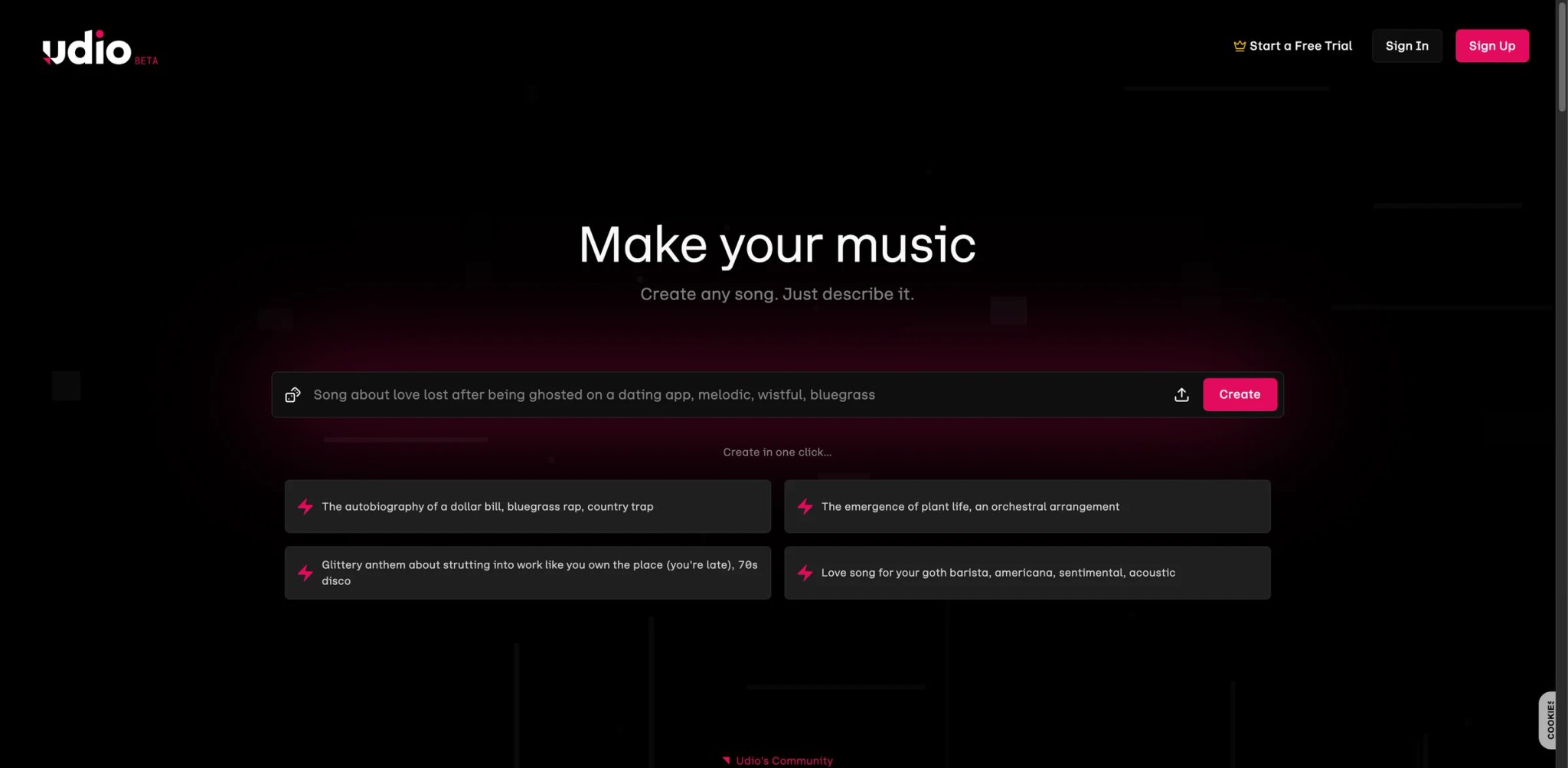
If you opened Suno this morning, regenerated three tracks because v5.5 added "the same intro feel" to all three, and decided the muscle memory wasn't worth the renewal, Udio is the alternative you'll try first. The product shape is the closest match in the market — text prompt in, full song with vocals out, segment-level editing, extension. Founded by ex-Google DeepMind researchers, Udio reached "the AI music generator everyone compares Suno to" status within months of launch and has held it through 2026.
What Udio solves vs Suno:
- Vocal generation that, anecdotally on r/SunoAI cross-posts, holds character more consistently across regenerations than Suno v5.5
- Segment-level editing (regenerate a chorus without losing the rest of the song) — the workflow Suno Studio promised but limited
- Less of the "v5.5 sameness" complaint as of May 2026; the model output preserves more between regenerations
- Closest data-import path for Suno refugees: the prompt vocabulary translates without retraining
Pricing vs Suno: Free tier exists with monthly track generation; paid Standard and Pro tiers are publicly listed but the exact monthly numbers have shifted twice in 2026 — verify at checkout before assuming the headline price. The structural difference from Suno is generation quotas measured in tracks rather than credits with variable consumption.
Limitations: Same broad copyright/licensing uncertainty as Suno — both products are negotiating with major labels and the rules can change. Udio's prompt-control gap, while smaller than v5.5 Suno's, is not zero; "the model added a hi-hat I didn't ask for" complaints exist on r/aimusic. Stem export is more limited than what producers using DAWs will want. Pricing tier changes through 2026 mean the headline price you saw in February may not be the price in May — re-verify before signing up for an annual plan. For users who picked Suno because of its ecosystem (Suno Studio, Suno Voice Model, Suno Live mode), some of these features have no direct Udio equivalent yet.
Best for: Suno Pro/Premier subscribers whose primary complaint is the v5.5 audio quality and prompt-following regression, songwriters and content creators wanting full-song-with-vocals output, anyone whose Suno bill crossed $30/mo and wants a like-for-like swap. Not the right fit if you need stems for DAW production (AIVA, Splice better), royalty-free stock music for ads/YouTube (Soundraw, Mubert better), or absolute commercial-rights clarity (Stable Audio, AIVA better).
Get started with Udio
Producer.ai
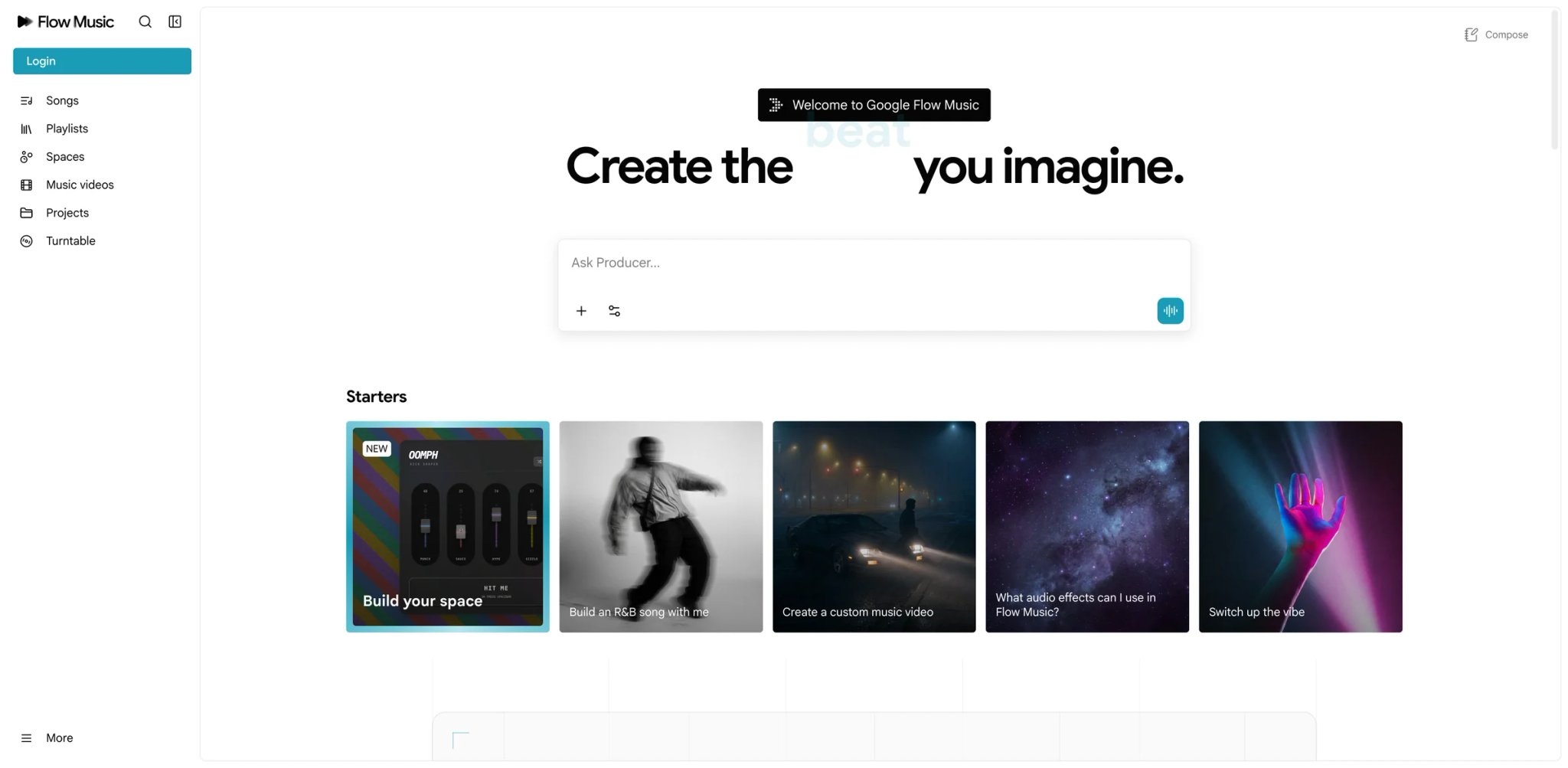
ProducerAI is now part of Google Labs as Google Flow Music, a generative music platform built around a conversational Producer workflow, Lyria models, projects, remixing, stems, publishing, and music-video creation — closer to working with a session musician than typing a prompt and waiting. For Suno users who left because the v5.5 model wouldn't follow structure or because Studio felt cumbersome, Producer.ai's workflow-first product is the alternative that least resembles Suno but most often satisfies the underlying need.
What Producer.ai solves vs Suno:
- Section-level prompts (write a verse here, change the chord progression here, regenerate just the bridge) replace the all-or-nothing Suno regenerate
- Better adherence to structural prompts because the model receives them as sequential edits, not as a single generation
- Built around the workflow of building a track over multiple sessions, not picking the best of 4 regenerations
- Reasonable on-ramp for producers who want AI assistance without giving up structural control
Pricing vs Suno: The public pricing page lists Free, Starter at $6/month, Plus at $18/month, and Member at $48/month, with monthly credit pools, daily top-ups, and higher concurrent-generation limits on paid plans. Pricing may continue to shift as Google Flow Music evolves — verify the current checkout price before committing to an annual plan.
Limitations: The co-producer workflow is a learning curve, especially for users who picked Suno because of its "type and you're done" simplicity. Final audio fidelity on full mixes is competitive but not yet ElevenLabs Music or Udio for pure vocal-led songs. The Riffusion-era community archives have moved or been re-organized, making documentation discovery harder than on more established platforms.
Best for: Producers and serious songwriters who outgrew Suno's prompt model, anyone whose Suno frustration is "the model doesn't listen to me" rather than "the model sounds bad," small studios building a repeatable workflow. Not the right fit if you want a one-shot Suno replacement (Udio fits better), royalty-free stock production (Soundraw/Mubert better), or absolute price certainty (the public pricing has moved).
Get started with Producer.ai

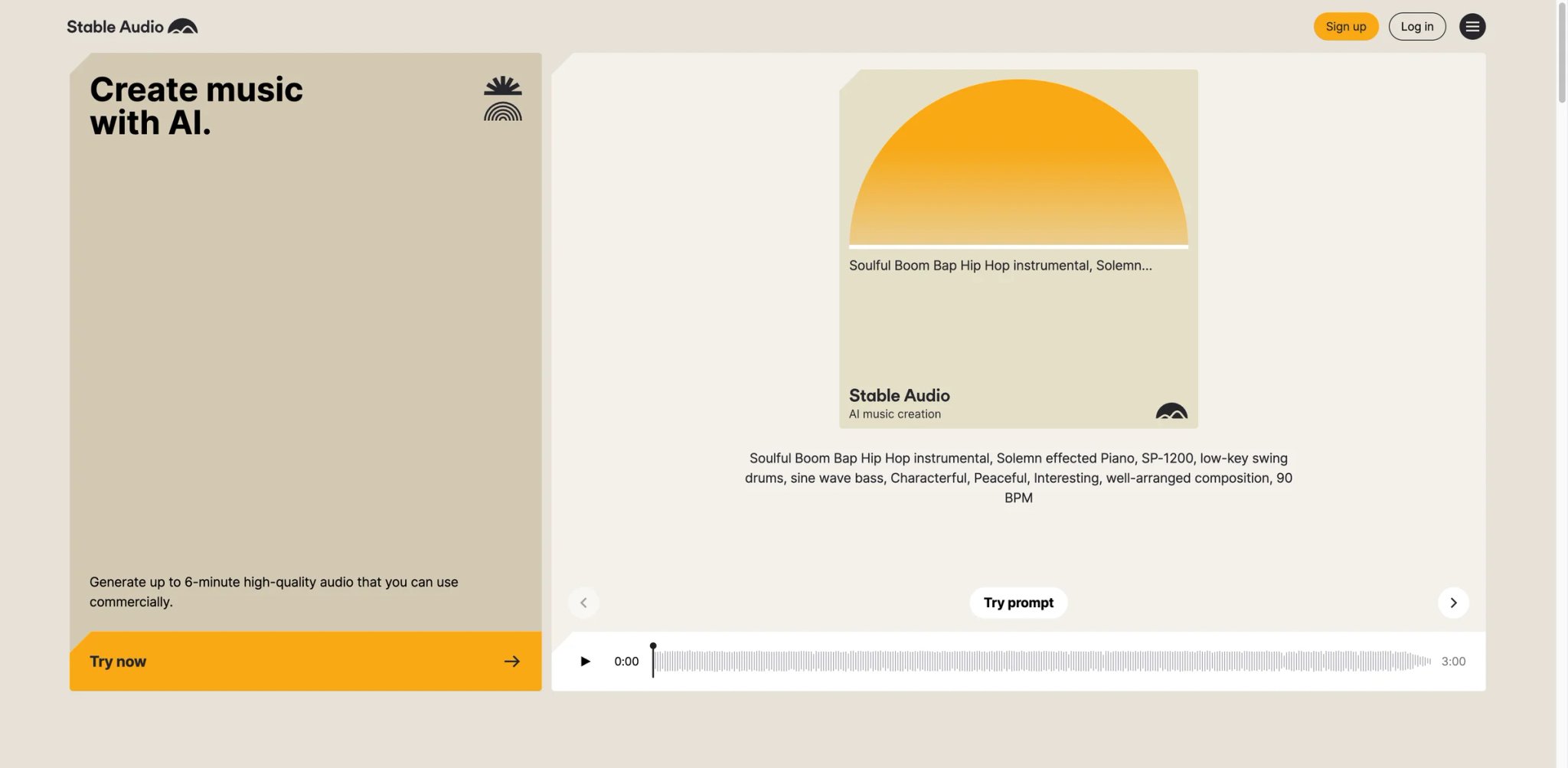
Stable Audio is Stability AI's licensed-data music and audio-generation stack. As of May 2026, the product story spans Stable Audio 3.0 with open-weight Small SFX, Small, and Medium models, API/enterprise access for Large, ownership of outputs under the Stability AI Community License, and Enterprise licensing for organizations over $1M annual revenue. The hosted product is structured around explicit quotas (10 tracks/month on Free, more on paid tiers), clear commercial-use boundaries on paid plans, and a sound palette that leans instrumental/cinematic/electronic rather than pop vocals.
Spec-driven pricing: For the hosted Stable Audio product, Free covers 10 tracks/month for non-commercial use; Pro is $11.99/mo with 250 monthly generations; Studio is $29.99/mo with 675 monthly generations; Max is $89.99/mo with 2,250 monthly generations. Stable Audio 3.0 also adds open-weight and API routes with separate Community/Enterprise license terms. This is the cleanest cost story in this list because every quota and right is enumerated up front, not gated behind a sales call.
What Stable Audio solves vs Suno:
- Commercial-use terms are explicit and tier-defined, not "subject to future updates" — directly answers the post-WMG anxiety
- Track quotas make budgeting predictable: 10/month free, more on paid, no credit-burn surprises
- Lineage from Stability AI's research means audio fidelity for instrumental/electronic genres is consistent
- API access on higher tiers means workflow integration into video and game production is realistic
Limitations: Stable Audio's output is instrumental-leaning — full-song vocal generation isn't the strength here. Pop-song writers and Suno-style "make me a track with verses and a chorus" users will find the model less fluent. The Stability AI license terms are clear but conservative compared to Suno's broad creator allowances — paid plan required for any commercial use, no "free for personal projects that might get monetized" gray area. The track-quota model is more disciplined than credits but can feel slow for someone used to generating 20 variations on Suno before picking a favorite — Stable Audio's economics nudge you toward picking the right prompt first.
Best for: Content creators (YouTube, podcasts, indie games, ads, video producers) who need instrumental and cinematic music with bulletproof commercial-use clarity, anyone whose Suno pain is licensing uncertainty more than audio quality. Not the right fit if you need vocal-led pop songs (Udio, ElevenLabs Music better) or you're a hobbyist songwriter (the instrumental focus won't match).
Get started with Stable Audio

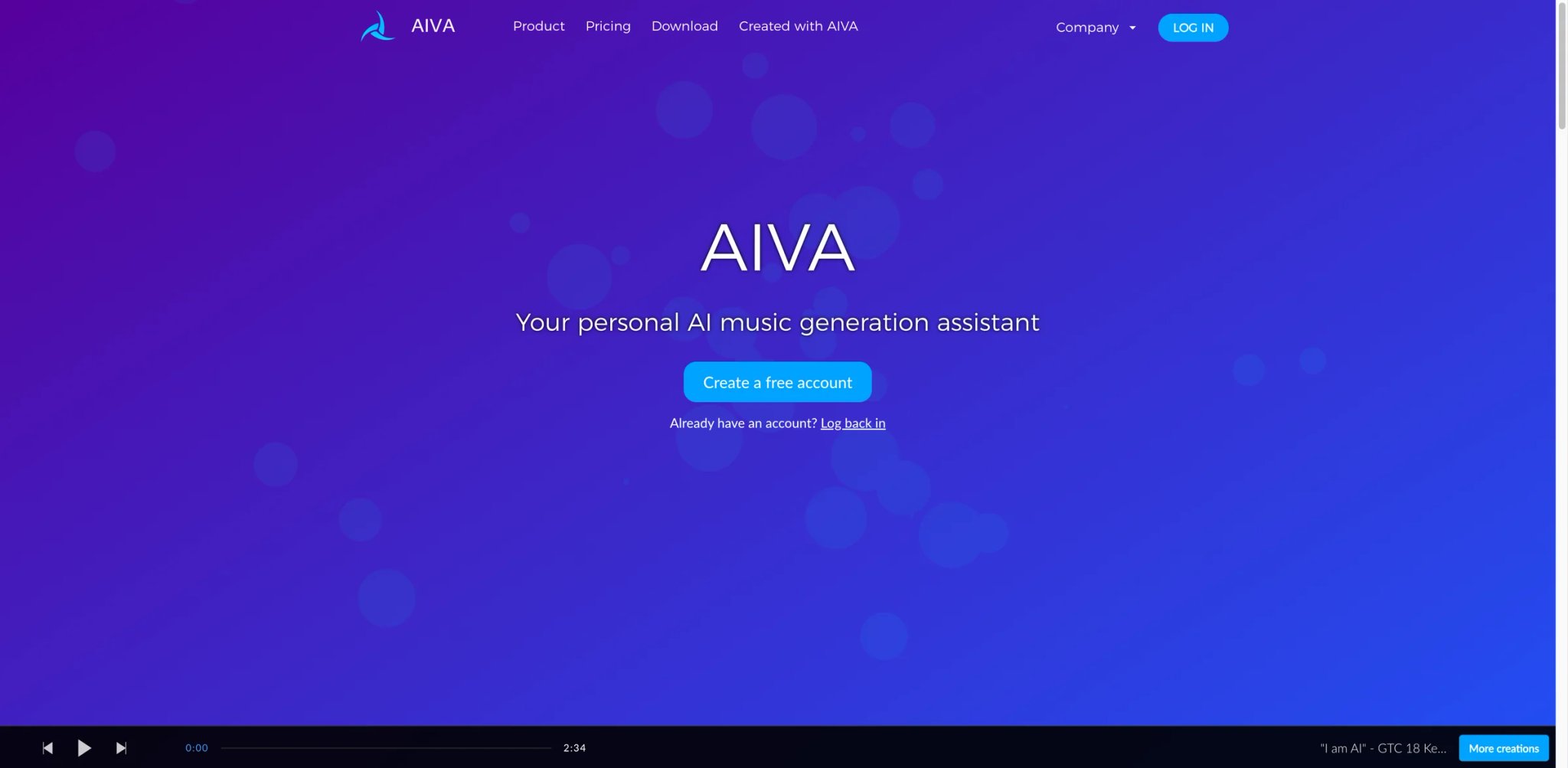
AIVA is the Suno alternative for composers — people who want AI to draft a structure and then want to edit notes, instruments, and arrangement in something closer to a score than a waveform. The product has been in market since 2016 (predating most of this list), and the framing is "AI music for composers and creators who want structural control," not "generate a finished track."
Composer workflow: Output is editable in the AIVA editor, exportable to MIDI for use in any DAW, and built around the assumption that you'll iterate on the arrangement after generation. This is the structural difference from Suno: AIVA gives you a starting point you can re-orchestrate, not a finished bounce.
What AIVA solves vs Suno:
- Editable structure: change tempo, key, instrumentation, section length after generation, not just regenerate
- MIDI export to Logic, Ableton, Cubase, FL Studio for production refinement — closes the Suno Studio gap
- Clearer rights model: Pro tier (€33/mo billed annually) grants broader copyright ownership of generated works
- Stable vendor history: smaller team, longer track record, fewer dramatic product pivots than Suno's 2025–2026 cycle
Pricing vs Suno: Free tier is €0 with 3 downloads/month and noncommercial use. Standard is €11/mo billed annually with 15 downloads/month and limited commercial use. Pro is €33/mo billed annually with 300 downloads/month and broader copyright ownership terms — the most explicit "you own this music" terms among any AI generator in this list.
The math vs Suno Pro: Suno Pro at ~$10/mo gives you a credit pool consumed by regenerations with uncertain commercial-use clarity. AIVA Pro at €33/mo (annually billed) gives you 300 downloads with broader ownership rights and MIDI export. For a composer who produces 5–10 tracks/month and needs DAW-ready output with usable rights, AIVA Pro is structurally cheaper than Suno Pro plus the cost of "I'm not sure if I can use this commercially" friction.
Limitations: Vocal generation is not AIVA's strength — this is composer-grade instrumental and orchestral music, not pop songs with lyrics. The learning curve for the editor is meaningfully higher than Suno's "type and click generate." Genre coverage skews classical, cinematic, ambient, and electronic; if you want hip-hop with realistic vocals, look elsewhere.
Best for: Film/TV/game composers, songwriters and producers who think in terms of structure and arrangement, anyone wanting MIDI output for DAW workflow, vendors whose Suno pain is "I can't edit what it gives me." Not the right fit if you want full-song-with-vocals output (Udio, ElevenLabs Music, Boomy better) or you don't have a DAW workflow downstream.
Get started with AIVA

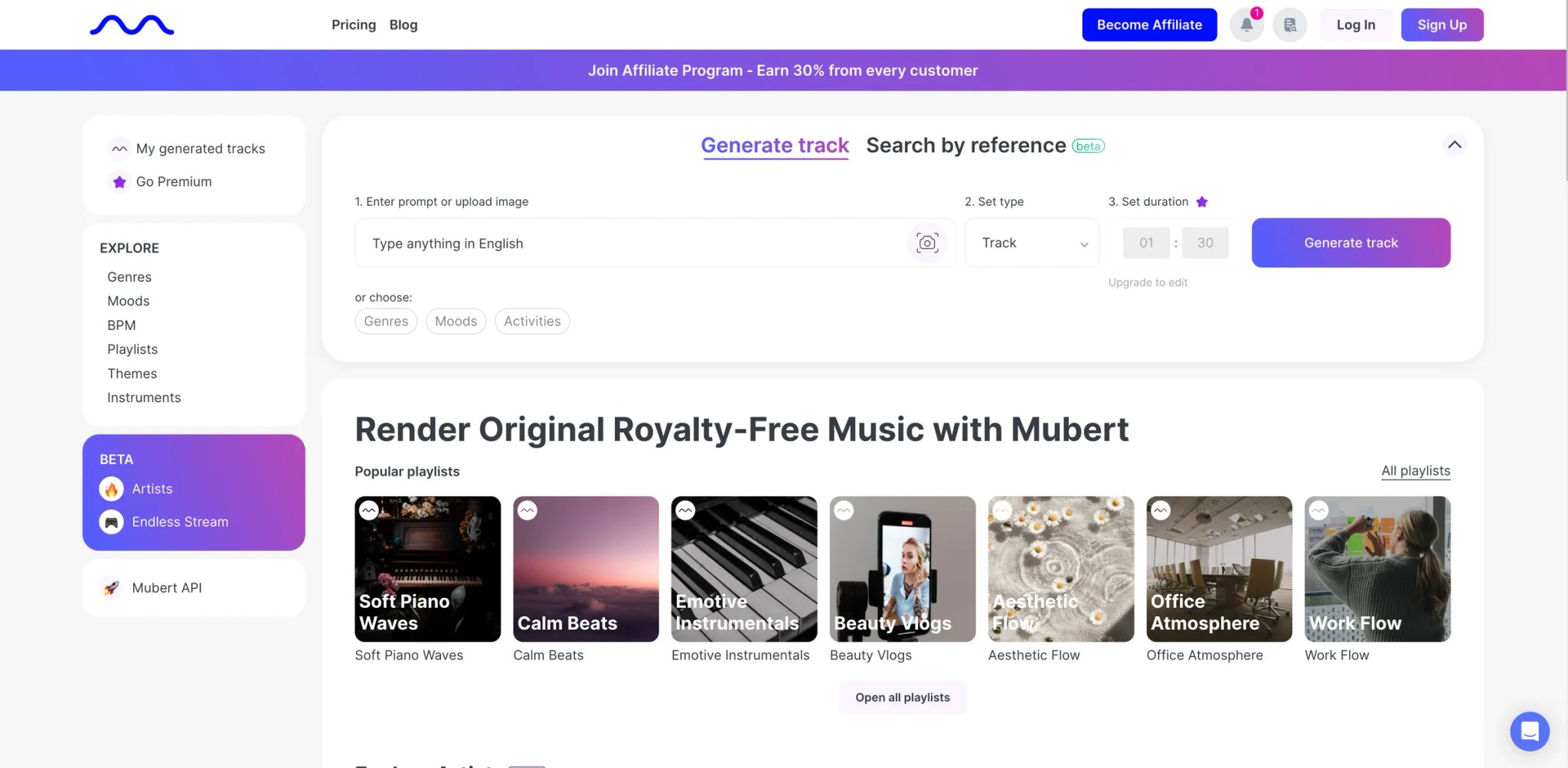
Mubert sits at the "I just need royalty-free background music for a YouTube video and I want it now" intersection. The product generates loops and tracks designed for content creators — clearly licensable, predictably structured, and tuned for ambient, lo-fi, electronic, and chill-out genres that work as background rather than centerpiece.
The differentiation from Suno isn't audio quality but use case. Suno wants to make you a hit; Mubert wants to give you a track that won't pull attention away from your video. For a creator who landed on Suno trying to use it as a royalty-free music source and is fighting the WMG/Sony licensing uncertainty, Mubert removes the entire question.
Pricing vs Suno: Free generation is available for testing; Creator plan is publicly listed around $11.69/mo. Pro and Business tiers exist for broader commercial and advertising use — verify current pricing at checkout, as the Mubert pricing page has been updated in 2026. Mubert's paid tiers include license certificates, but the pricing page states that tracks are not licensed for Content ID, standalone release on streaming platforms, or stock-music sites; Creator and Pro rights should be understood by use case rather than as unrestricted royalty-free music.
Limitations: No vocal music — this is instrumental ambient/electronic/chill-out only. Track variety inside a session can feel narrow if you generate many tracks at once. Mubert's brand is creator background music, not "make me a song" — coming in with Suno-style expectations will feel limited.
Track generation flow: Pick mood/genre/duration, generate, preview, download. The whole loop is under 60 seconds for a 2-minute track. No regeneration credit burn (within plan limits) — you preview before committing to a download, which is the workflow Suno credits make impossible.
Best for: YouTube creators, podcasters, indie app developers, ad producers who need background music with verified royalty-free status, anyone leaving Suno over the WMG/Sony commercial-use anxiety. Not the right fit if you want vocal songs or production-grade tracks for music distribution (Udio, ElevenLabs Music, AIVA better).
Get started with Mubert

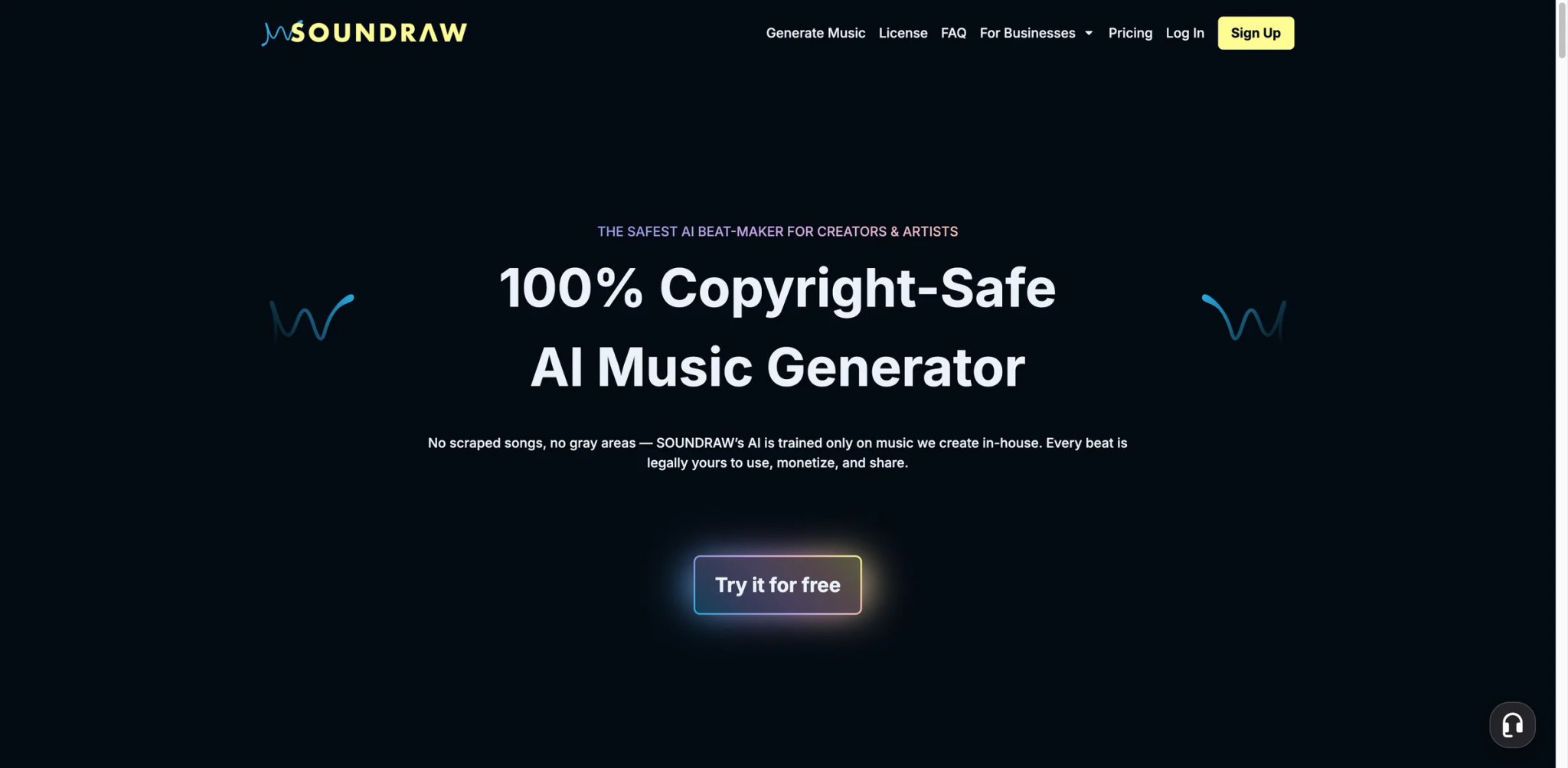
Soundraw is the controllable royalty-free instrumental answer — think Mubert with more knobs. The product gives you genre, mood, length, and instrumentation sliders, then generates an instrumental that you can edit (change the energy, swap instruments, trim length) before downloading. The license terms are explicit: Creator tier downloads are license-free for use across platforms.
Pricing & Plans: SOUNDRAW's current public pricing is no longer the older $12.99/$25.99 structure. Use the current Creator, Artist Starter, Artist Pro, Artist Unlimited, and Enterprise tiers from the pricing page; regional currency and limited-time annual promotions may change the effective monthly price. Creator covers background music for videos/podcasts/social content, while Artist tiers are required for distributing songs on streaming platforms and for WAV/stem workflows. This is the clearest tier-to-use mapping in this list: hobby creators on Creator, monetizing artists on Artist tiers.
What Soundraw solves vs Suno:
- Slider-based control means you don't fight the model — you adjust dimensions and it follows
- License-free baseline removes the post-WMG anxiety entirely
- Editable output (trim, energy curve, instrumentation swap) before download
- Track customization in the editor means less regeneration burn than Suno credits
Limitations: Instrumental only — no vocals or lyrics. Style coverage is content-creator-friendly (cinematic, corporate, upbeat, electronic) rather than experimental or avant-garde. The aesthetic ceiling is stock-music territory rather than "this could be a Spotify hit."
Best for: Content creators wanting controllable instrumental tracks for video/podcast/ad use, anyone who liked Suno's idea but needed more control over the result, creators uploading to YouTube and Instagram who want zero copyright friction. Not the right fit if you need vocals or you're producing music as the primary product (use AIVA + Udio + DAW workflow instead).
Get started with Soundraw

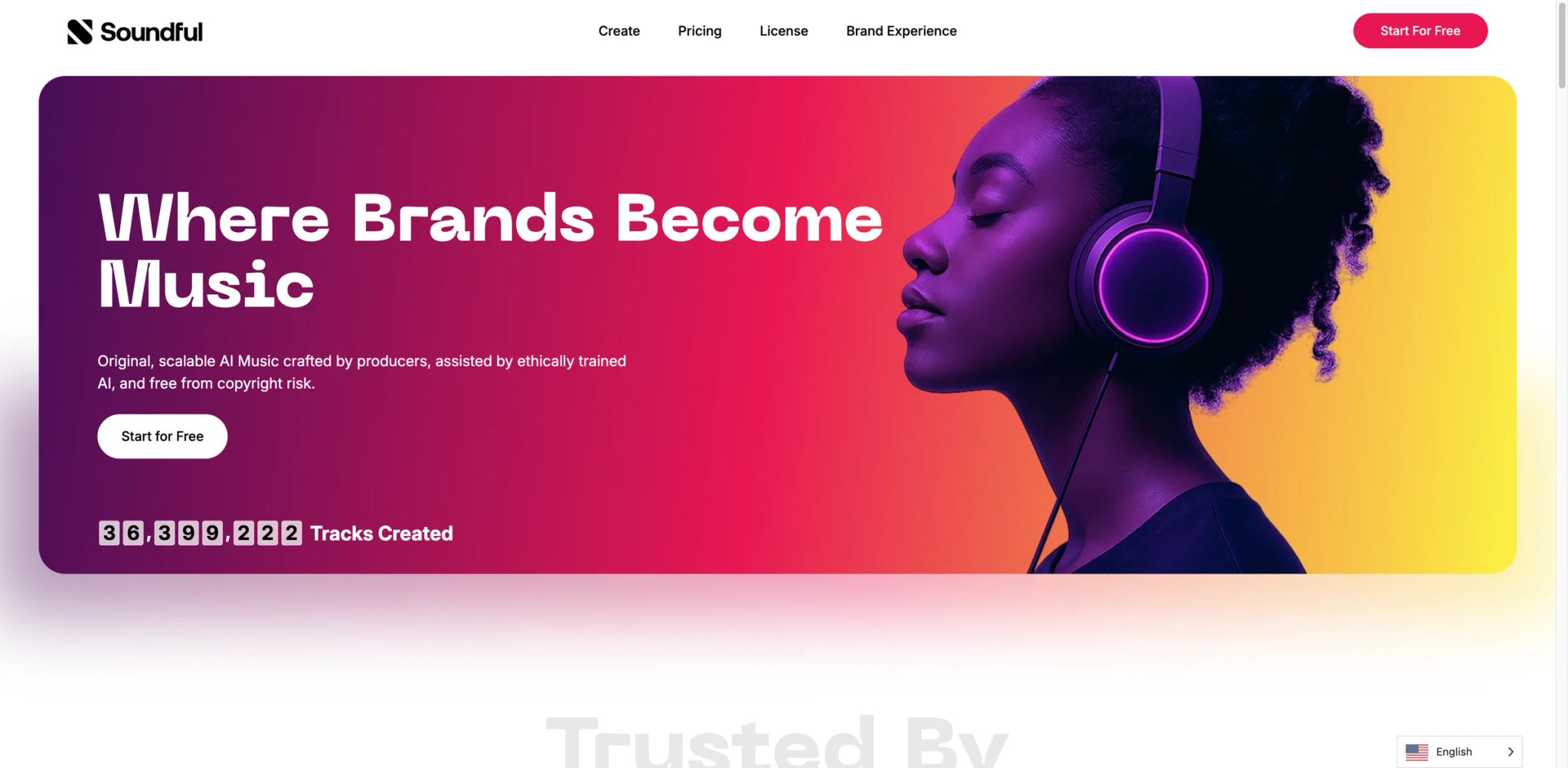
Low entry pricing is the differentiator. Soundful's Plus tier is $9.99/month when billed monthly or $4.99/month on annual billing, while Pro is $14.99/month when billed monthly or $9.99/month on annual billing. The rest of the product is built to make those prices defensible — predictable genre templates, royalty-free downloads, no surprise credit consumption. For a creator who tried Suno at $10/mo for the credits and felt the value evaporate, Soundful's tiers cost less and ship what they advertise.
The Free Forever tier exists for personal use only. Plus unlocks 100 MP3/WAV downloads per month and a Music Creator License. Pro unlocks 400 MP3/WAV downloads, 20 STEM packs per month, SoundCloud distribution, and the Music Creator License. Business and custom tiers handle enterprise needs.
Soundful's range is narrower than Suno's — genre templates rather than open prompts, instrumental focus, less "make me a song" and more "give me a track in this style." But for the price band and the no-surprise royalty-free terms, it's the budget answer for creators who don't need vocal-led music.
The differentiation worth knowing about: Soundful's templates are pre-mastered to a consistent loudness target, which sounds boring as a sales pitch but matters in practice. Background music for podcasts and YouTube videos needs to sit at a predictable level under voice, and Soundful's output requires less re-mixing than tracks from Suno or Udio (where loudness varies generation-to-generation and the mastering often pushes vocal-led mixes too hot for background use). For creators producing weekly content where time matters, this is the kind of operational advantage that doesn't show up on a features table.
Best for cost-sensitive creators (YouTubers under 100K subs, indie game devs, podcast hosts) wanting predictable monthly cost and royalty-free terms. Not the right fit if you need vocals, you want experimental genres outside the template library, or you're producing music as the artistic centerpiece rather than as background.
Get started with Soundful

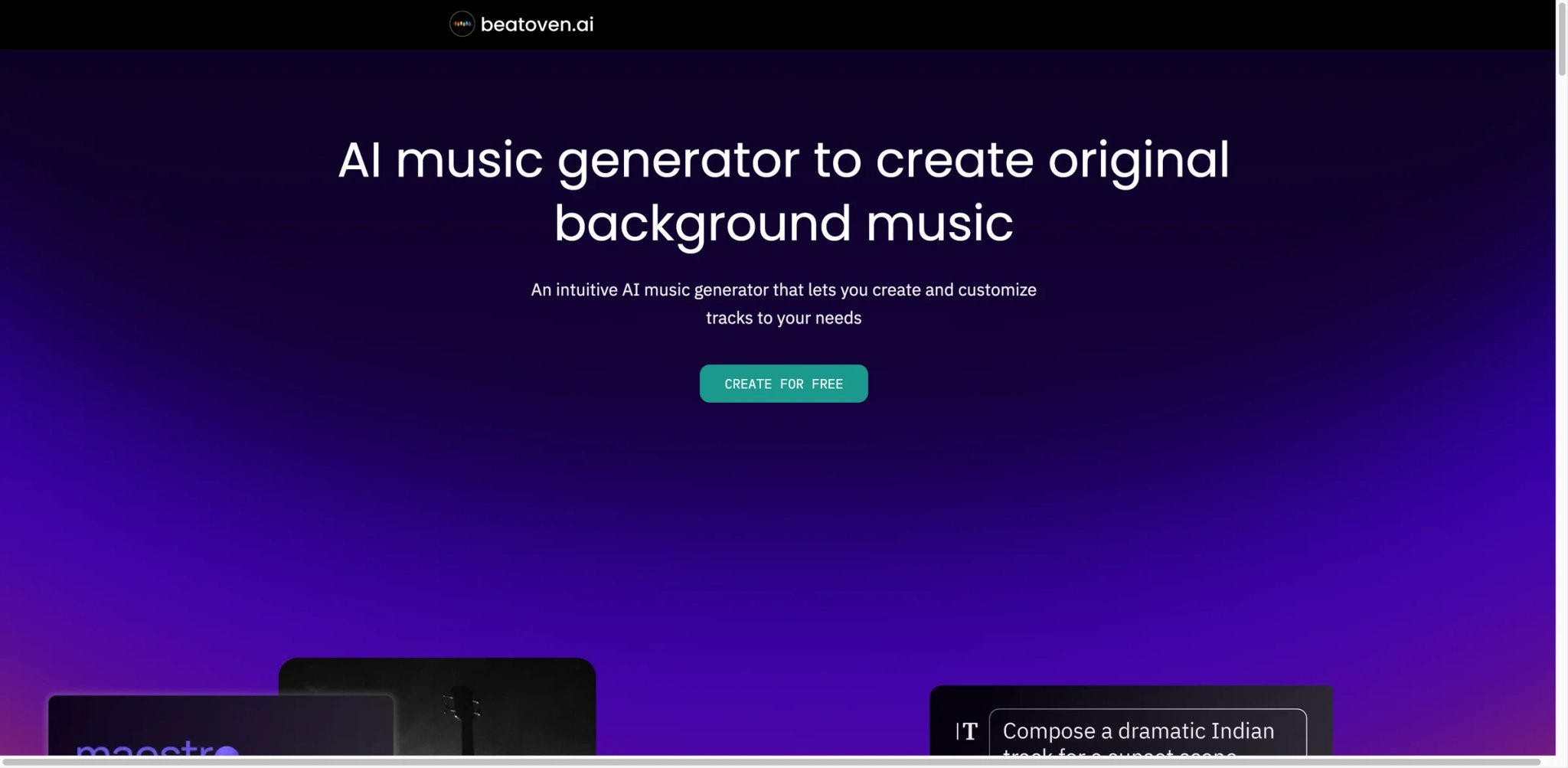
Beatoven.ai prices by download minute, not credits or tracks. That's useful for soundtrack workflows — instead of consuming 50 credits per regeneration with no preview, Beatoven charges $10/mo for 30 download minutes (or $20/mo for 60), with extra minutes at $3/each. You generate freely, you only pay when you download what you'll use. The license is designed for video/audio content rather than standalone music resale, registration, or streaming-platform distribution.
The product positioning is soundtrack scoring — music for video, ads, games, podcasts, where mood and length matter more than memorable hooks. The mood selector and scene-aware features make it stronger than generic background music tools when you have a video timeline and need a track that hits emotional beats at specific timestamps.
Pricing vs Suno: Trial Free; Creator $10/mo with 30 download minutes; Visionary $20/mo with 60 download minutes; extra minutes $3/min. This is the cleanest pay-only-for-what-you-use model in the list.
Limitations: Instrumental soundtrack focus — no vocals, no pop-song territory. The catalog of instruments and genres is curated for video soundtracking, which is great for the use case and limiting if your need is broader. Free tier is genuinely a trial, not a long-term free option like Mubert or Soundful.
Best for: Video producers, indie game developers, podcast scoring, ad makers who need mood-aware soundtrack generation with download-minute pricing transparency. Not the right fit if you want vocals, pop-song output, or unlimited downloads on a flat monthly fee.
Get started with Beatoven.ai


Boomy started life as "anyone can make a song in 30 seconds and publish to Spotify" and that's still the product's center of gravity. It's not the most sophisticated music generator in this list, but for creators whose Suno workflow was "make a track quickly and share it," Boomy's combination of fast generation, simple genre selection, and built-in publishing to streaming platforms is the lowest-friction alternative.
The model output is pop/electronic/hip-hop oriented, the editor is intentionally simple (pick a genre, generate, adjust a couple of dials, publish), and the distribution layer means you can take a song from "I clicked generate" to "it's on Spotify" without leaving the product.
Pricing vs Suno: Free $0 basic plan covers song creation with limited saves and distribution. Creator plan is publicly listed at $14.99/mo with full song saves, distribution, and a more generous track allowance. Promotional pricing has appeared in official snippets — verify at checkout before signing up.
Limitations: Audio fidelity is competitive at the SMB-creator tier but not at the production level of Udio or ElevenLabs Music. Genre coverage skews pop/electronic; jazz, classical, complex arrangements are not Boomy's lane. The "anyone can publish" framing has historically led to Spotify removing AI-generated tracks at scale — read Boomy's current Spotify and TikTok distribution policies before relying on it for monetization.
Best for: Hobby songwriters, creators wanting fast iteration plus built-in publishing, anyone whose Suno workflow was about volume and distribution rather than production quality. Not the right fit if you need audio production quality (Udio, ElevenLabs Music better), you're targeting label-tier output, or you want stem export to a DAW.
The streaming-platform caveat worth flagging: Boomy has been associated with prior streaming-platform takedown and fraud-scrutiny episodes, so creators using Boomy specifically for monetized distribution should verify Boomy's current distribution and commercial-rights policy before relying on streaming revenue. For non-monetized uses (sharing tracks with friends, posting to social, demoing ideas), this isn't a concern.
Get started with Boomy
ElevenLabs Music
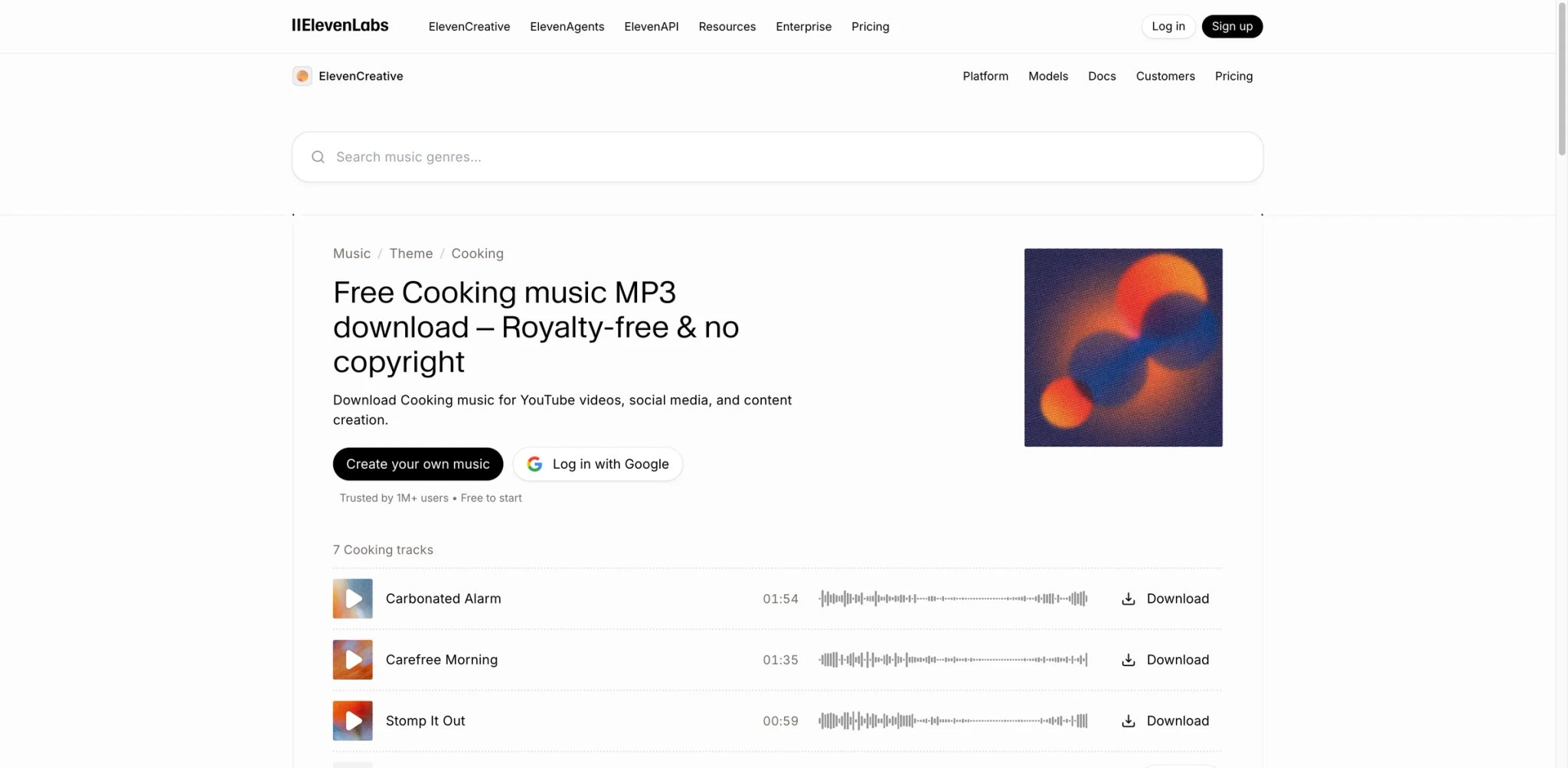
Before pricing, the framing: ElevenLabs is the AI vendor that built its reputation on audio fidelity — voice cloning, TTS, dubbing — and ElevenLabs Music is the music-generation product they shipped after that audio infrastructure was in place. For Suno refugees whose primary complaint is the v5.5 sound quality regression, ElevenLabs Music is the alternative whose foundation is "audio first."
The audio-first thesis: ElevenLabs spent years optimizing voice synthesis fidelity, and the same infrastructure underpins Music. In editorial listening tests, ElevenLabs Music is worth A/B-ing against Suno v5.5 specifically on sustained vocals, harmony layers, and high-frequency artifacts — the exact areas Suno r/SunoAI threads complain about — but treat any "cleaner than v5.5" claim as a listening-test impression rather than a published benchmark.
What ElevenLabs Music solves vs Suno:
- Audio fidelity baseline higher than Suno v5.5 on vocal-led songs (the most-cited Suno complaint)
- Same credit pool as ElevenLabs Voice and Dubbing — useful if you're already a customer for TTS or dubbing
- Commercial license clarity from Starter tier upward (no post-WMG-style uncertainty)
- Vendor with multi-product roadmap and stable communication — addresses the Suno "silence" pain
Pricing vs Suno: Free $0 with 10K credits/month covering Music + other ElevenLabs products. Starter is $6/mo with more credits and explicit commercial license. Creator and Pro tiers scale credits up; enterprise plans available. The cross-product credit pool means a customer running TTS + Music + Dubbing pays one bill, not three.
Limitations: Music is newer than ElevenLabs' established voice products and the editor lacks some of the section-level controls Producer.ai or AIVA offer. Genre coverage is broad but less culturally tuned than Suno for very specific subgenres (drill, hyperpop, regional Spanish trap, etc.). Credit consumption per track is harder to estimate up front than Stable Audio's track-quota model — you spend credits to find out how many a song costs. The cross-product credit pool is an advantage if you use multiple ElevenLabs products, a wash if you only need music.
Best for: Creators who already use ElevenLabs for voice/TTS, anyone whose Suno pain is specifically the v5.5 audio fidelity drop, songwriters wanting vocal-led output with cleaner highs and sustained notes than v5.5 Suno produces. Not the right fit if you want pure instrumental output (Stable Audio, AIVA, Mubert better) or you've never used an ElevenLabs product before and want the simplest UX (Udio is still more direct).
Get started with ElevenLabs Music
Honorable Mentions
Splice ($12.99–$39.99/mo) isn't an AI song generator — it's a sample-and-loop library plus AI-assisted creative tools (AI Stack for picking samples that work together, AI Tempo for matching BPMs). For producers whose Suno frustration is "I want DAW control, not a finished bounce," Splice's massive sample library combined with the AI assistant features is the workflow most professional producers actually run — pick the samples, build the arrangement in Logic/Ableton/FL Studio, finish with mastering. Best when you want building blocks for DAW production rather than a finished generated song. Not a fit if you want a song generated from text.
BandLab (Free + $14.99/mo Pro + $29.99/mo Max) is a social DAW with AI features layered on (SongStarter for AI-assisted song starters, AI mastering, vocal isolation). The Free tier is unusually generous — cloud DAW with collaboration, storage, and most production features available at zero cost — and the platform is built around the workflow of finishing songs collaboratively, including built-in distribution to streaming platforms. Best as the post-generation editor for tracks you build in Udio or AIVA, or as a free-tier alternative to Logic/Ableton for hobbyists. Not a primary AI music generator on its own.
LANDR (Free tier + $24/year Distribution Basic + $45/year Pro + $8.25/mo Studio) is the mastering and distribution layer — what you reach for after generating a track elsewhere. For Suno users ready to release music commercially, LANDR's AI mastering produces release-ready files comparable to a low-end mastering engineer, and the distribution side gets them to Spotify, Apple Music, Amazon Music, and others with split-payment support for collaborators. Best as the finishing layer in a multi-tool workflow that starts with AIVA or Udio for generation.
Output Co-Producer (Pack Generator currently free, royalty-free stems) is a sample-pack and stem ideation assistant from a respected music-tech brand. The output is building blocks (drum loops, melody fragments, basslines, chord progressions) royalty-free for use in your own productions, not finished songs. Best for producers who want creative starting points to develop in a DAW. Not a Suno replacement for full-song generation, but a useful complement when AI ideation needs to flow into hands-on production.
Migrating from Suno — A Practical Guide
Data and Account Migration
There is no automatic Suno-to-anywhere importer in 2026. Suno's prompt history and Studio sessions are platform-specific. The realistic migration path:
- Audit your active Suno catalog. Export the songs you want to keep as audio files (the highest-quality format your tier allows) while your subscription is active. Suno's download terms have moved post-WMG; do this before considering cancellation, because some tier-and-track combinations may lose download access after the next pricing update.
- Document your prompt vocabulary. Save the prompt templates that worked for you on Suno v4/v5 — most of them transfer conceptually to Udio and ElevenLabs Music, though the syntax and the genre-tag vocabulary varies between vendors. Producer.ai and AIVA require a different prompt-as-edit-instruction approach, so a Suno prompt won't directly map.
- Choose the destination by use case, not by overall ranking. Vocal-led songs → Udio or ElevenLabs Music. Royalty-free background → Soundraw, Mubert, Soundful. Composer workflow with MIDI → AIVA. Commercial-clarity priority → Stable Audio. Mood-aware soundtrack → Beatoven.ai. Multi-section iterative production → Producer.ai.
- Run a 14-day parallel test. Don't cancel Suno on day one. Pick your highest-stakes use case (your weekly track, your podcast intro, your client deliverable) and rebuild the same workflow in the destination tool. Compare audio quality, prompt-following, commercial-use confidence, and bill predictability across both products on the same input.
- Re-verify rights on previously generated Suno tracks before publishing them under your new vendor's name. The post-WMG terms apply to your existing Suno catalog as much as to new generations. If you're moving content commercially, treat the rights on tracks generated before April 2026 separately from tracks generated after — the terms may differ.
- Cancel or downgrade Suno only after the destination tool has handled your real workload for two weeks, including the highest-stakes monthly use case. If you generate music weekly, watch the destination's behavior across at least two full generation cycles before pulling the plug on Suno.
Pre-paid Suno credits don't refund on cancellation. If you're mid-annual on Pro/Premier, spend the credits down while running the new tool in parallel — the credits won't carry over to anywhere, and a partially-used Suno annual plan has no salvage value.
Learning Curve by Alternative
Near-zero curve (if you can use Suno, you can use this same day): Udio, Boomy, Soundful, Mubert.
Medium curve (a few hours to recover Suno's UX comfort): Stable Audio, Soundraw, Beatoven.ai, ElevenLabs Music. The prompt grammar shifts, the editors look different, but the core "type and generate" mental model carries.
High curve (days to weeks): Producer.ai (co-producer workflow is a different paradigm), AIVA (composer editing with MIDI export), Splice + BandLab (these require a DAW skillset). The reward is more control than Suno offered; the investment is real.
Pricing Brackets vs Suno Pro
Cheaper than Suno Pro: Soundful Plus ($4.99/mo), ElevenLabs Music Starter ($6/mo), Mubert Creator (~$11.69/mo), Beatoven Creator ($10/mo), Stable Audio Pro ($11.99/mo), Soundraw Creator ($12.99/mo).
Same bracket ($14–$20/mo): Boomy Creator ($14.99/mo), Splice Sounds+ ($12.99/mo) / Creator ($19.99/mo), BandLab Pro ($14.99/mo), AIVA Standard (€11/mo annually).
More expensive: Stable Audio Studio ($29.99/mo), Stable Audio Max ($89.99/mo), AIVA Pro (€33/mo annually with broader rights), Producer.ai paid tiers up to ~$64/mo, Splice Creator+ ($39.99/mo). Most of the premium tier delivers either expanded commercial rights, higher quotas, or stem/MIDI export — the features Suno doesn't include even at Premier. For commercial use specifically, AIVA Pro's broader copyright ownership is the closest thing in this category to "I own the music I generated," which has structural value beyond the monthly difference.
Best Suno Alternatives by Use Case
If Your Reason Is "I want better audio quality after Suno v5.5 disappointed me"
ElevenLabs Music has the cleanest audio foundation in this list — the same infrastructure that powers their TTS produces noticeably better sustained vocals than v5.5 Suno. Udio is the like-for-like swap if you want a Suno-shaped product without the audio regression — same prompt-to-song workflow, fewer of the "same intro feel" complaints surfacing in r/SunoAI v5.5 threads. Stable Audio wins if your use case is instrumental rather than vocal-led. A practical test: regenerate the same song idea on each candidate from your existing Suno prompt, then run all three through a loudness meter and check sustained vocal quality across the chorus — the v5.5 weakness is most audible there.
If Your Reason Is "The model needs to follow my lyrics, structure, and vocals"
Producer.ai's section-level prompt workflow is the strongest answer — you edit sequentially rather than regenerate from scratch, which solves the "I asked for instrumental and it added lyrics" failure mode r/SunoAI keeps reporting. AIVA gives you structural control via editable scores and MIDI export — the strongest fit for users who think in terms of song sections rather than prompt vocabulary. Soundraw and Beatoven.ai are non-vocal alternatives where the slider controls do what they say, which is the right pick for use cases that don't require vocals at all. Udio's prompt-following is reportedly better than v5.5 Suno but still requires regeneration discipline — if "follows my instructions" is your primary need, Producer.ai's workflow beats any prompt-only product.
If Your Reason Is "I care about commercial use, downloads, and rights clarity"
Stable Audio has the cleanest enumerated commercial-use terms by tier — every quota and right is listed on the pricing page rather than buried in updated TOS. AIVA Pro at €33/mo annually grants broader copyright ownership of generated works, which is the closest thing to "I own this music" any AI generator on this list offers. SOUNDRAW Creator covers royalty-free background music for videos, podcasts, and social content, but standalone music distribution requires an Artist plan; Artist plans also have restrictions around Content ID and selling unmodified SOUNDRAW beats. Soundful Plus is $9.99/mo monthly or $4.99/mo annually and allows commercial use under its Music Creator License. Beatoven.ai Creator at $10/mo carries an exclusive music license for video/audio content, but Beatoven prohibits resale, registering tracks, and distributing generated tracks on streaming platforms. All five sidestep the WMG/Sony/UMG anxiety entirely because they don't generate vocal-led music that competes with label catalogs.
If Your Reason Is "I want predictable monthly cost on a hobby budget"
Soundful Plus at $9.99/mo monthly or $4.99/mo annually, ElevenLabs Music Starter at $6/mo, and Beatoven.ai Creator at $10/mo are among the cheapest paid tiers with real product capability — and predictability matters as much as the headline price. Soundful uses fixed download counts (you know exactly what you get). ElevenLabs uses a credit pool with explicit per-track consumption. Beatoven.ai bills by download minute, so you preview unlimited but pay only when you commit. Boomy Free + Creator at $14.99/mo handles the "I want fast iteration with publishing" workflow without the credit-burn surprise — most users on Creator don't hit the cap. Avoid the trap of "Suno is $10/mo so any $10/mo tool is equivalent" — the per-track unit cost varies wildly because the credit consumption models differ.
If Your Reason Is "I want a production workflow with stems, samples, or DAW control"
AIVA exports to MIDI for Logic/Ableton/FL Studio integration — generate a starting point, then orchestrate freely. Producer.ai's section-level workflow plays nicely with finishing in a DAW because the iteration happens before bounce-down rather than as a hopeful regenerate-and-pray loop. Splice provides the sample library you build from rather than the song you generate. BandLab is the cloud DAW that hosts the production. Output Co-Producer provides stem packs for ideation. For serious music production, you'll likely combine 2–3 of these rather than pick one — a realistic stack is "AIVA for melodic ideas → Logic for production → LANDR for mastering → distribution."
If Your Reason Is "I mainly need royalty-free background music for YouTube, podcasts, ads, or apps"
Mubert is the lowest-friction creator-safe option for ambient/electronic backgrounds — most "I need calm music behind my podcast" use cases are solved in under 60 seconds. Soundraw adds slider-based control for instrumentals when you need the chorus to be more energetic than the verse. Beatoven.ai's download-minute pricing matches the use-case math when you generate freely and pay only for what you use. Soundful at $4.99/mo is the budget answer for cost-sensitive creators producing weekly content where consistency matters more than per-track artistic distinction.
If Your Reason Is "I want a more stable vendor and clearer product communication"
AIVA's smaller team and longer track record (active since 2016) means fewer dramatic product pivots than Suno's 2025–2026 cycle of model versions, Studio changes, and label deals. ElevenLabs (also covered in our AI voice generator roundup) has a multi-product roadmap with regular communication via their official blog and release notes — the company posts about model changes and feature shipments instead of leaving users to figure them out from Reddit. Beatoven.ai and LANDR are smaller and more responsive to direct support requests, which matters when something breaks at midnight before your client deadline. None of these match Suno's marketing footprint, but all match its capability for their respective use cases and offer a calmer vendor-relationship experience.
How to Choose the Right Suno Alternative
-
Name the dollar reason and the use-case reason separately. "I want to leave Suno because v5.5 sounds bad" is different from "I need royalty-free background music." Pick the alternative whose strength matches your actual use case, not whichever tool is highest in this article. The Suno-shaped products (Udio, ElevenLabs Music) win on use-case overlap; the structurally different products (AIVA, Stable Audio, Soundraw) win on specific axes you may care about more than the like-for-like swap.
-
Verify pricing at checkout for any tool flagged with
verify_pricing. Udio, Producer.ai, Mubert, and Boomy have had pricing-page changes through 2026 — the number you see when you actually click through to checkout is the real number, not the screenshot from a blog post (including this one). Stable Audio, AIVA, Soundraw, Soundful, Beatoven.ai, and ElevenLabs Music have stable public pricing as of May 2026. -
Test commercial-use clarity before committing. If you generate music for monetized content (YouTube, ads, sync licensing, client deliverables, app/game soundtracks), the rights story matters more than the audio quality. Stable Audio, AIVA Pro, Soundraw Creator, Soundful, and Beatoven.ai have the cleanest terms; the rest range from "yes, but verify" to "currently unclear post-deal." The test is to read the actual license terms on the destination's pricing or terms page, not to rely on third-party summaries — the terms change.
-
Run two weeks parallel before canceling Suno. Rebuild your highest-stakes recurring workflow (your weekly track, your podcast intro, your ad bed) in the destination tool. Watch audio quality, prompt-following, download experience, and bill predictability across both products on the same input. Cancel only after the new tool has matched Suno's reliability on real work, not on test prompts. The friction you discover in week three is the friction you'll live with — better to discover it during the trial than after the annual contract.
Frequently Asked Questions
What is the best free alternative to Suno?
Which Suno alternative is best for realistic vocals?
Which Suno alternative is safest for commercial or royalty-free music?
Should I wait for Suno v5.5 or v6 to stabilize?
Is Udio better than Suno?
What is the best Suno alternative for YouTube background music?
Can I move old Suno songs into another DAW or production workflow?
Which Suno alternative gives the most control over structure and arrangement?
For maximum control, AIVA + a DAW (Logic, Ableton, FL Studio) is the strongest workflow because you generate a starting point in AIVA, export MIDI, and finish the production with full editing rights and standard music-production tools. For simplicity with reasonable control, Producer.ai is the middle ground — you don't need to learn a DAW, but you get more structural control than Suno or Udio offer.
Get ToolWorthy Weekly
New AI tools, practical guides, and selected AI signals in one weekly brief.
Related Posts
- 10 Best Udio Alternatives 2026 — After the Download Lockdown
After Udio's UMG deal disabled downloads and walled the garden, creators are leaving. 10 alternatives — Suno, Mureka, ElevenLabs — by rights, export, and migration cost.
- Best AI Music Generators 2026 - 10 Tools Tested
Tested 10 AI music generators for quality and licensing. Compare Suno, Udio, and more—with pricing, features, and commercial rights.
For AI tool founders
Built a tool that belongs in this decision set?
Request an editorial evaluation for possible inclusion in ToolWorthy.
Submit your tool for reviewPaid submission does not guarantee a ranking, recommendation, inclusion, or editorial outcome.