
10 Best AI Language Learning Apps 2026 — Tested for Real Fluency
From Langua's human-like conversations to Talkpal's 80+ languages — we tested 10 AI speaking practice apps on real pricing, pronunciation accuracy, and honest limitations.
On this page
MIT research confirms what every language learner suspects: output-based practice — actually speaking — accelerates fluency roughly three times faster than passive methods like flashcards or grammar drills. Yet most people learning a new language have no conversation partner available at 11pm on a Tuesday, and the thought of stumbling through broken sentences with a stranger triggers enough anxiety to keep them on Duolingo's word-matching exercises indefinitely.
AI language learning apps have changed this equation. The best ones now simulate real conversations with real-time pronunciation feedback, grammar correction, and adaptive difficulty — available whenever you have five minutes. But the market has exploded past 50+ options, and the gap between "AI-powered" marketing copy and actual learning outcomes is wide. We tested and compared 10 AI language learning apps across conversation quality, pronunciation accuracy, pricing transparency, and real user feedback to help you pick the one that actually moves you toward fluency.
| Tool | Best For |
|---|---|
| Langua | Advanced learners wanting human-like AI conversations |
| Talkpal | Budget-conscious learners needing 80+ language coverage |
| Langotalk | Affordable daily conversation practice on web |
| Talkio AI | Pronunciation drilling across 70+ languages and 122 dialects |
| Speak | Structured speaking-first curriculum for beginners |
| Gliglish | Quick daily sessions with free tier access |
| Univerbal | Scenario-based roleplay practice |
| Busuu | Learners wanting AI plus human community feedback |
| Memrise | Vocabulary building with native speaker video content |
| Falou | Mobile-first learners who want high App Store ratings |
How We Selected and Tested
We started with a pool of 30+ AI-powered language learning tools and narrowed down based on measurable criteria: the app must use AI for interactive conversation or pronunciation practice (not just flashcard scheduling), support at least 5 languages, and be available to users in the US, Canada, and EU. Pure translation tools, human-only tutoring platforms, and dictionary apps were excluded.
Our research methodology combined multiple data sources to ensure accuracy. We analyzed official product pages and pricing documentation, cross-referenced feature claims against independent reviews on Trustpilot, App Store ratings, and expert evaluations from language learning publications. We also reviewed user complaints from Reddit and review platforms to identify real-world friction points that marketing pages won't mention.
Evaluation Dimensions: We evaluated each tool across 5 dimensions:
- Conversation quality — How natural and adaptive is the AI dialogue? Does it correct in context or just flag errors?
- Speaking practice depth — Real-time pronunciation feedback accuracy, accent options, and speaking-to-listening ratio
- Language coverage & content depth — Number of supported languages and whether content goes beyond beginner level
- Pricing transparency & value — Clear pricing pages, no hidden charges, and fair cost relative to features
- Real user satisfaction — App store ratings, Trustpilot scores, and patterns in user complaints
Note on Testing Scope: We conducted hands-on evaluation of conversation features and onboarding flows for the top-ranked apps. For pricing and advanced features, we relied on official documentation and verified third-party reviews. Research conducted in March-April 2026.
Transparency & Limitations: All information comes from official sources and credible third-party platforms — we don't fabricate ratings or performance claims. AI language apps update frequently, so specific features or pricing tiers may have changed since our research date.
Top 10 AI Language Learning Apps Compared
The table below gives you a side-by-side view of how these 10 apps stack up on the dimensions that matter most when choosing a language learning companion. Use it to quickly eliminate options that don't fit your needs before diving into the detailed reviews.
| Tool | Best For | Language Count | Speaking Focus | Free Tier | Starting Price |
|---|---|---|---|---|---|
| Langua | Advanced conversation practice | 23+ | Excellent | Limited | $19.99/mo |
| Talkpal | Wide language coverage on budget | 80+ | Good | 10 min/day | $14.99/mo |
| Langotalk | Affordable AI practice | 20+ | Good | Limited trial | $6.67/mo |
| Talkio AI | Pronunciation & dialect training | 70+ (122 dialects) | Excellent | Limited | $9.00/mo |
| Speak | Structured speaking curriculum | 6 | Excellent | Limited | $13.75/mo |
| Gliglish | Quick daily practice | 60+ | Good | 10 min/day | $16.00/mo |
| Univerbal | Scenario roleplay practice | 23 | Good | Free trial | ~$10.00/mo |
| Busuu | AI + community corrections | 14 | Moderate | Yes (limited) | $5.25/mo |
| Memrise | Vocab with native speaker videos | 40+ | Moderate | Yes (limited) | ~$5.17/mo |
| Falou | Mobile speaking practice | 20+ | Good | Limited | $9.99/mo |
Detailed Reviews
Langua

Most AI language apps give you a chatbot that responds in simple sentences and calls it "conversation practice." Langua (formerly LanguaTalk) takes a different approach — its AI generates responses that sound like an actual person talking, complete with colloquialisms, follow-up questions, and contextual corrections that explain why your sentence structure felt unnatural rather than just marking it wrong.
Key Features
- Human-like AI dialogue: Langua's conversations adapt to your proficiency level in real time. Unlike apps that stick to scripted exchanges, it generates context-aware responses that challenge you to use new vocabulary naturally — the difference between rehearsing phrases and actually communicating.
- Content import for personalized practice: You can paste articles, song lyrics, or work documents into Langua and practice vocabulary in context. Most competitors limit you to their pre-built lesson library.
- Hands-free conversation mode: Practice speaking while cooking or commuting without touching your phone. The AI manages turn-taking automatically, which removes the friction of tap-to-speak interfaces.
- Detailed grammar breakdowns: When the AI corrects you, it provides line-by-line explanations of grammar rules, not just a red underline. Reviewers on Trustpilot consistently highlight this as the feature that separates Langua from competitors.
Pricing
- Monthly: $19.99/mo
- Annual: Discounted (check website for current rates)
- Free version: Limited access available
Langua sits at the higher end of the price spectrum. There's no lifetime deal, and the monthly rate is roughly $5-13 more than most competitors. The value equation works if you're past the beginner stage and need conversation quality over gamification.
Limitations
- The price point is steep for casual learners — at $19.99/mo, you're paying nearly double what Talkpal or Langotalk charges, which only makes sense if you're using it daily
- Some users report occasional AI glitches and slow response times during conversations, particularly on the mobile app
- Not ideal for absolute beginners who need structured grammar foundations before jumping into free conversation
Best For
Intermediate to advanced learners who want the closest thing to a human conversation partner without scheduling a tutor session. Not the right fit if you're a complete beginner or need structured lesson progression — you'll get more value from Speak or Busuu first.
Get started with Langua
Talkpal
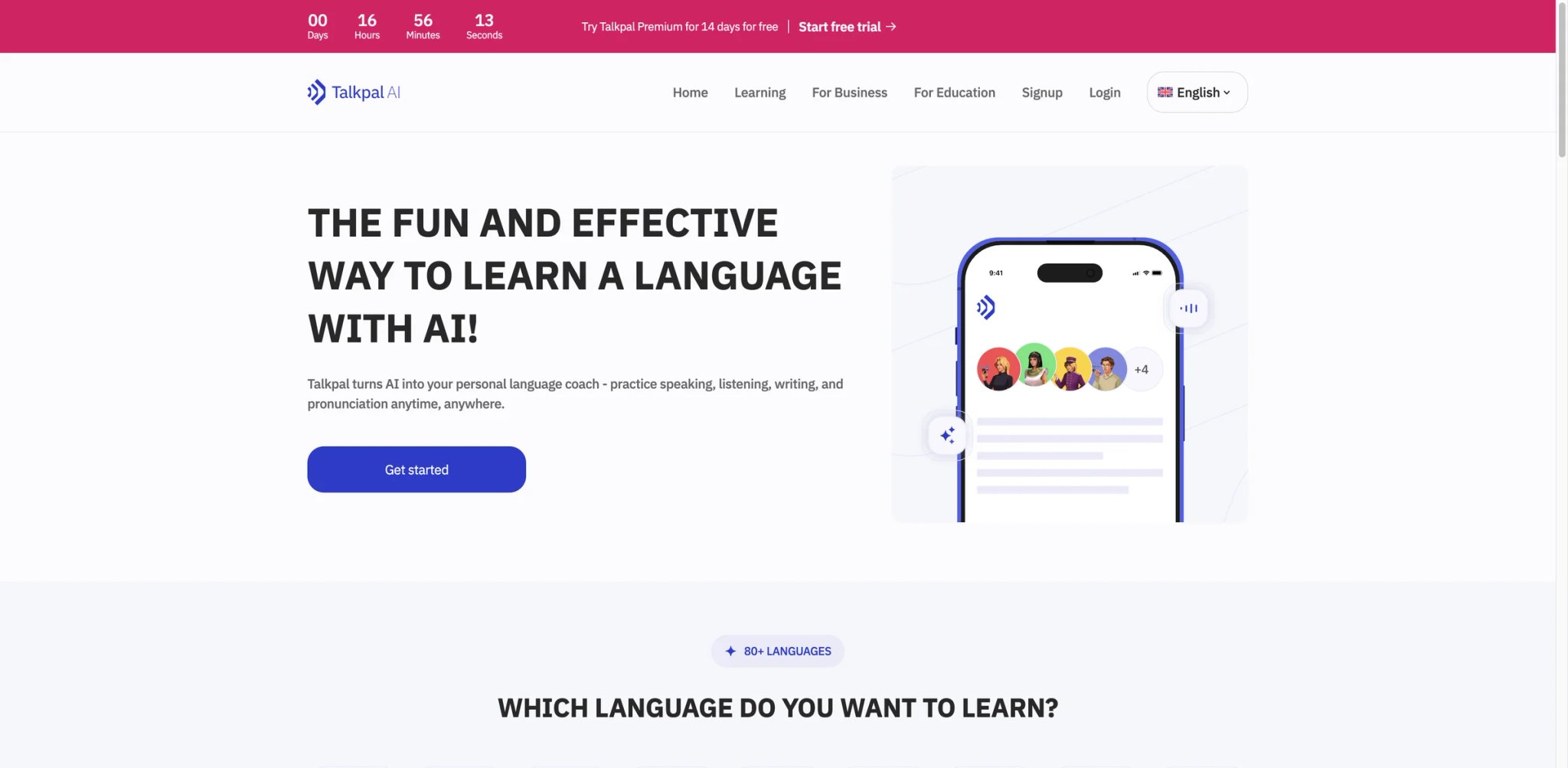
Covering 80+ languages — from Spanish and Mandarin to Yoruba and Tagalog — Talkpal has the widest language coverage of any AI conversation app we reviewed. For learners studying less commonly taught languages, this alone eliminates most competitors from consideration.
Key Features
- 80+ language support: Where most apps top out at 20-40 languages, Talkpal covers niche languages that other platforms ignore entirely. If you're learning Urdu, Swahili, or Indonesian, your options narrow to Talkpal quickly.
- Multiple practice formats: Beyond standard chat, Talkpal offers debate mode, character roleplay (practice with historical figures or fictional characters), photo descriptions, and audio-only "phone calls" — each forcing different vocabulary and grammar patterns.
- Transparent pricing: At $14.99/mo, Talkpal publishes clear pricing with no hidden tiers or usage caps on premium features. What you see is what you pay.
Pricing
- Free: 10 minutes/day of conversation practice
- Premium: $14.99/mo (monthly) or discounted on annual plans
- All premium features included — no tiered upsells
Limitations
- Pronunciation feedback accuracy is inconsistent — independent testing found that roughly 75% of pronunciation assessments were inaccurate, marking incorrect pronunciations as correct
- No spaced repetition system means vocabulary doesn't resurface strategically in later lessons, and there's no way to track which words you've mastered
- Grammar explanations are shallow compared to dedicated language apps, and the AI occasionally teaches incorrect forms in some languages
Best For
Learners studying less common languages where alternatives simply don't exist, or budget-conscious users who want varied practice modes without paying premium prices. Not the right fit if pronunciation accuracy is your primary goal — Talkpal's speech recognition isn't reliable enough for serious accent work.
Get started with Talkpal
Langotalk

At $6.67/month on the annual plan, Langotalk delivers AI conversation practice at roughly one-third the cost of Langua and half the cost of Talkpal. For learners who want daily speaking practice without a significant monthly commitment, that math is hard to argue with.
Key Features
- Strongest value per dollar: Langotalk's annual pricing undercuts every AI-first conversation app we tested. The question isn't whether it's affordable — it's whether the conversation quality justifies choosing it over free alternatives like ChatGPT voice mode.
- Custom lesson creation: Generate practice sessions from any prompt — describe a job interview scenario, a restaurant ordering situation, or a medical appointment, and Langotalk builds a targeted conversation around it.
- Multiple AI personas: Practice with different virtual characters (a strict teacher, a casual friend, a formal business contact) to develop register-appropriate language skills.
Pricing
- Monthly: ~$11.99/mo
- Annual: $6.67/mo (billed annually)
- Free trial: Available with limited features
Limitations
- The web app and mobile app aren't fully synced — different structures and sometimes different content between platforms, which disrupts learning continuity
- No spaced repetition or structured revision system — you have to manage your own review schedule independently
- Grammar coverage is minimal, and the AI's corrections tend to be brief without explaining the underlying rule
Best For
Budget-conscious learners who want daily AI conversation practice and don't mind a web-first experience. Also works well as a supplement to a primary structured course. Not the right fit if you need a fully structured curriculum or rely heavily on mobile-first learning — the app experience lags behind the web version.
Get started with Langotalk
Talkio AI
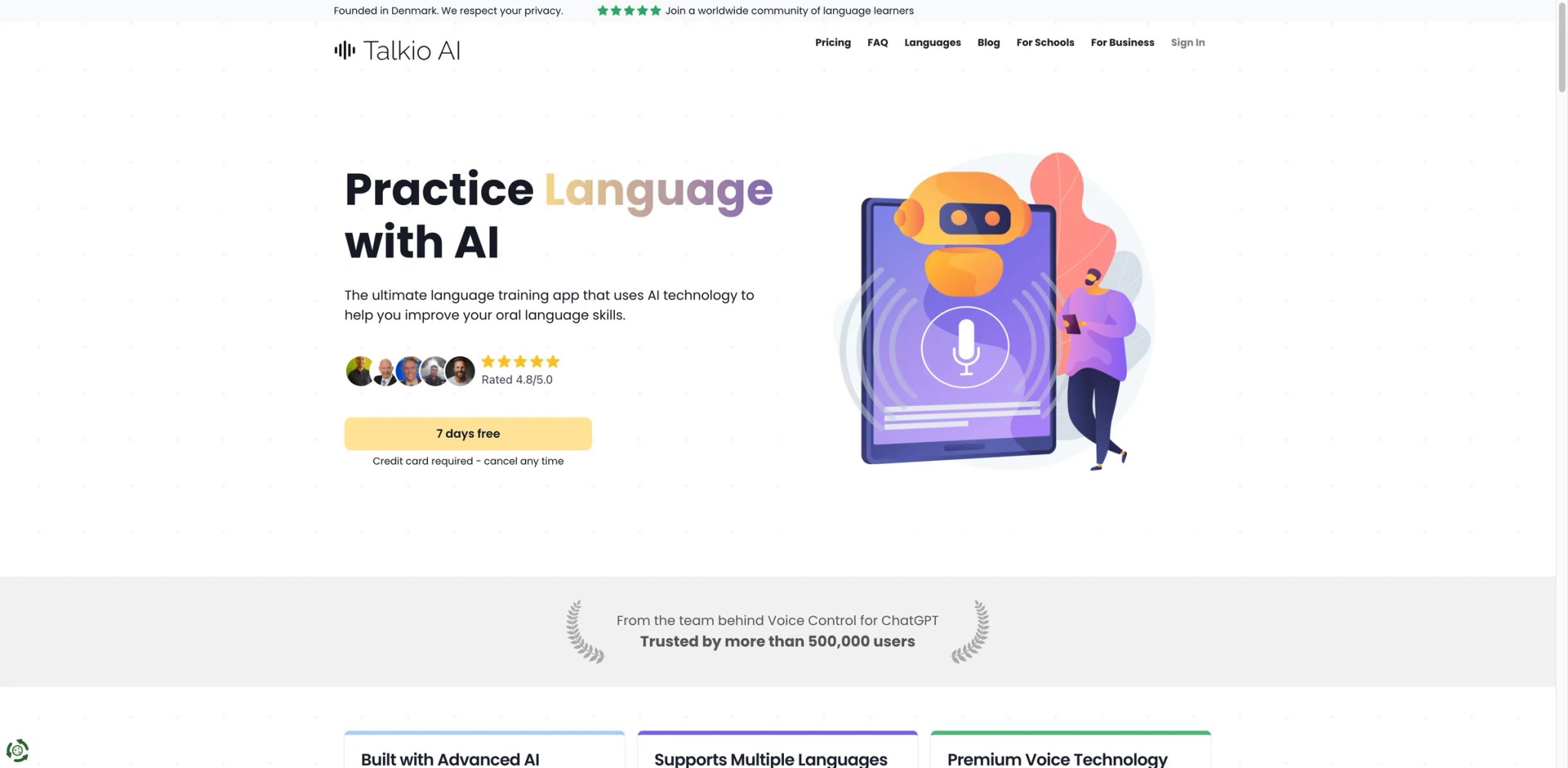
Where most AI language apps treat pronunciation as a checkbox feature — a green or red indicator after you speak — Talkio AI builds its entire experience around it. With 70+ languages and 122 regional dialects, you can practice Mexican Spanish vs. Castilian Spanish, or Brazilian Portuguese vs. European Portuguese, with AI tutors that model each variant's specific sounds and rhythms.
Key Features
- 122 dialect-specific AI tutors: The distinction between "Spanish" and "Argentine Spanish" matters for real-world communication. Talkio is the only app we tested that lets you train against specific regional accents rather than a generic "standard" pronunciation.
- Real-time pronunciation scoring: Get immediate visual feedback on individual phonemes, stress patterns, and intonation — not just a pass/fail on the whole sentence. For tonal languages like Mandarin or Vietnamese, this granularity is essential.
- 400+ conversation scenarios: Pre-built situations covering travel, business, medical, and daily life contexts, each tuned to the dialect you're practicing.
Pricing
- Monthly: $9.00/mo
- Annual: Discounted rates available
- Team plans: Available for schools and businesses
At $9/mo, Talkio sits in a comfortable middle ground — less than Langua or Gliglish, with a more focused value proposition around pronunciation.
Limitations
- Not designed to teach a language from scratch — it's a pronunciation and conversation practice tool, not a complete course. Complete beginners will struggle without foundational vocabulary from another source
- Grammar feedback isn't always accurate, and the AI occasionally misunderstands non-standard speech
- The interface lacks gamification or progress tracking features, which may reduce daily motivation for users who need external structure
Best For
Intermediate learners focused specifically on pronunciation and accent accuracy, especially those learning languages with significant regional variation. Also strong for expats preparing to communicate in a specific dialect. Not the right fit if you need a structured beginner course or gamified motivation to maintain daily practice habits.
Get started with Talkio AI
Speak
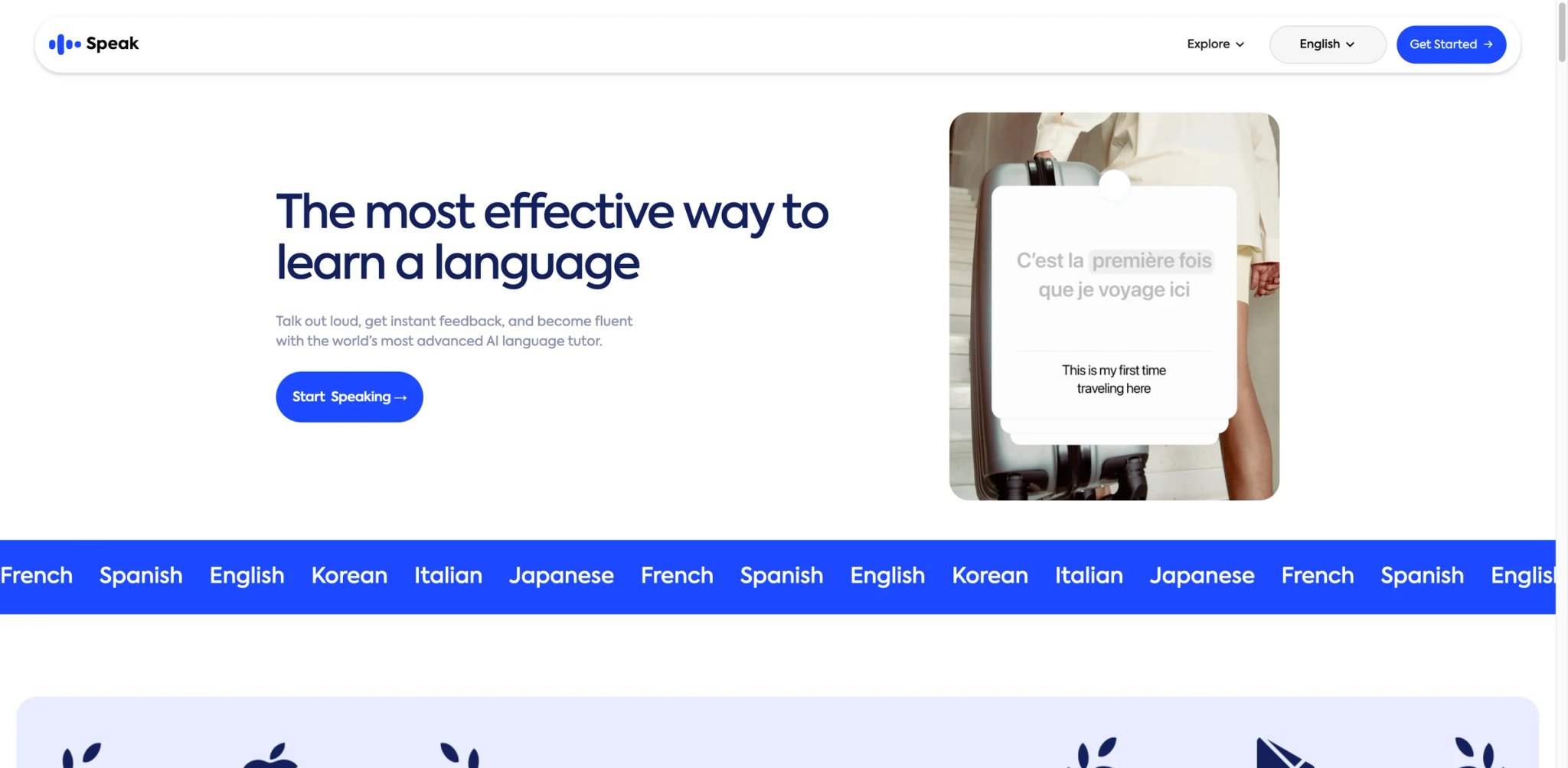
The New York Times' Wirecutter named Speak one of the best language learning apps in 2026, and there's a clear reason: it treats speaking as the default activity rather than an optional add-on. Where Duolingo has you matching word tiles and Babbel has you filling in blanks, Speak forces you to construct and say full sentences from your very first lesson.
Key Features
- Speaking-first curriculum design: Every lesson starts with you talking, not reading or listening. Speak's course structure is built around the principle that producing language — even incorrectly — builds fluency faster than passive recognition exercises.
- Structured 5-level progression: Unlike open-ended conversation apps (Langua, Talkpal), Speak provides a clear path from beginner to upper-intermediate with measurable milestones. You always know what you've covered and what's next.
- AI roleplay with context memory: The AI remembers previous conversations and adjusts difficulty based on recurring mistakes, creating a personalized learning loop rather than isolated practice sessions.
Pricing
- Premium: ~$13.75/mo (billed annually)
- Super Premium: ~$250/year (includes all features)
- Free tier: Limited lesson access
Be aware that some users report unexpected charges after free trials, with the premium tier jumping to $250 without clear notification. Check the terms carefully before subscribing.
Limitations
- Only supports 6 languages (Spanish, French, German, Japanese, Korean, Italian) — if your target language isn't on this list, Speak isn't an option
- Speech recognition is too lenient — users report that deliberately mispronounced phrases still get marked as correct, which creates false confidence
- Course content becomes repetitive at higher levels, and there's minimal integration between the structured course and free conversation features
Best For
Beginners who want a structured speaking-first curriculum in one of the 6 supported languages. The clear progression system works especially well for learners who've tried and abandoned Duolingo. Not the right fit if you're learning a language outside the supported six, or if you're already at an intermediate level and need open-ended conversation practice.
If you're exploring AI-powered apps beyond language learning, our AI tool rankings cover the best options across categories.
Get started with Speak
Gliglish
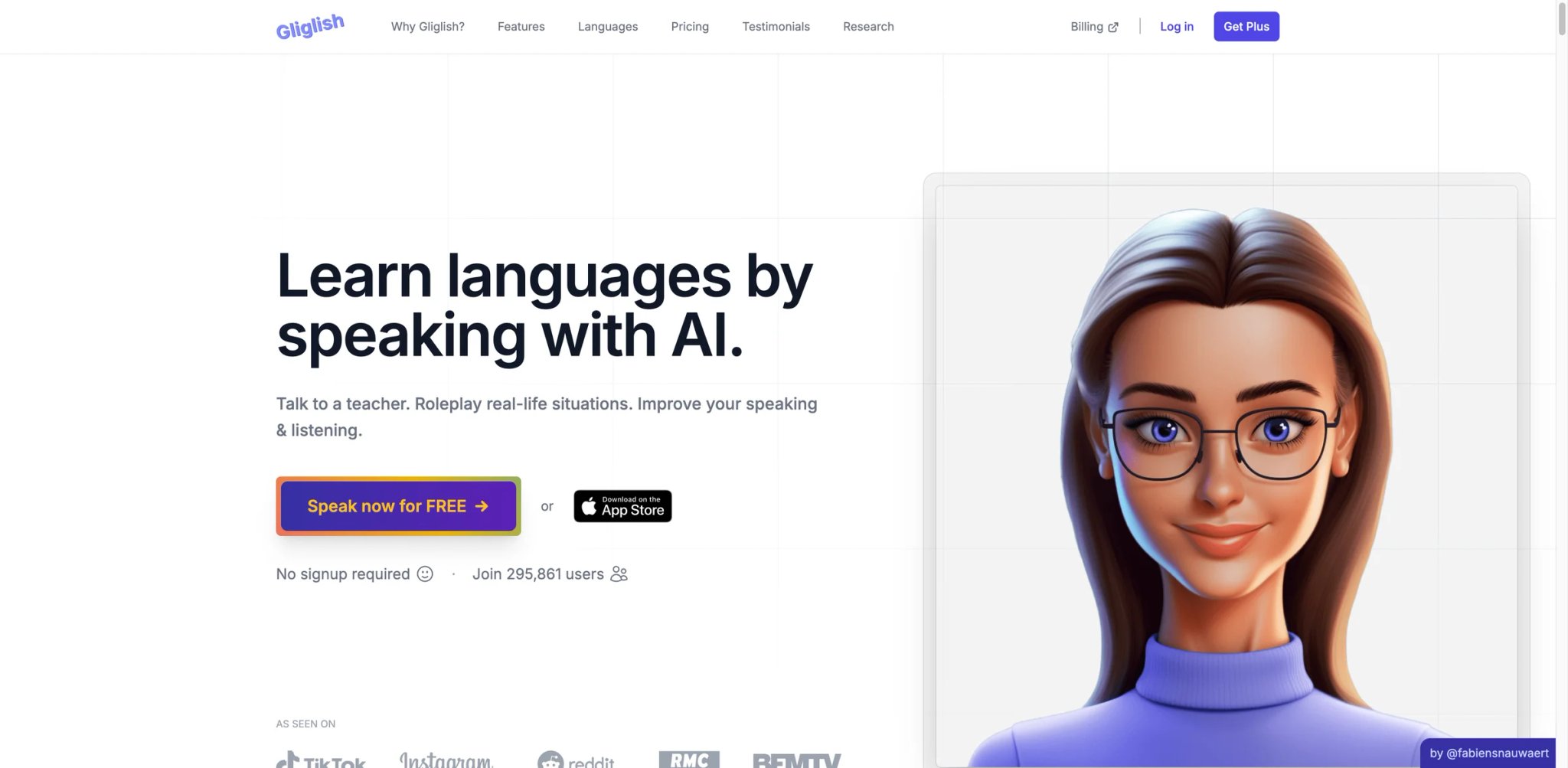
Gliglish takes a web-first approach that most competitors ignore in favor of mobile apps. Open a browser tab, start talking, and the AI responds within seconds — no app download, no account required for the free tier. For desktop workers who want to squeeze in 10 minutes of speaking practice between tasks, this accessibility matters.
Key Features
- Zero-friction web experience: No download, no mandatory sign-up. You can start a conversation in your target language within 30 seconds of landing on the site. This is the lowest barrier to entry of any app we tested.
- Free tier without artificial gating: The free version gives you 10 minutes per day of actual conversation practice — not a 3-lesson teaser before a paywall. That's enough for consistent daily habit-building.
- 60+ language support: Broad coverage that includes many languages underserved by competitors, though conversation depth varies between popular and niche languages.
Pricing
- Free: 10 min/day, 50 messages max
- Premium: $16.00/mo
- Annual: Discounted rates available
The free tier is genuinely usable for daily practice. The premium price ($16/mo) is on the higher side given that Langotalk offers comparable features at $6.67/mo.
Limitations
- Pronunciation feedback only works for US English — if you're learning French, Japanese, or any other language, you won't get pronunciation scoring, just conversational corrections
- Customer support is a documented weak point — multiple users report difficulty canceling subscriptions and unanswered support tickets
- The web app can be buggy on mobile browsers, with speech input functions failing intermittently, which undermines the "use anywhere" promise
Best For
Desktop workers who want a quick, no-commitment way to practice daily conversation. The free tier makes it an excellent supplement to a primary learning method. Not the right fit if you need mobile-first access or pronunciation feedback in a language other than English.
Get started with Gliglish
Univerbal
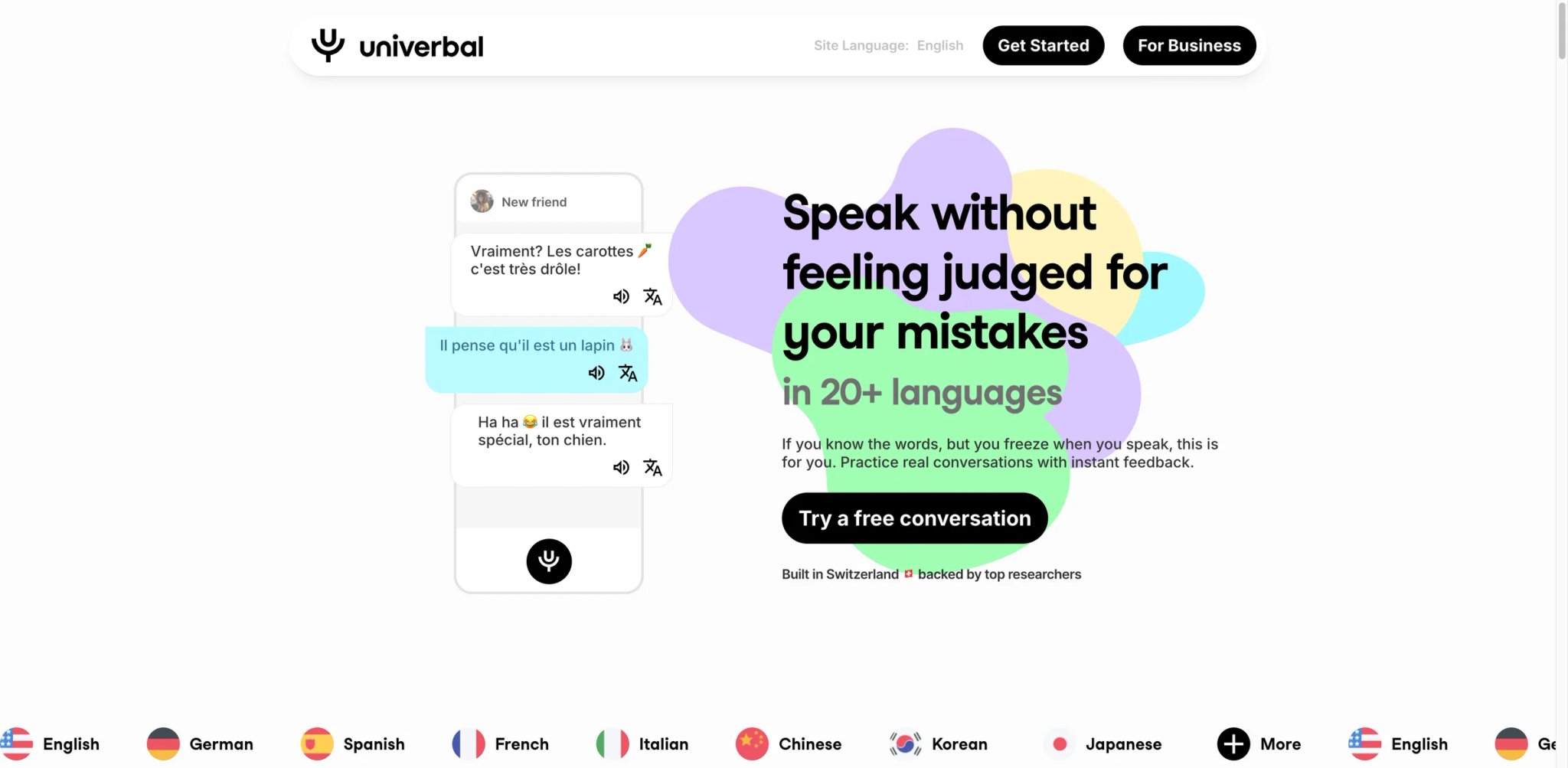
Rather than dropping you into an open-ended chat and hoping for the best, Univerbal structures its AI conversations around 100+ real-world scenarios — ordering coffee in Paris, negotiating rent in Berlin, presenting at a conference in Tokyo. Each scenario comes with target vocabulary, grammar patterns, and contextual cues that give your practice session a clear purpose.
Key Features
- 100+ structured scenarios: Each conversation has a defined context, objective, and vocabulary set. This bridges the gap between apps that are too structured (Duolingo) and too open-ended (ChatGPT) — you get realistic conversation practice with built-in learning goals.
- 23 languages with scenario consistency: The same scenarios are available across all supported languages, making it useful for polyglots comparing their progress across multiple languages.
- Post-conversation analysis: After each session, Univerbal provides a breakdown of grammar mistakes, missed vocabulary opportunities, and fluency metrics — more detailed than the in-conversation corrections most apps offer.
Pricing
- Monthly: ~$13.99/mo
- Annual:
$89.99/year ($7.50/mo) - Family plans: Available for 2-5 users
- Free trial: Available with limited chats
Limitations
- Pricing transparency is poor — rates vary by platform (iOS vs. web) and region, and some users report being quoted different prices within the same week
- Limited to 23 languages, which puts it behind Talkpal (80+) and Gliglish (60+) for less common languages
- Scenario-based structure can feel restrictive for advanced learners who want genuinely free-flowing conversation
Best For
Learners preparing for specific real-world situations — travel, work relocation, or exam preparation where contextual vocabulary matters more than open conversation. Not the right fit if you want unstructured free conversation or need a language not in the 23 supported.
Get started with Univerbal
Busuu

Busuu occupies a unique position: it's one of the few language apps that combines AI conversation practice with corrections from native-speaking community members. Your writing exercises get reviewed by real humans, while AI handles your speaking practice — a hybrid approach that covers weaknesses inherent in either method alone.
Key Features
- AI + community correction hybrid: Submit a writing exercise and get feedback from native speakers within hours. Then practice the same concepts verbally with AI. This dual-feedback loop addresses the accuracy gap that pure AI apps struggle with.
- CEFR-aligned course structure: Lessons map directly to the Common European Framework of Reference levels (A1-B2), which means your progress translates to an internationally recognized proficiency benchmark.
- Official language certificates: Busuu offers certificates recognized by McGraw-Hill Education, adding a tangible credential that most AI conversation apps can't match.
For more on AI writing assistants that complement language learning, see our category guide.
Pricing
- Free: Basic vocabulary and limited lessons
- Premium: ~$5.25/mo (annual plan)
- Premium Plus: ~$6.66/mo (annual, includes AI Conversations + certificates)
- 14-day money-back guarantee
Busuu's annual Premium Plus plan is one of the cheapest ways to access AI conversation features, though the AI component is less advanced than dedicated conversation apps.
Limitations
- AI Conversations is only available in the Premium Plus tier and only on mobile — you can't access it via the web app, which limits practice flexibility
- Only 14 languages are supported, and the quality varies significantly between popular languages (Spanish, French) and smaller ones (Chinese, Arabic)
- The free tier is heavily restricted — no grammar instruction, no AI features, and no community feedback, making it essentially a flashcard app without paying
Best For
Learners who want structured courses with human community feedback alongside AI speaking practice, especially those who value CEFR certification. Not the right fit if you're primarily looking for AI conversation quality — Busuu's AI feature is a complement to its course structure, not the main event.
Get started with Busuu
Memrise
Memrise made its name with spaced repetition flashcards and crowd-sourced vocabulary courses. Its AI companion feature is a more recent addition that layers conversational practice on top of the vocabulary foundation — an approach that makes sense if you believe (correctly) that you can't have a conversation without knowing words first.
Key Features
- Native speaker video integration: Unlike apps that rely entirely on synthesized AI voices, Memrise includes clips of real people speaking in everyday situations. Hearing natural speech patterns, slang, and mumbled pronunciation prepares you for actual conversations in ways robotic TTS can't.
- 40+ language coverage with community content: The breadth of available languages is strong, and community-contributed content extends coverage to niche topics and regional variations.
- Vocabulary-to-conversation pipeline: The app connects flashcard learning directly to AI conversation practice, so words you memorize appear in your speaking sessions — reinforcing retention through active use.
Pricing
- Free: Limited access, ad-supported
- Pro Monthly: Varies (~$5-25/mo depending on promotions)
- Pro Annual:
$61.99/year ($5.17/mo) - Lifetime: ~$329.99 (one-time)
Memrise's pricing is volatile — rates change frequently with promotions, making it hard to pin down the "real" price. The lifetime deal is worth considering if you plan to use it for multiple languages over years.
Limitations
- The AI conversation feature feels bolted-on rather than central — it's noticeably less sophisticated than dedicated conversation apps like Langua or Talkpal
- Memrise removed user-generated courses from the main platform, significantly narrowing the content library that originally attracted many users
- Customer support is essentially non-existent — users report bugs with stuck exercises and no way to reach support for resolution
Best For
Vocabulary-focused learners who want native speaker video content and a proven spaced repetition system, with AI conversation as a supplementary feature. Not the right fit if speaking practice is your primary goal — Memrise's AI conversations are a secondary feature, not the core product.
Looking for AI tools in other categories? Browse our complete AI chatbot comparison for more options.
Get started with Memrise
Falou
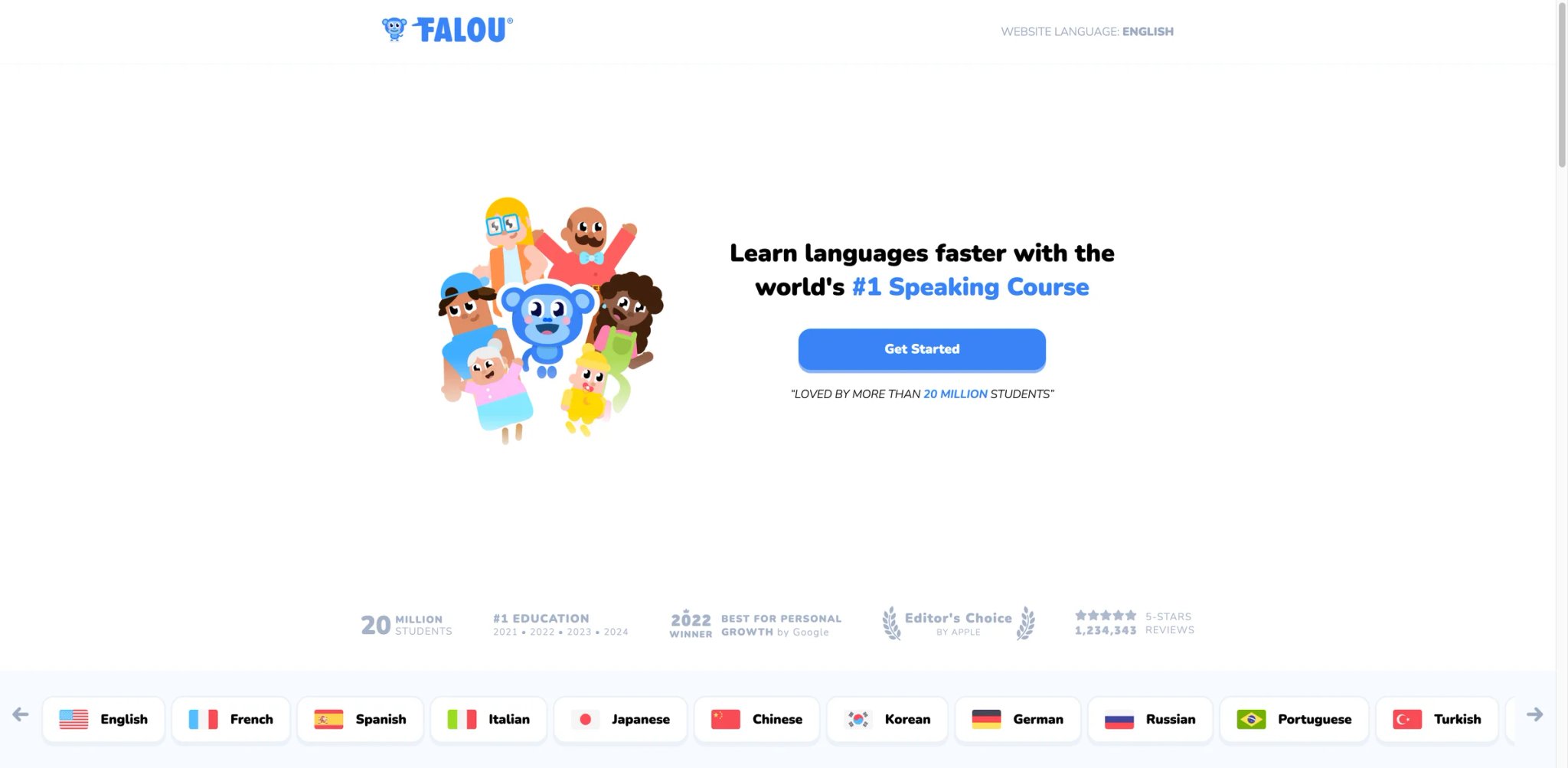
Falou's App Store rating (4.6 stars, 50K+ reviews) is among the highest of any language learning app, period. That user satisfaction comes primarily from its straightforward approach: speak a phrase, get instant feedback, repeat. No complex course structures, no gamification theatrics — just concentrated speaking reps.
Key Features
- Focused speaking repetition: Falou strips away the lesson bloat and concentrates on the drill that matters most — saying things out loud and hearing whether you got them right. Each session feels more like a speaking workout than a classroom exercise.
- 20+ languages with clean UX: The interface is deliberately simple — pick a language, pick a topic, start talking. This minimal design keeps sessions friction-free, which contributes to higher daily usage rates.
- Strong user satisfaction metrics: Consistently high ratings across both App Store and Google Play suggest that the core experience delivers on its promise, even if the feature set is narrower than competitors.
Pricing
- Free: Very limited, ad-supported with 14-minute unskippable premium ads after lessons
- Monthly: $9.99/mo
- Annual:
$149.99/year ($12.50/mo)
Watch out for the free tier experience — some users report being funneled into subscriptions advertised as "one cent a day" that actually charge $40-48 upfront. Read the payment screen carefully.
Limitations
- Mobile-only with no web version, restricting practice to phone or tablet
- Voice recognition is inconsistent, especially for tonal languages and non-European language families — the AI marks correct pronunciation as wrong and vice versa
- Minimal grammar instruction and no writing practice, making it a pure speaking drill tool rather than a comprehensive learning platform
Best For
Learners who want a simple, focused daily speaking drill without the complexity of full course platforms. Works well as a supplementary practice tool alongside a structured course. Not the right fit if you want web access, grammar instruction, or accurate pronunciation feedback for tonal languages.
Get started with Falou
Best AI Language Learning App by Use Case
For Complete Beginners Building Foundations
If you've never studied your target language and need structure to avoid overwhelm, Speak provides a clear beginner-to-intermediate curriculum that forces you to speak from lesson one. Busuu is the stronger choice if your target language isn't in Speak's supported six, offering CEFR-aligned lessons with community corrections that catch errors AI misses.
For Intermediate Learners Pushing Past the Plateau
You've completed a beginner course but your conversational ability doesn't match your grammar knowledge. Langua excels here — its human-like AI conversations challenge you to use vocabulary in context rather than rehearse canned phrases. At $19.99/mo, it's a premium option, so consider Langotalk at $6.67/mo if you want similar AI conversation practice at one-third the cost.
For Pronunciation and Accent Refinement
Your grammar is solid but native speakers still struggle to understand you. Talkio AI is the only app offering 122 dialect-specific tutors — essential if you're targeting a specific regional accent for relocation or business. The $9/mo price point makes dedicated pronunciation practice accessible.
For Learners Studying Less Common Languages
Most apps stop at 20-40 languages, leaving learners of Yoruba, Tagalog, or Indonesian without options. Talkpal covers 80+ languages and offers multiple practice formats even for niche languages, making it the default choice when your target language limits your app selection.
For Budget-Conscious Daily Practice
If you want free daily conversation practice without commitment, Gliglish gives you 10 minutes/day with zero sign-up on web. For a paid option, Langotalk at $6.67/mo (annual) or Busuu at $5.25/mo offer the best value among apps with substantive AI features.
How to Choose the Right AI Language Learning App
Step 1: Check language availability first. This is the fastest filter. If you're learning Korean, Speak covers it. If you're learning Swahili, only Talkpal does. No amount of feature comparison matters if the app doesn't teach your language.
Step 2: Identify your primary weakness. Speaking anxiety and lack of practice partners? Prioritize conversation apps (Langua, Talkpal, Langotalk). Poor pronunciation? Talkio AI's dialect-specific training is purpose-built. No vocabulary foundation? Start with Memrise or Busuu's structured courses before jumping to conversation practice.
Step 3: Test free tiers before paying. Gliglish and Talkpal both offer 10 minutes/day free. Busuu and Memrise have ad-supported free versions. Use these to verify that the AI's conversation quality and voice recognition work acceptably for your language before committing money.
Step 4: Calculate your actual monthly cost. Annual plans cut prices 40-60% but lock you in. Langotalk at $6.67/mo (annual) vs. Langua at $19.99/mo (monthly) is a 3x difference. Decide whether you'll realistically use the app daily for 12 months before choosing the annual commitment.
Step 5: Plan for tool stacking. No single app covers every language skill. The most effective approach pairs a conversation app (Langua, Talkpal, or Gliglish) with a structured course (Busuu or Speak) and real-world immersion (podcasts, movies, native speaker conversations). Budget for two apps rather than expecting one to do everything.
For guidance on evaluating AI tools across categories, see our tool selection standards.
Frequently Asked Questions
Can an AI language learning app replace a human tutor?
AI language apps can cover a large portion of structured practice, including conversation, grammar correction, and pronunciation feedback. However, they still lack deeper cultural nuance, idiomatic accuracy, and real human accountability. Most learners benefit from combining AI tools for daily practice with occasional human tutor sessions for correction and guidance.
Which AI language learning app is best for speaking practice?
The best option depends on your learning stage. Beginner learners benefit from structured speaking apps like Speak, while intermediate users often prefer open-ended conversation tools such as Langua or Talkpal. For pronunciation-focused practice, Talkio AI offers more detailed feedback than most alternatives.
Are free AI language learning apps worth using?
Gliglish's 10-minute daily free tier is genuinely useful for maintaining a speaking habit. Busuu and Memrise's free versions work for vocabulary building but lock most AI features behind paywalls. Talkpal's free 10 minutes per day gives you a taste of AI conversation. As a primary learning tool, free tiers are insufficient — but as daily practice supplements, they deliver real value.
How much should I expect to pay for an AI language app?
Prices range from $5.17/mo (Memrise annual) to $19.99/mo (Langua monthly). The sweet spot for most learners is $6-10/mo on an annual plan — Langotalk ($6.67/mo), Talkio AI ($9/mo), and Busuu ($5.25/mo) all fall in this range. Watch for apps that advertise low daily rates but charge quarterly or annually upfront, and always check cancellation policies before subscribing.
Is Duolingo's AI (Duolingo Max) worth considering?
Duolingo Max's AI features — Video Call and Roleplay — are impressive but come with significant limitations. They're only available on mobile (not web), support a limited set of languages for AI features, and the subscription price isn't publicly listed on their website. For dedicated AI conversation practice, the specialized apps in this guide offer more depth. However, if you're already a daily Duolingo user, Max adds a convenient speaking layer without switching apps.
Can I use multiple language learning apps together effectively?
Yes, and most language learning experts recommend it. A common effective combination is one structured course app (Busuu or Speak for grammar and vocabulary progression) plus one AI conversation app (Langua, Talkpal, or Gliglish for speaking practice). The key is assigning each app a specific role rather than doing the same type of exercise on multiple platforms. Budget $10-15/mo total for two annual subscriptions.
How accurate is AI pronunciation feedback in language apps?
Accuracy varies significantly by app and language. For major European languages, most apps provide reasonable pronunciation scoring. For tonal languages (Mandarin, Vietnamese, Thai), accuracy drops considerably — independent testing of Talkpal found approximately 75% of pronunciation assessments were inaccurate. Talkio AI currently offers the most granular pronunciation feedback, but no AI app yet matches the ear of a trained human language teacher for accent work.
Do AI language learning apps work for children?
Most apps in this guide are designed for adult learners and lack child-specific content, parental controls, or age-appropriate conversation scenarios. Duolingo (standard version, not Max) remains the strongest option for children due to its gamification, visual design, and content moderation. For teens, Busuu and Memrise offer relatively safe environments with community features that include moderation. Always review privacy policies before creating accounts for minors.
Get ToolWorthy Weekly
New AI tools, practical guides, and selected AI signals in one weekly brief.
Related Posts
- 14 Best AI Homework Helper Tools 2026 - Learn Without Copying
Compare 14 AI homework helper tools by tutoring style, subject coverage, camera input, pricing, and academic-integrity risk before you pay.
For AI tool founders
Built a tool that belongs in this decision set?
Request an editorial evaluation for possible inclusion in ToolWorthy.
Submit your tool for reviewPaid submission does not guarantee a ranking, recommendation, inclusion, or editorial outcome.