

Overview
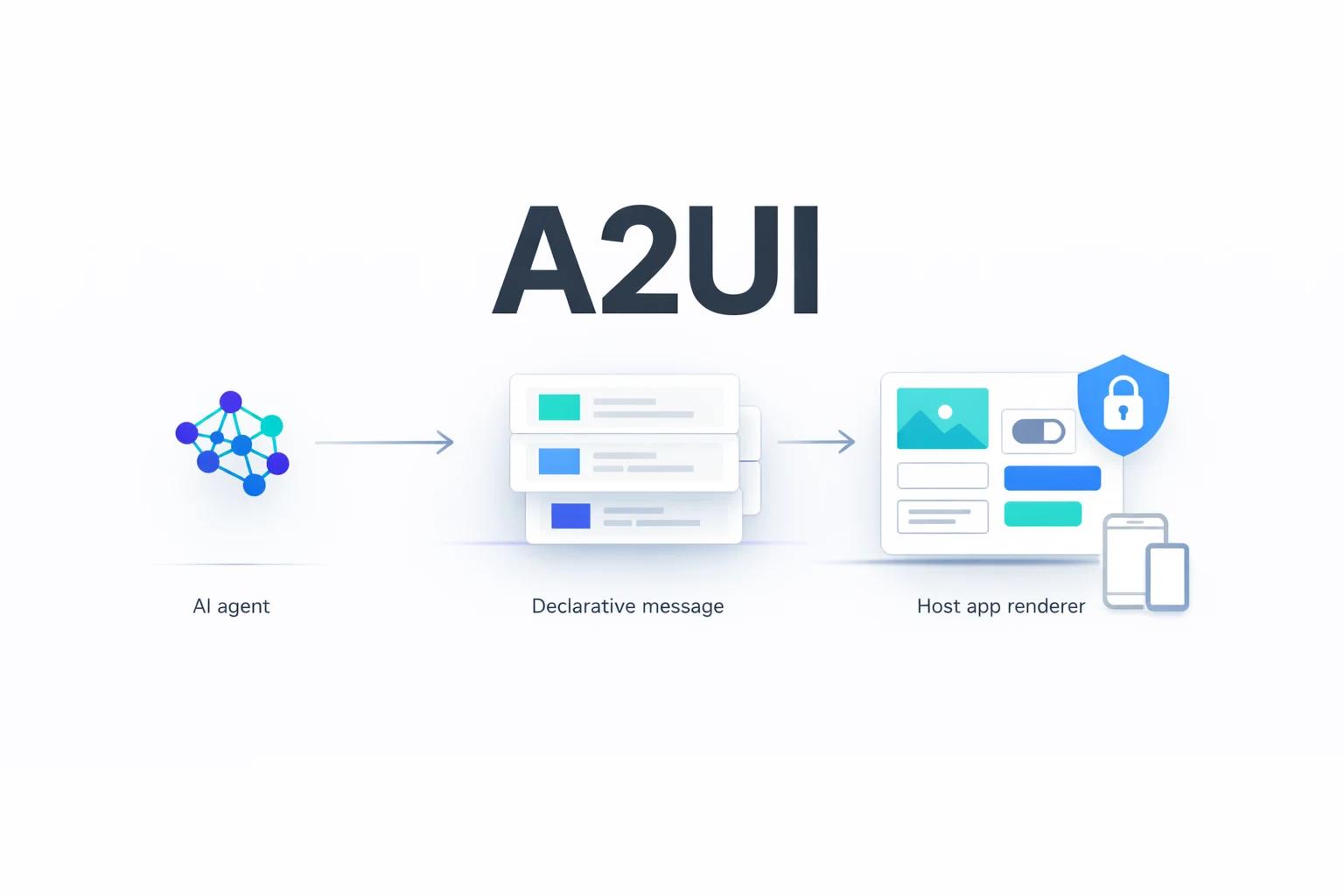
A2UI is an open-source specification developed by Google that enables AI agents to communicate user interface intent through declarative message formats. Rather than being a traditional UI framework, A2UI defines a structured data format for agents to describe interfaces, which host applications then render using trusted component catalogs and native styling.
Designed for the multi-agent world, A2UI addresses a key challenge of rendering UIs across trust boundaries: remote agents (including A2A subagents) can return declarative UI messages that the host application renders securely with its own components. Instead of transmitting executable code, A2UI passes UI layouts as structured data, reducing the risk of remote code execution and UI injection while maintaining flexibility.
The project is framework-agnostic and ships with an initial set of renderers for Lit, Angular, and Flutter, with more planned. Currently at v0.8 Public Preview, A2UI is released under the Apache License 2.0 and welcomes community contributions as it continues to evolve.
Key Features
Declarative UI Format — Uses a structured, declarative data format optimized for representing updatable, agent-generated interfaces. The LLM-friendly flat structure with ID references enables progressive rendering and efficient incremental changes without transmitting executable code.
Cross-Platform Rendering — Includes an initial set of renderers for Lit, Angular, and Flutter, allowing agent-generated interfaces to display consistently across different platforms. The ecosystem is still evolving as part of the v0.8 Public Preview.
Catalog-Based Security Model — UI layouts are transmitted as data messages that reference components from the host app's trusted catalog. This approach reduces the risk of remote code execution and UI injection by keeping component implementation under the host's control.
Component-Based Architecture — Supports a set of common components and client-advertised custom components that can be composed into flexible layouts, giving agents building blocks to create contextually appropriate interfaces.
Incremental Updates — Supports incremental UI updates and progressive rendering, allowing agents to evolve the interface as the conversation progresses rather than regenerating the entire layout.
Multi-Agent Mesh Support — Designed for multi-agent environments including the A2A protocol, where orchestrators and remote subagents can return UI payloads that host apps render with native components.
Pricing & Plans
A2UI is completely free and open-source under the Apache License 2.0. There are no licensing fees or premium features.
Developers can use, modify, and distribute A2UI for both personal and commercial projects without restrictions. The source code is publicly available on GitHub, and community contributions are encouraged.
While the software itself is free, operational costs depend on your implementation stack. Organizations deploying A2UI are responsible for expenses related to LLM usage, infrastructure, hosting, and transport protocols. Support is primarily community- and GitHub-based; no paid support or SLA is explicitly advertised for the open-source project.
Best For
- AI agent developers building multi-agent systems that require dynamic UI generation
- Platform engineers creating cross-platform applications where agents need to render contextual interfaces
- Research teams exploring agent-to-agent communication protocols with UI components
- Developers prioritizing security in agent-driven interfaces who want to avoid executing remote code
- Organizations building agent orchestration layers that need framework-agnostic UI rendering
- Open-source contributors interested in shaping the future of agent-driven interface standards
FAQ
Is A2UI free to use?
Yes, A2UI is completely free and open-source under the Apache License 2.0. You can use, modify, and distribute it for both personal and commercial purposes without any licensing fees or usage restrictions.
What platforms does A2UI support?
A2UI includes renderers for Lit, Angular, and Flutter frameworks. The declarative format is framework-agnostic, allowing developers to create additional renderers for other platforms if needed.
How does A2UI ensure security?
A2UI reduces security risks by transmitting UI layouts as structured data messages rather than executable code. Security depends on the host application maintaining a trusted component catalog and implementing proper renderer policies (including sandboxing for custom or legacy content). This model gives the host control over what can be rendered.
Can I use A2UI with existing AI agents?
A2UI is designed for the Agent-to-Agent protocol environment. Integration requires your agents to generate UI layouts using A2UI's declarative format and your host application to include an A2UI renderer for your chosen framework.
What kind of UIs can agents generate with A2UI?
Agents can generate forms, date pickers, time selectors, buttons, and other common UI components by composing them from A2UI's component catalog. Custom components can also be integrated for application-specific needs.
Is there commercial support available?
No official commercial support is provided by Google. A2UI is a community-driven open-source project with documentation, issue tracking, and contribution guidelines available on GitHub.
What are the technical requirements to use A2UI?
Developers need familiarity with their chosen UI framework (Lit, Angular, or Flutter), understanding of multi-agent architectures, and the ability to integrate the A2UI renderer into their host application. Specific runtime requirements depend on the selected framework.
How mature is the A2UI project?
A2UI is currently at v0.8 (Public Preview) and is in the Early Stage. The specification and implementations are functional and being used in some Google products, but the project is still evolving. Teams should evaluate carefully for production use and expect potential changes as the ecosystem develops.